
What is backpropagation?
Backpropagation is a machine learning technique essential to the optimization of artificial neural networks. It facilitates the use of gradient descent algorithms to update network weights, which is how the deep learning models driving modern artificial intelligence (AI) “learn.” (IBM)
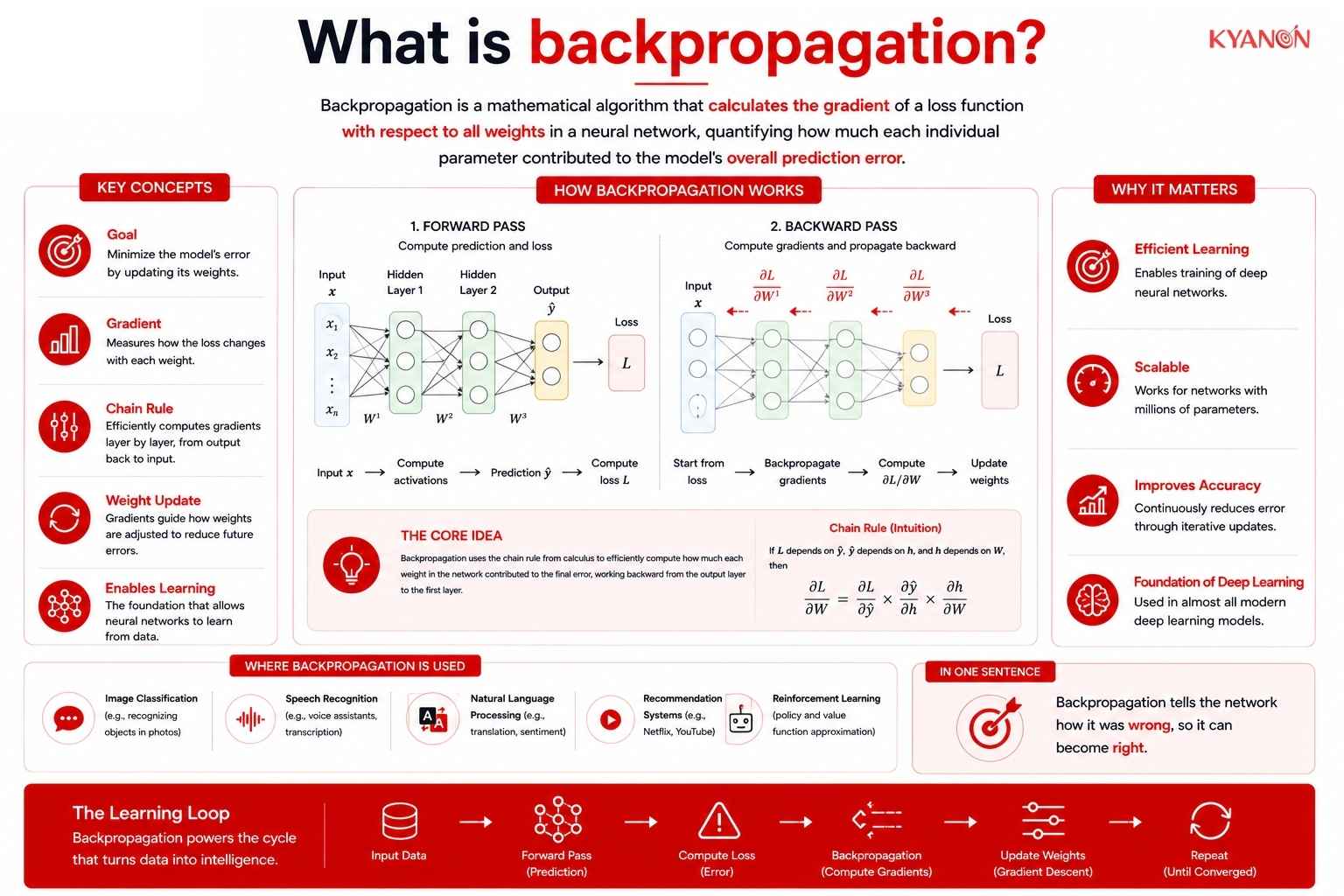
How backpropagation works
Backpropagation functions by computing the error at the output layer and sequentially distributing that error backward through the network’s hidden layers using the calculus chain rule. This systematic attribution of mathematical error provides the exact gradient blueprints that optimization algorithms require to adjust parameters and reduce prediction mistakes over successive training cycles.
- Forward Pass: The network makes a prediction based on input data.
- Error Measurement: A loss function calculates the difference between the prediction and the correct answer.
- Backward Pass: The algorithm works backward through the network layers.
- Gradient Calculation: It uses calculus (the chain rule) to find how much each weight contributed to the error.
- Weight Update: An optimization algorithm, like gradient descent, adjusts the weights to reduce future errors.
Backpropagation vs Feedforward
Both are fundamental operational phases of neural network training, but they move mathematical data in opposite directions to serve distinctly different computational purposes.
|
Dimension |
Backpropagation | Feedforward |
| Direction of flow | Output to input (backward) |
Input to output (forward) |
|
Primary objective |
Calculate error gradients | Generate predictions and calculate loss |
| Mathematical operation | Partial derivatives (Chain rule) |
Matrix multiplication and activation functions |
|
Execution sequence |
Occurs second, after the loss is determined | Occurs first, before any error is known |
| Role in learning | Evaluates precise weight adjustments |
Evaluates current model state against data |
When to consider backpropagation dynamics
Consider diagnosing backpropagation dynamics if:
- Your engineering team is experiencing the vanishing gradient problem, where deep learning models fail to converge during training on large enterprise datasets.
- You are migrating from pre-trained foundation models to custom-built neural architectures that require domain-specific parameter optimization.
- Your model’s computational training costs are exceeding operational budgets due to stalled or highly inefficient convergence cycles.
It may not be the right priority if:
- Your AI strategy relies entirely on utilizing off-the-shelf APIs or classical statistical models like random forests that do not utilize deep neural networks.
Why backpropagation matters for enterprise IT
In large-scale custom model development, understanding gradient flow directly dictates an AI project’s timeline and its total computational cloud budget.
Backpropagation is critical for enterprise IT as the foundational mechanism enabling efficient training of deep learning models on large datasets, directly reducing computational costs and improving AI accuracy. By optimizing neural network weights, this algorithm makes AI commercially viable and scalable for production environments.
Common misconceptions
Backpropagation is the algorithm that actually trains the model and updates the weights
Reality: Backpropagation does not update any weights at all; it strictly calculates the mathematical gradient to show how much each weight contributed to the error. An entirely separate optimization algorithm, such as Adam or Stochastic Gradient Descent, uses those gradients to make the actual parameter adjustments.
It is simply the basic calculus chain rule we learn in high school
Reality: While it fundamentally utilizes the chain rule, standard single-variable calculus is insufficient for neural networks. Backpropagation technically computes the Partial Derivative across highly dimensional matrices to account for multiple paths of information flowing through the network simultaneously.
Because it learns from mistakes, backpropagation guarantees finding the perfect solution
Reality: Backpropagation, combined with gradient descent, is only guaranteed to find a local minimum within the loss landscape. If the error signal becomes too small to update early layers (vanishing gradient), the model will plateau and fail to converge to an optimal solution.
How Kyanon Digital applies backpropagation
Kyanon Digital analyzes backpropagation dynamics as a core diagnostic metric during custom AI model development to prevent training instability and optimize model convergence rates. Our engineering teams review gradient flows and loss landscapes for enterprise clients across Vietnam, Singapore, and Thailand, ensuring custom neural architectures avoid optimization plateaus and reach deployment within strict time-to-market constraints.
Explore our Data & AI services:











 Create project brief with AI