

Executive Summary
The backend insurance workflows were mostly in place, but the mobile frontend still carried launch risks: inconsistent user experience, unclear sprint visibility, slow issue resolution, security hygiene gaps, and limited readiness tracking before pilot release.
For digital insurance, these issues are not only technical risks. They affect claims submission, policyholder trust, agent productivity, operational cost, and the speed at which the business can bring a new digital channel to market.
Kyanon Digital supported the client through AI-Driven Agile Team model, combining mobile engineering execution with lightweight agile governance, AI-assisted development, quality controls, security hygiene, and launch readiness reporting.
The engagement helped the client move from an open-ended development effort to a more measurable delivery model, where sprint scope, blockers, risks, and release readiness were tracked clearly before launch.
Accelerating Singapore Digital Insurance App Launch Readiness with an AI-Driven Agile Team.
Client Background
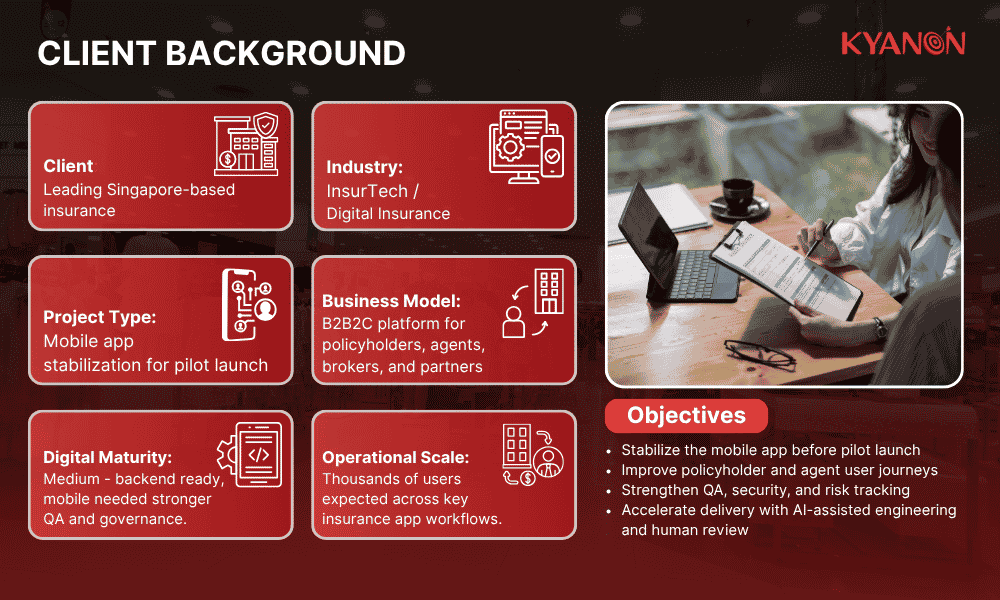
Client: Leading Singapore-based insurance
Industry: InsurTech / Digital Insurance
Project Type: Mobile app stabilization and pilot launch readiness
Business Model: B2B2C insurance platform serving policyholders, agents, brokers, and partner channels.
Operational Scale: Thousands of policyholders and agent-assisted transactions expected after launch, including claims submission, document upload, policy lookup, and status updates.
Digital Maturity: Medium. Core backend workflows existed, but mobile delivery needed stronger governance, QA, and release discipline.
Objectives:
Kyanon Digital was engaged to help the client:
- Stabilize the mobile app before pilot launch.
- Improve frontend consistency across policyholder and agent journeys.
- Reduce coordination pressure on the internal Tech Lead.
- Improve sprint visibility for business and product stakeholders.
- Strengthen security hygiene before market release.
- Track blockers, known issues, and launch risks clearly.
- Apply AI-assisted engineering to improve delivery speed without reducing human review.
- Improve launch confidence without expanding internal management overhead.

Challenges
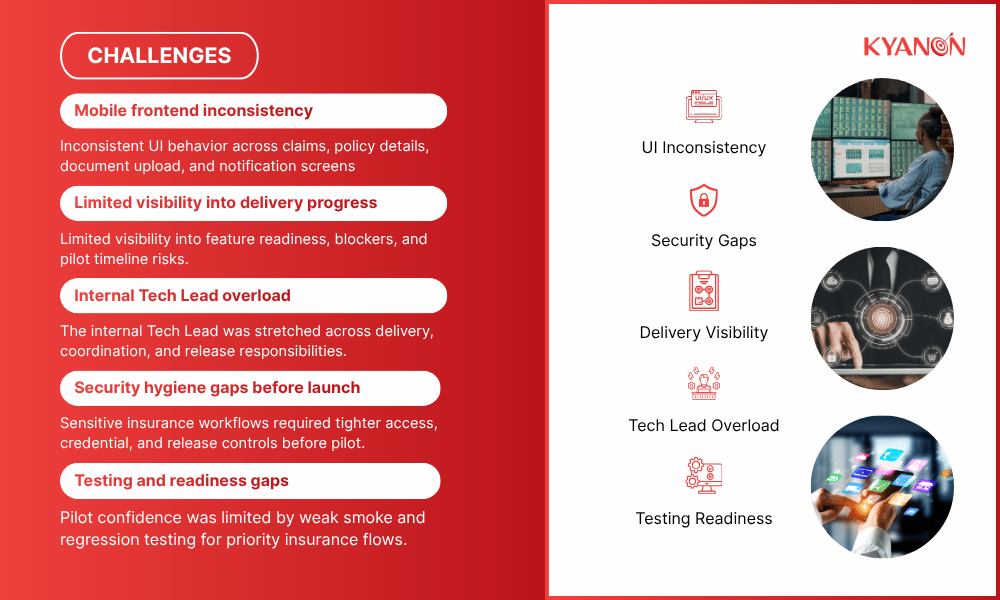
Mobile frontend inconsistency
The app had inconsistent UI behavior across claims, policy details, document upload, and notification screens. Some styling and interface logic were handled through patch-based fixes, making the experience less consistent for policyholders and agents.
Business impact: A confusing interface could increase abandoned claims submissions, support tickets, and agent intervention.
Limited visibility into delivery progress
Business stakeholders did not have a clear view of which app features were complete, which were blocked, and which items could affect the pilot timeline.
Business impact: Management could not confidently assess launch readiness, budget exposure, or operational risk.
Internal Tech Lead overload
The client’s internal tech lead was responsible for technical decisions, backlog clarification, developer coordination, stakeholder updates, and release pressure at the same time.
Business impact: Decision-making slowed down, blockers stayed open longer, and delivery risk became concentrated around one key person.
Security hygiene gaps before launch
As the app handled sensitive insurance workflows, repository access, credentials, branch permissions, and developer offboarding needed stronger control before pilot release.
Business impact: Weak access hygiene could expose the business to preventable security and compliance risks.
Testing and readiness gaps
Unit testing existed, but smoke testing and regression coverage for priority insurance flows were not mature enough for a confident pilot.
Business impact: Critical user journeys such as claims submission, document upload, login, policy viewing, and notification handling could fail after release.
Our Solution
Kyanon Digital offers/provides an AI-driven agile team model to support the client’s mobile launch readiness.
The solution focused on three practical layers:
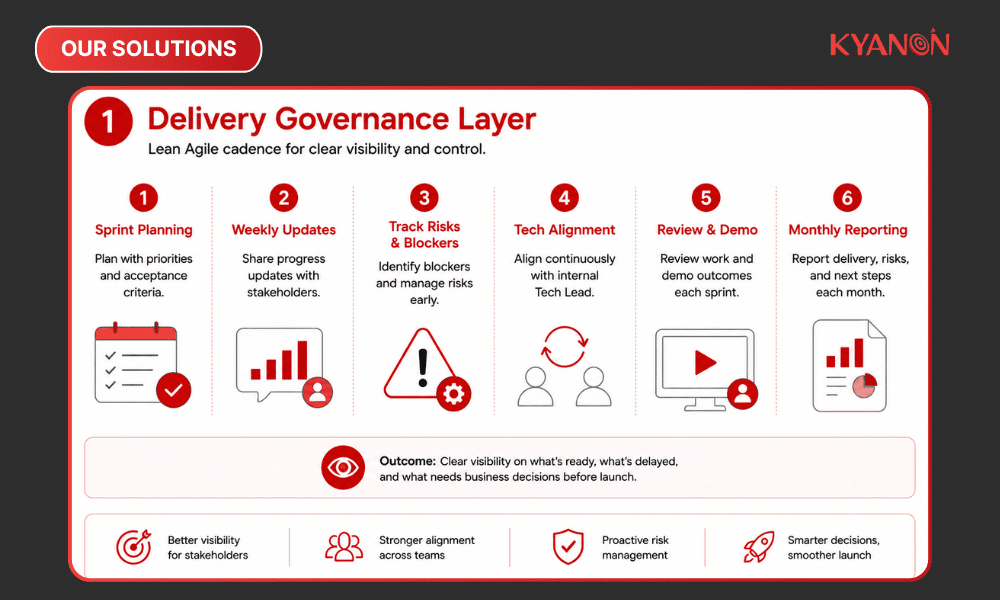
Delivery Governance Layer
This included:
- Sprint planning with agreed priorities and acceptance criteria.
- Weekly progress updates for stakeholders.
- Blocker and risk tracking.
- Technical alignment with the client’s internal Tech Lead.
- Sprint review and demo sessions.
- Monthly delivery reporting with completed work, open risks, and next-step recommendations.
This gave the client a clearer view of what was ready, what was delayed, and what required business decisions before launch.
Mobile Stabilization Layer
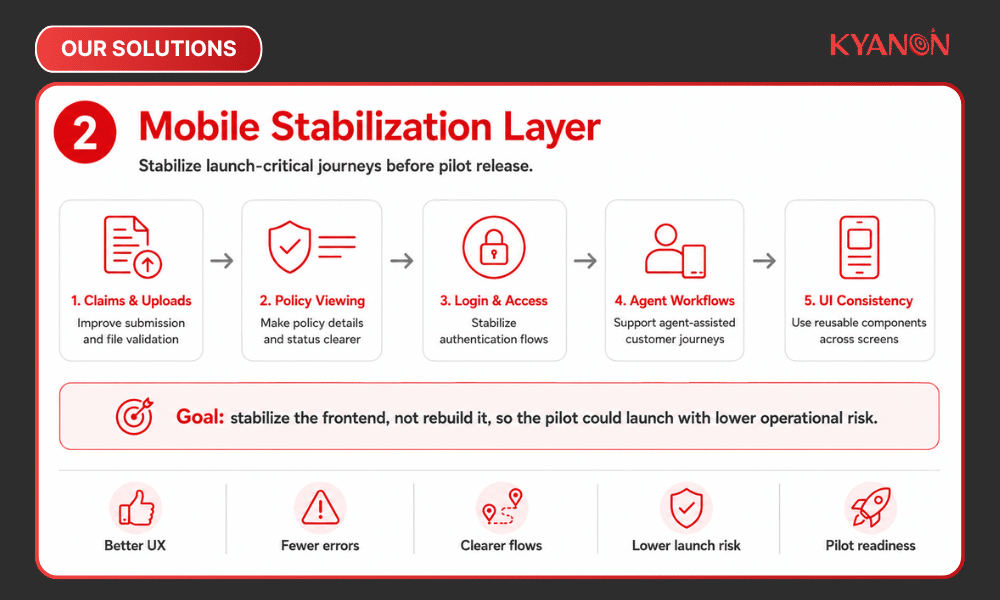
Focus areas included:
- Claims submission flow.
- Policy detail viewing.
- Document upload and validation experience.
- Login and authentication experience.
- Push notification and status update flows.
- Agent-assisted customer workflows.
- Reusable mobile components.
- UI consistency across priority screens.
The goal was not to rebuild the product from scratch, but to stabilize the frontend so the pilot could proceed with lower operational risk.
Quality, Security, and AI-Enabled Delivery Layer
Key controls included:
- Code review before merge.
- Definition of Done for sprint items.
- Static code checks before release.
- Smoke testing for priority business flows.
- Repository access review.
- MFA and secure login enforcement.
- Credential rotation recommendations.
- Secrets check for exposed keys or tokens.
- Branch permission controls.
- Offboarding checklist for previous contributors.
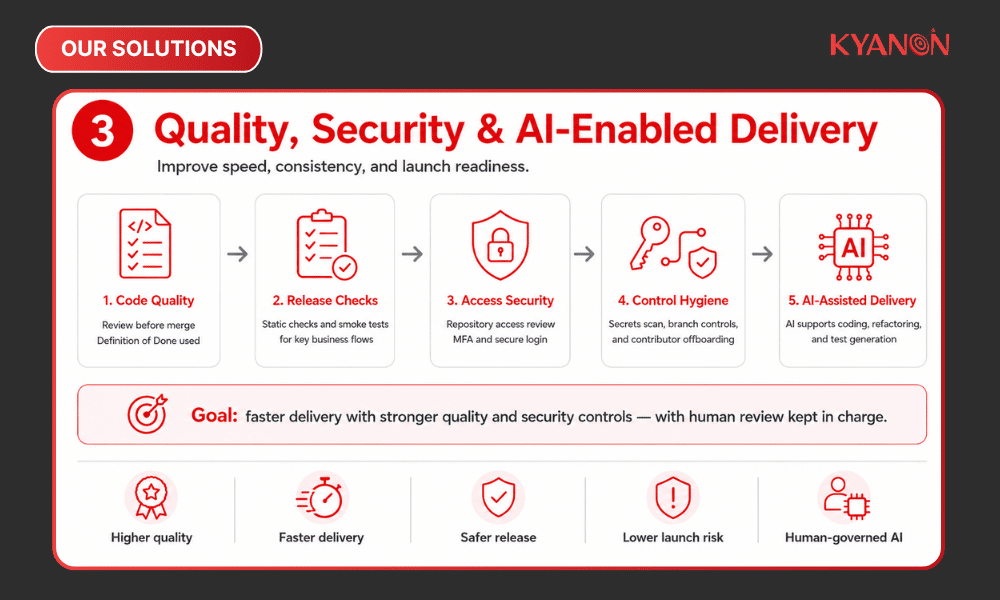
AI-assisted development was used to support repetitive coding, refactoring, test case generation, and frontend implementation tasks. Human engineers still controlled final review, business logic validation, and release decisions.
The Team Model
Role | Business Function |
Senior Mobile Engineer | Led mobile stabilization, reviewed frontend risks, guided technical decisions, and supported secure mobile implementation |
| Mobile Engineer | Executed priority fixes, improved UI consistency, supported API integration, resolved defects, and helped validate key flows |
Project Manager / Delivery Coordinator | Managed sprint planning, stakeholder updates, blocker tracking, risk visibility, delivery reporting, and launch readiness coordination |
This structure helped the client reduce dependency on internal coordination while keeping the team lean.
Delivery Approach
Phase | Business Purpose | Key Activities |
Phase 1: Onboarding & Risk Review | Build a clear view of launch risk | Access setup, codebase review, product walkthrough, priority flow mapping, security hygiene review |
| Phase 2: Sprint Stabilization | Improve release-critical workflows | Fix frontend defects, clean inconsistent UI, improve reusable components, validate priority journeys |
Phase 3: Readiness Tracking | Give stakeholders launch visibility | Weekly reporting, risk log, blocker tracking, known issue list, sprint demo |
| Phase 4: Pilot Preparation | Reduce operational disruption after release | Smoke testing, release checklist, documentation, handover notes, next-step recommendations |
Results & Business Impact
Within the pilot readiness phase, Kyanon Digital helped the Singapore digital insurance client move from unclear delivery progress to a more measurable and controlled launch process.
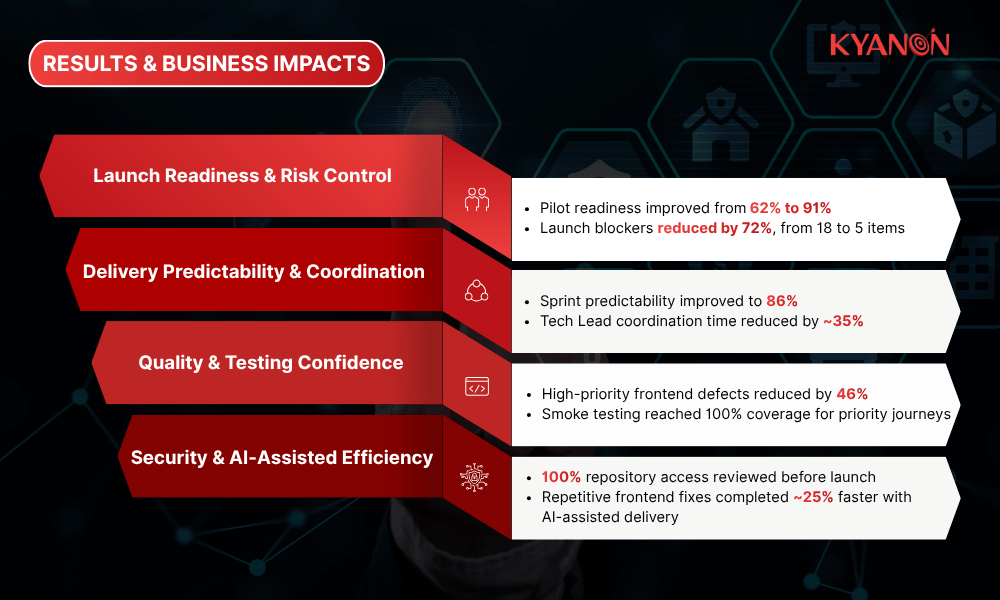
- Pilot readiness score improved from 62% to 91% across priority insurance journeys, including login, policy viewing, claims submission, document upload, notifications, and agent-assisted flows.
- Open launch blockers were reduced by 72%, from 18 active blockers to 5 remaining low-to-medium risk items before pilot release.
- Sprint completion predictability improved to 86%, with sprint scope, priorities, and acceptance criteria agreed before execution.
- Internal Tech Lead coordination time was reduced by approximately 35%, as sprint tracking, blocker follow-up, reporting, and stakeholder updates were handled by the Project Manager / Delivery Coordinator.
- High-priority frontend defects were reduced by 46% across critical flows, supported by code reviews, cleanup of reusable components, static checks, and smoke testing.
- Smoke testing coverage reached 100% of priority launch journeys, helping reduce the risk of failed claims submission, document upload issues, and support escalation during the pilot.
- 100% of repository access was reviewed before launch, with unused contributor access removed, MFA enforced, and exposed credential risks remediated.
- Turnaround time for repetitive frontend fixes was shortened by approximately 25% through AI-assisted coding, refactoring, and test generation, while human engineers retained final review and release control.
Kyanon Digital supported the client through an AI-driven Agile Team model and helped the client improve delivery control by combining mobile engineering, agile governance, AI-assisted development, quality controls, security hygiene, and launch readiness tracking.
The value was not simply additional development capacity. It was a more accountable delivery model that helped business stakeholders understand progress, control risk, and prepare the product for market with greater confidence.
Contact Kyanon Digital to build an AI-Driven Agile Team that helps turn your backlog into measurable sprint outcomes with stronger governance, faster execution, and clearer launch readiness.




 Create project brief with AI