

From Mobile Bottlenecks to Learning Momentum: Kyanon Digital’s AI-Driven Agile Delivery for an APAC EdTech App
Executive summary
A fast-scaling EdTech platform was preparing for a major back-to-school user acquisition campaign across APAC. The business opportunity was clear, but its mobile learning application was not ready for the planned campaign launch window.
The client’s backend infrastructure was stable and well-architected. However, the React Native mobile frontend had become the main delivery constraint. Technical debt, inconsistent UI implementation, slow feature releases, limited regression coverage, and unresolved security concerns were putting the campaign timeline at risk.
For an EdTech business, mobile app quality is not only a technical issue. It directly affects learner engagement, course completion, subscription conversion, enterprise learner satisfaction, and app store reputation.
Kyanon Digital deployed an Outcome-Based AI-Driven Agile Team to help the client stabilize its mobile application, accelerate priority learning features, improve release confidence, and strengthen security hygiene within a strict 3-month window.
The engagement focused on two connected priorities:
- Mobile app solutions: Strengthening the React Native learning app so learners could access lessons, videos, quizzes, and progress tracking with greater consistency.
- AI-driven agile team: Improving delivery speed, sprint accountability, quality control, and stakeholder visibility without requiring the client to rapidly expand its internal team.
The result was an on-time campaign launch, a more reliable mobile learning experience, 35%+ higher development velocity, stronger executive visibility, improved security readiness, and approximately 20 hours per week returned to internal technical leadership.
Client background
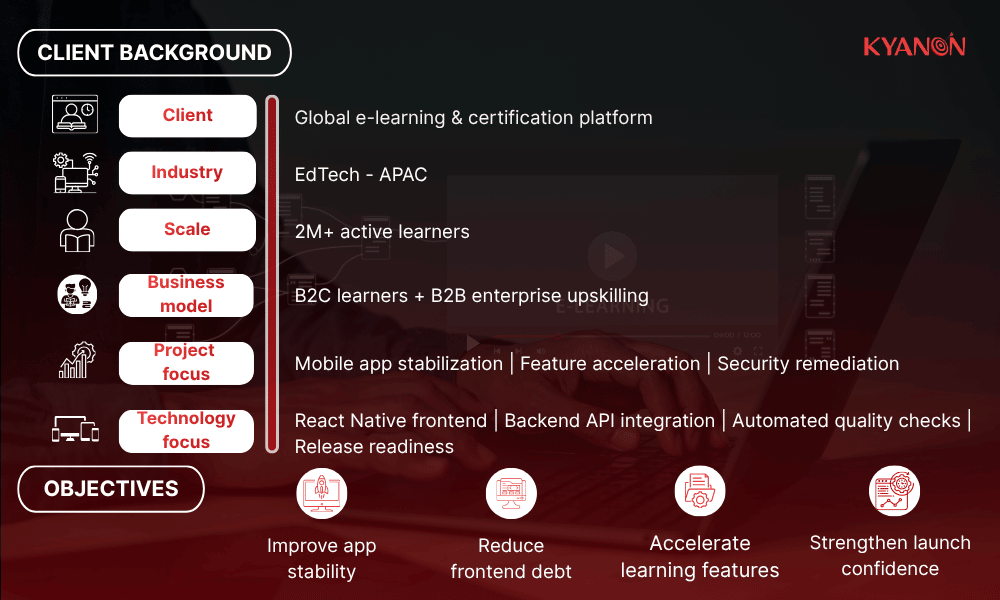
Client: A global e-learning and certification platform
Industry: EdTech
Region: APAC
Project type: Mobile app stabilization, feature acceleration, and security remediation
Business model: B2C direct-to-learner and B2B enterprise upskilling
Operational scale: More than 2 million active learners, with high-concurrency video streaming and assessment tracking
Digital maturity: Medium
Technology focus: React Native mobile frontend, backend API integration, automated quality controls, secure release readiness
The client served both individual learners and enterprise upskilling customers across APAC. Its platform supported online courses, certification pathways, video-based learning, assessments, and learner progress tracking.
The backend API ecosystem was stable, but the mobile app delivery lifecycle lacked the structure needed for faster product growth. CI/CD practices were limited, peer review discipline was inconsistent, and release readiness was difficult to assess across each sprint.
As the back-to-school campaign approached, the business needed to move quickly. Learners expected smooth mobile access to lessons, video content, quizzes, and offline study flows. Enterprise customers expected reliable assessment tracking, accurate learner progress data, and secure handling of learner information.
The client’s objective was clear: improve mobile app stability, reduce frontend technical debt, accelerate interactive learning features, and enter the campaign launch window with stronger delivery confidence.

The challenge
The client’s growth was not constrained by market demand. It was constrained by mobile delivery friction.
Mobile frontend debt was slowing product growth
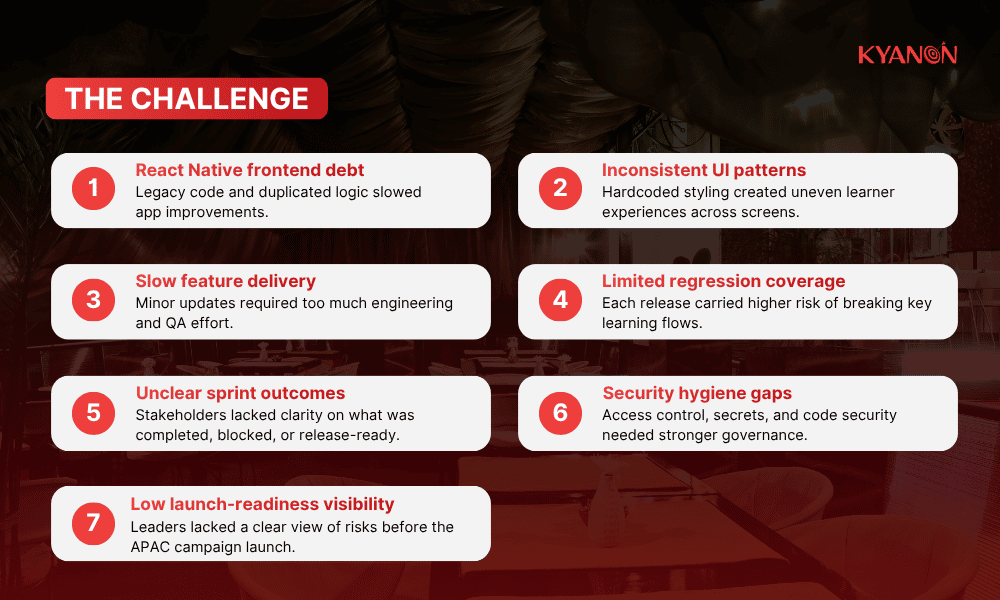
The React Native codebase had accumulated significant technical debt. Styling was hardcoded in several areas, UI patterns were inconsistent, and reusable components were limited.
This created a high-effort delivery environment. Even small interface changes required repeated engineering and QA effort. For a learning app, this became a direct business risk because learner-facing flows such as course browsing, lesson access, quiz interaction, and progress tracking needed to be consistent across devices.
Without a stronger frontend structure, the product team could not respond quickly enough to campaign requirements or learner experience improvements.
Learning experience quality was at risk before launch
In EdTech, learners often use mobile apps in short, repeated sessions. They may watch lessons during commutes, complete quizzes between classes, or continue course modules across different devices.
This made mobile reliability critical. Any friction in video access, micro-learning flows, real-time quiz syncing, or progress tracking could reduce engagement and increase drop-off.
The client needed to release new interactive learning features before the campaign deadline, but limited regression coverage made each release difficult to trust.
Sprint execution lacked clear outcome accountability
The client had engineering capacity, but sprint execution was still difficult to control. Scope was often discussed as tasks and effort rather than committed deliverables.
This made it harder for product and business stakeholders to understand what would be completed, what was at risk, and what was truly ready for release.
For an EdTech mobile app preparing for a regional campaign, this created direct delivery risk. Interactive learning features, quiz flows, offline video improvements, and learner progress updates needed to move through the backlog with clearer ownership and stronger release discipline.
Without a structured delivery model, the team risked carrying unresolved backlog items across sprints and entering the campaign launch window without reliable visibility into mobile app readiness.
Security hygiene needed immediate attention
A recent security incident had exposed weaknesses in repository access control and development hygiene.
For an EdTech platform handling learner data, assessment records, and enterprise training activity, security readiness was business-critical. Any exposed credentials, weak access control, or poor pre-merge discipline could increase compliance exposure and damage customer trust before a high-visibility regional campaign.
Executives lacked clear launch-readiness visibility
The existing delivery process relied on fragmented updates. Stakeholders could see activity, but not always the real status of completed work, open blockers, release risks, or security readiness.
Before the regional campaign launch, the leadership team needed a clearer view of whether the mobile app was ready.
Our solution
Kyanon Digital implemented an outcome-based AI-driven agile team designed to improve mobile app stability, accelerate delivery, and strengthen governance without adding unnecessary team complexity.
The engagement was structured around two service pillars.
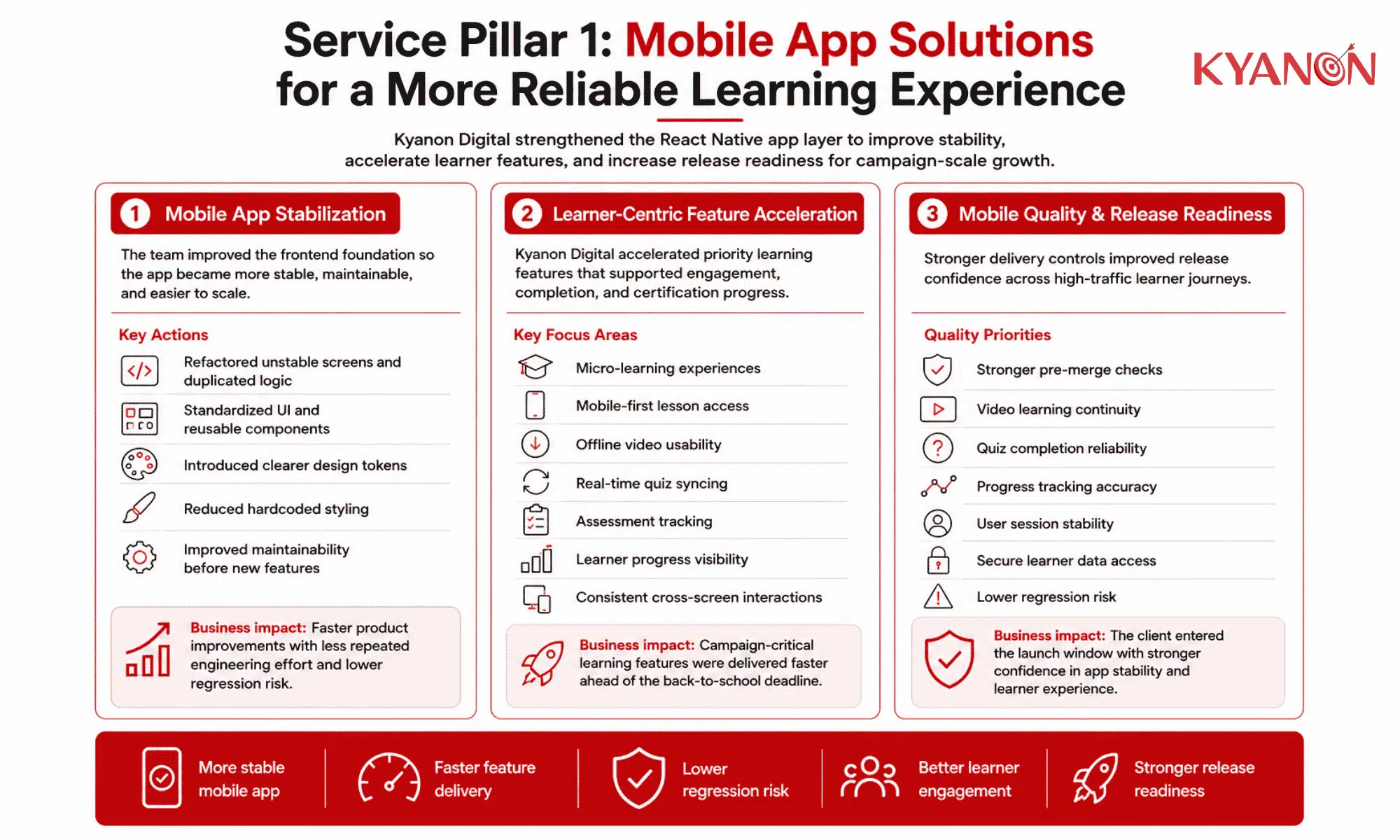
Service pillar 1: Mobile app solutions for a more reliable learning experience
Kyanon Digital focused first on the mobile app layer because it was the direct learner touchpoint and the main delivery bottleneck.
The goal was not to rebuild the platform from scratch. The goal was to make the existing React Native application more stable, more maintainable, and more ready for campaign-scale user acquisition.
Mobile app stabilization
Kyanon Digital’s senior React Native engineers reviewed the frontend structure and identified areas where technical debt was slowing delivery.
The team improved the mobile codebase by:
- Refactoring unstable screens and duplicated logic
- Standardizing UI implementation across key learning flows
- Building reusable React Native components
- Creating a clearer design token structure
- Reducing hardcoded styling
- Improving code maintainability before new feature delivery
This helped the client move from isolated screen-level fixes to a more scalable frontend foundation.
Business impact: The product team could deliver learning experience improvements faster, with less repeated engineering effort and lower regression risk.
Learner-centric feature acceleration
The mobile app needed to support the client’s campaign goals, especially around learner engagement and course completion.
Kyanon Digital helped accelerate priority interactive learning features, including improvements related to:
- Micro-learning experiences
- Mobile-first lesson access
- Offline video usability
- Real-time quiz syncing
- Assessment tracking flows
- Learner progress visibility
- Consistent cross-screen interaction patterns
For EdTech, these features are not simply product enhancements. They directly support learner retention, course completion, certification progress, and enterprise training value.
Business impact: The client improved its ability to launch campaign-critical learning features before the back-to-school campaign deadline.
Mobile quality and release readiness
To improve release confidence, Kyanon Digital introduced stronger quality controls around the mobile delivery process.
The team strengthened pre-merge checks and improved validation around key learner flows. This helped reduce the risk of shipping unstable screens, broken interactions, or inconsistent learning experiences into production.
Testing priorities were aligned with EdTech-specific risks, such as:
- Video learning continuity
- Quiz completion reliability
- Progress tracking accuracy
- User session stability
- Secure access to learner data
- Regression risk across high-traffic learner journeys
Business impact: The client entered the campaign launch window with stronger confidence that the mobile app could support increased learner acquisition and engagement.
Service pillar 2: AI-driven agile team for committed sprint outcomes
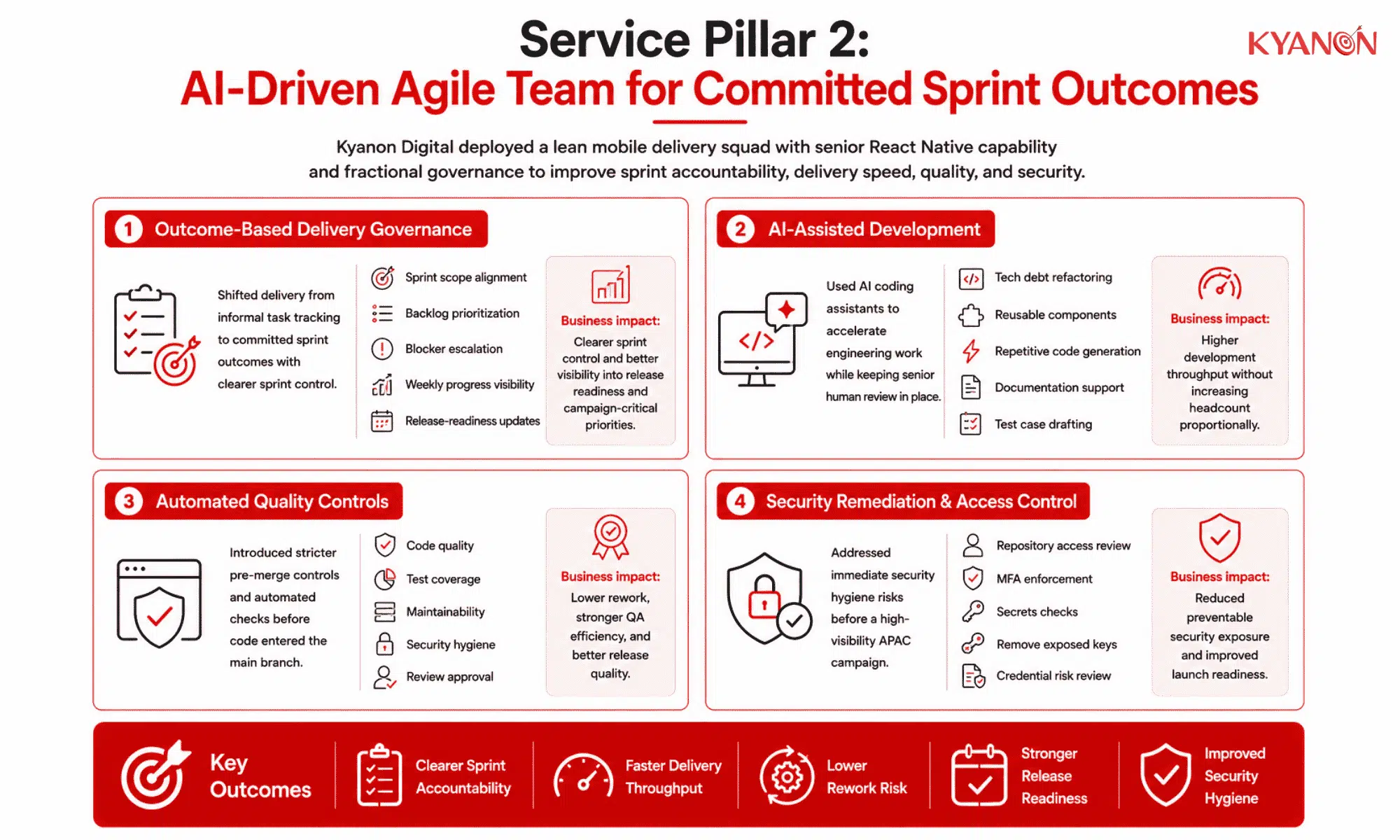
The second pillar focused on delivery execution. Kyanon Digital deployed a lean mobile delivery squad combining senior React Native capability with fractional delivery governance.
The team was structured to stabilize the app, accelerate priority features, and provide clearer sprint accountability without expanding the client’s internal headcount.
Outcome-based delivery governance
Kyanon Digital shifted the delivery model from informal task tracking to committed sprint outcomes.
The workflow included:
- Sprint scope alignment before execution
- Clear backlog prioritization
- Blocker tracking and escalation
- Weekly progress visibility
- Risk and dependency reporting
- Release-readiness updates for stakeholders
- Clear separation between completed work, carry-over items, and next priorities
This gave the client stronger visibility into what was actually delivered each sprint, not only how much effort was spent.
Business impact: The client gained clearer delivery control and reduced ambiguity around sprint progress, release readiness, and campaign-critical backlog items.
AI-assisted development across the SDLC
Kyanon Digital embedded AI into specific points of the software development lifecycle to accelerate engineering work while maintaining senior human review.
The team used AI coding assistants such as GitHub Copilot and Cursor Agent Mode to support:
- Technical debt refactoring
- Reusable component creation
- Repetitive code generation
- Code consistency improvements
- Documentation support
- Test case drafting
- Faster implementation of frontend patterns
AI was used as an engineering accelerator, not as a replacement for engineering judgment. Senior engineers reviewed all AI-assisted outputs before accepting them into the codebase.
Business impact: The client increased development throughput without increasing headcount proportionally.
Automated quality controls before code merge
Kyanon Digital introduced stricter merge request policies supported by automated checks.
The team implemented pre-merge controls using tools such as SonarQube/SAST and ESLint to detect code quality issues, maintainability risks, and security concerns before they entered the main branch.
Code could only be merged when it met agreed criteria for:
- Code quality
- Test coverage
- Maintainability
- Security hygiene
- Review approval
Business impact: The client reduced rework, improved QA efficiency, and created a stronger quality gate before release.
Security remediation and access control
Kyanon Digital also addressed immediate security hygiene issues.
The team conducted:
- Repository access review
- Multi-Factor Authentication enforcement
- Secrets checks
- Identification and removal of exposed keys or tokens
- Review of hardcoded credential risks
- Recommendations for stronger repository management practices
These actions were especially important because the platform handled learner information, assessment activity, and enterprise upskilling records.
Business impact: The client reduced preventable security exposure before entering a high-visibility APAC user acquisition campaign.
Results & business impact
Within 3 months, Kyanon Digital helped the EdTech platform improve mobile app stability, sprint visibility, release confidence, and security readiness ahead of its APAC back-to-school campaign.
Result | Business impact |
| On-time APAC campaign launch | Priority mobile learning features were delivered before the campaign deadline |
35%+ increase in development velocity | The team moved faster through the backlog without weakening review discipline |
| 20 hours per week returned to internal technical leadership | Internal leaders regained time for scalability planning and architecture decisions |
Stronger mobile app release confidence | Clearer quality gates reduced uncertainty before launch |
| Improved security readiness | Repository controls, MFA, and secrets remediation reduced preventable security risks |
Clearer executive visibility | Weekly reports gave stakeholders a clearer view of progress, risks, and release readiness |
On-time launch for the APAC back-to-school campaign
Kyanon Digital stabilized the React Native mobile app and delivered priority interactive learning features ahead of the campaign deadline.
The client entered the launch window with a more reliable mobile learning experience and stronger product readiness across APAC markets.
35%+ faster development velocity
AI-assisted engineering, reusable component development, frontend refactoring, and automated pre-merge checks helped the team accelerate backlog delivery.
The client achieved more than 35% improvement in development velocity while maintaining senior review, quality control, and release discipline.
20 hours per week returned to internal technical leadership
By moving sprint coordination, reporting, and blocker management into a structured delivery governance model, the client recovered approximately 20 hours per week from internal technical leadership.
This time was redirected toward backend scalability planning, architecture decisions, and long-term platform improvements.
Stronger mobile app release confidence
The client gained a more structured release process supported by clearer quality gates, improved code review discipline, and stronger validation of learner-facing flows.
This helped reduce release uncertainty before launching the campaign across APAC markets.
Improved security readiness for learner data
Kyanon Digital strengthened security hygiene through repository access review, MFA enforcement, secrets remediation, and automated code quality checks.
For an EdTech platform handling learner data, assessment records, and enterprise training activity, this improved confidence in data protection and brand trust.
Clearer executive visibility into delivery risks
Weekly delivery reports, risk logs, sprint tracking, and release-readiness updates gave senior stakeholders a clearer view of what was completed, blocked, or at risk.
Instead of relying on fragmented progress updates, executives could make faster launch decisions based on delivery evidence.
Contact Kyanon Digital to build a lean AI-driven agile team for faster, safer, and more confident product launches.





 Create project brief with AI