

Executive summary
A leading home hospice and palliative care provider in Singapore relies on a Microsoft Dynamics 365-based Electronic Medical Records (EMRx) platform for critical patient records and operational workflows.
Kyanon Digital established a structured managed services model combining centralized service management, severity-based L1–L3 support, controlled change delivery, and recurring governance. The engagement created a more transparent and controlled operating model for maintaining platform reliability while supporting ongoing enhancements and continuous improvement.
Client background
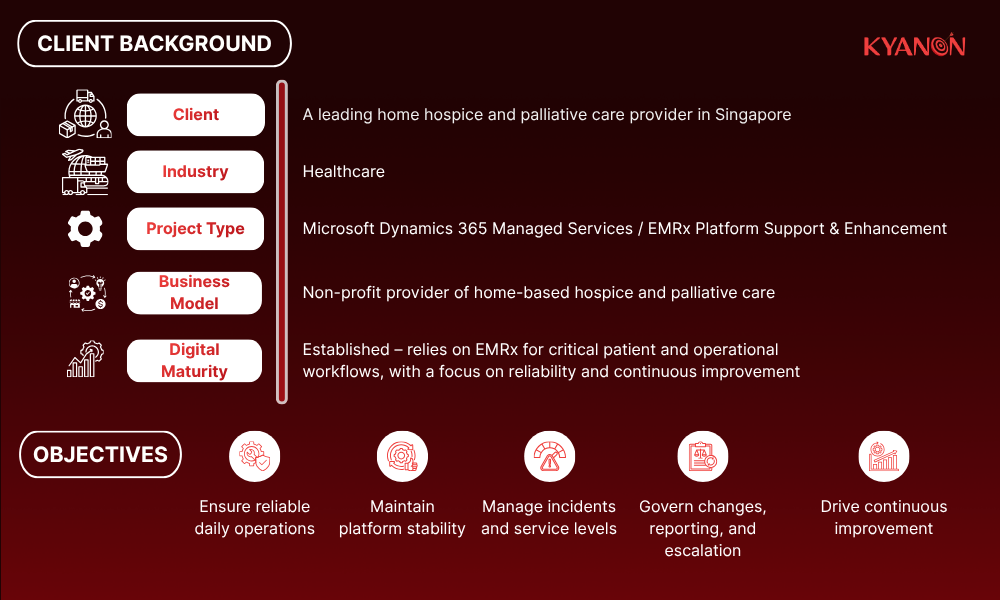
- Client: A leading home hospice and palliative care provider in Singapore
- Industry: Healthcare
- Project type: Microsoft Dynamics 365 Managed Services / EMRx Platform Support & Enhancement
- Business model: A non-profit healthcare provider delivering home-based hospice and palliative care through multidisciplinary clinical and psychosocial teams.
- Digital maturity: Established – relying on a production EMRx platform for critical patient and operational workflows, with increasing focus on reliability, governance, and continuous enhancement.
- Objective: Maintain reliable day-to-day operation of a mission-critical EMRx platform while establishing structured controls for incident management, service levels, platform changes, reporting, escalation, and continuous improvement.

Challenges
The client needed a more structured way to maintain reliable EMRx operations while managing incidents, platform changes, and service performance.
Key challenges included:
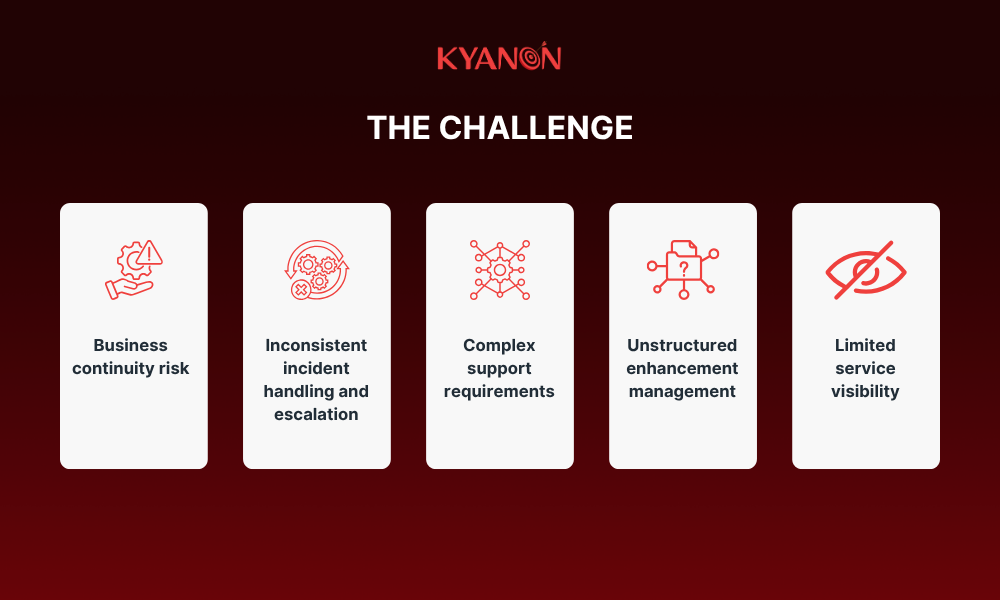
- Business continuity risk: Issues affecting the mission-critical EMRx platform could disrupt access to patient information and important operational workflows.
- Inconsistent incident handling and escalation: Different incident severities required clear priorities, response expectations, resolution targets, ownership, and escalation paths.
- Complex support requirements: Requests ranged from routine user issues to functional, configuration, integration, and system-level problems, sometimes requiring coordination across multiple internal and external teams.
- Unstructured enhancement management: Platform improvements needed a controlled process for assessment, approval, effort allocation, delivery, and validation rather than ad hoc support handling.
- Limited service visibility: Leadership needed a consistent view of incident volumes, SLA performance, outstanding issues, change-request progress, and effort utilization.
Our solution – A four-pillar managed services framework
Kyanon Digital established a structured Microsoft Dynamics 365 managed services framework designed to maintain day-to-day EMRx reliability while creating clear governance for support, enhancements, service performance, and continuous improvement.
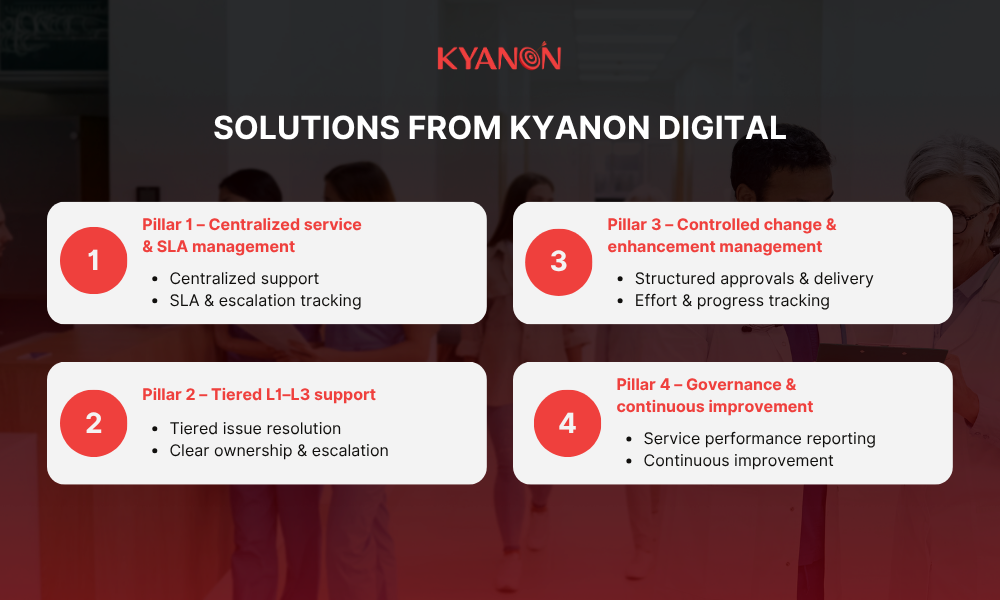
Pillar 1 – Centralized service & SLA management
Kyanon Digital established Jira Service Management as the central operating platform for support and change activities.
The service model enables the team to:
- Centralize incident and service-request intake
- Categorize issues by type and severity
- Assign clear ticket ownership
- Monitor response and resolution targets
- Track escalation and resolution progress
- Separate operational incidents from planned Change Requests
- Maintain historical resolution information for recurring issues
The operating model provides active support during Monday–Friday, 9:00 AM–6:00 PM SGT, with after-hours, weekend, and Singapore public holiday coverage available for Severity 1 incidents.
Approach: Centralized service management, severity classification, SLA monitoring, ticket ownership, and escalation control.
Business outcome: The client gains a consistent and transparent mechanism for controlling support demand and prioritizing incidents according to operational impact.
Pillar 2 – Tiered L1–L3 support
Kyanon Digital introduced a defined support model that routes issues according to their complexity and required expertise.
- L1 – Helpdesk & User Support: Handles initial ticket intake, user guidance, known issues, and basic troubleshooting.
- L2 – Functional & Configuration Support: Investigates application workflows, configuration, access, reporting, and functional issues.
- L3 – Technical & System Support: Handles complex application, customization, integration, performance, and system-level issues, including coordination with developers and external technology providers.
Issues remain governed through a defined escalation structure as they move between support levels.
Approach: Tiered application support, functional investigation, technical escalation, and cross-team coordination.
Business outcome: Support requests can be handled by the appropriate level of expertise while maintaining clear ownership throughout the resolution lifecycle.
Pillar 3 – Controlled change & enhancement management
Kyanon Digital separated planned enhancements from day-to-day support through a structured Change Request process: Request → Assessment → Approval → Planning → Delivery → Validation → Closure.
The framework provides visibility into:
- Change requirements and scope
- Approval status
- Allocated effort
- Consumed effort
- Remaining capacity
- Delivery progress
- Validation and closure status
Support incidents and enhancement demand remain visible within the same service-management environment while following separate governance workflows.
Approach: Structured Change Request governance, effort tracking, approval controls, delivery management, and validation.
Business outcome: Platform improvements move through a controlled delivery process rather than relying on ad-hoc changes, helping the client balance ongoing enhancement with business-as-usual support.
Pillar 4 – Governance & continuous improvement
Kyanon Digital supports the managed services engagement through recurring reporting, escalation management, and service reviews.
Operational reporting covers:
- Incident volumes and status
- SLA performance
- Response and resolution progress
- Outstanding issues and escalations
- Change Request pipeline
- Effort consumed versus allocated
- Upcoming enhancement priorities
A formal escalation model defines how complex issues are coordinated across Kyanon Digital, the client, Microsoft Dynamics 365 support, and relevant third-party providers. Regular service reviews provide a structured forum to assess operational performance, review unresolved issues, evaluate effort utilization, and prioritize future improvements.
Approach: Service reporting, escalation governance, effort visibility, operational reviews, and continuous-improvement planning.
Business outcome: Management gains a consistent view of platform support performance, enhancement demand, and service priorities beyond individual support tickets.
Tech stack
Layer | Technology/approach |
| Core platform | Microsoft Dynamics 365-based Electronic Medical Records (EMRx) |
Service management | Jira Service Management |
| Support model | L1–L3 managed application support |
Service governance | Severity-based SLA management and escalation workflows |
| Change management | Structured Change Request assessment, approval, effort tracking, delivery, and validation |
Reporting | Recurring incident, SLA, Change Request, escalation, and effort-utilization reporting |
Results & business impact
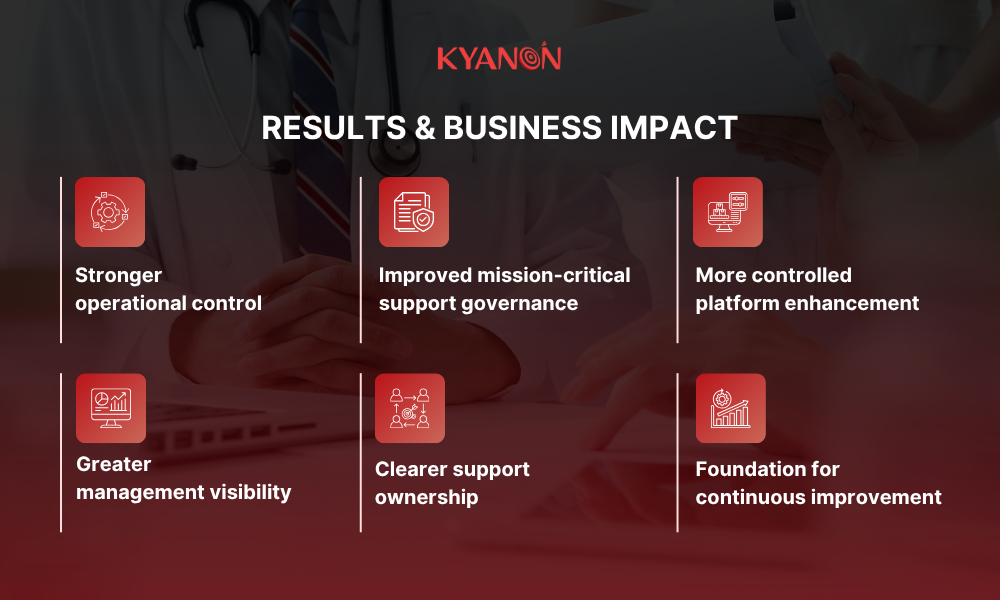
- Stronger operational control: Replaced fragmented support handling with a centralized, SLA-backed managed services model covering incident management, escalation, and platform enhancements.
- Improved mission-critical support governance: Introduced severity-based L1–L3 support and defined escalation paths for issues affecting critical EMRx and operational workflows.
- More controlled platform enhancement: Established a repeatable Change Request pipeline with defined assessment, approval, effort tracking, delivery, and validation stages.
- Greater management visibility: Consolidated support and Change Request reporting into a recurring operational view covering ticket volumes, SLA performance, delivery progress, escalations, and effort utilization.
- Clearer support ownership: Established defined responsibilities across support levels and external technology providers, helping complex issues move through a controlled escalation path.
- Foundation for continuous improvement: Combined operational support, enhancement governance, and recurring service reviews into a structured model for maintaining and progressively improving the EMRx platform.
Kyanon Digital’s Managed Services help organizations maintain business-critical applications while creating a more predictable operating model for support, change, and continuous enhancement.
Contact Kyanon Digital to discuss your managed services and application support requirements.





 Create project brief with AI