
What is AI-Augmented development?
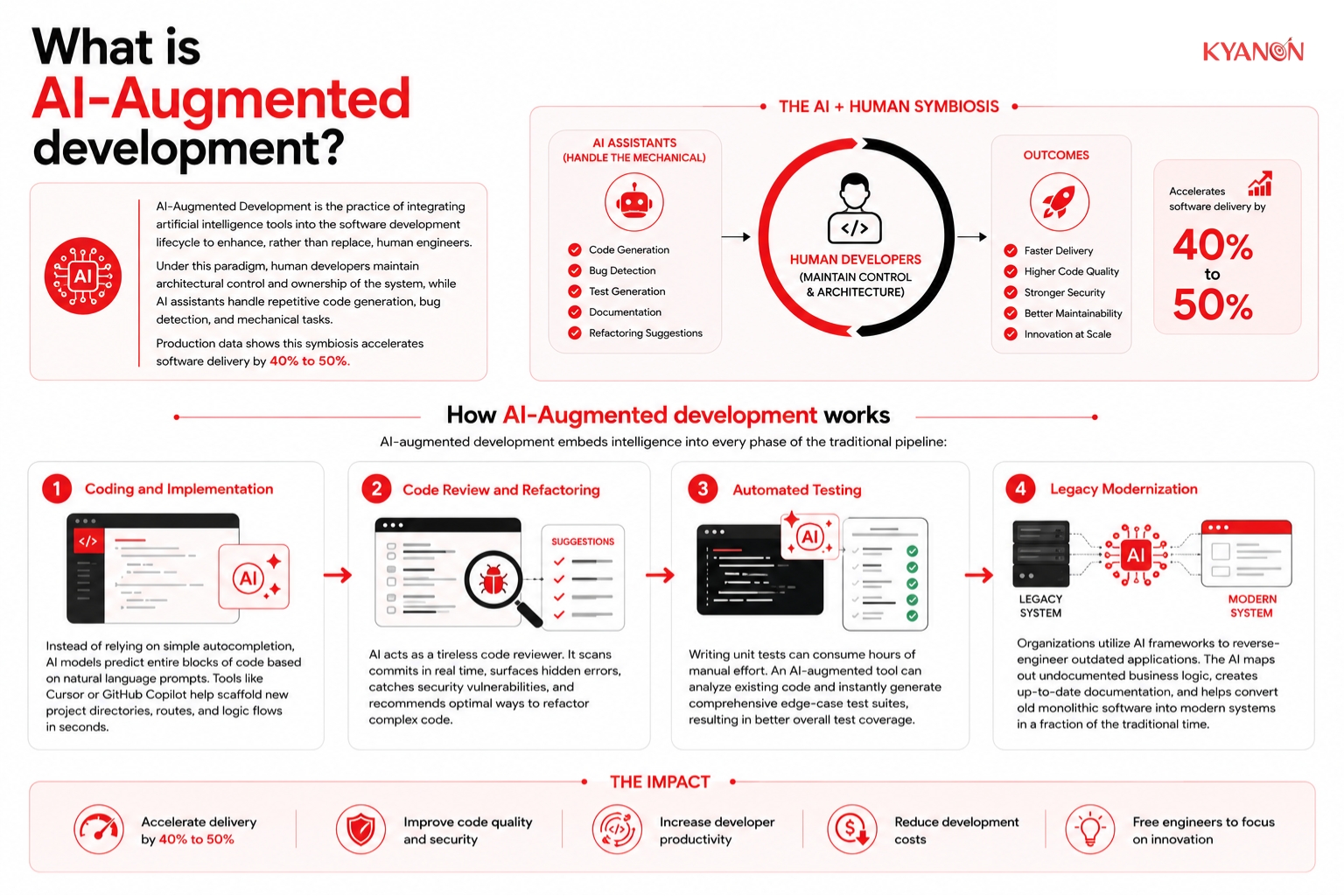
AI-Augmented Development is the practice of integrating artificial intelligence tools into the software development lifecycle to enhance, rather than replace, human engineers. Under this paradigm, human developers maintain architectural control and ownership of the system, while AI assistants handle repetitive code generation, bug detection, and mechanical tasks. Production data shows this symbiosis accelerates software delivery by 40% to 50%.
How AI-Augmented development works
AI-augmented development embeds intelligence into every phase of the traditional pipeline:
Coding and Implementation
Instead of relying on simple autocompletion, AI models predict entire blocks of code based on natural language prompts. Tools like Cursor or GitHub Copilot help scaffold new project directories, routes, and logic flows in seconds.
Code Review and Refactoring
AI acts as a tireless code reviewer. It scans commits in real time, surfaces hidden errors, catches security vulnerabilities, and recommends optimal ways to refactor complex code.
Automated Testing
Writing unit tests can consume hours of manual effort. An AI-augmented tool can analyze existing code and instantly generate comprehensive edge-case test suites, resulting in better overall test coverage.
Legacy Modernization
Organizations utilize AI frameworks to reverse-engineer outdated applications. The AI maps out undocumented business logic, creates up-to-date documentation, and helps convert old monolithic software into modern systems in a fraction of the traditional time.
AI-Augmented Development vs AI-Native Development
Both paradigms utilize artificial intelligence in software creation, but differ fundamentally in the locus of control and decision-making.
|
Dimension |
AI-Augmented Development | AI-Native Development |
| Primary decision-maker | Human engineer |
AI agents |
|
Code generation role |
Assistant / Copilot | Autonomous creator |
| Upfront complexity | Low |
High |
|
Best for |
Scaling existing engineering teams | Experimental greenfield projects |
| Security and QA focus | Human-led peer review |
Automated validation loops |
Key benefits of AI-Augmented Development
AI-augmented development fundamentally transforms software engineering by pairing human ingenuity with machine efficiency.
- Reduced burnout: Shifting mechanical, administrative workloads to AI minimizes developer fatigue.
- Faster time-to-market: Features transition from ideation to production in days rather than weeks.
- Democratized jearning: Junior developers can quickly understand complex algorithms and learn to write better code by interacting with AI explanations.
When to consider AI-Augmented Development
Consider AI-Augmented Development if:
- Your engineering team spends a disproportionate amount of time writing boilerplate code and documentation rather than solving core business problems.
- You are scaling your product suite rapidly and need to increase developer output without compromising code consistency or peer review standards.
- Your legacy modernization efforts are stalled due to the high cognitive overhead required to untangle and refactor undocumented codebases.
It may not be the right priority if:
- Your organization lacks mature CI/CD pipelines, automated testing frameworks, and clear code governance, as AI will simply scale the production of technical debt.
Why AI-Augmented Development matters for enterprise software
For enterprise organizations, AI-augmented development is no longer just an experimental productivity hack; it is a critical strategy to address systemic IT challenges. Worldwide IT spending is expected to reach $6.31 trillion in 2026, up 13.5% from 2025, according to the latest forecast by Gartner.
By inserting AI as a collaborative partner throughout the software development lifecycle (SDLC), enterprises can scale operations, secure intellectual property, and innovate at a pace previously bottlenecked by manual engineering hours.
Common misconceptions
More code generated automatically means our delivery timelines will shrink by 50%
Reality: AI accelerates code writing but does not fix organizational pipeline bottlenecks. Generating code faster increases the volume that must be compiled, peer-reviewed, and tested; if your QA and deployment processes remain manual, overall delivery times will stall despite the AI coding boost.
Implementing AI workflows means we can downsize our engineering team and rely on junior staff
Reality: AI changes the nature of a developer’s role rather than eliminating it. Because AI produces a high volume of code, senior developers with strong critical thinking, system-level architecture skills, and debugging experience are more valuable than ever to audit and integrate that code safely.
AI tools naturally write secure code that passes corporate compliance
Reality: AI tools are predictive models based on probabilities and frequently introduce subtle vulnerabilities or use deprecated libraries. Blindly trusting AI output expands your attack surface, making strict human oversight and automated security scanning mandatory.
How Kyanon Digital applies AI-Augmented Development
Kyanon Digital embeds AI-augmented development tools and practices directly into our Agile engineering workflows for enterprise clients across Southeast Asia and global markets. By empowering IT experts with advanced AI-assisted coding capabilities, we accelerate product delivery, minimize technical debt, and improve code reliability across web, mobile, and custom software development projects. Our approach prioritizes human architectural oversight while utilizing AI to eliminate workflow bottlenecks.
Explore our AI development services:











 Create project brief with AI