
What is back-office integration?
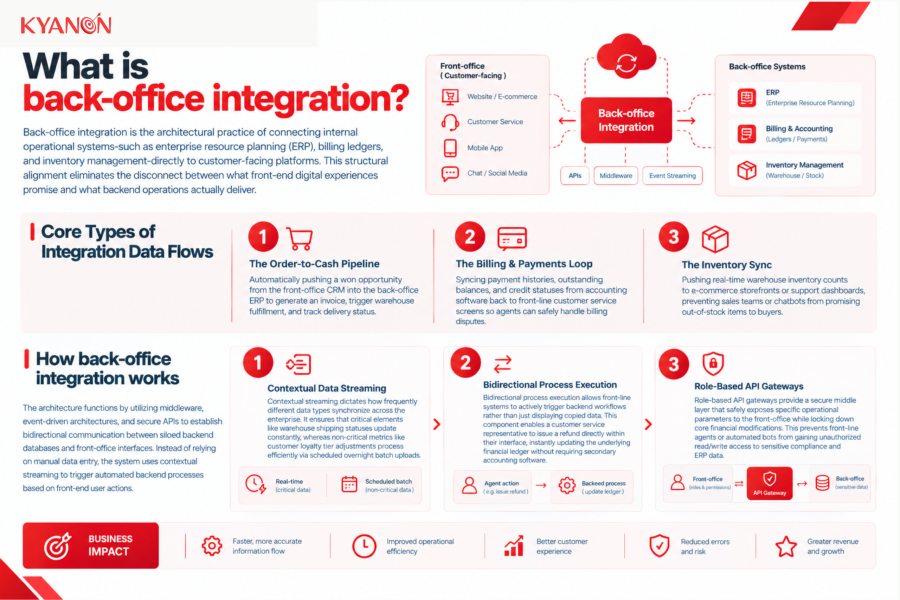
Back-office integration is the architectural practice of connecting internal operational systems-such as enterprise resource planning (ERP), billing ledgers, and inventory management-directly to customer-facing platforms. This structural alignment eliminates the disconnect between what front-end digital experiences promise and what backend operations actually deliver.
Core types of integration data flows
- The order-to-cash pipeline: Automatically pushing a won opportunity from the front-office CRM into the back-office ERP to generate an invoice, trigger warehouse fulfillment, and track delivery status.
- The billing & payments loop: Syncing payment histories, outstanding balances, and credit statuses from accounting software back to front-line customer service screens so agents can safely handle billing disputes.
- The inventory sync: Pushing real-time warehouse inventory counts to e-commerce storefronts or support dashboards, preventing sales teams or chatbots from promising out-of-stock items to buyers.

How back-office integration works
The architecture functions by utilizing middleware, event-driven architectures, and secure APIs to establish bidirectional communication between siloed backend databases and front-office interfaces. Instead of relying on manual data entry, the system uses contextual streaming to trigger automated backend processes based on front-end user actions.
Contextual data streaming
Contextual streaming dictates how frequently different data types synchronize across the enterprise. It ensures that critical elements like warehouse shipping statuses update constantly, whereas non-critical metrics like customer loyalty tier adjustments process efficiently via scheduled overnight batch uploads.
Bidirectional process execution
Bidirectional process execution allows front-line systems to actively trigger backend workflows rather than just displaying copied data. This component enables a customer service representative to issue a refund directly within their interface, instantly updating the underlying financial ledger without requiring secondary accounting software.
Role-based API gateways
Role-based API gateways provide a secure middle layer that safely exposes specific operational parameters to the front-office while locking down core financial modifications. This prevents front-line agents or automated bots from gaining unauthorized read/write access to sensitive compliance and ERP data.
Back-Office Integration vs CRM Integration
Both practices focus on unifying business data, but differ significantly in architectural depth and operational scope.
Dimension | Back-Office Integration | CRM Integration |
| System scope | ERP, billing, supply chain, HR | Marketing, sales, customer support |
Data sensitivity | High (Financial ledgers, compliance) | Moderate (Contact info, interaction history) |
| Integration depth | Deep bidirectional process automation | Surface-level customer data syncing |
Primary users | Finance, operations, and IT teams | Sales representatives and marketing teams |
| Impact metric | Operational TCO and fulfillment speed | Lead conversion and customer retention |
When to consider back-office integration
Consider back-office integration if:
- Your customer service agents suffer from burnout due to “swivel-chair integration,” constantly cross-referencing invoice IDs across multiple disconnected windows to resolve a single ticket.
- You have invested heavily in front-end digital experience interfaces, but customer satisfaction remains low because backend fulfillment systems take days to accurately reflect order statuses.
- Your finance department spends excessive billable hours manually reconciling transactional discrepancies between your e-commerce platform and legacy accounting software.
It may not be the right priority if:
- Your organization is operating an early-stage digital MVP where manual backend processes and low transaction volumes do not yet bottleneck the customer experience.
Why back-office integration matters for enterprise organizations
Fragmented backend infrastructure directly increases total cost of ownership (TCO) by requiring extensive manual labor to bridge operational gaps, which in turn degrades the overall customer experience. Aligning operational engines with front-end interfaces drastically accelerates time-to-market for new services by ensuring the underlying infrastructure can support digital promises.
IBM’s 2025 Institute for Business Value research, based on 680 IT leaders across 21 countries, found that organizations using intelligent automation reported 28% lower IT costs, while automation investments were associated with 10% revenue growth. IBM identifies legacy software, siloed data, and uncoordinated technology as major sources of enterprise complexity.
Common Misconceptions
We synced the billing fields into our CRM, so our systems are now fully integrated
Reality: Simply mirroring data fields across platforms is a passive link; true integration is functional and bidirectional. If an agent can see a past-due balance on their screen but still has to ping a finance manager to actually issue a refund, the workflow remains completely broken.
We need every single backend database to update in absolute real-time across the enterprise
Reality: Forcing real-time synchronization on heavy legacy databases, like historical financial ledgers, is incredibly expensive and degrades system performance. Effective architectures utilize contextual streaming, reserving real-time updates for critical statuses while processing secondary data in batches.
f we deploy this state-of-the-art AI chatbot, it will finally fix our poor customer experience
Reality: A stunning front-end interface cannot mask broken backend operations. If your fulfillment system takes five days to update order statuses, a shiny front-end chatbot will simply give customers inaccurate or delayed answers much faster.
We should give our front-line agents full edit access to the backend so they can solve issues instantly
Reality: Back-office systems hold highly sensitive financial and compliance data, and granting front-line teams wide-open read/write access creates massive security risks. A mature integration requires a sophisticated API layer that safely exposes specific parameters while locking down the core ledger.
How Kyanon Digital applies back-office integration
Kyanon Digital integrates back-office systems with customer-facing platforms for enterprise clients, specifically targeting the disconnect between digital promises and operational realities. Operating across Vietnam, Singapore, Thailand, ANZ and Malaysia, our engineering teams build custom API layers and middleware that connect legacy ERPs and billing engines directly to modern CX interfaces. Our approach prioritizes measurable reductions in TCO and manual operational overhead, going beyond surface-level data syncing to deliver deep, bidirectional process automation.
Explore our Customer loyalty services.

 Create project brief with AI