
What is behavioral segmentation?
The concept of behavioral segmentation is a data-driven strategy that divides a customer base into distinct groups based on their observable interactions, such as purchasing habits, feature usage, and website navigation patterns. This framework allows organizations to transition from generic marketing broadcasts to targeted, event-triggered lifecycle messaging.
The 4 core types of behavioral segmentation
- Purchase & Buying Behavior: Grouping consumers based on how they make decisions. This separates impulsive buyers, intense price-comparison shoppers, and highly methodical buyers who require multiple touchpoints before converting.
- Usage Rate & Occasion: Segmenting by how often or when a customer uses a product. This categorizes users into heavy, medium, or light users, or groups them by specific times (e.g., consumers who only buy coffee during morning commutes or shop exclusively on Black Friday).
- Benefits Sought: Dividing customers based on the specific value or problem they want your product to solve. For example, two people buying the same smartphone might belong to different segments: one buys it strictly for battery life and durability, while the other buys it for camera quality and status.
- Customer Loyalty Status: Grouping users by their level of brand retention. This isolates your highest-value brand advocates from habitual repeat buyers, casual switchers (who jump to competitors for discounts), and high-churn risk users.
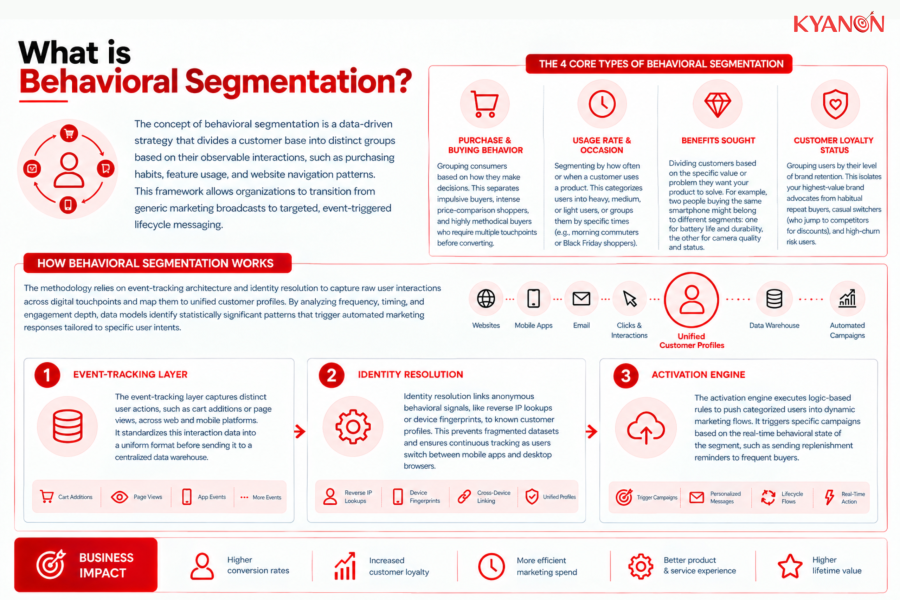

How behavioral segmentation works
The methodology relies on event-tracking architecture and identity resolution to capture raw user interactions across digital touchpoints and map them to unified customer profiles. By analyzing frequency, timing, and engagement depth, data models identify statistically significant patterns that trigger automated marketing responses tailored to specific user intents.
Event-Tracking Layer
The event-tracking layer captures distinct user actions, such as cart additions or page views, across web and mobile platforms. It standardizes this interaction data into a uniform format before sending it to a centralized data warehouse.
Identity Resolution
Identity resolution links anonymous behavioral signals, like reverse IP lookups or device fingerprints, to known customer profiles. This prevents fragmented datasets and ensures continuous tracking as users switch between mobile apps and desktop browsers.
Activation Engine
The activation engine executes logic-based rules to push categorized users into dynamic marketing flows. It triggers specific campaigns based on the real-time behavioral state of the segment, such as sending replenishment reminders to frequent buyers.
Behavioral segmentation vs Demographic Segmentation
While demographic segmentation groups audiences by inherent traits, behavioral segmentation categorizes them by actual digital actions.
Dimension | Behavioral segmentation | Demographic Segmentation |
| Primary data source | First-party interaction events | Surveys and third-party databases |
Grouping criteria | Actions, usage rate, purchase history | Age, gender, income, location |
| Dynamic nature | High (Updates in real-time) | Low (Remains static over long periods) |
Implementation complexity | High (Requires event-tracking APIs) | Low (Standard CRM fields) |
| Best for | Trigger-based personalization and lifecycle marketing | Broad market sizing and initial targeting |
When to consider behavioral segmentation
Consider behavioral segmentation if:
- Your email marketing campaigns generate high open rates but suffer from low click-through and conversion metrics due to generic product recommendations.
- Your e-commerce platform struggles to distinguish between price-sensitive deal hunters and high-frequency premium buyers, resulting in blanket discount strategies that erode profit margins.
- You are preparing to launch a loyalty program and need a structured method to reward core utility actions rather than just measuring transactional volume.
It may not be the right priority if:
- Your product catalog consists of a single, highly commoditized item with infrequent purchase cycles where broad demographic targeting yields sufficient acquisition results.
Why behavioral segmentation matters for Retail & FMCG
Treating entire customer bases as identical monolithic entities inflates customer acquisition costs (CAC) and accelerates churn among high-value accounts. Structuring marketing operations around observed behavior allows product teams to map specific campaigns to actual user intent, increasing total customer lifetime value while reducing wasted ad spend on unengaged cohorts.
Deloitte’s 2025 Consumer Products Industry Outlook found that 70% of consumer-products executives see precision analytics as a way to improve marketing ROI. Nearly three-quarters, 74%, said analytics capabilities are helping them make more precise decisions about pricing, promotions, and discounts.
Common Misconceptions
Once a customer is a discount buyer, they will always be a discount buyer
Reality: Behavioral segments are highly fluid, and locking users into rigid buckets based on historical data prevents brands from showing them relevant upsell opportunities. A customer who historically bought strictly on clearance might shift to premium, convenience-focused purchasing due to a life event like a salary increase or a new baby.
If two users abandon the checkout at the same screen, they need the exact same discount coupon
Reality: Behavior alone does not explain intent; User A might have abandoned because the price was too high, while User B abandoned because their credit card failed or they ran out of time. Treating them identically will fail to convert the user with technical issues and needlessly cut into profit margins on the price-sensitive user.
We are highly segmented because we track email open rates and page views
Reality: Segmenting audiences based on superficial vanity metrics provides a false sense of security. Effective data models prioritize core utility actions-such as feature adoption or checkout progression-because a quiet user with a high average order value is significantly more profitable than a user who clicks every email out of habit but never buys.
Since we track every click, we no longer need psychographic or demographic data
Reality: Behavior dictates what happened, but psychographics and demographics provide the qualitative guardrails for how to talk to a customer. Behavioral data might show a customer buys organic pet food every two weeks, but marketing copy still requires demographic context to know if they buy it because they are affluent or intensely focused on animal welfare.
We need hundreds of hyper-specific micro-segments to execute this correctly
Reality: Unless a marketing team has a fully automated, AI-driven dynamic content engine, they will lack the bandwidth to create unique messaging for hundreds of micro-segments. Over-segmentation leads to operational paralysis; a healthy framework strikes a balance between behavioral distinctness and actionable scale.
How Kyanon Digital applies behavioral segmentation
Kyanon Digital builds behavioral segmentation models for enterprise clients in retail and FMCG across Vietnam, Singapore, Malaysia, Thailand, ANZ, and Malaysia. Our implementation engineering teams design precise event-tracking architectures that map real-time digital interactions into unified customer profiles. We focus on outcome-driven data strategies, connecting analytics directly to activation engines to ensure your segmentation efforts yield measurable improvements in conversion rates and reductions in total cost of ownership.
Explore our services:

 Create project brief with AI