
What is intent-driven CX?
Intent-driven CX is an approach to customer experience that identifies the goal behind an interaction and uses that understanding to choose relevant information, assistance, or next steps.
How intent-driven CX works
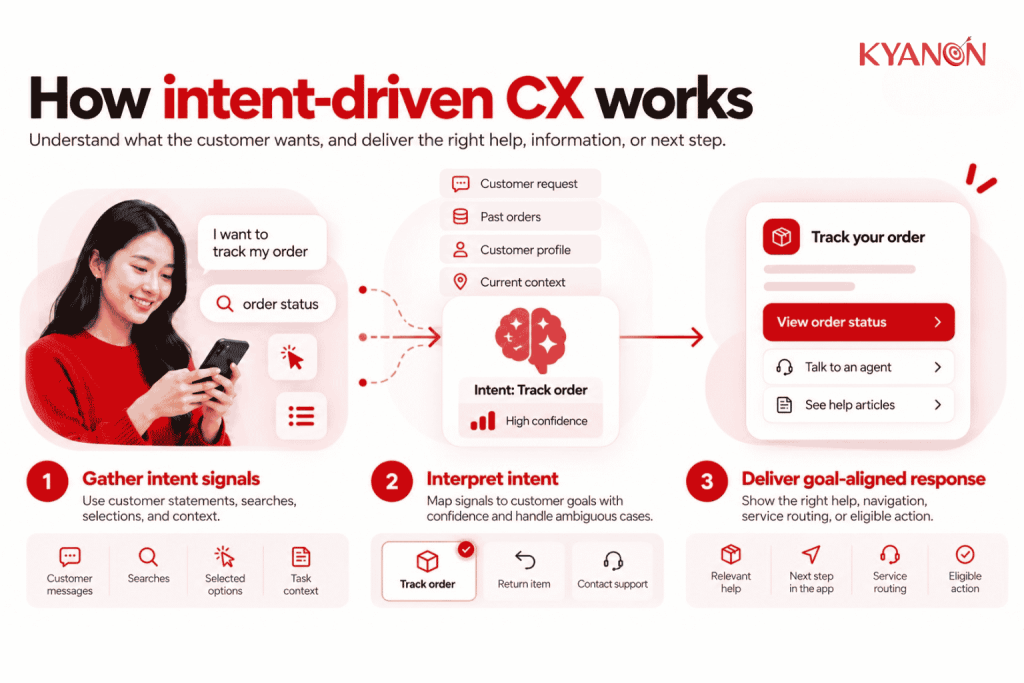
Intent-driven CX combines explicit requests with contextual evidence to distinguish what a customer is trying to accomplish. Intent remains a hypothesis until sufficiently supported, so the experience needs clarification and correction paths rather than treating every click as a definitive signal.
Intent signals
Use customer statements, searches, selected options, and relevant task context. Explicitly stated needs can be more reliable than behavioral guesses, particularly when one action has several plausible meanings.
Interpretation and confidence
Map signals to a manageable set of customer goals. Rules or models can support the interpretation, but confidence thresholds and ambiguous cases need deliberate handling.
Goal-aligned response
Select help, navigation, service routing, or an eligible action that supports the goal. Allow customers to correct the interpretation and measure whether they actually accomplish the intended task.

What signals reveal customer intent?
Customer intent can come from several types of evidence, but they should not be treated as equally reliable.
| Signal | Example | Interpretation |
Explicit request | “Change my delivery address” | Strong evidence of current intent |
| Selected task | Customer chooses “Cancel order” | Strong within the current journey |
Search query | “refund pending” | Useful but may require clarification |
| Current journey | Customer repeatedly fails payment | Indicates a problem, not necessarily its cause |
Recent interaction | Open support case about an order | Relevant context for the next interaction |
| Historical behavior | Previous purchases or browsing | Supporting context, but weak evidence of current intent |
Explicit customer input should generally outweigh behavioral inference when the two conflict.
The design question is not how many signals are available, but whether the available evidence is strong enough to change the customer’s next step.
How do you distinguish intent from sentiment?
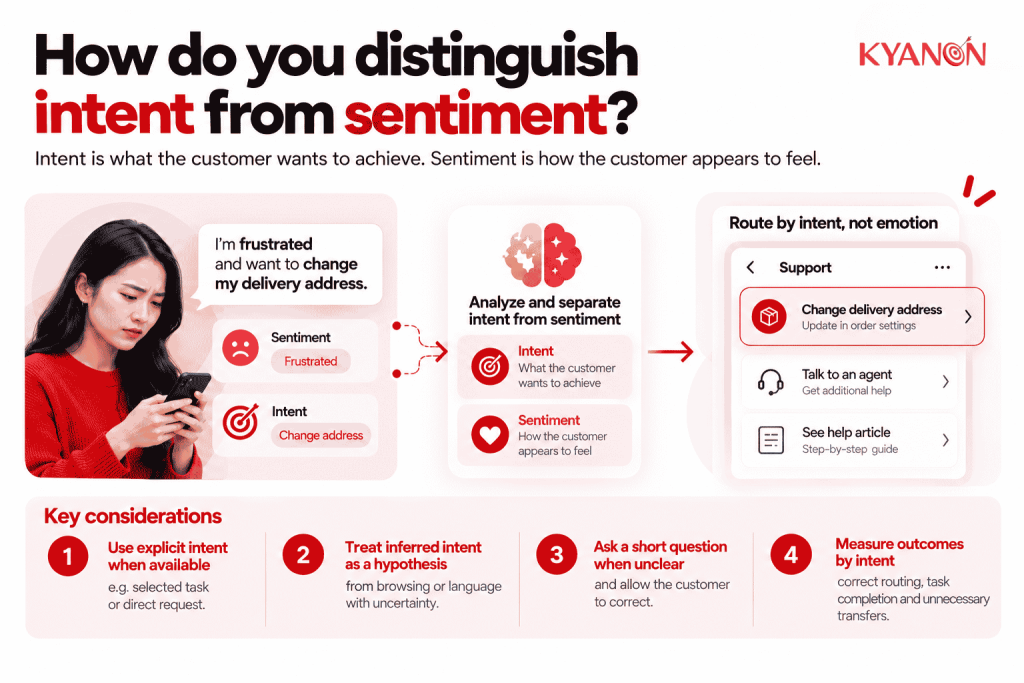
Intent describes what a customer is trying to achieve; sentiment describes how the customer appears to feel. ‘I am frustrated and want to change my delivery address’ combines negative sentiment with a specific service intent. Routing only by emotion could miss the action the customer needs.
Use explicit intent where available, such as a selected task or direct request. Treat inferred intent from browsing or language as a hypothesis with uncertainty. When several goals are plausible, ask a short clarifying question and allow correction. Track correct routing, task completion and unnecessary transfers by intent category. A classifier can label a conversation accurately while the experience still fails because the selected workflow cannot fulfill the request.
Intent-driven CX vs. behavioral segmentation
Intent-driven CX focuses on the current goal; behavioral segmentation groups people according to patterns in their actions.
| Dimension | Intent-Driven CX | Behavioral Segmentation |
Main question | What is this person trying to do now? | Which behavioral group describes this person? |
| Time horizon | Current situation | Defined historical period |
Evidence | Explicit request and contextual signals | Repeated or categorized behavior |
| Output | Relevant next step or assistance | Segment membership |
Failure risk | Incorrectly inferred goal | Overgeneralizing from group membership |
What should happen when customer intent is uncertain?
An intent-driven journey should not force a prediction when available evidence supports several plausible goals.
The appropriate response depends on the cost of being wrong:
- Low uncertainty and low consequence: Proceed with the likely next step while keeping alternatives accessible
- Moderate uncertainty: Ask a short clarifying question that meaningfully changes the route
- High uncertainty or consequential action: Require explicit confirmation before proceeding
- Unsupported intent: Route the customer to an appropriate human, specialist, or alternative workflow
For example, repeated visits to a cancellation page could indicate an intention to cancel, a search for cancellation terms, or concern about a future commitment. Automatically presenting a retention offer assumes more than the behavior establishes.
The higher the consequence of an incorrect interpretation, the stronger the evidence or confirmation should be before the experience acts on inferred intent.
When to consider intent-driven CX
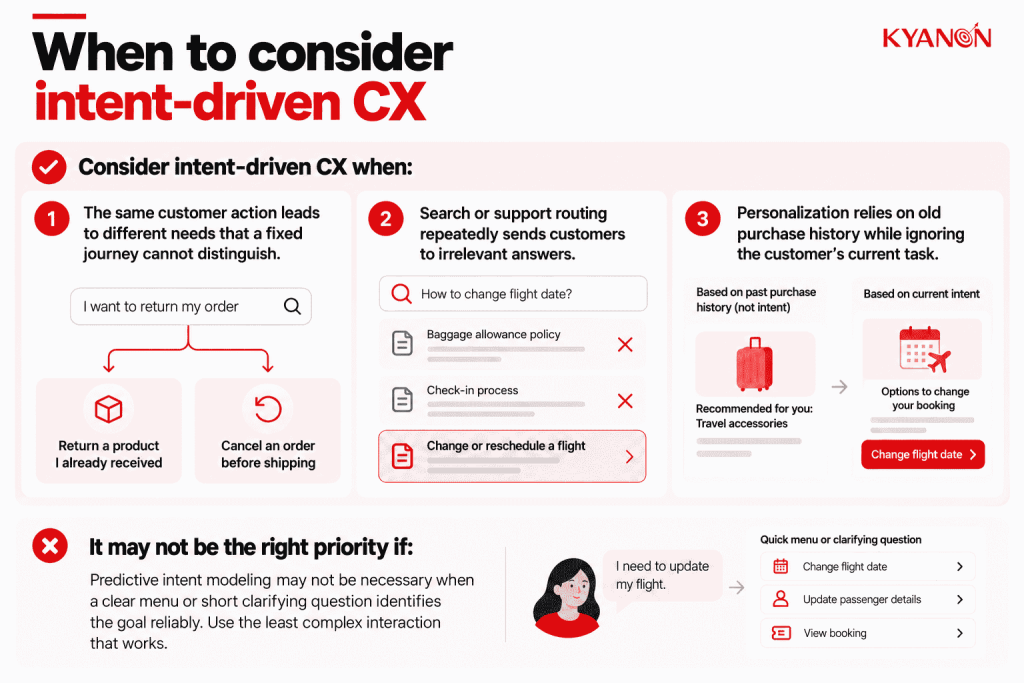
Consider intent-driven cx when the following conditions affect customer outcomes or operational control:
- The same customer action leads to different needs that a fixed journey cannot distinguish.
- Search or support routing repeatedly sends customers to irrelevant answers.
- Personalization relies on old purchase history while ignoring the customer’s current task.
It may not be the right priority if:
Predictive intent modeling may not be necessary when a clear menu or short clarifying question identifies the goal reliably. Use the least complex interaction that works.
What happens after customer intent is identified?
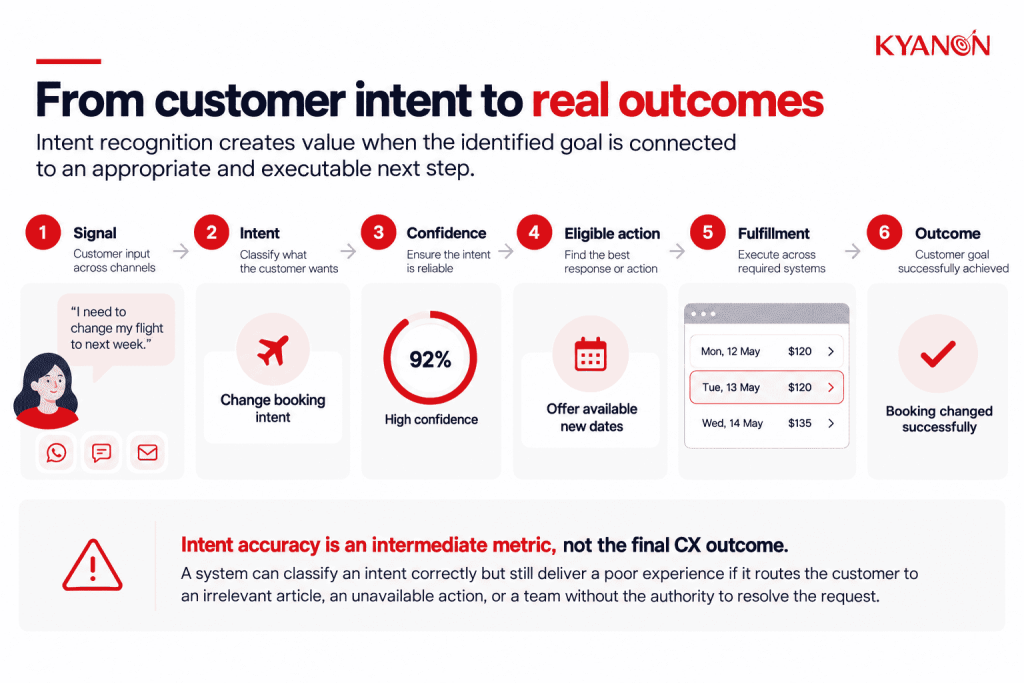
Intent recognition creates value only when the customer experience can connect the identified goal to an appropriate and executable next step.
A useful intent-to-action chain is:
Signal → Intent → Confidence → Eligible action → Fulfillment → Outcome
For each important intent, define:
- What evidence identifies the intent?
- How much confidence is required?
- Which response or action is appropriate?
- Which systems are required to complete it?
- What happens if the action is unavailable?
- When should the interaction move to a human?
- How will successful completion be measured?
A system can classify an intent correctly and still deliver a poor experience if it routes the customer to an irrelevant article, unavailable action, or team without the authority to resolve the request.
Intent accuracy should therefore be treated as an intermediate metric, not the final CX outcome.
How should businesses measure intent-driven CX?
Measure whether identifying customer intent leads to the right outcome, not simply whether a model assigns the correct label.
Useful signals include:
- Intent accuracy: Was the customer’s goal interpreted correctly?
- Clarification rate: How often does the experience need additional information before acting?
- Routing accuracy: Did the intent lead to the appropriate content, workflow, or team?
- Task completion: Did the customer accomplish the underlying goal?
- Correction rate: How often do customers reject or change the inferred intent?
- Transfer rate: Are customers being moved unnecessarily between workflows or teams?
- Repeat contact: Does the same intent generate another interaction because the first journey did not resolve it?
A technically accurate intent model can still produce poor CX if the downstream workflow cannot fulfill the request. Measure intent → action → outcome as one journey.
Why intent-driven CX matters for digital customer journeys
Intent-driven CX becomes valuable when the same interaction can represent different customer goals and choosing the wrong response creates additional effort.
This matters increasingly as AI moves from answering questions toward helping customers complete tasks. In a 2026 Gartner survey of 3,566 B2B and B2C customers, 58% of GenAI users said they had used the technology to complete a task on their behalf, rising to 74% among B2B customers.
As customer interfaces become more conversational and action-oriented, identifying a likely intent is only the first step. Organizations also need to determine whether the intent is sufficiently clear, which actions are permitted and available, and whether the resulting workflow actually fulfills the customer’s goal.
The business value therefore comes from better intent-to-outcome decisions, not from producing more intent predictions.
Common misconceptions
“A click tells us what the customer wants.”
Reality: The same behavior can represent several goals. Explicit requests and task selections generally provide stronger evidence than behavioral inference, while ambiguous or consequential situations may require clarification.
“Intent-driven CX is only a chatbot feature.”
Reality: Intent can influence search, navigation, recommendations, forms, service routing, next-best actions, and agent workflows. The underlying capability is connecting a customer goal to an appropriate response, regardless of interface.
“High intent-classification accuracy means the experience is working.”
Reality: Classification is only one step. The experience can identify intent correctly and still fail if it selects the wrong workflow, cannot execute the required action, or routes the customer to someone without the authority to resolve it.
How Kyanon Digital applies intent-driven CX
Kyanon Digital incorporates intent modeling into CX platform design through customer research, interaction data, and decision rules. The resulting experiences can route customers to relevant content, services, or support, with clarification and fallback paths for uncertain situations. This connects customer goals with implementable platform behavior and measurable task outcomes.
Explore Kyanon Digital’s UX design services.

 Create project brief with AI