
What is interaction data?
Interaction data is recorded information about exchanges and actions between a customer and an organization, such as searches, clicks, messages, calls, service requests, and digital product events.
Salesforce similarly describes interaction data as actions arising from direct engagement between users and systems, including clicks, taps, scrolls, form submissions, and other interactions.
For CX teams, the important distinction is that interaction data records what happened at a customer touchpoint. It becomes more useful when that event can also be connected to the relevant customer or session, journey context, and subsequent outcome.
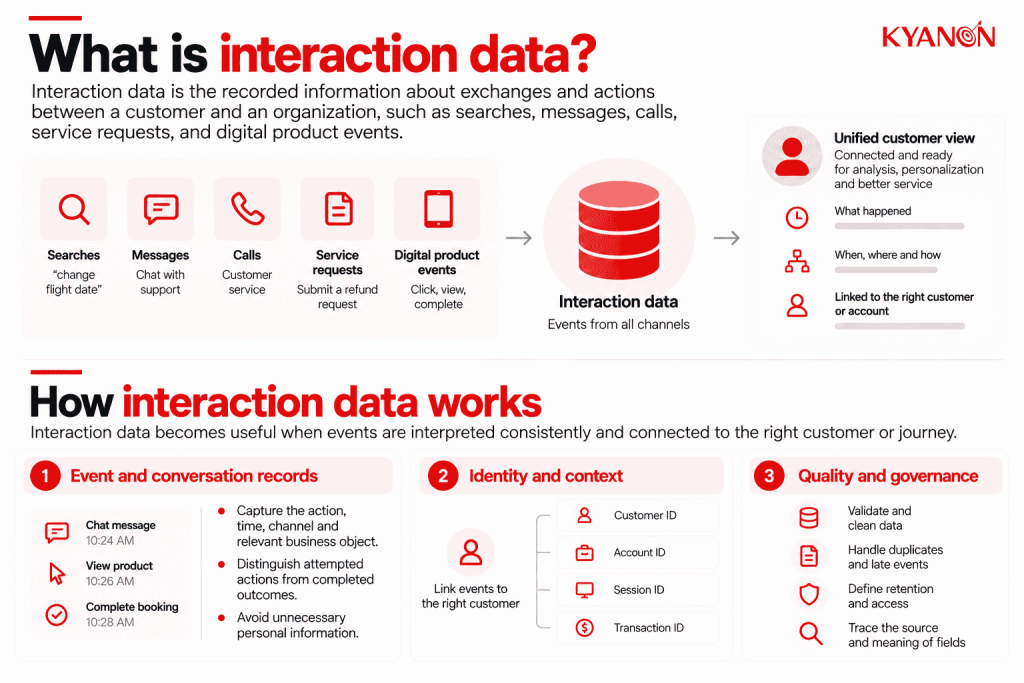
How interaction data works
Interaction data becomes useful when events can be interpreted consistently and connected to the right customer, account, or journey. Collection alone is insufficient: timestamps, event definitions, identity confidence, and permitted use determine whether the records support reliable decisions.
Event and conversation records
Capture the action, time, channel, and relevant business object. Distinguish an attempted action from a completed outcome, and avoid placing unnecessary personal information in event payloads or transcripts.
Identity and context
Associate records using appropriate customer, account, session, or transaction identifiers. Preserve uncertainty where identity cannot be confirmed instead of merging records solely because they appear similar.
Quality and governance
Validate schemas, handle duplicates and late events, and define retention and access. Trace the source and meaning of important fields so analytics and personalization teams do not interpret the same event differently.

What is an example of interaction data?
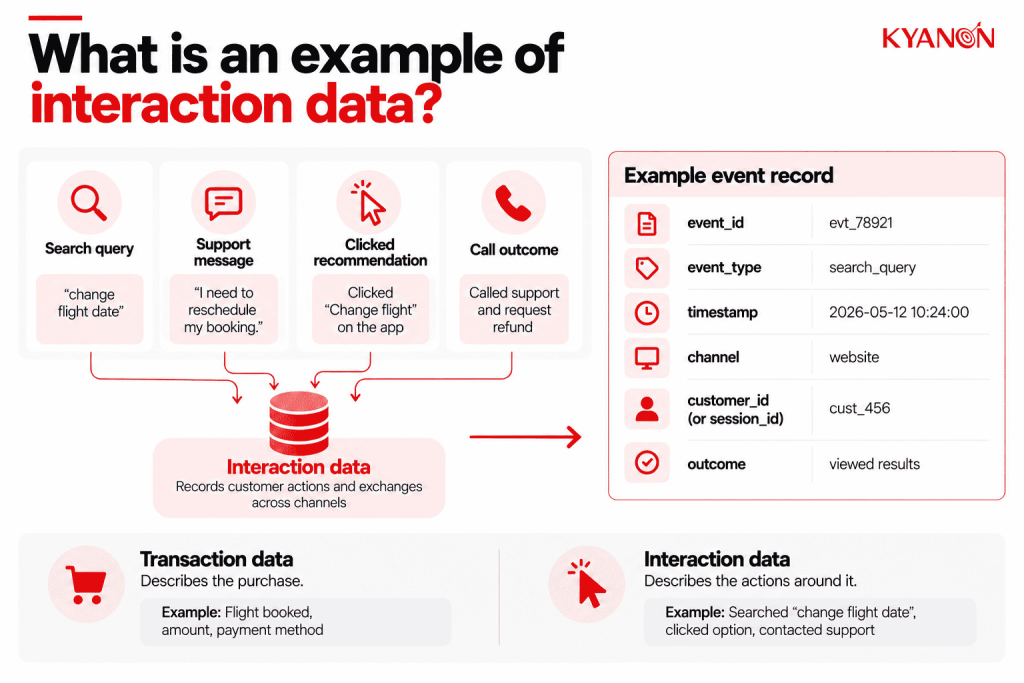
Interaction data can include a search query, a support message, a clicked recommendation or a recorded call outcome. A transaction record describes a purchase; interaction records describe actions surrounding it. One event can contribute to both categories, so document the intended analytical use rather than assuming a universal taxonomy.
An illustrative event might contain event_id, event_type, timestamp, channel, an appropriately scoped customer or session reference, and outcome. Conversation text is unstructured data and may need different access and retention controls from basic event metadata. Agree on event names and ownership before integration. Check for duplicate events, missing timestamps and incorrect identity links; otherwise, a dashboard may show several apparent customers or actions where only one exists.
What makes interaction data usable?
Collecting an event does not make it decision-ready. Useful interaction data needs enough context for teams and systems to interpret the event consistently.
A practical interaction record should answer:
- What happened? The action or interaction
- When did it happen? A reliable timestamp and sequence
- Where did it happen? Channel, application, or journey
- Who or what performed it? Customer, account, device, or session where appropriately identifiable
- What was it related to? Product, order, case, campaign, or other relevant business object
- What happened next? Completion, failure, abandonment, escalation, or another meaningful outcome
Without these relationships, organizations can accumulate large event volumes while still being unable to reconstruct a reliable customer journey.
Interaction-data quality should therefore be evaluated by decision usability, not event volume.
What commonly breaks interaction data?
Interaction data becomes unreliable when different systems record the same customer journey in incompatible ways.
| Problem | Business consequence |
Inconsistent event names | Teams measure the same behavior differently |
| Duplicate events | Engagement or conversion appears higher than it is |
Missing or incorrect timestamps | Journey sequence becomes unreliable |
| Weak identity matching | One customer appears as several profiles, or separate customers are incorrectly merged |
Missing outcome events | Teams see an attempted action but cannot determine whether it succeeded |
| Channel silos | Service, commerce, app, and marketing teams see different versions of the journey |
Schema changes without governance | Dashboards and downstream models silently change meaning |
Fixing these problems after data has already reached dashboards, personalization engines, or AI systems is significantly harder than governing the event definition at the source.
Interaction data vs. transactional data
Interaction data records touchpoints and activity; transactional data records business transactions such as purchases, payments, and refunds, with some records serving both purposes.
Dimension | Interaction Data | Transactional Data |
Main focus | Engagement and exchanges | Business transactions |
| Examples | Search, chat, call, page event | Order, payment, invoice, refund |
Volume and structure | Often high-volume and varied | Often structured around business records |
| Primary use | Journey understanding and service context | Operational and financial processing |
Key control | Identity, meaning, privacy, event quality | Accuracy, reconciliation, transaction integrity |
How is interaction data different from behavioral data?
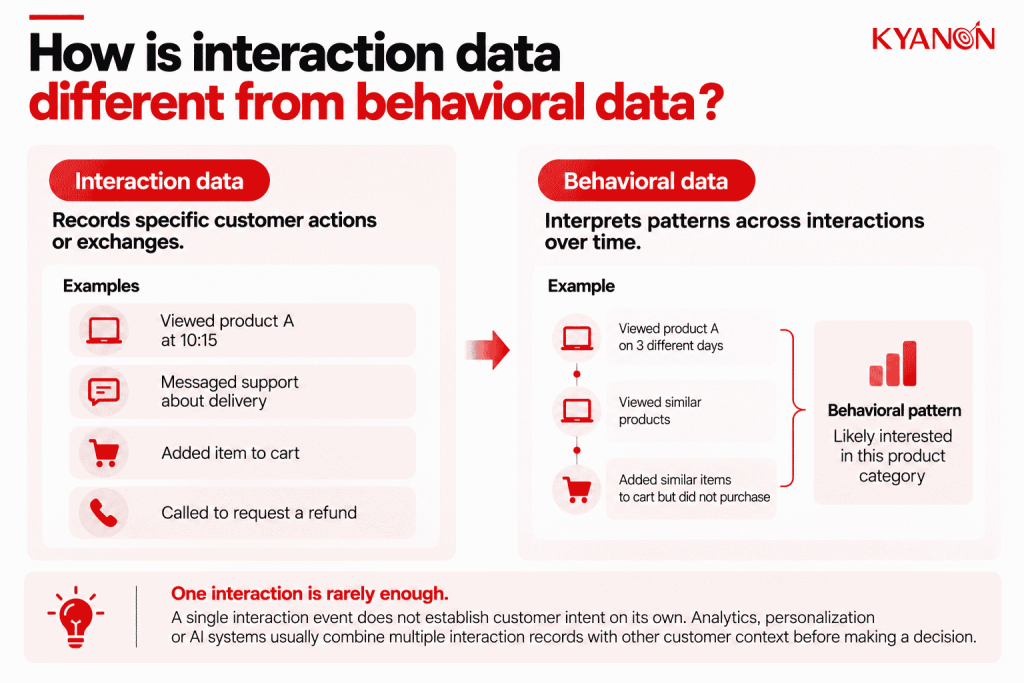
Interaction data records specific customer actions or exchanges, while behavioral data interprets patterns across those interactions over time.
For example, viewed product A at 10:15 is an interaction event. Repeatedly viewing similar products across several sessions can contribute to a behavioral pattern suggesting product interest.
The distinction matters because a single interaction rarely establishes customer intent on its own. Analytics, personalization, or AI systems may combine multiple interaction records with other customer context before making a decision.
When to consider interaction data
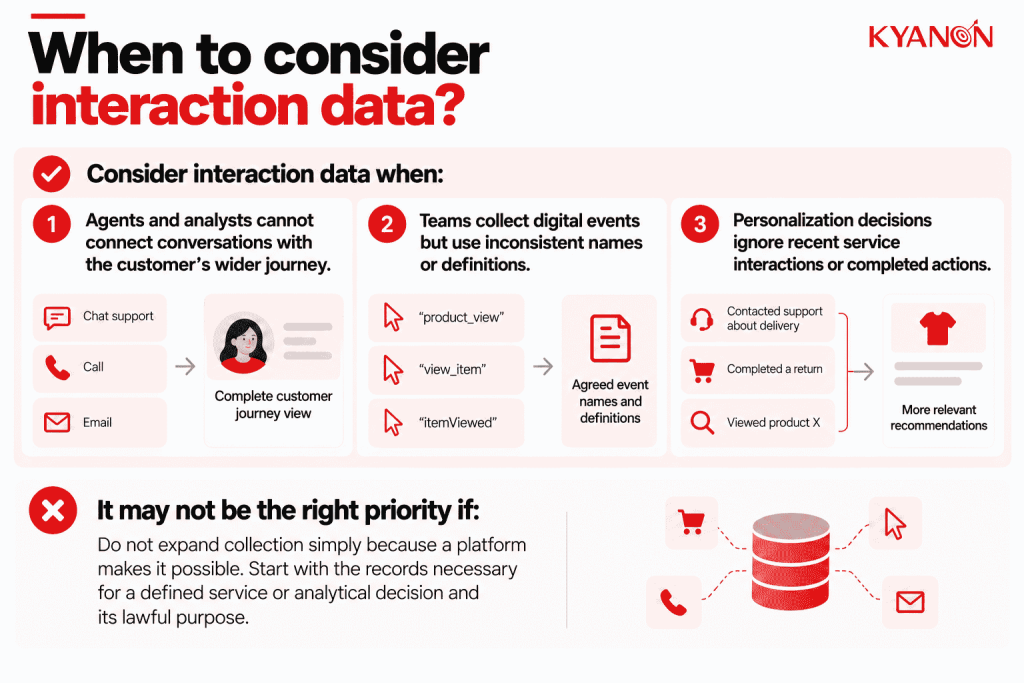
Consider interaction data when the following conditions affect customer outcomes or operational control:
- Agents and analysts cannot connect conversations with the customer’s wider journey.
- Teams collect digital events but use inconsistent names or definitions.
- Personalization decisions ignore recent service interactions or completed actions.
It may not be the right priority if:
Do not expand collection simply because a platform makes it possible. Start with the records necessary for a defined service or analytical decision and its lawful purpose.
Which interaction data should businesses collect?
Start with the customer or business decision the data needs to support rather than instrumenting every possible action.
For each proposed event, ask:
- What decision or analysis will use this event?
- Does the event distinguish an attempt from a successful outcome?
- What customer, session, or business context is actually required?
- How long does the information need to remain useful?
- Which systems or teams are permitted to use it?
- What would break if the event definition changed?
An event with no defined consumer, decision, or governance requirement may create more data-processing cost than customer value.
Why interaction data matters for connected customer experiences
Interaction data gives analytics, service, personalization, and AI systems evidence of what customers actually did across a journey. Its value depends on whether those records can be connected and interpreted reliably.
This remains a significant enterprise constraint. Adobe’s 2026 customer-engagement research found that only 44% of organizations considered their data quality and accessibility adequate for AI, while 75% identified data integration and quality as an implementation challenge.
Poor interaction data can therefore propagate beyond reporting. An incorrect identity link, duplicated event, or inconsistent definition can influence customer profiles, journey analytics, personalization, service context, and AI-driven decisions. The objective is not to create the largest possible interaction dataset. It is to establish trusted customer-event data that downstream systems can interpret and act on consistently.
Case study: How did Kyanon Digital turn customer interactions into usable behavioral insight?
For a leading retail brand, Kyanon Digital transformed a loyalty application that lacked sufficient visibility into how customers actually engaged with the experience.
- Challenges: Limited behavioral tracking made it difficult to understand customer preferences, measure campaign effectiveness, or identify high-intent engagement moments.
- Solutions: Kyanon Digital implemented comprehensive event tracking across the app lifecycle, including app launches, reward views, redemptions, notification responses, and conversion actions, with data pipelines feeding analytics dashboards.
- Results & impacts: The resulting behavioral-data foundation enabled A/B testing, campaign optimization, more contextually relevant communication, and marketing decisions grounded in actual customer interactions.
The case demonstrates the practical role of interaction data: individual events become valuable when their definitions are reliable and they can be connected to customer context, downstream behavior, and measurable outcomes.
Common misconceptions
“A CDP automatically makes all our interaction data accurate.”
Reality: A CDP can unify and activate records, but it does not automatically correct poor instrumentation, inconsistent event definitions, or incorrect identity links. Bad inputs can simply become more widely distributed.
“We need to capture every customer action.”
Reality: More events do not automatically create more insight. Prioritize interactions that support a defined customer, operational, or analytical decision and keep their meaning stable over time.
“If an event was captured, we know what happened.”
Reality: An isolated event may show an action without explaining its context or outcome. A payment click, for example, does not establish that payment succeeded. Reliable analysis often requires the event sequence, relevant business context, and an explicit outcome.
How Kyanon Digital applies interaction data
Kyanon Digital designs interaction-data foundations that connect customer events with the context required for analytics, personalization, and customer-experience decisions. Depending on the use case, this can include event design, instrumentation, data pipelines, identity alignment, analytics, and integration with customer and transactional platforms.
Explore Kyanon Digital’s data and analytics services.

 Create project brief with AI