
What is Jailbreak Detection?
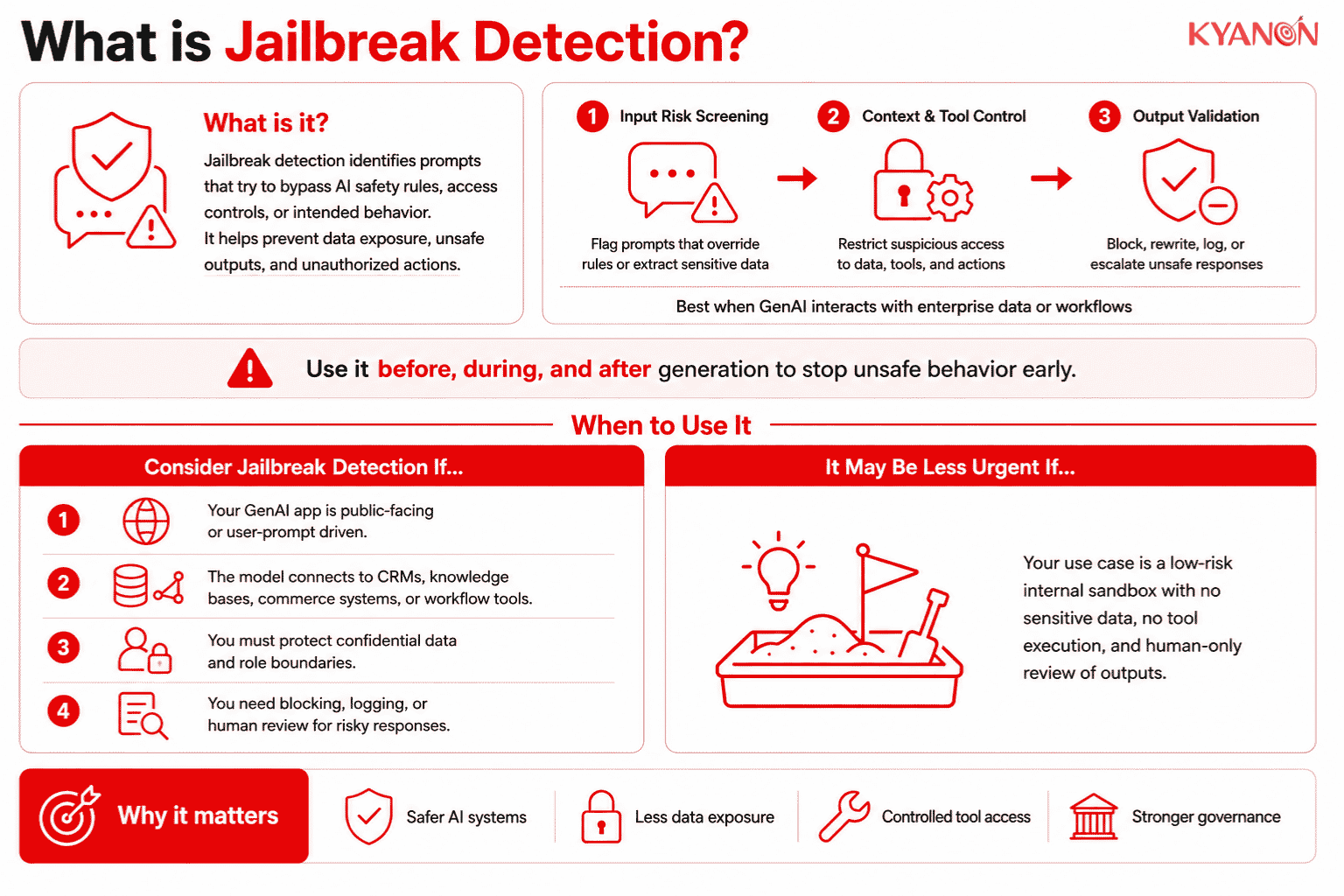
Jailbreak detection is the process of identifying prompts that attempt to bypass the safety rules, access controls, or intended behavior of a generative AI system. In enterprise GenAI deployments, jailbreak detection helps prevent confidential data exposure, unauthorized actions, and unsafe outputs before an LLM response reaches users or connected systems.
How Jailbreak Detection Works
Jailbreak detection works by evaluating user prompts, retrieved content, tool instructions, and model outputs against known attack patterns, policy rules, semantic risk signals, and runtime behavior. A jailbreak detection layer should operate before, during, and after model generation because unsafe behavior can originate from direct user input, indirect content injection, or model responses.
Input Risk Screening
Input risk screening checks whether a prompt contains instructions that attempt to override system rules, extract confidential information, manipulate role boundaries, or force restricted behavior. This matters because many jailbreak attempts are embedded directly in natural language rather than in traditional code-like attack patterns.
Context and Tool Boundary Control
Context and tool boundary control limits what the LLM can access, retrieve, or execute when a prompt appears suspicious. For enterprise systems connected to CRMs, commerce platforms, internal knowledge bases, or workflow tools, jailbreak detection must be combined with least-privilege access control.
Output Validation and Escalation
Output validation checks whether the model response contains unsafe instructions, sensitive information, policy violations, or signs of prompt leakage. High-risk outputs can be blocked, rewritten, logged, or escalated to a human reviewer depending on the business process.

Limitations of Jailbreak Detection
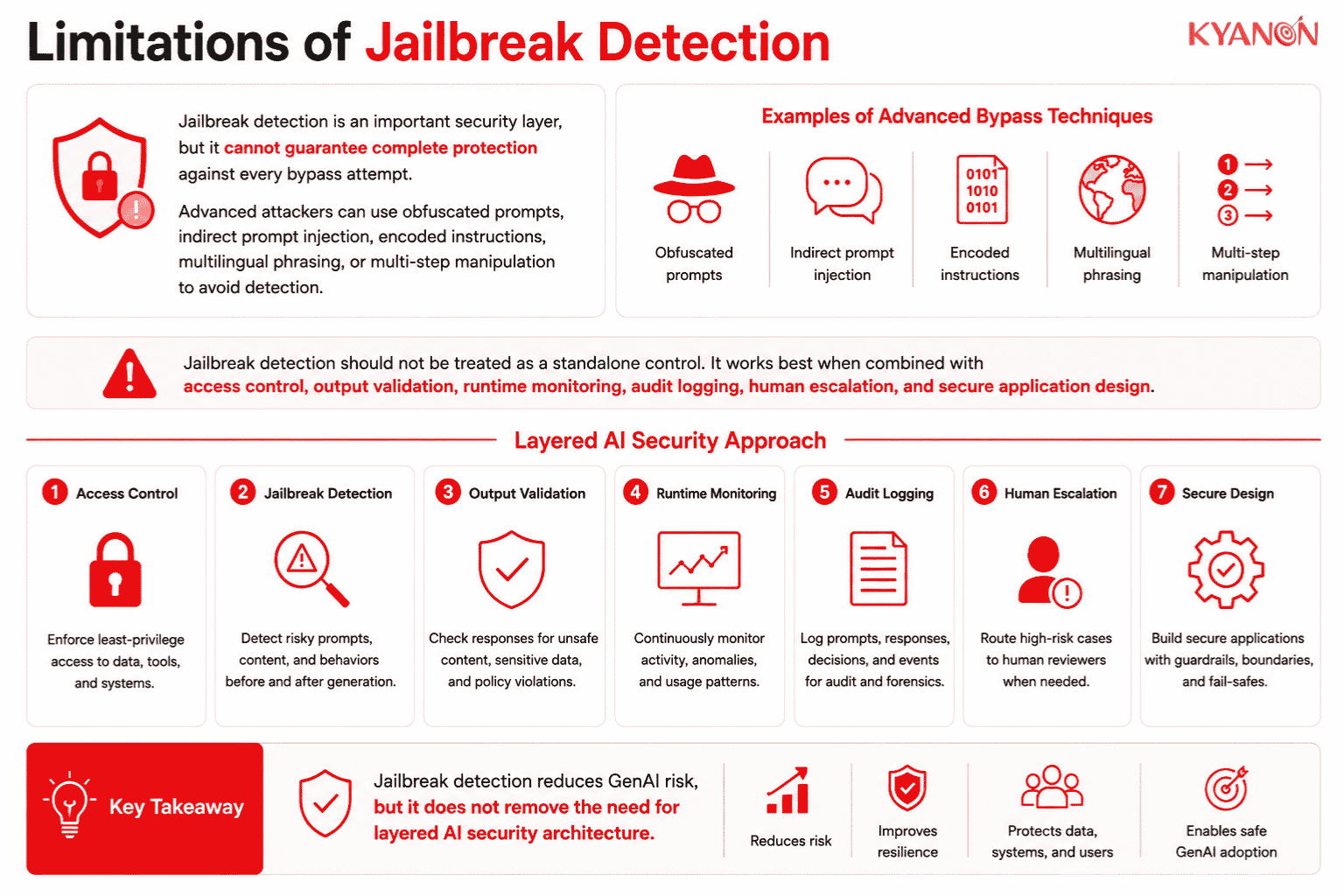
Jailbreak detection is an important security layer, but it cannot guarantee complete protection against every bypass attempt. Advanced attackers can use obfuscated prompts, indirect prompt injection, encoded instructions, multilingual phrasing, or multi-step manipulation to avoid detection.
For enterprise GenAI systems, jailbreak detection should not be treated as a standalone control. It works best when combined with access control, output validation, runtime monitoring, audit logging, human escalation, and secure application design.
A practical rule for CTOs and IT leaders is simple: jailbreak detection reduces GenAI risk, but it does not remove the need for layered AI security architecture.
Jailbreak Detection vs Runtime Application Self-Protection (RASP)
Both mechanisms aim to secure applications operating in potentially hostile environments, but they differ fundamentally in their scope of action and defense depth.
Dimension | Jailbreak Detection | Runtime Application Self-Protection (RASP) |
| Primary Focus | Identifying compromised host environments | Protecting app execution from within |
Action Mechanism | Alerts or halts execution upon detection | Actively blocks specific attacks (e.g., memory tampering) |
| Integration Layer | OS and File System checks | Embedded within the application runtime |
Bypass Difficulty | Susceptible to kernel-level spoofing | Highly resistant due to code obfuscation |
| Primary Use Case | Device compliance and GenAI prompt screening | Real-time threat neutralization and application shielding |
What Happens When a Jailbreak is Detected?
When a jailbreak attempt is detected, the application can trigger automated protective responses based on the severity of the risk. These responses help prevent unsafe outputs, confidential data exposure, or unauthorized actions before the model response reaches the user or connected enterprise systems.
Common response options include:
- Hard blocking: The system stops the interaction, displays a warning, and prevents the model from generating or returning a response.
- Feature restriction: The system limits high-risk capabilities, such as accessing internal documents, calling business APIs, processing payments, or executing workflow actions.
- Safe response rewrite: The system replaces the unsafe output with a policy-compliant response that explains the limitation without exposing sensitive details.
- Human escalation: High-risk interactions are routed to a security, compliance, or operations team for review.
- Silent reporting: The system logs the event and alerts IT or security teams, helping them identify repeated attacks, compromised accounts, or risky usage patterns.
For enterprise GenAI deployments, the right response should depend on business context. A customer support chatbot may block unsafe requests immediately, while an internal AI assistant may log the event, restrict data access, and escalate repeated attempts to IT security.
When to Consider Jailbreak Detection
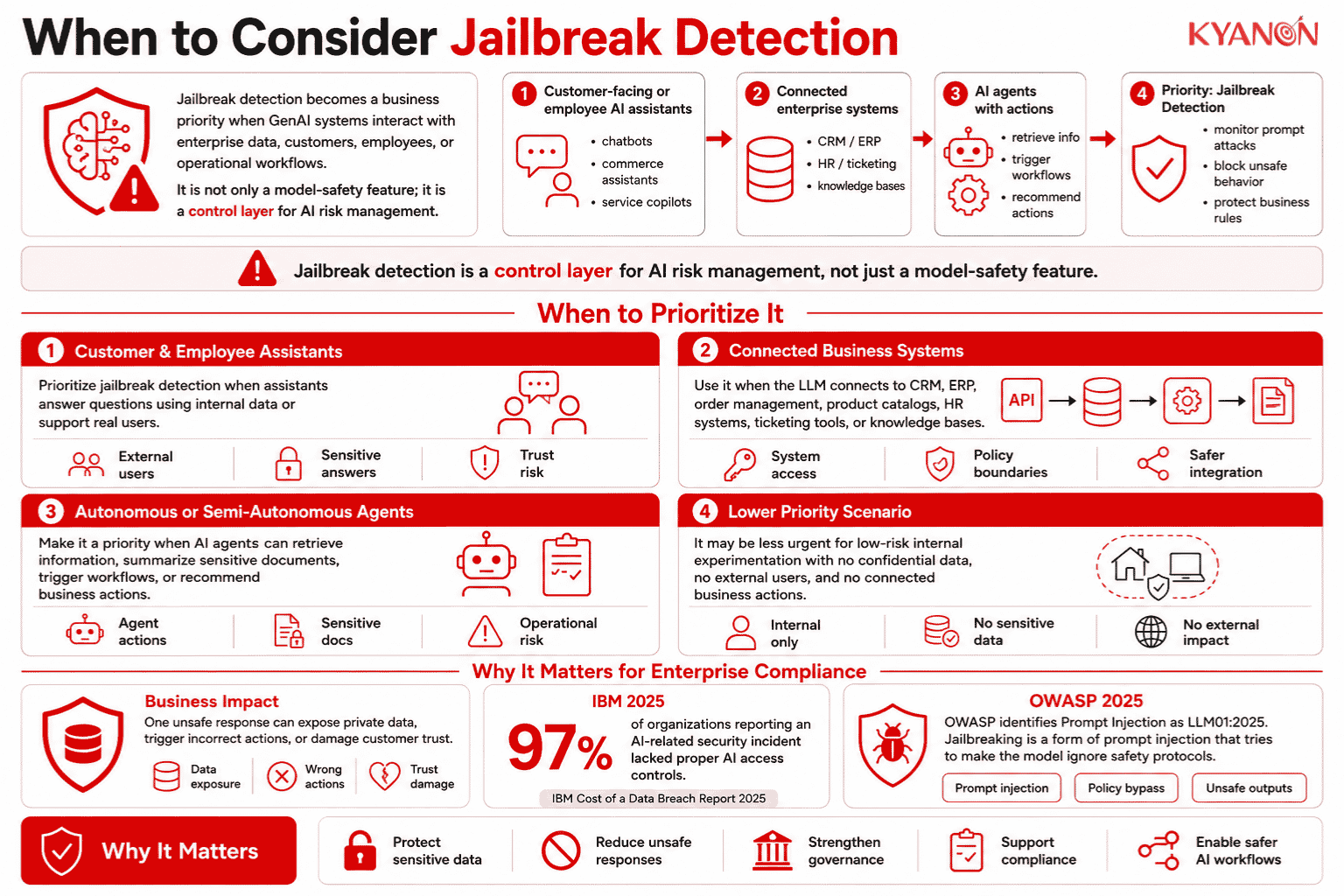
Jailbreak detection becomes a business priority when GenAI systems interact with enterprise data, customers, employees, or operational workflows. It is not only a model-safety feature; it is a control layer for AI risk management.
Consider Jailbreak Detection if:
- Your organization is deploying a customer-facing chatbot, commerce assistant, service copilot, or employee AI assistant that can answer questions using internal data.
- Your LLM application connects to enterprise systems such as CRM, ERP, order management, product catalogs, HR systems, ticketing tools, or knowledge bases.
- Your AI roadmap includes autonomous or semi-autonomous agents that can retrieve information, trigger workflows, summarize sensitive documents, or recommend business actions.
It may not be the right priority if:
- Your GenAI use case is limited to low-risk internal experimentation with no access to confidential data, no external users, and no connected business actions.
Why Jailbreak Detection Matters for Enterprise Compliance
Jailbreak detection matters because enterprise LLM applications increasingly operate inside business workflows where one unsafe response can expose private data, trigger incorrect actions, or damage customer trust. For CTOs, IT Directors, and digital product leaders, the core question is not whether an LLM can answer questions but whether it can operate within enforceable security, privacy, and governance boundaries.
IBM’s 2025 Cost of a Data Breach report found that 97% of organizations reporting an AI-related security incident lacked proper AI access controls, showing why enterprise GenAI security must include governance, monitoring, and permission design, not only model selection.
OWASP’s 2025 LLM security guidance identifies prompt injection as the top LLM application risk and describes jailbreaking as a form of prompt injection where attackers try to make the model disregard safety protocols. For an e-commerce enterprise, this could mean a shopping assistant being manipulated to reveal internal promotion logic, expose customer support instructions, or recommend actions outside approved policy.
Common Misconceptions
Enterprise teams often treat jailbreak detection as a single security switch, but jailbreak risk changes as prompts, models, retrieval sources, integrations, and attacker techniques change. Jailbreak detection should be managed as part of a layered GenAI security architecture.
“If the model has built-in safety filters, we do not need a separate jailbreak detection layer.”
Reality: Built-in model safety filters are not enough for enterprise applications because they do not understand every company’s data boundaries, business rules, compliance obligations, or connected tools. A CTO should treat model safety as one layer and application-level jailbreak detection as a separate control.
“Detection is infallible once we configure the right rules.”
Reality: Jailbreak detection cannot guarantee that every bypass attempt will be caught because attackers can use obfuscation, multilingual prompts, role-play, encoding, indirect injection, or long multi-step instructions. The safer operating model is layered defense: input screening, least-privilege access, output validation, logging, and regular adversarial testing.
“Checking for known jailbreak phrases is enough.”
Reality: Keyword matching can catch simple attacks, but it misses semantic bypass attempts that do not use obvious phrases. Enterprise systems need policy-aware detection, behavior monitoring, context isolation, and red-team testing against real workflows.
“Jailbreak detection can replace secure GenAI architecture.”
Reality: Jailbreak detection does not replace secure coding, data classification, API authorization, RAG governance, or human approval for high-risk actions. It reduces risk only when combined with access control, observability, and runtime enforcement.
How Kyanon Digital Applies Jailbreak Detection
Kyanon Digital builds jailbreak detection layers for enterprise GenAI deployments that need to protect confidential data, customer interactions, internal knowledge, and connected business systems. For clients across Vietnam, Singapore, Malaysia, Thailand, ANZ, the US, and Nordic Europe, Kyanon Digital typically combines prompt risk scoring, policy guardrails, retrieval controls, output validation, logging, and human escalation paths to reduce prompt injection and unsafe-output risk without blocking legitimate business use cases
→ Explore our Generative AI Development services.

 Create project brief with AI