
What is journey orchestration?
Journey orchestration is the coordinated execution of customer interactions and workflows across channels, using events, customer context, and decision rules to determine the appropriate next step.
Salesforce similarly describes journey orchestration as designing and managing end-to-end customer experiences across touchpoints, adapting engagement based on customer behaviors and interactions.
For CX teams, the key distinction is coordination: the system does not simply trigger an action. It determines whether that action is still relevant given what the customer has already done, their current state, eligibility, and other active journeys.
How journey orchestration works
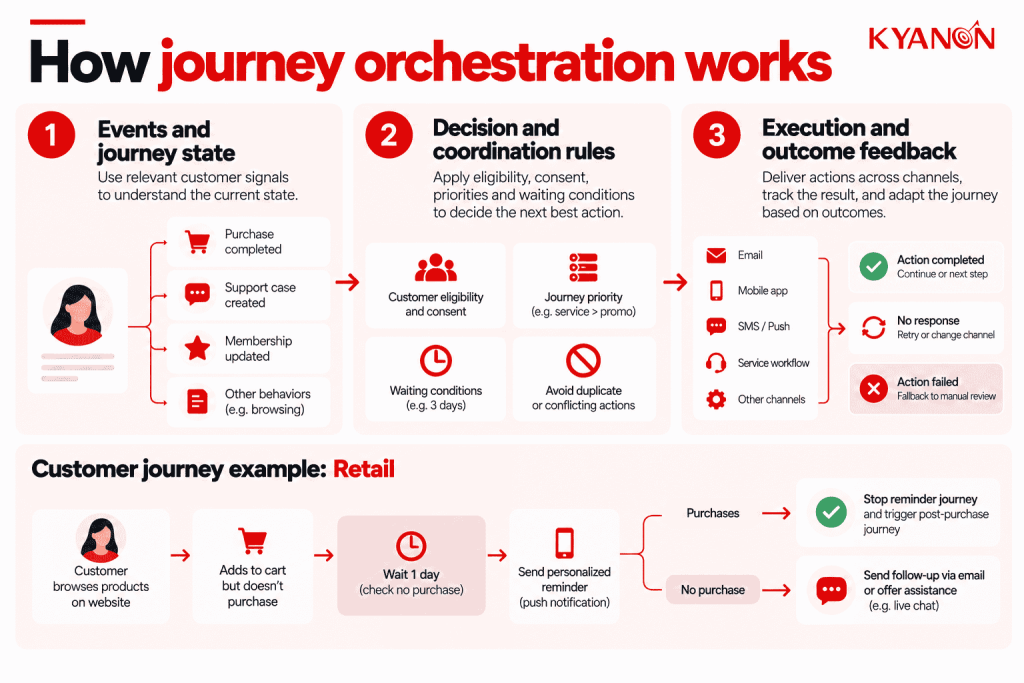
Journey orchestration maintains the relevant journey state and reacts when conditions change. It can schedule communications, trigger service actions, wait for outcomes, or stop an obsolete sequence, connecting what the business knows with what its channels do.
Events and journey state
Use relevant signals such as completed purchases, unresolved cases, or membership changes. Reliable state prevents messages being sent from outdated assumptions about the customer’s situation.
Decision and coordination rules
Apply eligibility, consent, priorities, waiting conditions, and conflict rules. A service issue may take precedence over a promotional journey, while duplicate events should not trigger duplicate actions.
Execution and outcome feedback
Connect decisions to channel delivery or business workflows and record the result. Define retries, timeouts, and fallback ownership so failed actions do not disappear silently.

Journey orchestration vs. marketing automation
Marketing automation executes predefined campaigns or workflows; journey orchestration coordinates actions as customer context changes across journeys and channels.
Journey Orchestration | Marketing Automation | |
Main logic | Customer state and context | Predefined workflow |
| Trigger | Events, conditions and changing context | Schedule or campaign trigger |
Scope | Cross-channel and cross-journey | Usually defined campaign |
| Key control | Eligibility, priority, suppression | Workflow execution |
For example, automation can schedule an abandoned-cart reminder. Orchestration determines whether that reminder should still be sent after the customer purchases, contacts support, or becomes ineligible.
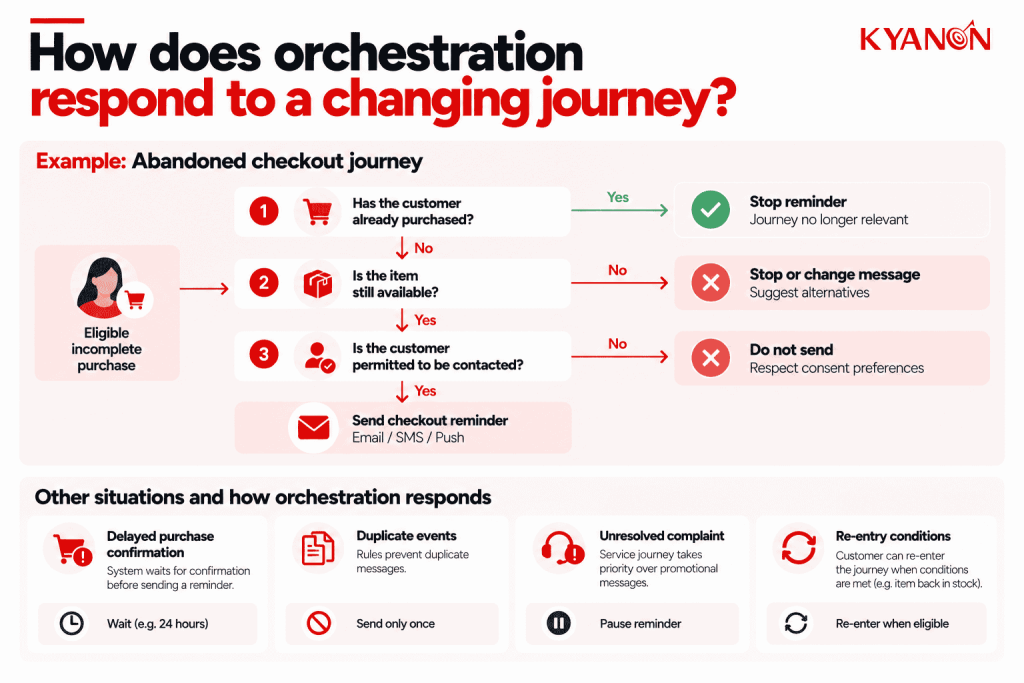
How does orchestration respond to a changing journey?
An illustrative abandoned-checkout journey begins with an eligible incomplete purchase. Before sending a reminder, the system checks whether the customer has since purchased, whether the item is available, and whether the contact is permitted. A completed purchase should stop that reminder even if the original event already entered the workflow.
This requires coordinated state and rules, not just scheduled messages. Define competing-journey priorities, re-entry conditions, timeouts and a safe fallback when data is late. Test negative paths as carefully as the intended path: duplicate events, delayed purchase confirmation and an unresolved complaint can all change the appropriate response. Use journey outcomes and unwanted-contact rates to evaluate performance rather than the number of automated steps executed.
Journey orchestration vs. journey analytics
Journey orchestration coordinates what happens next; journey analytics studies what happened and how it relates to outcomes.
Dimension | Journey Orchestration | Journey Analytics |
Primary role | Execute coordinated interactions | Analyze observed journeys |
| Inputs | Events, profiles, eligibility, rules | Connected events and outcome records |
Outputs | Messages, tasks, waits, handoffs | Patterns, explanations, measurements |
| Time sensitivity | Driven by the action’s business deadline | Driven by the analytical question |
Failure risk | Wrong, repeated, or mistimed action | Misleading interpretation or missing data |
When to consider journey orchestration
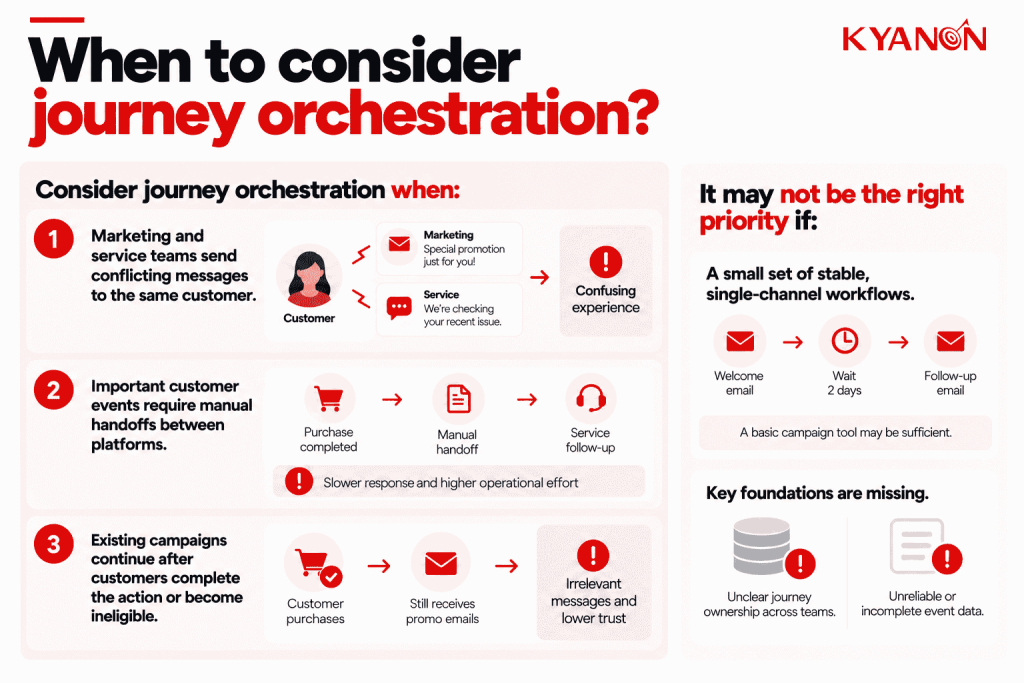
Consider journey orchestration when the following conditions affect customer outcomes or operational control:
- Marketing and service teams send conflicting messages to the same customer.
- Important customer events require manual handoffs between platforms.
- Existing campaigns continue after customers complete the intended action or become ineligible.
It may not be the right priority if:
A full orchestration platform may be unnecessary for a small set of stable, single-channel workflows. Clarify journey ownership and event reliability before adding broader automation.
What does journey orchestration require?
Before scaling journey orchestration, businesses need four foundations:
- Reliable events: Has the relevant customer action actually occurred?
- Journey state: What has already happened and what remains unresolved?
- Decision rules: Which actions are eligible, permitted, or higher priority?
- Execution integration: Can the selected channel or business system actually perform the action?
Weak foundations can automate the wrong experience faster. A delayed purchase event, for example, could cause an unnecessary abandoned-cart reminder even when the orchestration logic itself is correct.
Why journey orchestration matters for retail and banking
Journey orchestration matters when customer circumstances change faster than disconnected campaigns and workflows can respond.
In retail, a purchase should stop an abandoned-cart journey, while a return or service issue may change which offer is appropriate. In banking, application submission, missing documentation, eligibility changes, and open service cases can each change the next appropriate interaction.
Without a coordinated journey state, individual systems may work as designed while collectively creating a poor experience, such as promoting a product the customer already purchased or sending a reminder for an action they already completed.
The business value comes from preventing irrelevant or conflicting actions while moving the customer toward the appropriate next outcome.
Case study: How did Kyanon Digital orchestrate a real-time loyalty journey?
Explore Kyanon Digital’s AI-powered loyalty engagement platform case study.
For a leading beverage brand, Kyanon Digital developed a data-driven loyalty engagement platform connecting physical consumption events with digital engagement.
- Challenges: Customer acquisition, consumption tracking, rewards, and CRM retargeting were not connected into a unified engagement journey.
- Solutions: Kyanon Digital connected QR, receipt, and IoT-generated events with customer profiles, reward eligibility, automated CRM flows, and personalized retargeting. Customer behavior could trigger rewards, coupons, loyalty points, and subsequent communications.
- Results & impacts: The platform connected real-world customer actions with timely digital rewards and re-engagement, while improving behavioral-data visibility and personalized targeting.
The case demonstrates journey orchestration as an operating loop: capture the event → understand customer state → apply rules → trigger the appropriate action → use the response to inform subsequent engagement.
How should businesses measure journey orchestration?
Measure whether orchestration produces the right action at the right point in the journey, not how many automated actions execute.
Track journey completion, unwanted or suppressed contacts, duplicate actions, failed handoffs, time to next appropriate action, and relevant business outcomes. A higher automation volume is not a success if customers receive redundant, conflicting, or obsolete interactions
Common misconceptions
“Journey orchestration is another name for email automation.”
Reality: Email can be one execution channel, but orchestration also coordinates state, decisions, and cross-system actions. Its value depends on the connected customer workflow.
“Every journey must react in milliseconds.”
Reality: Required timing depends on the decision. A service alert and a monthly renewal reminder need different response windows, reliability controls, and operating costs.
“More automated journeys mean better orchestration.”
Reality: Orchestration should prevent unnecessary actions as well as trigger useful ones. Suppressing an obsolete reminder or pausing a promotion during an unresolved service issue can be as valuable as sending another message.
How Kyanon Digital applies journey orchestration
Kyanon Digital connects customer events, data, decision rules, and engagement systems to coordinate actions across customer journeys. The implementation can include real-time triggers, eligibility, workflow integration, personalization, and outcome tracking.
Explore Kyanon Digital’s Customer Data Platform & Personalization services.

 Create project brief with AI