
What is the Kano model (CX)?
The Kano Model (CX) is a framework for classifying customer needs according to how their fulfillment or absence affects satisfaction. It helps teams distinguish basic expectations, performance needs, potential delighters, indifferent features, and features customers may actively dislike.
For CX teams, the model helps answer a practical question: Which experience improvements protect against dissatisfaction, which improve satisfaction as performance increases, and which could create differentiation?
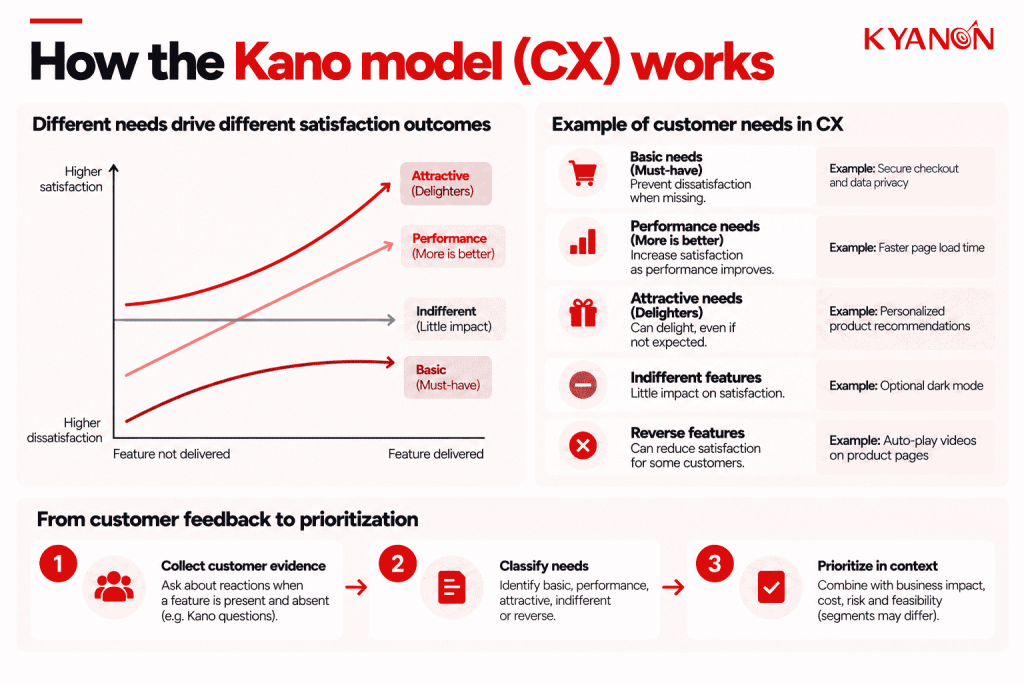
How the Kano model (CX) works
Kano analysis recognizes that satisfaction does not increase in the same way for every feature. A basic requirement can cause strong dissatisfaction when absent yet little delight when present, while an unexpected benefit can improve satisfaction without being essential.
Customer evidence
Use research to understand reactions to a capability being present and absent. Paired Kano questions are one method, and the wording must describe a capability clearly enough for respondents to evaluate.
Need classification
Basic needs prevent dissatisfaction, performance needs improve satisfaction as delivery improves, and attractive needs can delight. Indifferent and reverse responses also matter, while contradictory answers can indicate a question or interpretation problem.
Contextual prioritization
Combine the classification with business impact, cost, risk, and feasibility. Categories can differ by segment and change over time, so a Kano result is an input to prioritization rather than a permanent feature ranking.

What are the five Kano categories?
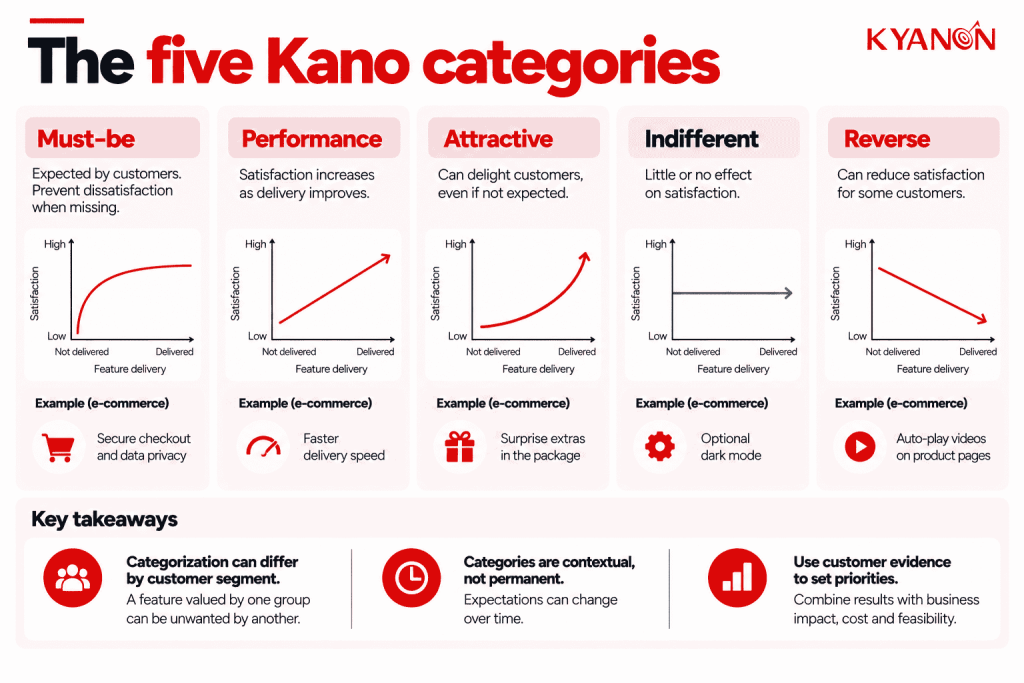
The five commonly used categories are must-be, performance, attractive, indifferent and reverse. Must-be features are expected; performance features produce more satisfaction as delivery improves; attractive features can delight without being expected. Indifferent features have little effect on satisfaction. Reverse features are unwanted by the relevant respondents.
An illustrative study might investigate order tracking, delivery speed and optional surprise extras, but researchers should not assign categories in advance. Ask paired questions about how customers feel when a feature is present and absent, then classify response combinations using a Kano evaluation method. Contradictory responses may require review. Analyze segments separately: a feature valued by one group can be unwanted by another. Combine the findings with delivery effort, dependencies and required obligations before setting priorities.
Kano categories are contextual, not permanent. A capability can be attractive for one customer segment and irrelevant to another. Expectations can also change over time: an experience that once differentiated a product may eventually become a basic expectation.
Run analysis for relevant segments and revisit important classifications when customer expectations, competitors, or the product context changes.
Kano model (CX) vs. importance ratings
Kano analysis examines how satisfaction changes with fulfillment; importance ratings ask customers how important they consider an attribute.
| Dimension | Kano Model (CX) | Importance Ratings |
| Question | How do presence and absence affect satisfaction? | How important is this feature? |
| Output | Need category | Importance score |
| Relationship assumed | Can be asymmetric and nonlinear | Often interpreted as a ranked priority |
| Strength | Distinguishes essentials from differentiators | Simple comparison of stated priorities |
| Limitation | Requires careful research and interpretation | Many features may be rated highly important |
When to consider the Kano model (CX)
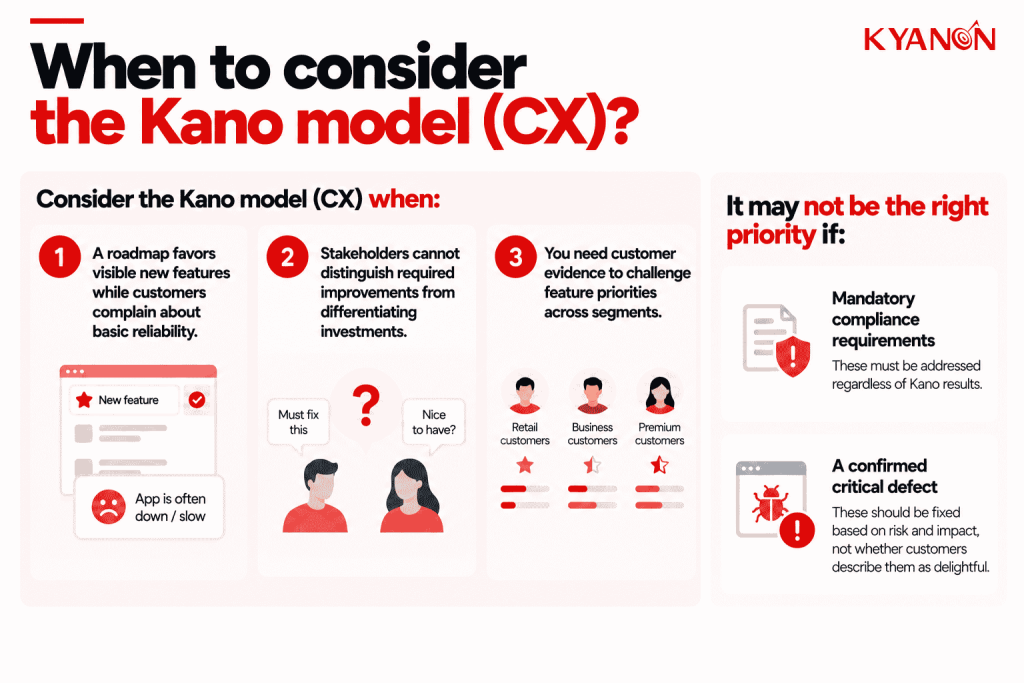
Consider the Kano model (CX) when the following conditions affect customer outcomes or operational control:
- A roadmap favors visible new features while customers complain about basic reliability
- Stakeholders cannot distinguish required improvements from differentiating investments
- You need customer evidence to challenge feature priorities across segments
It may not be the right priority if:
Kano research is not a substitute for addressing mandatory compliance or a confirmed critical defect. Those obligations do not depend on whether customers describe them as delightful.
Does Kano determine what to build first?
No. A Kano category describes how a capability relates to customer satisfaction; it does not by itself determine roadmap priority.
Combine Kano findings with:
- Customer impact: How important is the underlying need?
- Business impact: Which outcome could improve?
- Risk: Is the capability required for compliance, security, or operational control?
- Effort: What does implementation and maintenance require?
- Evidence: How confident are you in the customer research?
A must-be requirement may need immediate attention when it is failing, while an attractive feature may not justify investment if its value is uncertain or the implementation cost is disproportionate.
Use Kano to understand the satisfaction relationship, then use broader product and business evidence to make the investment decision.
Why the Kano model (CX) matters for e-commerce
The Kano Model helps e-commerce teams avoid treating every roadmap item as if it contributes equally to customer satisfaction.
A reliable checkout or accurate order confirmation may be a basic expectation: failure creates dissatisfaction, while simply working correctly may generate little additional delight. Other improvements may increase satisfaction as performance improves, while selected unexpected experiences can differentiate the journey.
The value of Kano analysis is therefore not finding the most exciting feature. It is helping teams balance essential experience quality with improvements and potential differentiators before committing to roadmap investment.
Common misconceptions
We should build delighters before basic improvements.
Reality: A delightful extra rarely compensates for a failed essential task. Evaluate the impact of unmet basic needs before funding optional additions.
A feature keeps its Kano category forever.
Reality: Expectations change as customers gain experience and competitors improve. Revisit the classification when the market, segment, or product context changes.
“Kano categories give us the roadmap priority.”
Reality: Kano explains how feature fulfillment relates to customer satisfaction. Roadmap decisions still need evidence about customer importance, business value, risk, feasibility, cost, and dependencies.
How Kyanon Digital applies the Kano model (CX)
Kyanon Digital combines customer research with business goals, technical feasibility, and delivery constraints to help organizations prioritize CX and product improvements.
Where Kano analysis is appropriate, its customer-satisfaction classifications can inform this broader prioritization process alongside evidence such as customer research, journey friction, implementation effort, risk, and expected business impact.
The objective is not to maximize the number of differentiating features but to protect essential experience quality while investing selectively in improvements that create meaningful customer value.
Explore Kyanon Digital’s UX design services.

 Create project brief with AI