
What is KYC (know your customer)?
KYC (Know Your Customer) is the set of processes used to establish and verify a customer’s identity and understand relevant customer risk, commonly as part of a financial institution’s wider customer due diligence obligations.
Digital KYC can use digital identity evidence and verification technologies during onboarding, but identity verification is only one part of the process. Depending on applicable requirements and risk, KYC may also involve understanding the customer relationship, beneficial ownership, risk assessment, additional due diligence, recordkeeping, and subsequent updates.
The exact requirements depend on jurisdiction, customer type, product, and risk.
How KYC (know your customer) works
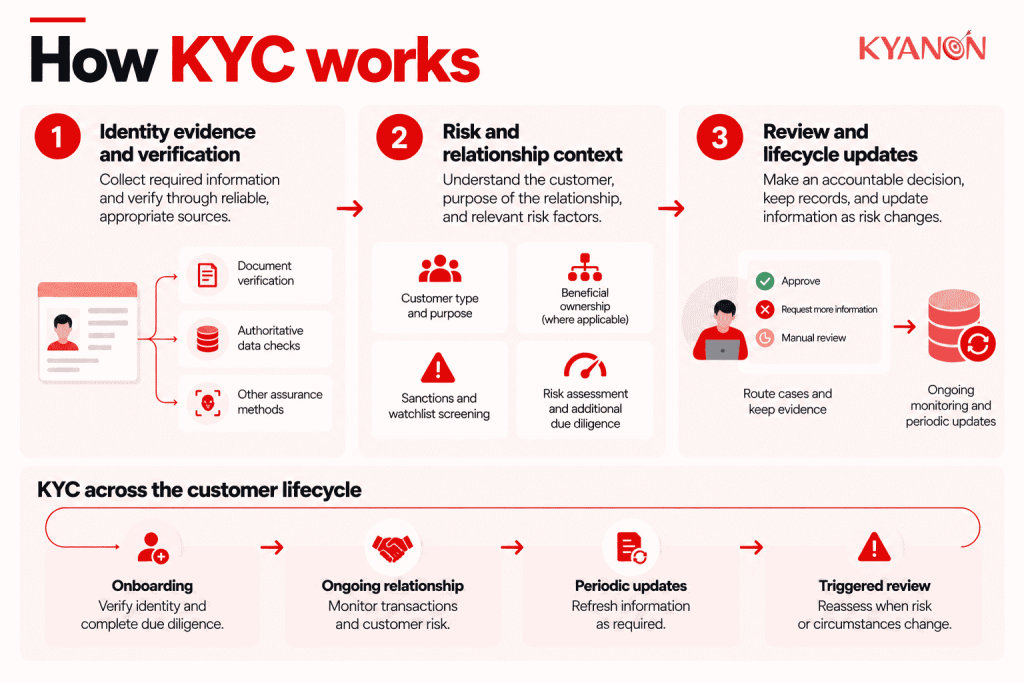
KYC connects identity evidence with risk assessment and an accountable customer decision. The required checks depend on jurisdiction, product, customer type, and risk; passing an automated identity check does not by itself complete every due diligence obligation.
Identity evidence and verification
Collect required identity information and verify it through reliable, appropriate sources. Digital workflows may use document checks, authoritative data, or other assurance methods, with alternatives for customers who cannot complete the default route.
Risk and relationship context
Assess the purpose of the relationship and relevant risk factors, including beneficial ownership where applicable. Screening and additional due diligence should follow the institution’s policy and applicable legal requirements. FATF Recommendation 10 provides the international due diligence framework; local law determines the applicable obligations.
Review and lifecycle updates
Route unresolved discrepancies to authorized reviewers and preserve the evidence behind decisions. KYC information may need updating as the relationship or risk changes, alongside broader ongoing customer due diligence.

What does a digital KYC journey include?
A digital KYC journey typically collects the information required for the customer and product, verifies identity using appropriate sources, assesses relevant risk, and routes exceptions for review. Customer due diligence can also require beneficial-owner identification and understanding the intended relationship. KYC supports the wider anti-money-laundering framework; the terms are not interchangeable. Exact obligations depend on jurisdiction and institution.
From a CX perspective, explain what evidence is needed before collection, preserve progress and provide useful recovery when a document cannot be verified. Do not promise approval before review is complete. Track completion, time to decision and reasons for manual referral without encouraging weaker checks. Onboarding is only part of the lifecycle: applicable ongoing monitoring and updates must also fit the operating model.
KYC (know your customer) vs. identity verification
KYC includes identity and customer-risk processes; identity verification addresses the narrower question of whether claimed identity is sufficiently established.
Dimension | KYC (Know Your Customer) | Identity Verification |
Scope | Customer identity and relevant risk context | Identity evidence and assurance |
| Typical inputs | Identity, ownership, purpose, risk information | Documents, data sources, identity evidence |
Output | Onboarding or review decision within policy | Verification result and evidence |
| Lifecycle | Onboarding and subsequent updates | At required verification points |
Limitation | Requirements vary by jurisdiction and risk | Does not complete all due diligence |
When to consider KYC (know your customer)
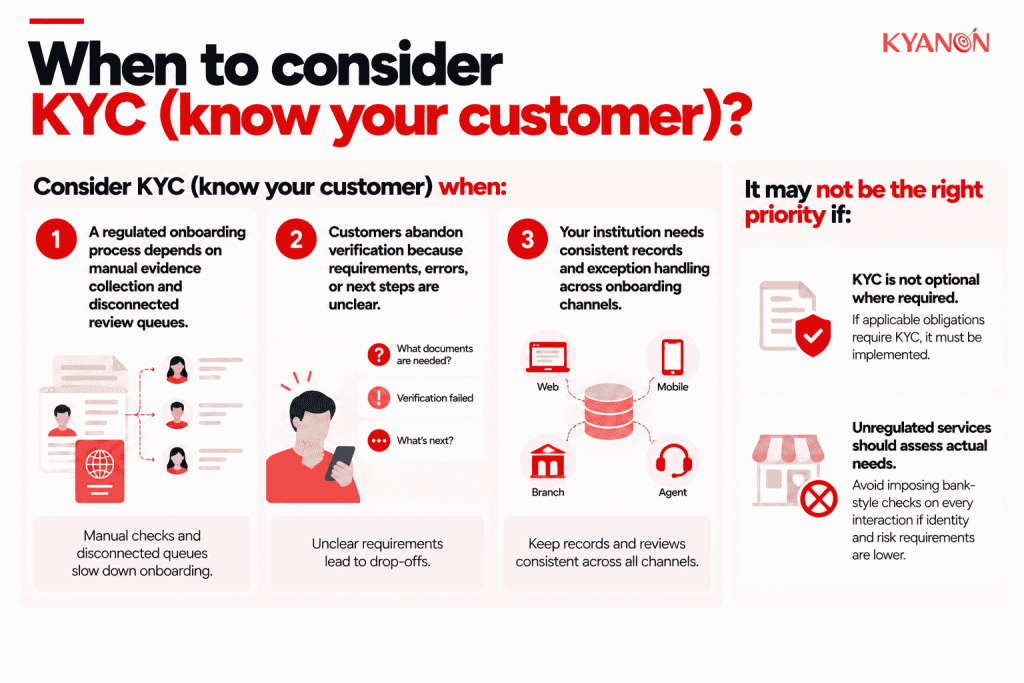
Consider KYC (know your customer) when the following conditions affect customer outcomes or operational control:
- A regulated onboarding process depends on manual evidence collection and disconnected review queues
- Customers abandon verification because requirements, errors, or next steps are unclear
- Your institution needs consistent records and exception handling across onboarding channels
It may not be the right priority if:
KYC is not optional where applicable obligations require it. An unregulated service should assess its actual identity and risk needs rather than impose bank-style checks on every interaction.
Where does digital KYC create customer friction?
KYC friction often comes from the workflow around verification rather than the control itself.
Common failure points include:
- Unclear document or evidence requirements
- Repeated submission of information already provided
- Document or biometric verification failures with no useful recovery path
- Loss of progress when customers change channels
- Manual review with no status visibility
- Requests for additional evidence without explaining the next step
The CX objective is not to remove required controls. It is to remove avoidable effort around those controls while preserving the institution’s approved risk and compliance requirements.
What happens when automated KYC cannot make a decision?
Digital KYC needs an exception path for cases that cannot be resolved automatically.
A useful workflow should preserve the submitted evidence, record why verification or screening requires review, route the case to an authorized team, and communicate an appropriate status or next step to the customer.
Measure manual referral reasons, not just the referral rate. A high volume of legitimate customers reaching review because of the same document or integration failure may indicate an operational problem rather than higher customer risk.
Does KYC end after onboarding?
Not necessarily. Customer information and risk can change after account opening. Depending on applicable requirements and institutional policy, subsequent due diligence may involve updating customer information, reviewing relevant changes, and maintaining appropriate records.
Design the operating model for the customer lifecycle rather than treating KYC as a one-time onboarding screen.
Why KYC matters for digital banking
Digital KYC sits at the intersection of customer onboarding, regulatory control, and operational efficiency.
Poorly designed workflows can create avoidable abandonment and manual review, while insufficient controls can expose the institution to financial crime and compliance risk. The objective is therefore not simply faster verification but a controlled journey that moves straightforward cases efficiently while routing unresolved or higher-risk cases for appropriate review.
For financial institutions, the practical challenge is balancing customer effort, verification reliability, review capacity, and regulatory requirements without treating any one measure as the sole definition of success.
Case study: How did Kyanon Digital support eKYC and digital onboarding for a RegTech provider?

Kyanon Digital partnered with Singapore-based Cynopsis Solutions to scale the development of its regulatory-technology products for financial institutions and regulated organizations.
- Challenges: Growing demand for AML, KYC, and digital onboarding required faster product development while maintaining platform performance and adaptability to regulatory change.
- Solutions: Kyanon Digital established a cross-functional engineering team and Center of Excellence supporting software engineering, product development, QA, and continuous delivery.
- Results & impacts: The collaboration helped Cynopsis launch Transaction Monitoring, eKYC, and Digital Onboarding products within months while establishing a scalable development model.
The case demonstrates that digital KYC is not only a verification interface. It requires reliable product engineering, workflow integration, quality controls, and an operating model that can evolve with regulatory and business requirements.
Explore Kyanon Digital’s Cynopsis RegTech case study.
Common misconceptions
“A successful selfie check means KYC is complete.”
Reality: A selfie or liveness check is one possible verification component. Risk assessment and other required due diligence may remain outstanding.
“Digital KYC should approve everyone instantly.”
Reality: Some cases require further evidence or human judgment. Optimize the legitimate customer’s path without bypassing required checks or hiding unresolved discrepancies.
“A high manual-review rate means customers are higher risk.”
Reality: Manual referral can also result from poor document capture, incomplete data, verification-service failures, or unclear workflow rules. Track why cases require review before treating referral volume as a risk signal.
How Kyanon Digital applies digital KYC
Kyanon Digital supports the engineering and integration of digital KYC and RegTech platforms, connecting customer onboarding, verification, risk workflows, and the systems required to operate them at scale.
Explore Kyanon Digital’s custom software development services.

 Create project brief with AI