
What is lifetime value (LTV / CLV)?
Customer lifetime value (LTV / CLV) estimates the economic value a customer contributes over a defined relationship horizon. Depending on the business question, it may be expressed as expected revenue or, more usefully for investment decisions, expected contribution after relevant costs.
IBM similarly defines customer lifetime value as the total amount a customer is expected to spend on a business or its products over the lifetime of the relationship.
For decision-making, businesses should state whether CLV represents revenue, gross margin, contribution, or another value basis before using it to guide acquisition or retention spending.
How lifetime value (LTV / CLV) works
CLV combines expectations about customer activity, relationship duration, and economics. Revenue-based CLV and profit-based CLV answer different questions, so the metric should specify costs, horizon, discounting, and whether acquisition cost is included before it guides spending.
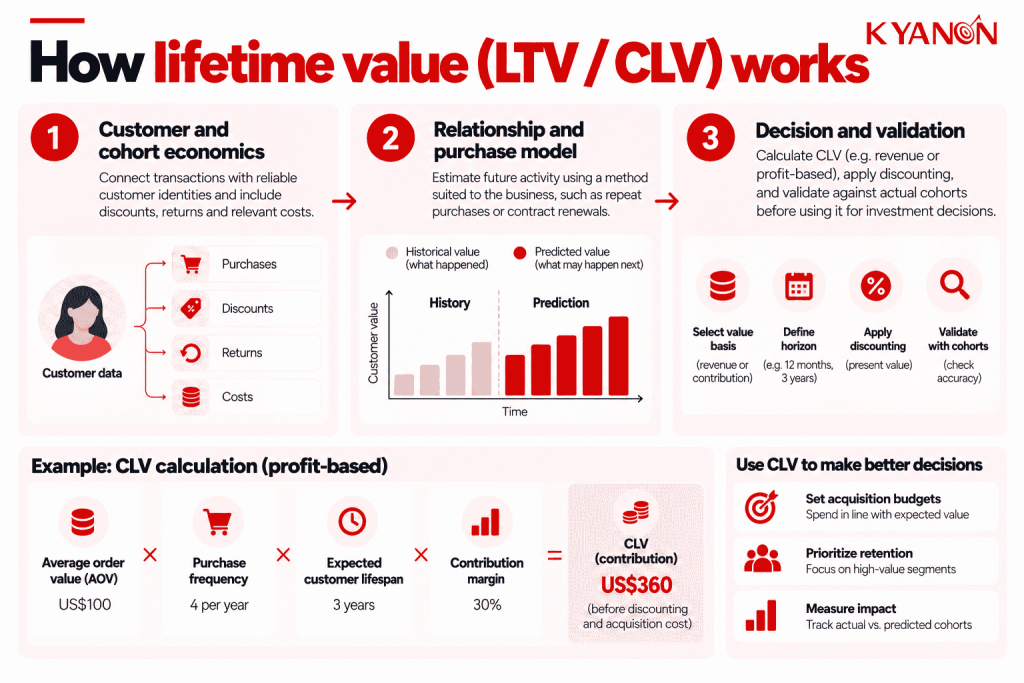
Customer and cohort economics
Connect transactions with reliable customer identities and account for discounts, returns, and relevant costs. Cohorts can reveal meaningful differences that a company-wide average hides.
Relationship and purchase model
Estimate future activity using a method suited to the business, such as contract renewal or repeat-purchase behavior. Historical customer value records what happened; predictive CLV estimates what may happen next
Decision and validation
For profit-based CLV, sum expected future contribution cash flows after discounting them to present value. Validate predictions against observed cohorts and state uncertainty before using them to set acquisition or retention budgets.

How do you calculate customer lifetime value?
A simple revenue-based estimate is average order value × purchases per year × expected customer lifespan in years. In an illustrative example, $50 × 4 × 3 gives $600 in expected lifetime revenue. At an assumed 40% gross margin, the corresponding gross-margin contribution is $240 before further relevant costs. These are teaching assumptions, not market benchmarks.
Historical value totals observed activity; predictive CLV estimates future value and must be checked against later outcomes. Match purchase frequency and lifespan units, account for returns where relevant, and state whether acquisition and service costs are included. When comparing LTV with customer acquisition cost (CAC), use compatible cohorts and a clearly defined value basis. A universal LTV:CAC target can hide differences in margin, payback time and retention risk.
Historical CLV vs. predictive CLV
Historical CLV measures customer value already realized. Predictive CLV estimates future value using assumptions or models about purchasing, retention, margin, and other relevant behavior.
Historical CLV is easier to verify but cannot tell the business what a customer may contribute next. Predictive CLV can support forward-looking decisions, but its usefulness depends on model accuracy and uncertainty.
For investment decisions, validate predicted value against what comparable customer cohorts actually generate over time.
Lifetime value (LTV / CLV) vs. average order value
CLV estimates value across a customer relationship; average order value measures revenue per order during a defined period.
| Dimension | Lifetime Value (LTV / CLV) | Average Order Value |
Unit | Customer or cohort | Order |
| Time horizon | Defined relationship period | Reporting period |
Inputs | Frequency, retention, value, costs, assumptions | Revenue and order count |
| Main use | Acquisition and retention investment | Basket and merchandising analysis |
Main limitation | Sensitive to model assumptions | Misses repeat behavior and relationship costs |
When to consider lifetime value (LTV / CLV)
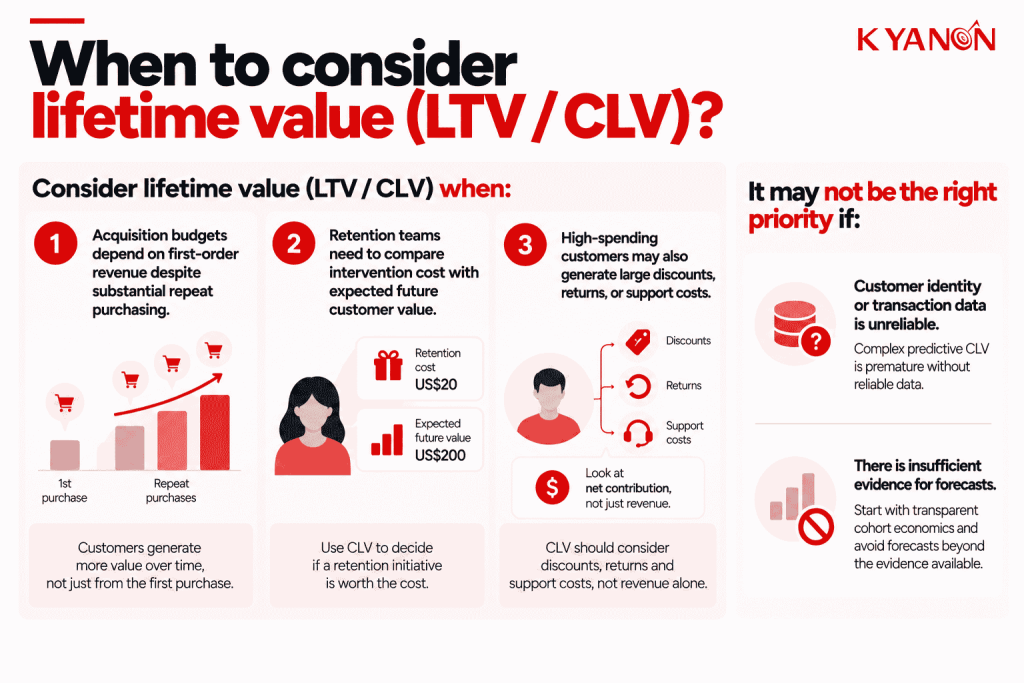
Consider lifetime value (ltv / clv) when the following conditions affect customer outcomes or operational control:
- Acquisition budgets depend on first-order revenue despite substantial repeat purchasing
- Retention teams need to compare intervention cost with expected future customer value
- High-spending customers may also generate large discounts, returns, or support costs
It may not be the right priority if:
Complex predictive CLV is premature when customer identity or transaction data is unreliable. Start with transparent cohort economics and avoid forecasts beyond the evidence available.
What makes a CLV estimate unreliable?
CLV becomes unreliable when its assumptions do not match actual customer economics.
Common problems include:
- Using revenue while ignoring margin, returns, discounts, or service costs
- Treating all customers as if they have the same retention pattern
- Predicting beyond the historical evidence available
- Combining customers acquired under materially different conditions
- Using incomplete customer identities that split or merge purchase histories
- Failing to recalibrate predictions as actual behavior changes
A precise-looking CLV score can therefore create false confidence. The useful question is not only “What is the predicted CLV?” but also “How accurate has this model been for comparable customers?”
How should CLV influence acquisition and retention spending?
CLV can help set an economic boundary for customer investment, but it should not be treated as an automatic spending allowance.
For acquisition, compare CLV and CAC using the same cohort and compatible value basis, while also considering payback time and uncertainty.
For retention, combine expected future value with the likelihood that an intervention will actually change customer behavior. A high-value customer who would remain without an incentive does not necessarily justify a costly retention offer.
The decision should therefore consider:
Expected customer value × probability of changing the outcome − intervention cost
Why CLV matters for retail and subscription services
CLV helps organizations evaluate customer investment across the relationship rather than optimizing only for the first transaction.
This matters in retail and subscription businesses where customers with similar revenue can have very different economics because of retention, discounts, returns, fulfillment, or service costs.
For example, two customers may each generate $1,000 in revenue, while one repeatedly returns products and requires expensive service interactions. A revenue-only CLV would treat them similarly; a contribution-based model can reveal materially different economics.
The objective is not simply to identify “high-value customers.” It is to understand which customer relationships are expected to create enough incremental economic value to justify additional acquisition, retention, or service investment.
Common misconceptions
“CLV is simply total customer revenue.”
Reality: Some organizations use a revenue-based measure, but it should be labeled accordingly. A spending decision also needs the costs required to earn that revenue.
“A high CLV prediction justifies any retention offer.”
Reality: An offer should create incremental value relative to doing nothing. Customers who would stay anyway can receive unnecessary discounts if targeting relies on CLV alone.
“There is one correct CLV number for each customer.”
Reality: CLV depends on the model, time horizon, value basis, cost assumptions, and expected future behavior. Treat predictive CLV as an estimate with uncertainty, not a permanent customer attribute.
How Kyanon Digital applies lifetime value (LTV / CLV)
Kyanon Digital helps organizations connect customer, transaction, behavioral, and operational data for customer analytics and decision-making.
Where CLV is part of the analytical use case, the underlying data foundation needs reliable customer identity, transaction history, relevant cost information, and consistent cohort definitions before more advanced predictive models can provide useful investment signals.
The objective is to support customer-investment decisions with transparent data and assumptions rather than treating CLV as an isolated score.
Explore Kyanon Digital’s data and analytics services.

 Create project brief with AI