
What is live chat?
Live chat is a customer-service channel that enables real-time text conversations between customers and human agents, sometimes supported by automation for triage or assistance.
Salesforce similarly describes live chat as a way for customers to communicate with service representatives in real time through digital channels.
For CX teams, the value comes from more than immediacy. Effective live chat connects the conversation with customer context, appropriate routing, agent knowledge, and the ability to resolve or correctly escalate the request.
How live chat works
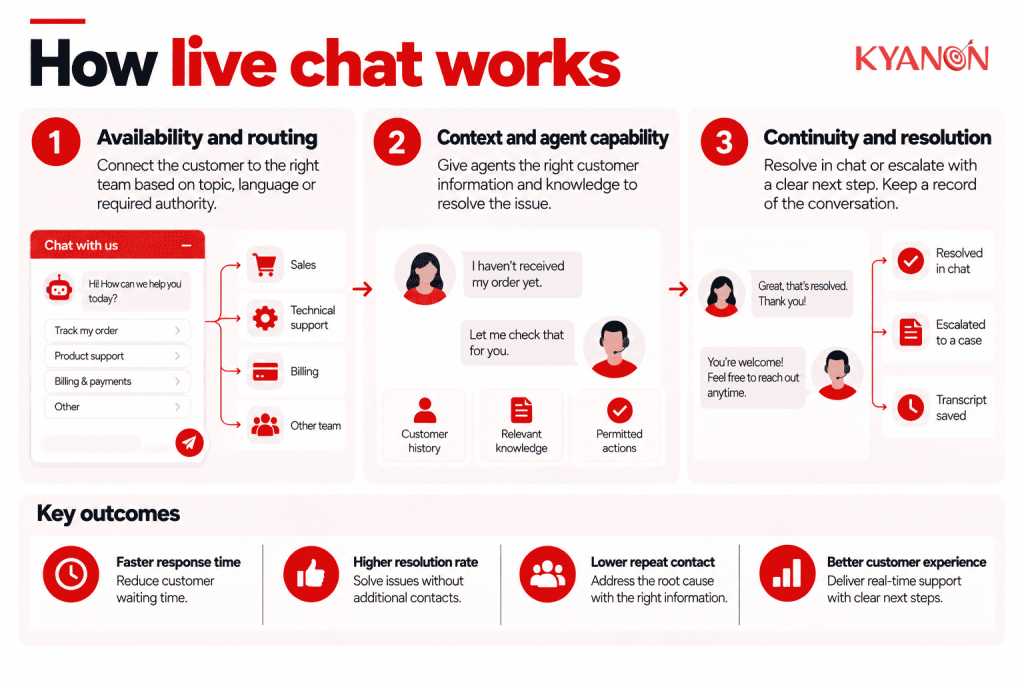
Live chat connects a customer request to an available agent and supports an immediate exchange. A chatbot or asynchronous inbox can share the same interface, but the service should clearly distinguish these modes and communicate realistic response expectations.
Availability and routing
Match the request with an appropriate team based on topic, language, or required authority. Display availability and a fallback when an agent cannot respond, rather than leaving the customer in an unexplained queue.
Context and agent capability
Provide relevant customer and case information under suitable access controls. Agents need usable knowledge and permitted actions to resolve the issue rather than merely acknowledge it.
Continuity and resolution
Preserve the transcript and connect unresolved conversations to a case with a named next step. Measure response time, resolution, repeat contact, and customer effort together.

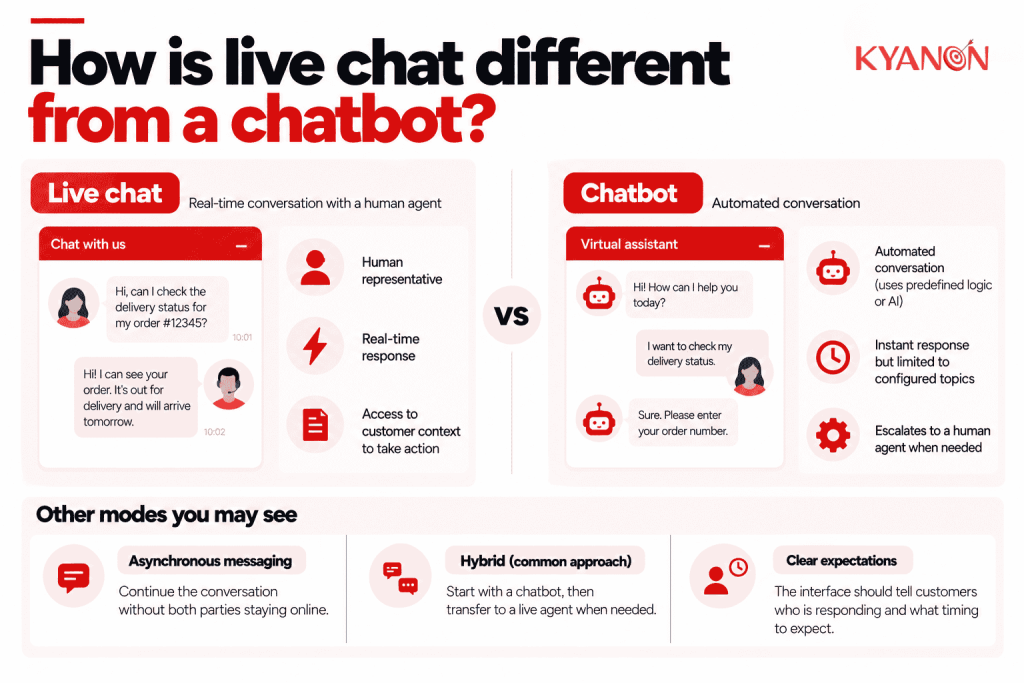
How is live chat different from a chatbot?
Live chat usually means real-time text conversation with a human representative. A chatbot automates conversation, while asynchronous messaging lets a conversation continue without both parties staying online. Products may combine these modes, so the interface should tell customers who is responding and what timing to expect.
Before adding live chat, set staffed hours, routing rules, realistic concurrency limits and a route for missed conversations. An illustrative delivery inquiry should reach an agent who can see the authorized order context and take the necessary action. Track waiting time, abandonment, resolution and repeat contact together. A fast greeting is not a successful chat if the customer must start over in email to complete the request.
Live chat vs. asynchronous messaging
Live chat assumes participants are present for an immediate exchange; asynchronous messaging allows the conversation to continue across longer gaps.
Dimension | Live Chat | Asynchronous Messaging |
Response expectation | Immediate or short wait | Within a stated response window |
| Customer presence | Usually remains in the session | Can leave and return |
Staffing | Needs live coverage and queue control | Can spread work across time |
| Best use | Immediate purchase or service obstacles | Non-urgent and follow-up requests |
Continuity requirement | Session preservation and handoff | Persistent conversation and notifications |
Use live chat when the issue benefits from immediate human interaction and the organization can staff the channel appropriately. Use asynchronous messaging when continuity matters more than an immediate response, and use a chatbot for suitable requests that can be handled reliably through automation.
The channels can work together: automation can collect context or handle routine requests, while cases requiring judgment, authority, or unsupported actions move to an appropriate human workflow.
When to consider live chat
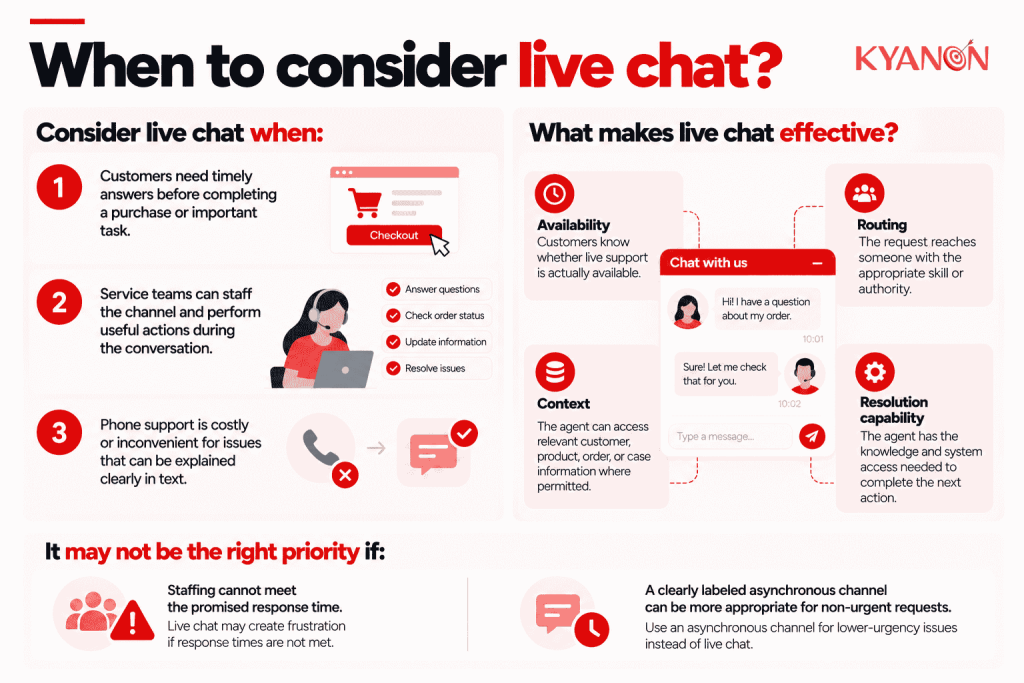
Consider live chat when the following conditions affect customer outcomes or operational control:
- Customers need timely answers before completing a purchase or important task.
- Service teams can staff the channel and perform useful actions during the conversation.
- Phone support is costly or inconvenient for issues that can be explained clearly in text.
It may not be the right priority if:
Live chat may create frustration if staffing cannot meet the promised response time. A clearly labeled asynchronous channel can be more appropriate for non-urgent requests.
What makes live chat effective?
Live chat creates value when the agent can do more than respond quickly. Four capabilities matter:
- Availability: Customers know whether live support is actually available
- Routing: The request reaches someone with the appropriate skill or authority
- Context: The agent can access relevant customer, product, order, or case information where permitted
- Resolution capability: The agent has the knowledge and system access needed to complete the next action
A chat channel can have a fast first response and still create poor CX if the customer must repeat the issue or move to another channel to get it resolved.
How should businesses measure live chat?
Measure live chat as a resolution channel, not only a response channel.
Track:
- Wait and first-response time
- Abandonment before an agent responds
- Resolution during or after the conversation
- Transfers and escalations
- Repeat contact for the same issue
- Customer effort or satisfaction
- Agent workload and concurrency
A lower response time is not automatically an improvement if customers experience more transfers, repeated explanations, or unresolved contacts.
Why live chat matters for e-commerce and SaaS
Live chat matters when a customer encounters an obstacle that can be resolved through timely conversation before it causes abandonment, delay, or another support contact.
In e-commerce, this may involve product compatibility, delivery, payment, or order questions. In SaaS, it may involve setup, account access, configuration, or an issue blocking a task.
The business objective should therefore be faster, appropriate resolution, not simply more chat conversations. If agents cannot access the required information or perform the next action, live chat may only move the support queue into another interface.
Common misconceptions
“A chatbot is the same as live chat.”
Reality: A chatbot automates responses; live chat conventionally refers to a real-time human conversation. Label the experience clearly when the interface switches between them.
“More simultaneous chats always improve productivity.”
Reality: Excessive concurrency can slow responses and increase errors. Set capacity according to issue complexity and resolution quality, not only message volume.
“Faster first response means better live chat.”
Reality: First-response time measures how quickly the conversation starts, not whether the customer’s problem is resolved. Evaluate response speed alongside resolution, transfers, repeat contact, and customer effort.
How Kyanon Digital applies live chat
Kyanon Digital helps organizations connect digital customer-service channels with customer data, CRM, knowledge, ticketing, and workflow systems.
Where live chat is part of the service model, these integrations can help agents receive relevant context, route requests appropriately, preserve conversation history, and move unresolved issues into accountable follow-up workflows.
The objective is to connect the conversation with the systems needed for resolution rather than operate chat as an isolated channel.
Explore Kyanon Digital’s custom software development services.

 Create project brief with AI