
What is loyalty program architecture?
Loyalty program architecture is the design of the systems, data, rules, and operating processes that manage membership, benefits, earning, redemption, and governance across a customer loyalty program.
In practice, the architecture connects member identity, program rules, transaction records, rewards, partners, and customer channels. Salesforce’s Loyalty Management architecture similarly separates loyalty data and capabilities such as members, tiers, benefits, partners, transaction journals, and loyalty ledgers.
For businesses, the key architectural question is which system is authoritative for member entitlements, reward transactions, and balances across every connected channel.
How loyalty program architecture works
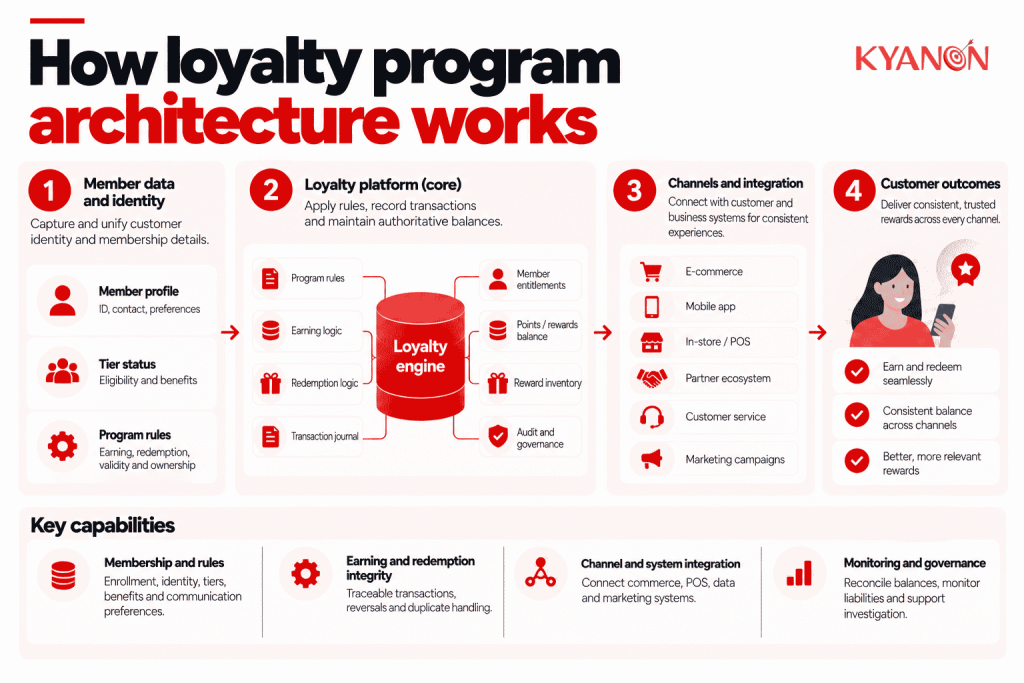
Loyalty program architecture translates a commercial promise into controlled transactions and customer-visible benefits. It connects customer identity with qualifying activity, reward rules, and authoritative balances so the program remains consistent across channels and exceptions.
Membership and program rules
Define enrollment, identity, tiers, benefit eligibility, and communication preferences. Rules need explicit effective dates and ownership so changes do not create inconsistent entitlements.
Earning and redemption integrity
Record points or benefit transactions with traceable references and appropriate reversals. Handle duplicate events, cancellations, and concurrent redemption so retries do not create extra rewards or negative balances.
Channel and operational integration
Connect commerce, POS, customer data, and marketing systems where relevant. Reconcile balances and reward inventory, monitor liabilities, and support customer-service investigation when transactions are disputed.

Which layers belong in a loyalty architecture?
A practical design separates membership and identity, earning and redemption rules, a traceable points ledger, reward inventory, channel interfaces and integration with commerce or enterprise systems. Reporting should reconcile the customer-facing balance with the underlying transactions. A returned order should trigger the appropriate reversal rather than leaving an unexplained adjustment.
For build-versus-buy decisions, assess rule flexibility, integration effort, transaction traceability, operational tooling and data portability. Buying a platform does not remove the need to define ownership of balances and exceptions; building one creates an ongoing obligation to maintain those controls. Test duplicate purchase events, concurrent redemptions, expiry and failed partner calls before assessing the visual membership experience alone.
What should be the source of truth for loyalty points?
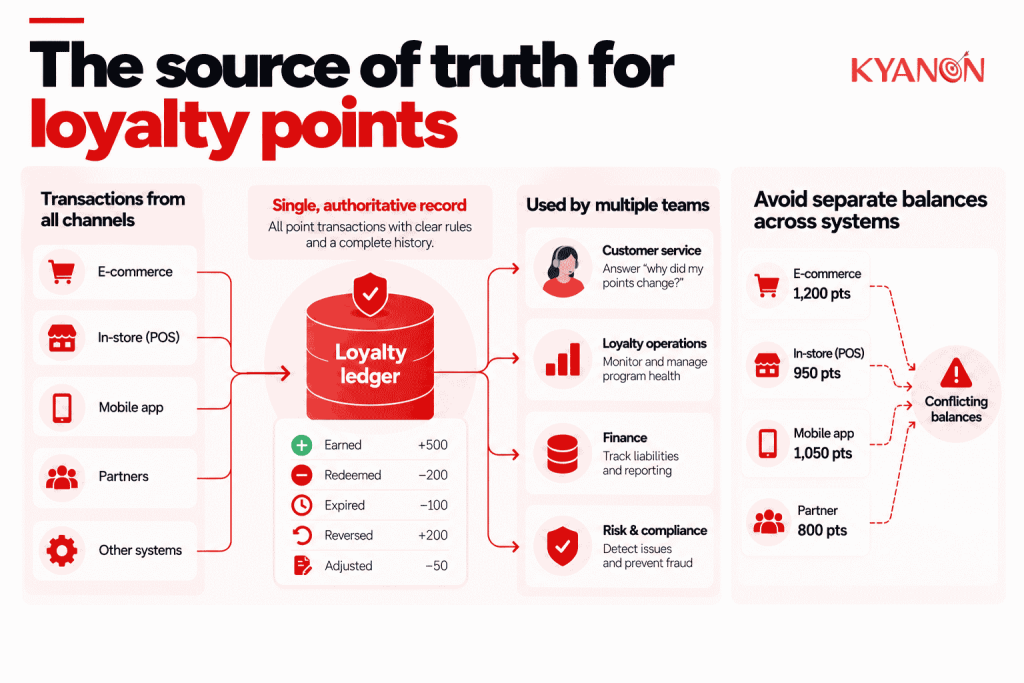
A loyalty architecture needs an authoritative transaction record for how points or benefits were earned, redeemed, expired, reversed, or adjusted.
Do not rely only on the current balance. A traceable ledger allows customer service, loyalty operations, finance, and risk teams to determine why the balance changed and which transaction caused it.
Connected POS, e-commerce, mobile, and partner systems should use the same governed loyalty logic rather than maintain conflicting versions of member balances or reward rules.
Loyalty program architecture vs. loyalty campaign
Loyalty program architecture provides the ongoing operating foundation; a loyalty campaign applies a time-bound offer or engagement mechanic within that foundation.
| Dimension | Loyalty Program Architecture |
Loyalty Campaign |
|
Time horizon |
Ongoing program lifecycle | Defined promotional period |
| Scope | Identity, rules, balances, integration, governance |
Audience, offer, timing, creative |
|
Core record |
Member entitlements and transactions | Campaign participation and results |
| Main risk | Incorrect balances or uncontrolled liability |
Unprofitable or ineffective promotion |
|
Success measure |
Program reliability and incremental economics |
Incremental campaign outcomes |
When to consider loyalty program architecture
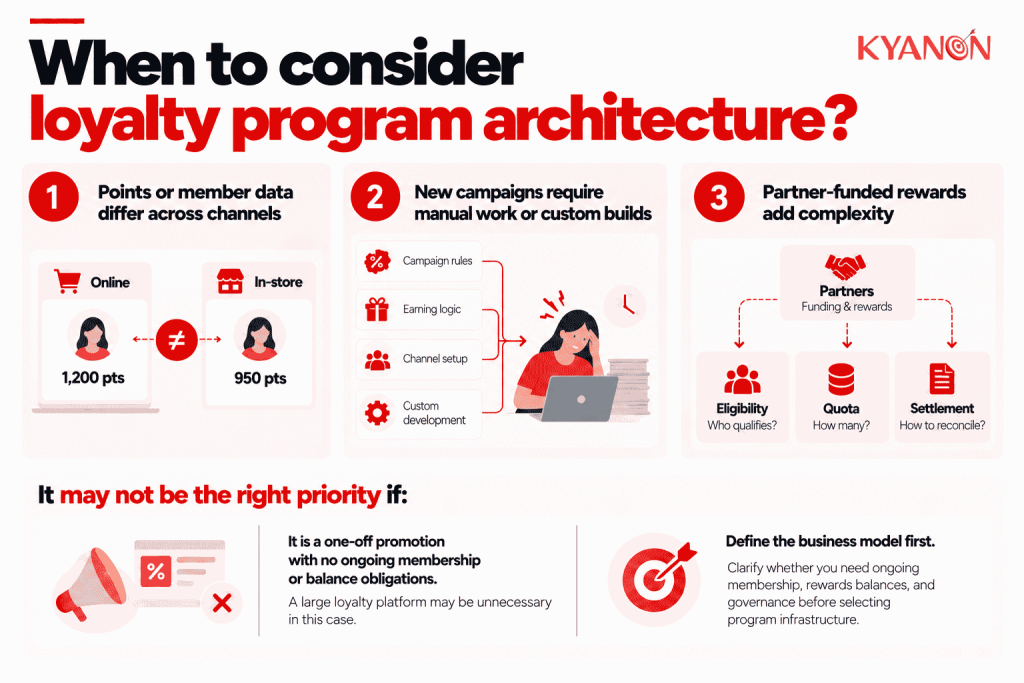
Consider loyalty program architecture when the following conditions affect customer outcomes or operational control:
- Points, benefits, or member identities differ between online and physical channels
- New campaigns require substantial manual reconciliation or custom development
- Partner-funded rewards create complex eligibility, quota, and settlement requirements
It may not be the right priority if:
A large loyalty platform may be unnecessary for a simple promotion with no ongoing membership or balance obligations. Define the business model before selecting program infrastructure.
What commonly breaks loyalty program architecture?
Common failure points include:
- Duplicate earning events creating extra points
- Inconsistent balances across POS, app, and e-commerce channels
- Failed reversals after returns or cancellations
- Simultaneous redemptions exceeding the available balance
- Partner transactions that cannot be reconciled
- Rule changes applied inconsistently across channels
- Manual adjustments without sufficient audit history
These are not only technical issues. They can create customer disputes, additional service work, fraud exposure, and incorrect reward liabilities.
Should businesses build or buy a loyalty platform?
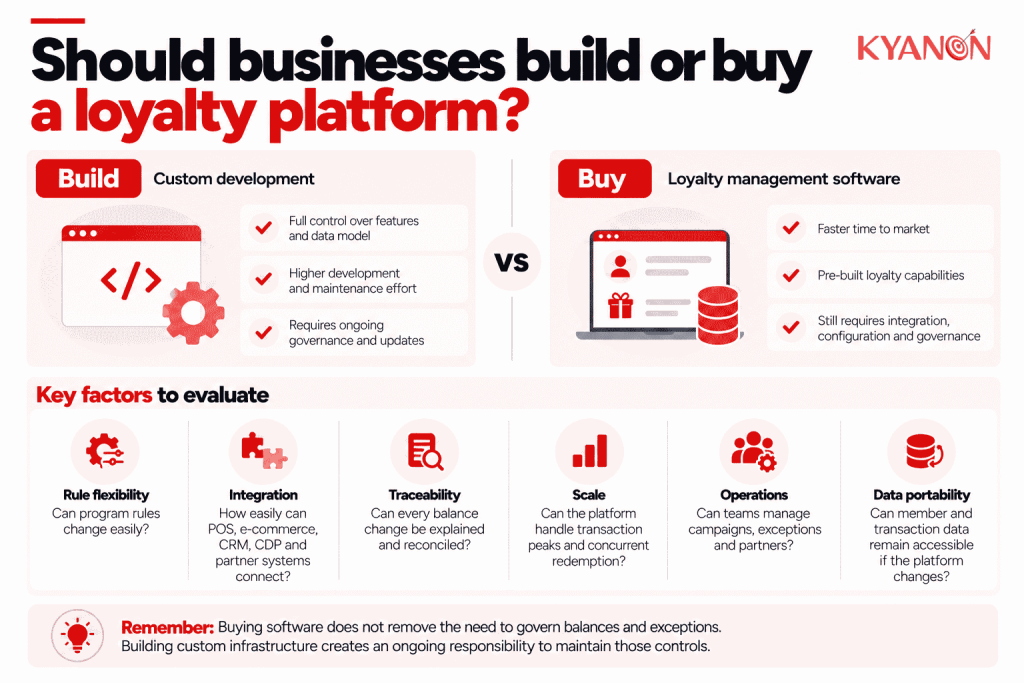
Evaluate build versus buy against the operating model rather than feature count alone.
Consider:
- Rule flexibility: Can earning, redemption, tiers, expiry, and exceptions change without excessive development?
- Integration: How easily can POS, e-commerce, CRM, CDP, payment, and partner systems connect?
- Traceability: Can every balance change be explained and reconciled?
- Scale: Can the architecture handle transaction peaks and concurrent redemption?
- Operations: Can authorized teams manage campaigns, exceptions, and partners effectively?
- Data portability: Can member and transaction data remain accessible if the platform changes?
Buying software does not remove the need to govern balances and exceptions. Building custom infrastructure creates an ongoing responsibility to maintain those controls.
Why loyalty program architecture matters for retail and consumer businesses
Loyalty architecture determines whether the business can deliver its reward promise accurately across customers, channels, stores, and partners while keeping program economics under control.
As programs become more complex, businesses need to reconcile what customers see with the transactions underneath it: points issued, rewards redeemed, reversals, expirations, partner funding, and outstanding reward liability.
A program can therefore generate strong customer engagement while still creating operational or financial problems if balances, rules, settlement, or reward costs cannot be reliably controlled.
The objective is not simply more earning and redemption. It is a loyalty system that is engaging for customers, traceable for operations, and economically manageable for the business.
Case study: How did Kyanon Digital architect a connected rewards ecosystem?
Explore Kyanon Digital’s Digital Rewards & Customer Loyalty Platform case study.
For a banking rewards platform, Kyanon Digital designed an integrated architecture connecting rewards, payments, customer channels, and merchant partners.
- Challenges: Fragmented rewards experiences, complex partner integration, and the need to operate rewards consistently across customer channels.
- Solutions: Kyanon Digital implemented a unified API layer, real-time reward calculation and eligibility, rewards-plus-payment integration, modular partner connectivity, and automated settlement and reconciliation.
- Results & impacts: The architecture created a connected rewards ecosystem across mobile, web, branch, and merchant environments while improving the platform’s ability to support new partners and reward models.
The case demonstrates why loyalty architecture extends beyond the customer-facing rewards experience: rules, transactions, integrations, reconciliation, and operational controls need to work as one system.
Common misconceptions
“The loyalty app is the loyalty platform.”
Reality: The app presents the experience, but earning, redemption, identity, and reconciliation require underlying services and operating rules. A polished interface cannot correct inconsistent balances.
“More rewards automatically improve retention.”
Reality: Rewards can subsidize purchases that would have happened anyway. Measure incremental behavior and contribution after reward costs, with appropriate comparison groups.
“The customer’s points balance is the loyalty system’s source of truth.”
Reality: A balance shows the current state but does not explain how it was reached. Loyalty systems need traceable transaction records for earning, redemption, expiry, reversals, and adjustments so balances can be investigated and reconciled.
How Kyanon Digital applies loyalty program architecture
Kyanon Digital designs loyalty program architectures for retail, FMCG, and F&B organizations, connecting membership and reward mechanics with e-commerce and marketing systems. The work can include earning rules, redemption flows, integration, and operational controls. This supports consistent customer benefits while giving the business visibility into program performance and exceptions.
Explore Kyanon Digital’s loyalty and rewards services.

 Create project brief with AI