
What are micro-moments?
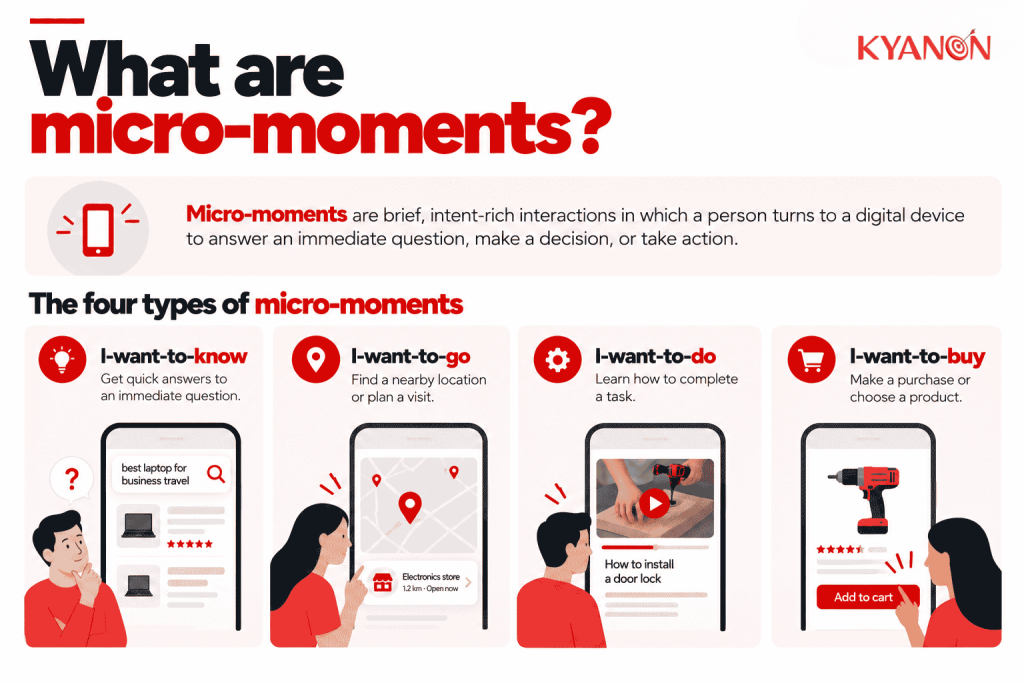
Micro-moments are brief, intent-rich interactions in which a person turns to a digital device to answer an immediate question, make a decision, or take action.
Google’s original framework groups these needs into four broad moments: I-want-to-know, I-want-to-go, I-want-to-do, and I-want-to-buy.
For CX teams, the important signal is not that the interaction is short. It is that the customer has an immediate need that requires a relevant answer or useful next action in context.
What are the four types of micro-moments?
Google’s framework describes four intent-led moments: I-want-to-know, I-want-to-go, I-want-to-do, and I-want-to-buy. Illustrative retail examples are checking material suitability, finding a nearby store, learning how to assemble a product, and confirming availability before purchase. These describe needs, not a requirement to push four kinds of advertisement.
Match the response to the immediate task: a concise answer, accurate location information, usable instructions or a clear purchase path. Preserve continuity when the customer acts later on another device or in a store. A micro-moment is different from a microinteraction, which is a small interface behavior such as a confirmation animation. Measure whether the need was met rather than treating every short session as a lost sale.
Are micro-moments only about mobile?
The concept emerged from mobile behavior, but the underlying CX principle is broader: customers express immediate intent across search, apps, commerce platforms, stores, service channels, and other connected touchpoints.
The business requirement is therefore not simply to optimize for a small screen. It is to recognize the customer’s immediate need and connect it with reliable information or action across the wider journey.
How micro-moments work
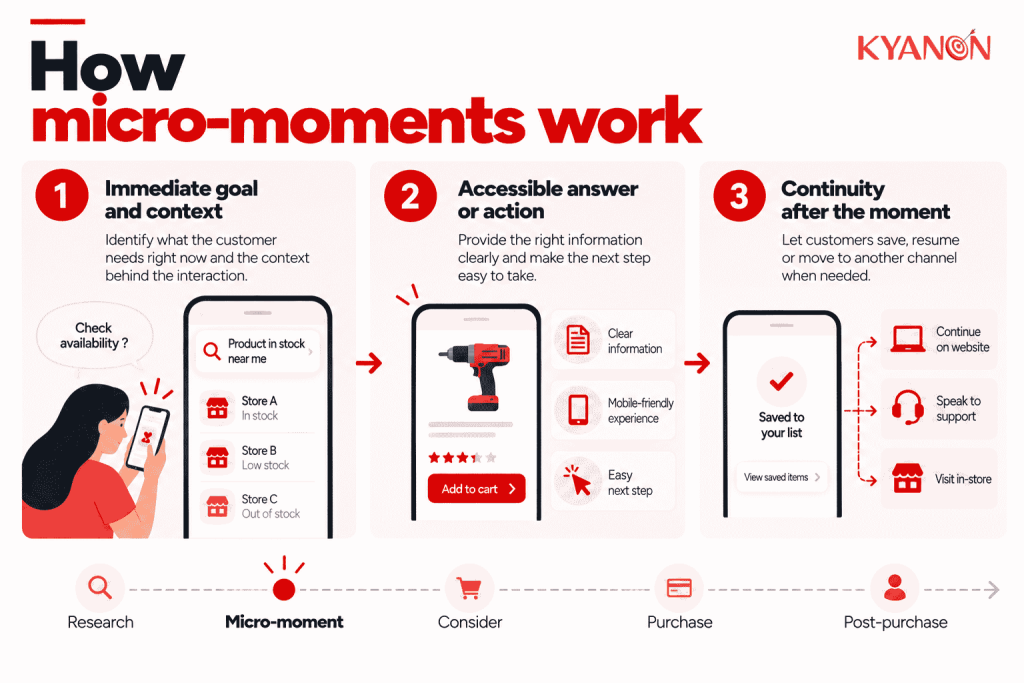
Micro-moment design connects a specific need with a useful response at the time it arises. The interaction may be short, but the underlying journey can be long; usefulness depends on relevance, clarity, and a practical next step rather than speed alone.
Immediate goal and context
Identify the task behind the interaction, such as checking availability, comparing a specification, or finding support. Avoid assuming a person is ready to buy simply because they are researching a product.
Accessible answer or action
Present the required information clearly and make the next step easy to find. Mobile performance, readable content, and accessible controls matter when the interaction happens under time or attention constraints.
Continuity after the moment
Allow customers to save, resume, or move to another channel when the task cannot finish immediately. A short interaction should contribute to the wider journey rather than become an isolated campaign click.

Micro-moments vs. touchpoint optimization
Micro-moments describe immediate intent-driven situations; touchpoint optimization is the broader practice of improving specific customer interactions.
Dimension | Micro-Moments | Touchpoint Optimization |
Focus | An immediate need in context | Quality of a defined interaction |
| Duration | Usually brief | Can be short or extended |
Typical examples | Availability lookup, quick comparison | Checkout, onboarding, support process |
| Design question | What is useful right now? | How can this interaction work better? |
Measurement | Immediate task success and next-step value | Completion, effort, satisfaction, errors |
When to consider micro-moments
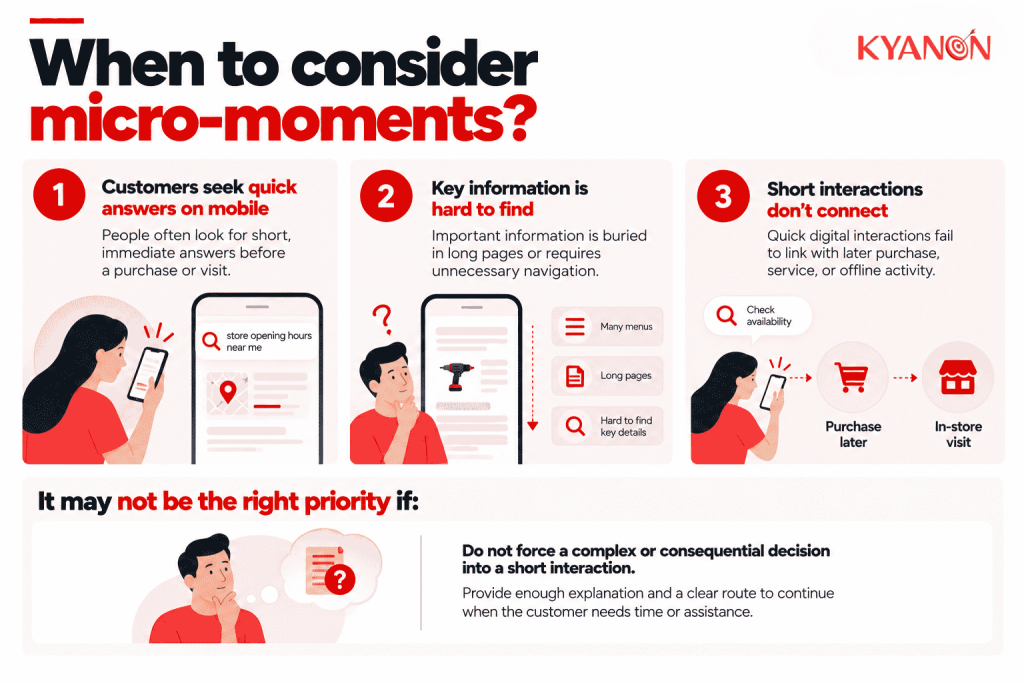
Consider micro-moments when the following conditions affect customer outcomes or operational control:
- Customers frequently seek quick answers on mobile before a purchase or visit
- Important information is buried in long pages or requires unnecessary navigation
- Short digital interactions fail to connect with later purchase, service, or offline activity
It may not be the right priority if:
Do not force a complex or consequential decision into a short interaction. Provide enough explanation and a route to continue when the customer needs time or assistance.
Which micro-moments should businesses prioritize?
Not every short customer interaction deserves optimization. Prioritize moments where an immediate need has a meaningful effect on the wider customer journey.
Consider:
- Frequency: How often does the need occur?
- Customer impact: What happens if the customer cannot complete the task?
- Business value: Can the moment influence conversion, service cost, retention, or another relevant outcome?
- Friction: Is the answer or action unnecessarily difficult today?
- Actionability: Can the business provide reliable information or a useful next step?
The objective is to identify high-value moments of intent, not optimize every click or mobile interaction.
How should a micro-moment be designed?
A useful micro-moment connects four elements:
Intent → Context → Response → Continuity
- Intent: What does the customer need right now?
- Context: What information changes the appropriate response?
- Response: What answer or action helps immediately?
- Continuity: What happens if the customer cannot finish the journey now?
For example, “Is this product available near me?” requires more than a store locator. A useful response may depend on current inventory, store location, opening hours, and whether the item can be reserved.
How should businesses measure micro-moments?
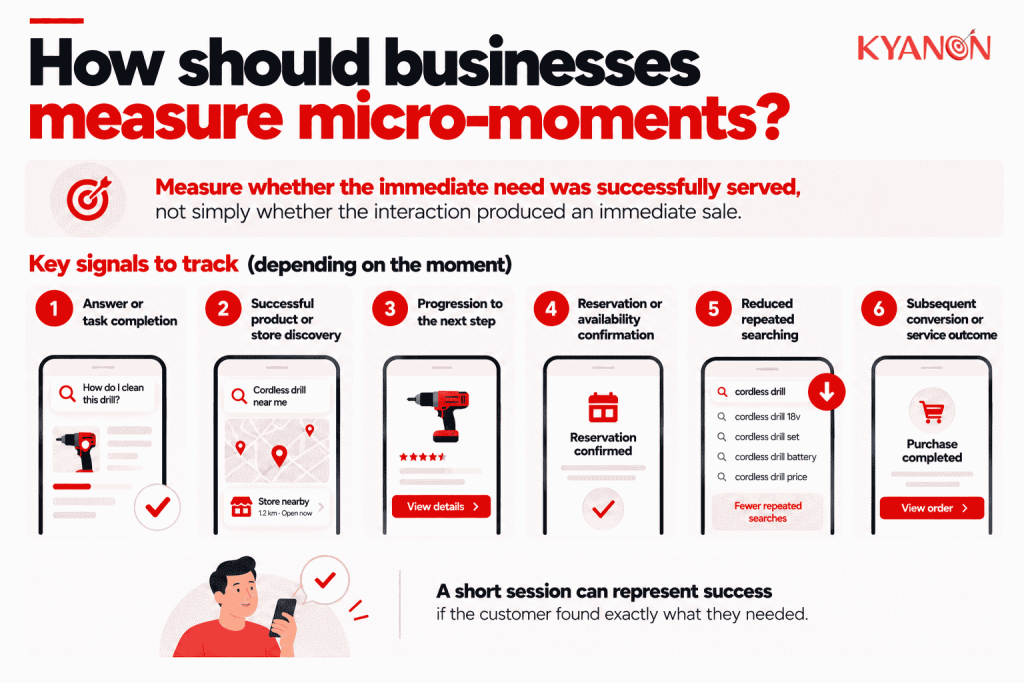
Measure whether the immediate need was successfully served, not simply whether the interaction produced an immediate sale.
Depending on the moment, useful signals can include:
- Answer or task completion
- Successful product or store discovery
- Progression to the appropriate next step
- Reservation or availability confirmation
- Reduced repeated searching
- Subsequent conversion or service outcome
A short session can represent success if the customer found exactly what they needed.
Why micro-moments matter for retail and location-based services
Micro-moments matter when a timely answer can remove uncertainty from a wider customer journey.
In retail, customers may need to confirm product specifications, compare alternatives, check local availability, locate a store, or determine whether an item can be collected before deciding what to do next.
Adobe Analytics reported that smartphones accounted for 56.4% of U.S. online transactions during the 2025 holiday shopping season, reinforcing that mobile interactions now span both product research and transaction.
The business opportunity is therefore not simply to generate more mobile engagement. It is to shorten the distance between customer intent and a reliable answer or action.
Common misconceptions
“Every micro-moment should lead directly to a sale.”
Reality: Many immediate needs concern research, navigation, or support. Serving them well can help the wider relationship without producing a transaction in that session.
“Micro-moments mean sending more push notifications.”
Reality: A micro-moment is defined by customer intent, not by a campaign interruption. Unrequested messages can create friction when they do not serve the current need.
“Every short mobile interaction is a micro-moment.”
Reality: Duration alone does not define a micro-moment. The important characteristic is an immediate customer intent or need that the experience can meaningfully serve.
How Kyanon Digital applies Micro-Moments in CX
Kyanon Digital helps businesses design digital experiences around immediate, intent-rich customer needs across key touchpoints.
In retail, this can include helping customers quickly find product information, check availability, identify fulfillment options, or continue between online and physical channels. The supporting experience may connect UX, customer data, inventory, commerce, and operational systems so the next step reflects the customer’s current context.
The focus is not on creating more short interactions but on reducing the distance between customer intent and a useful, actionable response.
Explore Kyanon Digital’s UX design services.

 Create project brief with AI