
What is multi-channel support?
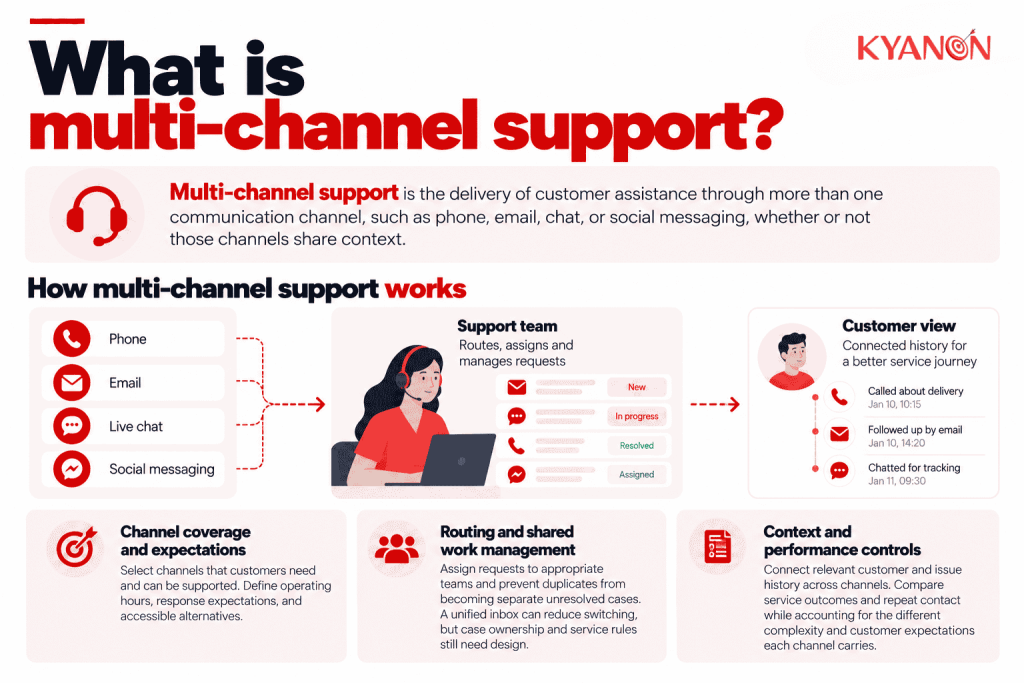
Multi-channel support is the delivery of customer assistance through more than one communication channel, such as phone, email, chat, or social messaging, whether or not those channels share context.
How multi-channel support works
Multi-channel support gives customers several ways to seek help. Its operating quality depends on how requests are routed, owned, and connected; simply adding channels does not establish a unified history or a continuous service journey.
Channel coverage and expectations
Select channels that customers need and the organization can support. Define operating hours, response expectations, and accessible alternatives instead of presenting every channel as equally immediate.
Routing and shared work management
Assign requests to appropriate teams and prevent duplicates from becoming separate unresolved cases. A unified inbox or agent desktop can reduce switching, but case ownership and service rules still need design.
Context and performance controls
Connect relevant customer and issue history across the selected channels. Compare service outcomes and repeat contact while accounting for the different complexity and customer expectations each channel carries.
How do you choose which support channels to offer?
Choose channels by customer needs and the work required to resolve them. Phone can support complex dialogue, email can carry detailed evidence, and chat can help with an immediate digital task. Offering several channels does not automatically preserve context when a customer switches between them.
For each channel, define availability, expected response, ownership and escalation. Give customers a case reference where appropriate and reconcile duplicate requests across channels. Evaluate performance by issue type as well as channel: a queue handling harder cases should not be judged solely against a queue of simple questions. Add a channel when the organization can support it reliably, and prioritize shared context when customers repeatedly move between existing channels.

What happens when support channels are disconnected?
Adding channels without connecting service operations can increase support complexity.
Common problems include:
- The same issue becoming multiple cases
- Customers repeating information after switching channels
- Agents seeing different versions of the customer history
- Unclear ownership when requests move between teams
- Inconsistent answers across channels
- Duplicate work that inflates service demand
The operational goal is therefore not simply to offer more contact options. It is to prevent channel choice from creating fragmented service ownership.
What context should support channels share?
Support channel integration should prioritize the information required to understand and resolve the customer’s current issue.
Depending on the service model, this can include:
- customer and account identity;
- active case and previous contacts;
- order, booking, or transaction status;
- previous actions and promised follow-up;
- relevant preferences or permissions;
- current case owner and escalation status.
The objective is not to expose every customer record to every agent. It is to provide the minimum relevant context needed for continuity and resolution, subject to appropriate access controls.
Multi-channel support vs. omnichannel CX
Multi-channel support provides several contact options; omnichannel CX aims to preserve relevant context and continuity across the broader customer journey.
Dimension | Multi-Channel Support | Omnichannel CX |
Scope | Support channels | Customer experience across functions and channels |
| Context sharing | Possible but not inherent | A core design objective |
Typical tools | Phone, email, chat, inbox, ticketing | Connected customer and operational platforms |
| Main goal | Accessible service through multiple routes | Consistent journey continuity |
Failure pattern | Duplicate cases and isolated channel histories | Broken handoffs or inconsistent business state |
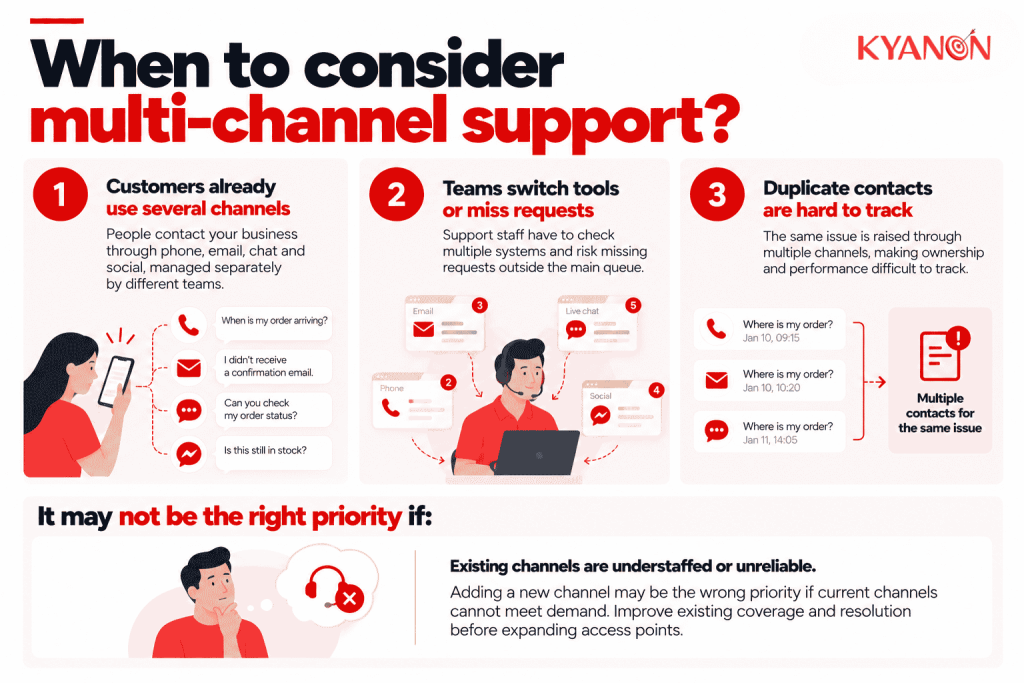
When to consider multi-channel support
Consider multi-channel support when the following conditions affect customer outcomes or operational control:
- Customers already contact the business through several channels that teams manage separately
- Support staff repeatedly switch tools or miss requests outside the main queue
- Duplicate contacts make ownership and service performance difficult to track
It may not be the right priority if:
Adding a new channel may be the wrong priority if existing channels are understaffed or unreliable. Improve current coverage and resolution before expanding access points.
How should businesses measure multi-channel support?
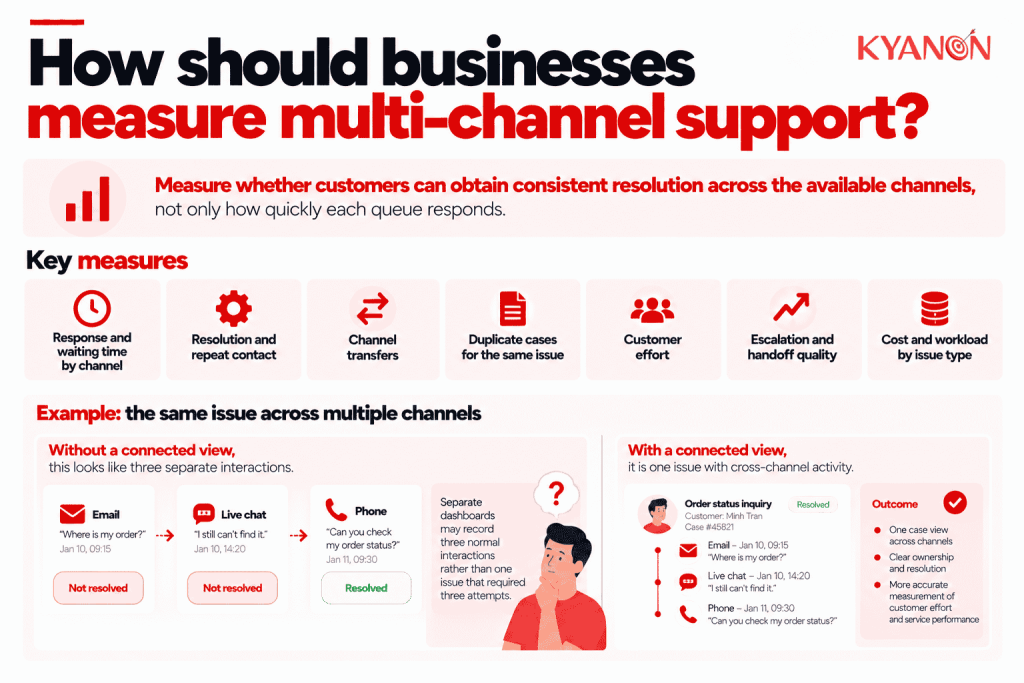
Measure whether customers can obtain consistent resolution across the available channels, not only how quickly each queue responds.
Useful measures include:
- Response and waiting time by channel
- Resolution and repeat contact
- Channel transfers
- Duplicate cases for the same issue
- Customer effort
- Escalation and handoff quality
- Cost and workload by issue type
Compare performance in context. A phone queue handling complex exceptions should not automatically be considered less effective than chat because its average handling time is longer.
A channel can appear efficient while the overall support journey is inefficient. If one unresolved problem generates an email, a chat, and a phone call, separate dashboards may record three normal interactions rather than one issue that required three attempts.
For this reason, multi-channel support should connect channel metrics with case-level resolution and cross-channel repeat contact.
Why multi-channel support matters for customer service operations
Customers may choose different channels depending on urgency, complexity, convenience, and the type of information they need to provide. The operational challenge is ensuring that those choices do not create fragmented service.
For example, a customer might email about a refund and later use chat to ask for an update. If both interactions relate to the same case, the second agent should be able to understand the relevant history and ownership without creating another refund request.
The value of multi-channel support therefore comes from balancing customer access with operational control: enough channel choice to make service accessible, with sufficient context and ownership to prevent duplicated effort.
Common misconceptions
“Offering more channels automatically improves service.”
Reality: Each channel introduces staffing, routing, and continuity requirements. Unsupported channels can create additional waiting and repeated requests.
“A unified inbox makes us omnichannel.”
Reality: An inbox can consolidate messages without connecting orders, policies, or fulfillment state. Omnichannel continuity requires the relevant business context as well as the conversation history.
“Each support channel should be optimized independently.”
Reality: Channel-level optimization can hide cross-channel problems. A fast chat queue provides limited value if unresolved customers repeatedly move between chat, email, and phone. Measure individual channel performance alongside case-level resolution and cross-channel repeat contact.
How Kyanon Digital applies multi-channel support
Kyanon Digital helps organizations connect customer-service channels with the customer data, case information, workflows, and business systems needed to support consistent resolution.
For multi-channel support, this can include channel integration, routing, shared agent context, case management, escalation workflows, and connections with CRM or other operational platforms.
The objective is not simply to add more contact channels, but to ensure that customer choice does not create fragmented ownership or repeated work across the service operation.
Explore Kyanon Digital’s custom software development services.

 Create project brief with AI