
What is a mystery shopper (digital)?
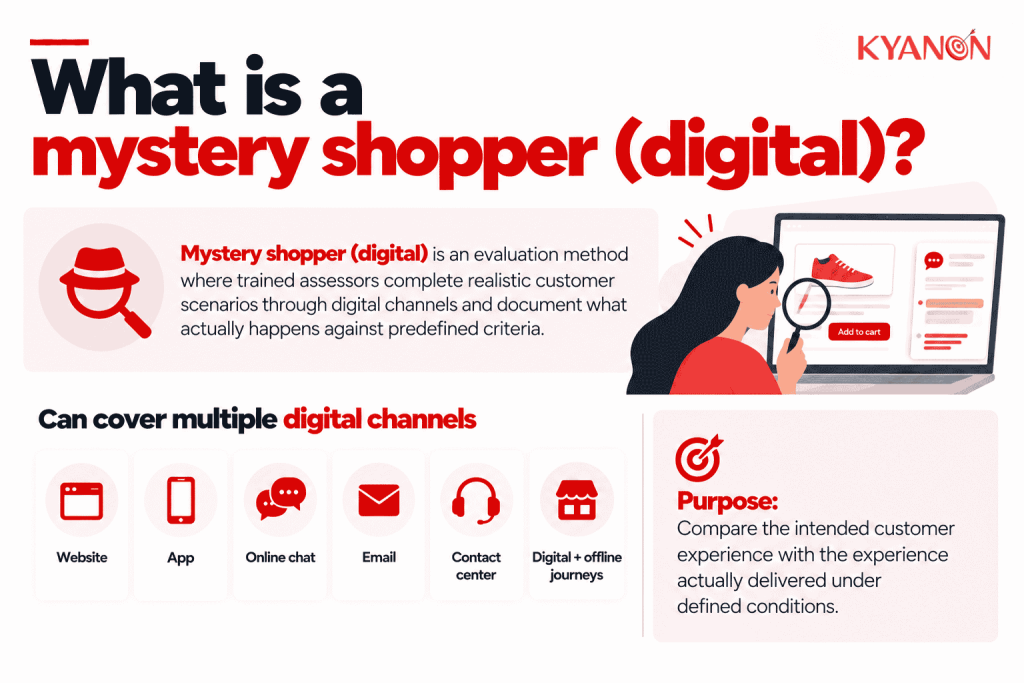
Mystery shopper (digital), or digital mystery shopping, is an evaluation method in which trained assessors complete realistic customer scenarios through digital channels and document what actually happens against predefined criteria.
The assessment can cover websites, apps, online chat, email, contact centers, or journeys that move between digital and offline touchpoints. Mystery Shopping Professionals Association (MSPA) guidance similarly covers online interactions and emphasizes realistic scenarios, defined measurement points, and appropriate ethical and operational controls.
Its purpose is to compare the intended customer experience with the experience actually delivered under defined conditions.
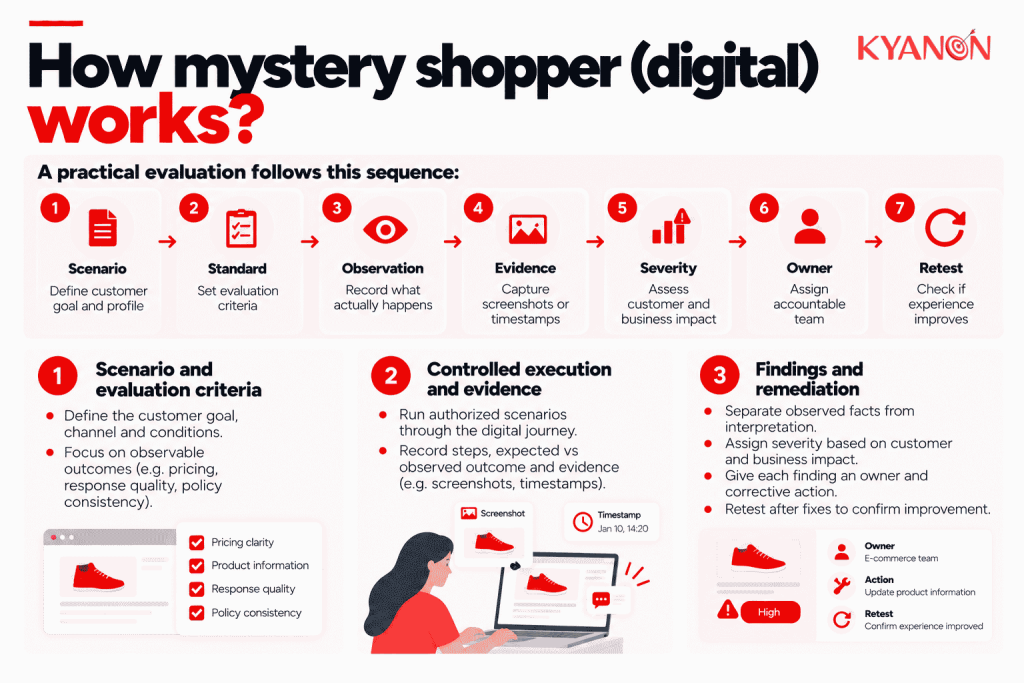
How mystery shopper (digital) works
Digital mystery shopping tests what a customer actually encounters under an agreed scenario. It combines structured task execution with consistent observation, making it useful for assessing service promises, digital processes, and cross-channel handoffs.
A practical evaluation follows this sequence:
Scenario → Standard → Observation → Evidence → Severity → Owner → Retest
Scenario and evaluation criteria
Define the customer goal, profile, channel, conditions, and expected service standard before testing begins.
Criteria should focus on observable outcomes such as pricing clarity, product information, response quality, cancellation handling, policy consistency, or successful handoffs.
Controlled execution and evidence
Run authorized scenarios through the relevant customer journey and preserve appropriate evidence.
For each finding, record the step attempted, expected outcome, observed outcome, relevant screenshot or timestamp, and customer impact. Keep conditions comparable where possible and avoid unnecessary collection of personal information.
Findings and remediation
Separate what was directly observed from interpretation. Assign severity according to customer and business impact rather than simply counting failed criteria.
Each significant finding should have an accountable owner and corrective action. After remediation, repeat the relevant scenario to determine whether the experience has actually improved.
A mystery-shopping program creates limited value if findings end as scores without changing the underlying experience.

What should a digital mystery shopper evaluate?
Use realistic tasks with defined starting conditions and expected service standards.
An e-commerce assessment, for example, could evaluate whether:
- Product and pricing information is clear
- Availability information is consistent
- Delivery costs appear before purchase
- Checkout errors can be recovered
- Support answers the customer’s actual question
- Return instructions match the published policy
- The journey remains consistent when moving between channels
Record evidence for each criterion rather than relying only on an overall impression.
A single observation should also be distinguished from a recurring pattern. Repeat comparable scenarios where necessary before drawing broader conclusions.
What can digital mystery shopping tell you?
Digital mystery shopping can demonstrate that a specific experience, failure, or service inconsistency occurred under defined conditions.
For example, it can establish that:
- A published policy differed from instructions provided through support;
- An advertised journey could not be completed;
- Information changed between channels;
- An expected service standard was not delivered;
- A handoff failed under a particular scenario.
It does not establish how frequently the problem occurs across the entire customer population.
Use operational analytics, customer feedback, representative research, or repeated assessments when the business needs to understand prevalence.
Digital mystery shopping provides evidence of experience delivery, not population prevalence.
Mystery shopper (digital) vs. usability testing
Digital mystery shopping evaluates whether a delivered experience meets defined scenarios and standards. Usability testing observes representative users completing tasks to understand how they interact with and interpret an experience.
Dimension | Mystery Shopper (Digital) | Usability Testing |
Participants | Trained assessors | Representative users |
| Main question | Was the expected service delivered? | Can intended users accomplish the task? |
Execution | Assessor performs a controlled scenario | Researcher observes user behavior |
| Evidence | Service outcomes and documented observations | Task behavior, confusion and feedback |
Best for | Service delivery and consistency | Usability and comprehension |
| Limitation | Does not establish population prevalence | Test conditions may differ from live service |
The methods can complement each other. If mystery shopping identifies a recurring journey problem but does not explain why customers struggle, usability research can help investigate the underlying behavior or comprehension issue.
Digital mystery shopping vs. CX analytics
Digital mystery shopping provides controlled observational evidence from defined scenarios, while CX analytics measures patterns across actual customer interactions at scale.
For example, analytics may reveal unusually high abandonment during an online returns journey. Mystery shopping can then reproduce that journey under controlled conditions to investigate whether policy information, system behavior, support responses, or cross-channel handoffs contribute to the problem.
The methods are complementary: analytics helps identify where a problem may exist; mystery shopping can test how the experience is actually delivered.
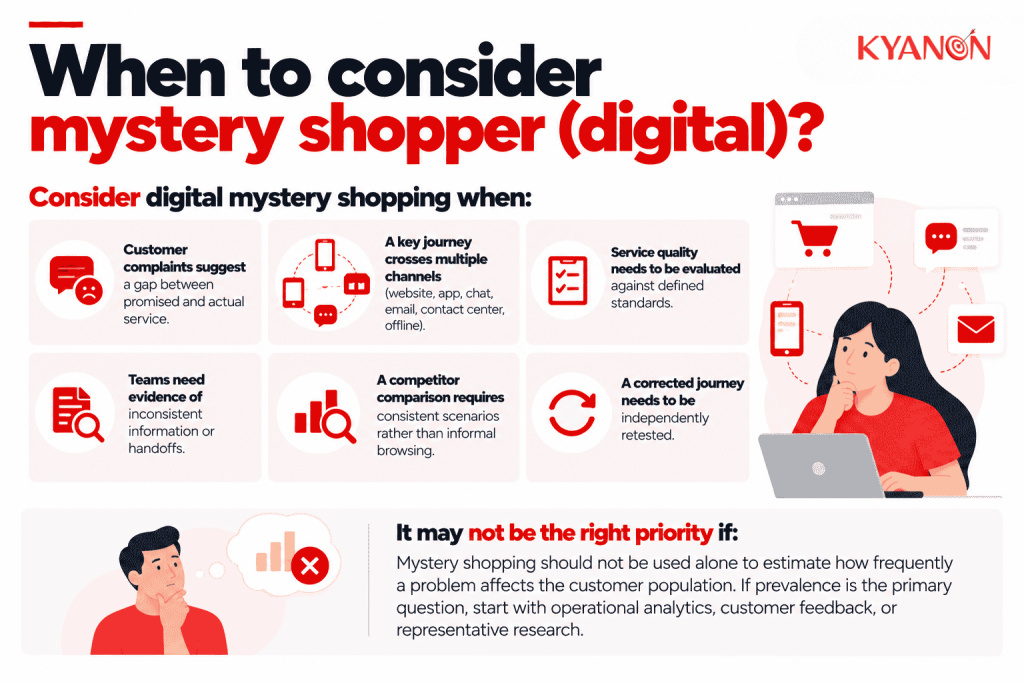
When to consider mystery shoppers (digital)
Consider digital mystery shopping when:
- Customer complaints suggest a gap between published promises and actual service
- An important journey crosses a website, app, chat, email, contact center, or physical touchpoints
- Service quality needs to be evaluated against defined standards
- Teams need evidence of inconsistent information or handoffs
- A competitor comparison requires consistent scenarios rather than informal browsing
- A corrected journey needs to be independently retested
It may not be the right priority if:
Mystery shopping should not be used alone to estimate how frequently a problem affects the customer population. If prevalence is the primary question, start with operational analytics, customer feedback, or representative research.
How should mystery-shopping findings be prioritized?
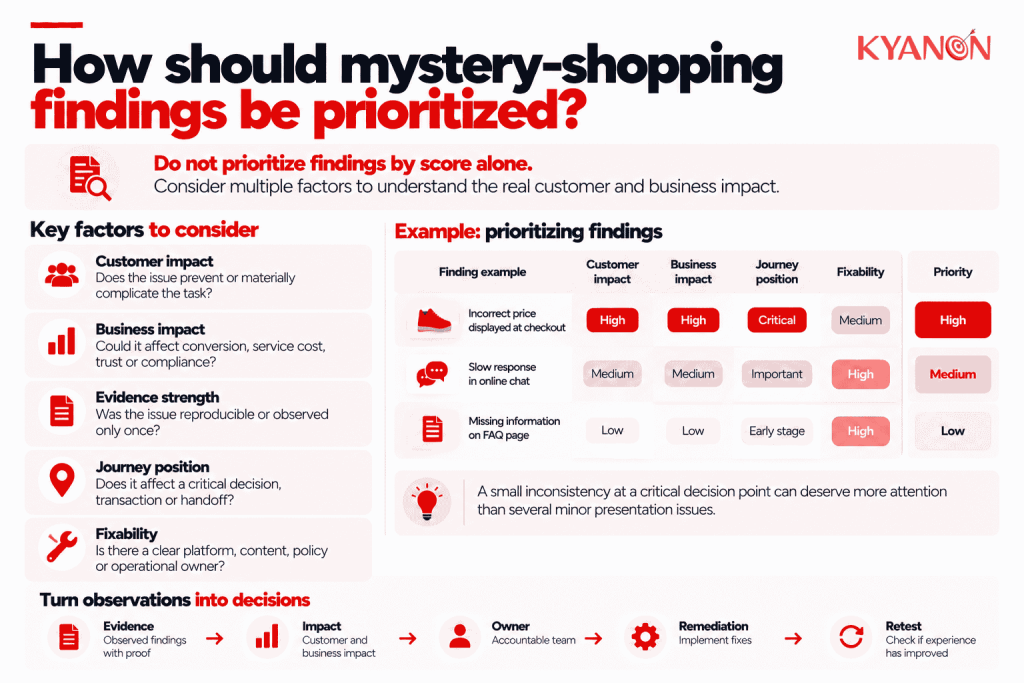
Do not prioritize findings by score alone.
Consider:
- Customer impact: Does the issue prevent or materially complicate the task?
- Business impact: Could it affect conversion, service cost, trust, or compliance?
- Evidence strength: Was the issue reproducible or observed only once?
- Journey position: Does it affect a critical decision, transaction, or handoff?
- Fixability: Is there a clear platform, content, policy, or operational owner?
A small inconsistency at a critical decision point can deserve more attention than several minor presentation issues.
The objective is to turn observations into decisions:
Evidence → Impact → Owner → Remediation → Retest
Why digital mystery shopping matters for complex customer journeys
Digital mystery shopping is particularly useful when customer experience depends on multiple systems, channels, policies, or service teams working together.
A journey may appear correct when each touchpoint is reviewed separately while still failing end to end.
For example, a retailer’s published return policy, chatbot response, agent instructions, and actual online returns workflow may each provide different information. A digital mystery shopper can execute the journey as a customer would, document the inconsistency, and identify where further investigation is required.
The business value comes from finding the gap between the experience the organization intends to provide and the experience it actually delivers.
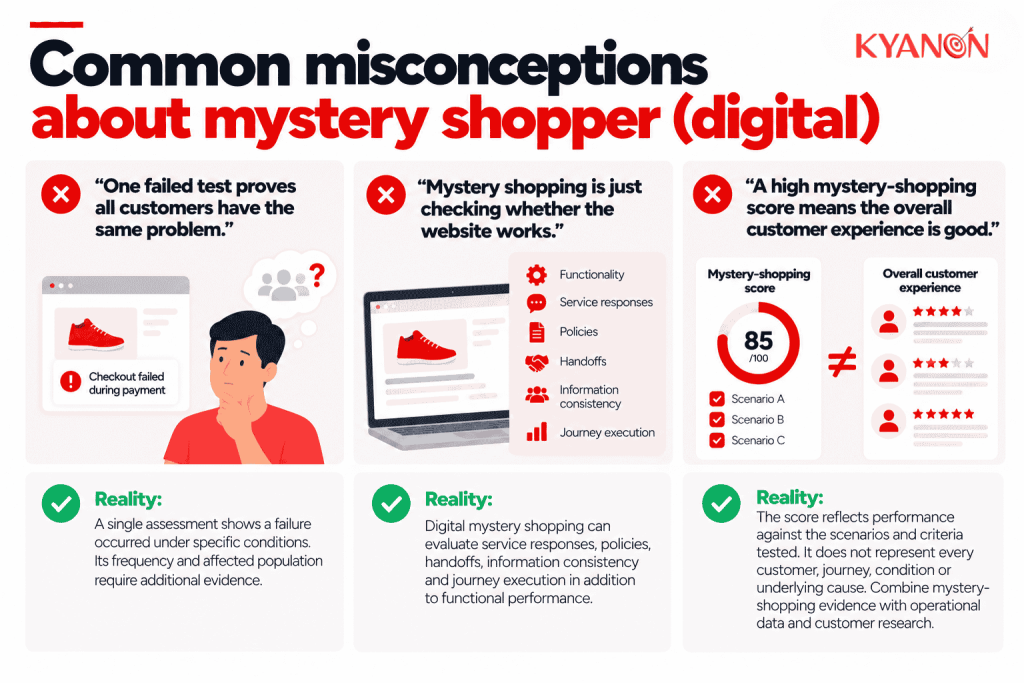
Common misconceptions
“One failed test proves all customers have the same problem.”
Reality: A single assessment demonstrates that a failure occurred under specific conditions. Its frequency and affected population require additional evidence.
“Mystery shopping is just checking whether the website works.”
Reality: Digital mystery shopping can evaluate service responses, policies, handoffs, information consistency, and journey execution in addition to functional performance.
“A high mystery-shopping score means the overall customer experience is good.”
Reality: The score reflects performance against the scenarios and criteria tested. It does not represent every customer, journey, condition, or underlying cause. Combine mystery-shopping evidence with operational data and customer research when broader conclusions are required.
How Kyanon Digital applies mystery shopper (digital) insights
Kyanon Digital helps organizations evaluate and improve digital customer journeys using UX research, experience evidence, analytics, and platform insights.
Where digital mystery shopping forms part of the assessment approach, observed journey issues can be connected with UX, content, platform, integration, or service-operation findings to investigate the underlying problem and determine appropriate remediation.
The objective is to move from observed experience gap → supporting evidence → root-cause investigation → experience improvement, rather than stopping at a scorecard.
Explore Kyanon Digital’s UX design services.

 Create project brief with AI