
What is the next best action (NBA)?
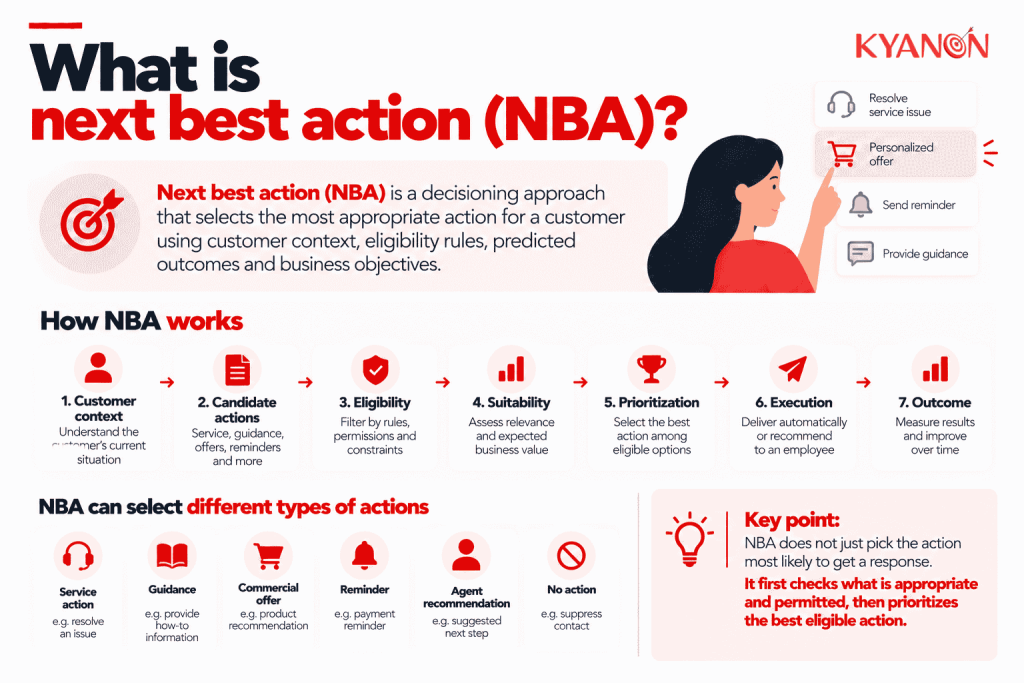
The next best action (NBA) is a decisioning approach that selects an appropriate action for a customer at a particular moment using customer context, eligibility rules, predicted outcomes, and business objectives.
NBA can choose among service actions, guidance, offers, reminders, agent recommendations, or no action. Pega’s decisioning approach similarly filters candidate actions through engagement policies before prioritizing eligible alternatives based on customer relevance and business priorities.
The important distinction is that the NBA does not simply ask, “Which action is most likely to get a response?” It first asks, “Which actions are appropriate and permitted?” and then determines which eligible action should take priority.
How the next best action (NBA) works
NBA compares eligible alternatives rather than automatically sending the next campaign message.
A practical decision flow is
Customer context → Candidate actions → Eligibility → Suitability → Prioritization → Execution → Outcome
Candidate actions and eligibility
Define the actions the organization can actually deliver and the conditions under which each is permitted.
Depending on the use case, this may include product eligibility, customer consent, service status, contact policies, account conditions, or operational availability.
An action that cannot or should not be delivered should be removed before ranking begins.
Suitability and prioritization
The NBA can use business rules, predictive models, or both to compare the remaining actions.
The decision should consider whether an action is appropriate in the customer’s current context as well as its expected business value. For example, an unresolved service problem may need to take priority over a commercial recommendation even when the offer has a high predicted response rate.
This separates constraints from optimization: first determine what is allowed and appropriate, then optimize among the remaining choices.
Execution and learning
The selected action can be delivered automatically through a customer channel or presented as a recommendation to an employee.
Record whether the action was executed, accepted, completed, or suppressed and what happened afterward. This outcome data can then inform future rules, models, and decision policies.

How does the NBA decide between competing actions?
A useful NBA process separates eligibility from prioritization.
For example, suppose a telecom customer could potentially receive:
- An upgrade offer
- A payment reminder
- A service callback
- Troubleshooting guidance or no communication
An upgrade might have the highest predicted response rate. However, if the customer has an unresolved billing complaint, the commercial action may be inappropriate.
The NBA should first filter candidate actions using relevant eligibility, suitability, customer, and operational constraints. Only the remaining actions should be prioritized against the defined objectives.
This prevents predictive scores from overriding the rules that determine whether an action should be considered at all.
Is the next best action always a sales offer?
No. The next best action can be a service intervention, guidance, clarification request, reminder, retention action, commercial offer, agent recommendation, or no contact. This distinguishes the NBA from the next best offer, which focuses specifically on selecting a commercial proposition.
The broader question for the NBA is: What is the most appropriate thing to do next for this customer in the current context?
Can “no action” be the next best action?
Yes. If no candidate action is sufficiently relevant, permitted, or valuable, the appropriate decision may be to wait or suppress contact.
For example, sending another promotion immediately after a customer reports a serious service problem may increase campaign activity while damaging the overall experience.
A mature NBA capability therefore decides not only what to trigger but also what to suppress.
Next best action (NBA) vs. next best offer
The next best action selects among service, guidance, commercial, and no-contact options. Next best offer focuses specifically on choosing an eligible commercial proposition.
| Dimension | Next Best Action (NBA) | Next Best Offer |
Decision scope | Any eligible customer action | Eligible commercial offer |
| Possible output | Help, review, reminder, offer, or no action | Product, upgrade, or incentive |
Objective | Balance customer and business outcomes | Improve offer relevance and response |
| Required context | Service, behavior, permissions, operations | Customer, product, and offer eligibility |
Main risk | Misaligned objectives or inappropriate action | Unsuitable or mistimed offer |
Put simply: Next best offer asks “Which offer?” NBA asks “What should we do next?”
Next best action vs. journey orchestration
The next best action decides what action is appropriate now. Journey orchestration coordinates when and how actions occur across an evolving customer journey.
| Dimension | Next Best Action | Journey Orchestration |
Core question | What should happen next? | How should the journey progress? |
| Decision unit | Individual action | Sequence and coordination of actions |
Inputs | Context, eligibility, predictions, objectives | Events, journey state, priorities, workflow |
| Output | Selected or suppressed action | Trigger, wait, route, suppress, or stop |
Example | Recommend service callback instead of upgrade | Pause the promotion journey until a service case closes |
The capabilities can work together. Journey orchestration determines when a decision is required, while NBA can determine which eligible action should take priority.
When to consider the next best action (NBA)
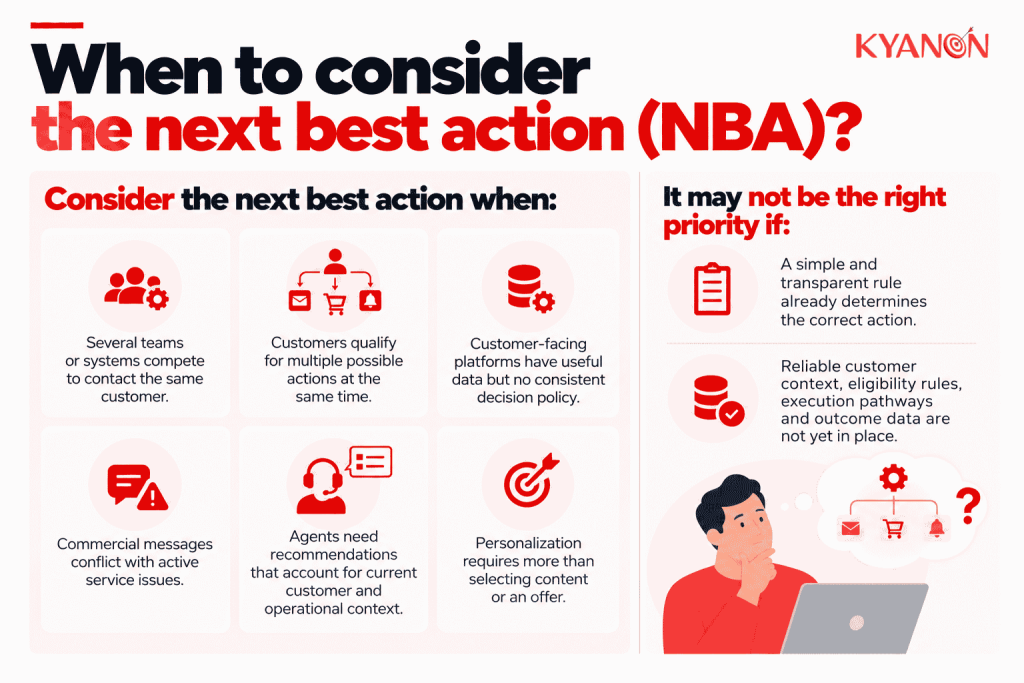
Consider the next best action when:
- Several teams or systems compete to contact the same customer
- Customers qualify for multiple possible actions at the same time
- Customer-facing platforms have useful data but no consistent decision policy
- Commercial messages conflict with active service issues
- Agents need recommendations that account for current customer and operational context
- Personalization requires more than selecting content or an offer
It may not be the right priority if:
The NBA may be unnecessary when a simple and transparent rule already determines the correct action.
Organizations should also establish reliable customer context, eligibility rules, execution pathways, and outcome data before investing heavily in predictive ranking.
What data does the next best action require?
The NBA requires enough current and reliable context to distinguish between eligible actions.
Depending on the decision, this can include:
- Customer identity and profile
- Recent interactions and behavior
- Product or account holdings
- Transaction history
- Open service cases
- Consent and contact preferences
- Product or offer eligibility
- Previous actions and responses
- Operational availability or capacity
Not every decision requires every data source.
The more useful question is: Which information could materially change the action selected now?
A sophisticated model operating on delayed or fragmented customer data can make a less appropriate decision than a simple rule using reliable current context.
How should the next best action be measured?
Measure whether the selected action improves the intended outcome compared with what would otherwise have happened.
Depending on the use case, useful measures can include:
- Action acceptance or completion
- Service resolution
- Conversion or retention
- Customer effort
- Suppression of inappropriate contacts
- Downstream customer or business value
- Operational cost
- Unintended outcomes
Where feasible, use control groups or experiments to estimate incremental impact.
A high acceptance rate does not prove the NBA system created value. Customers who accepted a recommendation may have taken the same action without it.
Why the next best action matters for banking, telecom, and retail
NBA becomes valuable when multiple possible actions compete for the same customer.
A bank may simultaneously have a service alert, product recommendation, retention intervention, and relationship-manager task. A telecom customer may qualify for an upgrade while having an unresolved billing complaint. A retailer may have several promotions available while the customer is waiting for a return to be resolved.
Without shared decisioning, each system or team can optimize its own objective while creating a poor overall customer experience.
The NBA provides a decision layer that determines which actions are eligible, which should take priority, and when taking no action is preferable.
Does the next best action have to be fully automated?
No, NBA can automatically execute an action or recommend an action to a human agent, relationship manager, or other decision-maker.
For example, IBM’s 2026 agent-assist capability in Watsonx Orchestrate includes intent detection, automated process triggers, and next-best-action recommendations within the customer-service agent workspace.
The operating model should determine where the system decides, where it recommends, and where a human retains final authority.
Common misconceptions
“The NBA always chooses something to sell.”
Reality: The appropriate action may be service recovery, education, clarification, escalation, or no contact. Restricting NBA to offers can ignore the customer’s current need.
“The model should decide without business rules.”
Reality: Predictions do not establish eligibility, authority, consent, or suitability. Explicit constraints should determine which actions can enter the decision before predictive ranking is applied.
“The action with the highest predicted response should always win.”
Reality: Prediction is only one input. An action may need to be excluded because of eligibility, suitability, consent, service state, operational constraints, or competing priorities. The NBA should optimize within defined constraints rather than allow predicted propensity to override them.
How Kyanon Digital applies next best action (NBA)
Kyanon Digital helps organizations build the data, analytics, integration, and AI foundations required for next-best-action decisioning.
This can include connecting customer profiles and behavioral signals, defining eligibility and decision rules, applying predictive models where appropriate, and integrating recommendations with customer-facing channels or employee workflows.
NBA should improve the quality of customer decisions, not simply increase the number of automated recommendations.
Explore Kyanon Digital’s AI integration services.

 Create project brief with AI