
What is notification architecture?
Notification architecture is the design of the services, rules, and data flows that determine which customer messages are sent, when they are sent, through which channels, and how delivery outcomes are handled.
It separates the business event, the decision to notify, and the delivery mechanism so individual applications do not independently control customer communication.
A notification architecture can coordinate email, SMS, push, in-app, and other channels while applying shared rules for preferences, priority, suppression, expiration, and delivery.
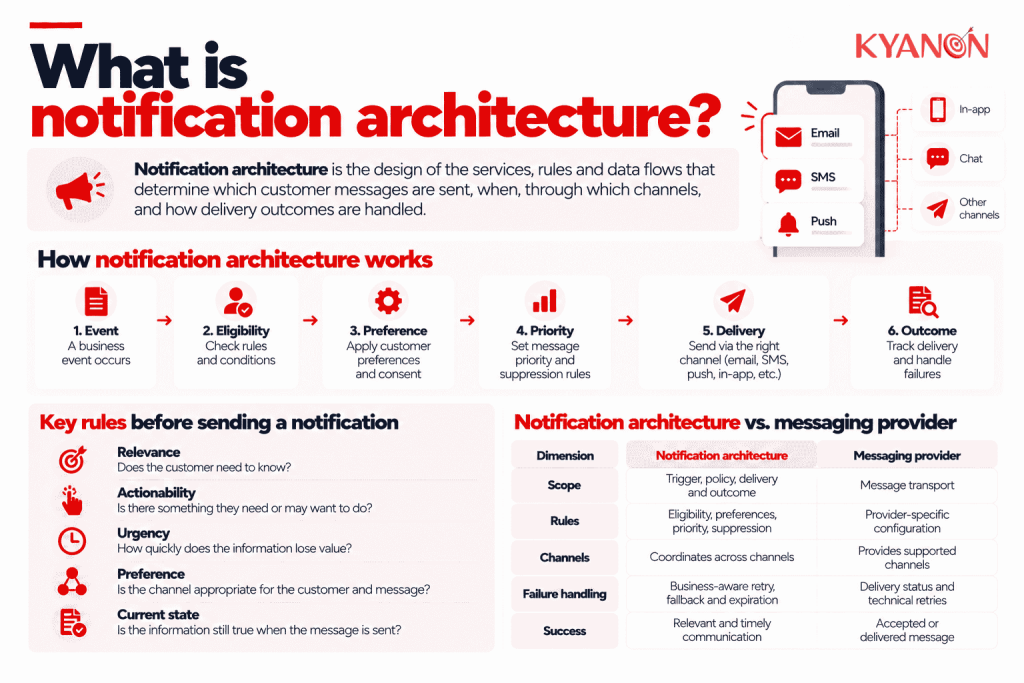
How notification architecture works
A notification system should not automatically turn every business event into a customer message.
A simplified flow is: Event → Eligibility → Preference → Priority → Delivery → Outcome
Trigger and message policy
Define which events justify communication and what the customer needs to know or do.
Operational, security, service, and promotional messages may require different rules for urgency, permission, content, and expiration.
Preferences and coordination
Apply relevant notification preferences, consent, quiet hours, frequency limits, and suppression rules before delivery.
Coordination across systems also prevents customers from receiving duplicate or contradictory messages about the same event.
Delivery and failure handling
Route approved messages through the appropriate channel and track the available delivery states.
Use deduplication, retries, expiration, and fallback rules where appropriate. Provider acceptance should not automatically be treated as proof that the customer received or acted on the message.

When should an event become a customer notification?
Before converting an event into a notification, consider:
- Relevance: Does the customer need to know?
- Actionability: Is there something they need or may want to do?
- Urgency: How quickly does the information lose value?
- Preference: Is the selected channel appropriate for the customer and message?
- Current state: Is the information still true when the message is sent?
For example, a pickup-ready notification should follow confirmed readiness rather than initial order acceptance. If the same event is processed twice, the customer should not receive unnecessary duplicates. If the order has already been collected before a delayed notification is delivered, that message may need to expire.
Reliable notification delivery does not mean delivering every message eventually. It means delivering useful information while it is still relevant.
How do you prevent duplicate or outdated notifications?
Use stable event or notification identifiers to recognize repeated processing and define retry and expiration rules according to message purpose.
Retries should not automatically create repeated customer-visible messages. Delayed notifications should also be checked against the latest business state when that state can make the original message obsolete.
For example, an order-status update may expire quickly, while a security notification may require a different retention or escalation policy.
The objective is to distinguish between a technical event that can be retried and a customer communication that should not be repeated unnecessarily.
Notification architecture vs. messaging provider
Notification architecture controls the end-to-end communication logic. A messaging provider supplies the infrastructure for delivering messages through one or more channels.
Dimension | Notification Architecture | Messaging Provider |
Scope | Trigger, policy, delivery, and outcome | Message transport |
| Rules | Eligibility, preferences, priority, suppression | Provider-specific delivery configuration |
Channels | Coordinates communication across channels | Provides supported delivery channels |
| Failure handling | Business-aware retry, fallback, expiration | Delivery status and technical retries |
Success | Relevant and timely communication | Accepted or delivered message |
Put simply:
A messaging provider answers “How can we deliver this message?” Notification architecture answers “Should we send it, when, where, and what happens next?”
Notification architecture vs. journey orchestration
Notification architecture governs customer-message decisions and delivery. Journey orchestration coordinates broader customer actions and workflows over time.
Dimension | Notification Architecture | Journey Orchestration |
Core question | Should and how should this message be delivered? | What should happen next in the journey? |
| Scope | Customer communication | Customer journey and workflow |
Output | Send, suppress, delay, retry, expire | Trigger, route, wait, suppress, stop |
| Main risk | Duplicate, missed, or outdated messages | Inconsistent or mistimed journey actions |
Journey orchestration may determine that a customer needs an update; notification architecture determines how that communication should be governed and delivered.
When to consider notification architecture
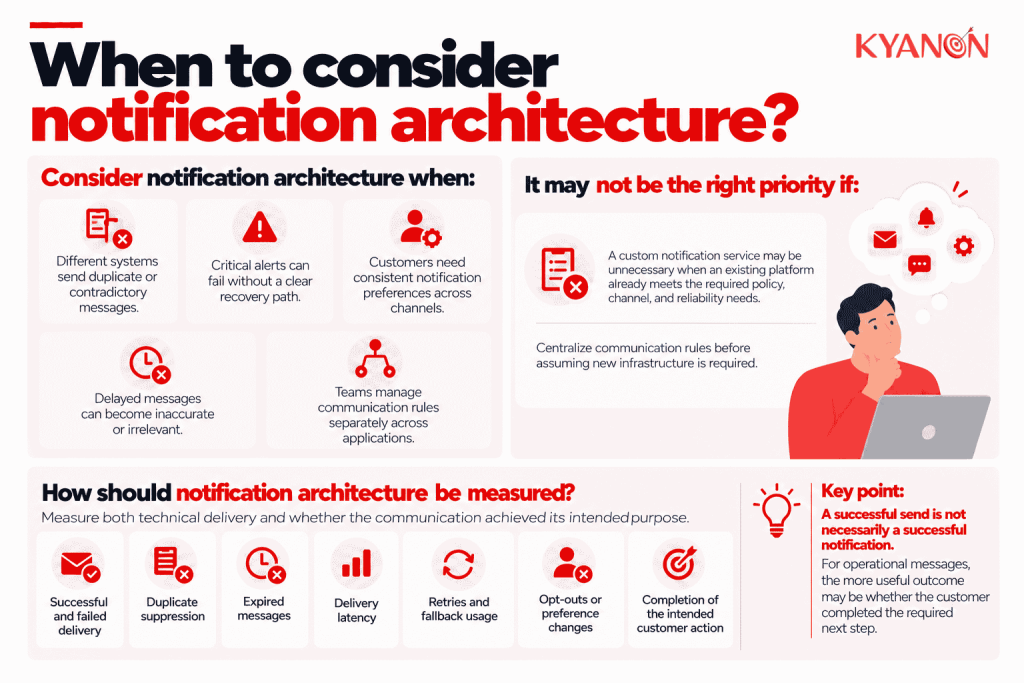
Consider notification architecture when:
- Different systems send duplicate or contradictory messages
- Critical alerts can fail without a clear recovery path
- Customers need consistent notification preferences across channels
- Delayed messages can become inaccurate or irrelevant
- Teams manage communication rules separately across applications
It may not be the right priority if:
A custom notification service may be unnecessary when an existing platform already meets the required policy, channel, and reliability needs. Centralize communication rules before assuming new infrastructure is required.
How should notification architecture be measured?
Measure both technical delivery and whether the communication achieved its intended purpose.
Useful measures include:
- Successful and failed delivery
- Duplicate suppression
- Expired messages
- Delivery latency
- Retries and fallback usage
- Opt-outs or preference changes
- Completion of the intended customer action
A successful send is not necessarily a successful notification. For operational messages, the more useful outcome may be whether the customer completed the required next step.
Why notification architecture matters for digital customer journeys
Notifications often connect a change in business state with the customer’s next action. An order becomes ready. A payment fails. A booking changes. A reward approaches expiry. A service case requires more information.
Poor notification architecture can turn these useful events into missed, duplicated, contradictory, or outdated messages. The objective is therefore not maximum message volume. It is reliable delivery of relevant information, while that information can still help the customer act.
Case study: How did Kyanon Digital build notification architecture for a retail loyalty platform?

Kyanon Digital supported a retail brand’s loyalty-platform transformation with a modular notification architecture for different customer communication scenarios.
- Challenges: The platform needed more relevant customer communication across different loyalty events and message types.
- Solutions: KD designed notification capabilities for new rewards, expiring benefits, tier milestones, personalized reminders, and campaigns, supported by scheduling, targeting, and behavioral tracking.
- Results & impacts: The architecture enabled more contextual communication and created stronger behavioral data for measuring customer engagement.
This demonstrates how notification architecture can connect customer events, communication rules, delivery, and behavioral feedback within a wider digital platform.
Common misconceptions
“A successful API response means the customer received the notification.”
Reality: It may mean only that the delivery provider accepted the request. Track the delivery states available and the customer outcome where relevant.
“Every update should be sent through every channel.”
Reality: Channel choice should reflect purpose, urgency, customer preferences, and the consequences of missed delivery. Repetition can create unnecessary noise.
“Every business event should trigger a notification.”
Reality: An event indicates that something happened. Relevance, urgency, customer preference, communication priority, and current state should determine whether the customer needs to be notified.
How Kyanon Digital applies notification architecture
Kyanon Digital designs notification architecture as part of connected digital platforms, linking customer and operational events with communication rules, targeting, scheduling, delivery channels, and outcome tracking.
Depending on the use case, this can include preference management, suppression, message categorization, delivery integration, behavioral tracking, and controls for preventing irrelevant or unintended communication.
The objective is a governed communication flow: Event → Decision → Delivery → Outcome
Explore Kyanon Digital’s custom software development services.

 Create project brief with AI