
What is omnichannel CX?
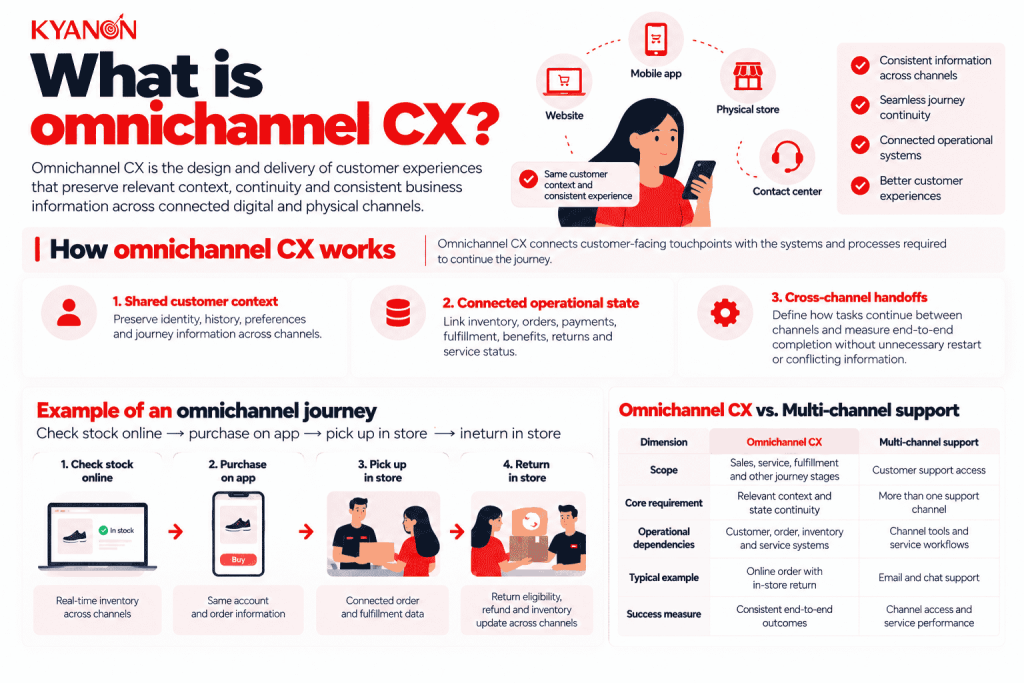
Omnichannel CX is the design and delivery of customer experiences that preserve relevant context, continuity, and consistent business information across connected digital and physical channels.
IBM similarly describes omnichannel customer experience as seamless interaction across interconnected channels and touchpoints rather than separate channels operating in silos.
For businesses, the key requirement is not simply being present on multiple channels. It is whether the customer’s task, context, and relevant business state can continue when the channel changes.
How omnichannel CX works
Omnichannel CX connects customer-facing touchpoints with the systems and processes required to continue the journey.
Shared customer context
Preserve relevant identity, history, preferences, and journey information so customers do not unnecessarily repeat themselves when moving between channels.
Connected operational state
Customer context alone is not enough. Journeys may depend on current inventory, orders, payments, fulfillment, benefits, returns, or service status.
A 360-degree customer profile can identify the customer, but operational context determines whether the next step can actually be completed.
Cross-channel handoffs
Define how tasks continue between the website, app, store, contact center, and other touchpoints. Measure whether the customer completes the journey without unnecessary restart, conflicting information, or manual intervention.

What does an omnichannel journey look like?
Consider a customer who checks stock online, purchases through an app, collects the order in store, and later returns it at the same store.
A connected journey requires the relevant product, inventory, order, fulfillment, and return information to remain usable across those steps.
Simply offering a website, app, store, and support channel does not make the experience omnichannel if the customer must restart the task or receives conflicting information.
What should businesses connect first for omnichannel CX?
Start with the cross-channel journey creating the most customer or operational friction.
For example:
- Buy online, pick up in store: Customer → Product → Inventory → Order → Fulfillment
- Buy online, return in store: Customer/Order → Return eligibility → Refund → Inventory update
Identify which systems control these states and connect what the journey actually requires. The objective is minimum sufficient continuity for the journey, not maximum system integration.
Omnichannel CX vs. multi-channel support
Omnichannel CX coordinates a connected customer journey; multi-channel support provides assistance through several channels, which may still operate separately.
| Dimension | Omnichannel CX | Multi-Channel Support |
Scope | Sales, service, fulfillment, and other journey stages | Customer support access |
| Core requirement | Relevant context and state continuity | More than one support channel |
Operational dependencies | Customer, order, inventory, and service systems | Channel tools and service workflows |
| Typical example | Online order with in-store return | Email and chat support |
Success measure | Consistent end-to-end outcomes | Channel access and service performance |
Multi-channel provides more ways to interact. Omnichannel preserves continuity when customers move between them.
When to consider omnichannel CX
Consider omnichannel CX when:
- Customers repeatedly restart tasks after changing channels
- Online and physical channels show conflicting inventory, order, or benefit information
- Cross-channel fulfillment or returns require manual coordination
- Service teams cannot access relevant context from previous interactions
It may not be the right priority if:
A broad omnichannel transformation may be unnecessary when there is no valuable cross-channel journey to improve. Start with a specific handoff causing measurable customer or operational friction.
Why omnichannel CX matters for retail and consumer businesses
Omnichannel CX connects customer promises with the operations required to fulfill them.
For example, returning an online order in store requires the store team to retrieve the order, verify the applicable policy, process the refund, and update inventory correctly.
A consistent website, app, and store interface cannot compensate for conflicting order, inventory, or fulfillment data. The business value comes from reducing friction between channels while preserving accurate customer and operational context.
Case study: How did Kyanon Digital enable omnichannel CX for a Singapore retailer?
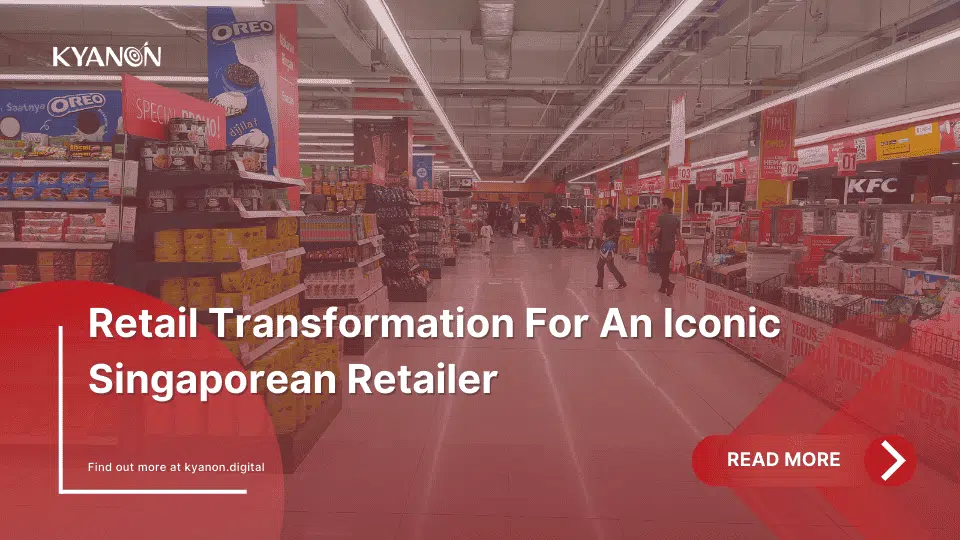
Kyanon Digital supported an iconic Singapore retailer in connecting its digital and physical shopping journeys.
- Challenges: Disconnected online and store systems created friction across O2O shopping, inventory, fulfillment, and returns.
- Solutions: KD connected the eStore, mobile app, CRM, PIM, OMS, WMS, fulfillment systems, and mobile POS.
- Results & impacts: Customers can buy online and pick up in store, return online purchases in store, or shop in store and have products delivered through connected inventory and fulfillment operations.
The case shows that omnichannel CX depends on connecting the customer journey with the operational systems required to complete it.
Common misconceptions
“Being on every channel makes us omnichannel.”
Reality: Channel presence does not create continuity. Relevant customer and operational information must support the transition.
“We must replace every system to become omnichannel.”
Reality: A high-value journey can often be improved through selected integrations and workflow changes without replacing the entire technology stack.
“A 360-degree customer view makes us omnichannel.”
Reality: Customer identity and history are only part of the requirement. Inventory, orders, payments, fulfillment, benefits, and service state may also determine whether the journey can continue.
How Kyanon Digital applies omnichannel CX
Kyanon Digital designs omnichannel customer experiences by connecting customer-facing touchpoints with the commerce, customer, inventory, order, fulfillment, and service systems behind them.
The work focuses on continuity requirements such as online-to-store purchasing, cross-channel returns, real-time inventory visibility, and connected customer information rather than adding channels in isolation.
The objective is to make the journey work across both the experience layer and operational layer.
Explore Kyanon Digital’s omnichannel ecommerce services.

 Create project brief with AI