
What is a Vision Transformer (ViT)?
A Vision Transformer (ViT) is a deep learning architecture that processes images by dividing them into a sequence of fixed-size patches and applying self-attention mechanisms to compute the global relationships between those visual elements. This framework adapts the transformer model from natural language processing to computer vision, achieving high classification accuracy on large-scale datasets.

How the Vision Transformer works
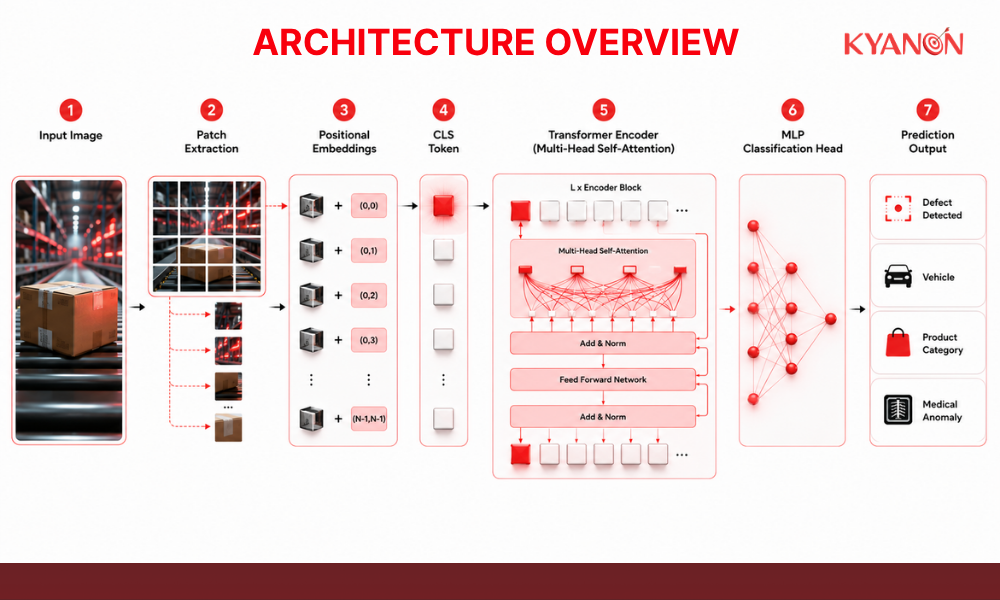
The Vision Transformer bypasses traditional pixel-by-pixel convolution by treating localized image sections as sequential data tokens. It extracts features by evaluating how every patch relates to every other patch simultaneously, establishing a comprehensive global mathematical understanding of the entire visual frame.
Patch extraction and projection
The system divides a standard image into a grid of smaller, uniform patches and flattens them into linear vectors. This step translates two-dimensional spatial data into a one-dimensional sequence that the transformer can process.
Positional embeddings
Because transformers process all tokens simultaneously without inherent spatial awareness, the architecture appends specific mathematical markers to each flattened patch. This ensures the model retains the original structural layout and neighborhood information of the image.
Classification token (CLS token)
A learnable classification token (CLS token) is appended to the patch sequence before transformer processing begins. During inference, this token aggregates contextual information from every visual patch and serves as the primary representation for final image classification tasks.
Transformer encoder blocks
The embedded patch sequence passes through multiple transformer encoder blocks composed of multi-head self-attention (MHSA), normalization layers, and feed-forward neural networks. These encoder layers iteratively refine the mathematical relationships between visual regions across the entire image.
Multi-head self-attention mechanism
Instead of relying on a single attention mapping, the Vision Transformer applies multiple attention heads simultaneously. This multi-head self-attention mechanism allows the model to capture different structural and semantic relationships in parallel, improving contextual understanding of complex scenes.
The model calculates importance weights across all patches concurrently during processing. This allows the neural network to recognize structural dependencies between distant visual elements without being constrained by a localized receptive field.
MLP classification head
After encoder processing, the final CLS token representation is forwarded into a multilayer perceptron (MLP) head that generates prediction probabilities for downstream tasks such as image classification, anomaly detection, or object recognition.

Vision Transformer (ViT) vs Convolutional Neural Network (CNN)
Both architectures perform image classification, but they differ fundamentally in how they extract and evaluate spatial features.
Dimension | Vision Transformer (ViT) | Convolutional Neural Network (CNN) |
| Feature Extraction | Global self-attention | Localized convolution filters |
| Inductive Bias | Low (Learns spatial layout from scratch) | High (Assumes spatial locality) |
| Data Efficiency | Requires massive datasets (Often >14M images) | Performs well on small/medium datasets |
| Scalability | Scales efficiently with model size | Scaling yields diminishing returns |
| Best For | Complex multi-modal tasks, massive datasets | Edge deployment, localized feature detection |
When to consider a Vision Transformer
Consider a Vision Transformer if:
- Your engineering team possesses massive, labeled datasets to train models effectively without relying on rigid spatial inductive biases.
- Your enterprise application requires complex scene understanding, where the relationship between distant objects in a frame dictates the classification outcome.
- You are building multi-modal AI systems that require a unified transformer architecture to process both textual and visual inputs simultaneously.
It may not be the right priority if:
- Your project involves small or medium-sized datasets where traditional convolutional models offer higher data efficiency and a significantly lower risk of overfitting.
Why Vision Transformers matter for digital commerce
For technology executives, adopting transformer-based vision models reduces architectural fragmentation by unifying text and image processing under a single mathematical framework. This consolidation accelerates feature deployment for advanced visual analytics and drives higher conversion rates in automated quality control or visual search applications.
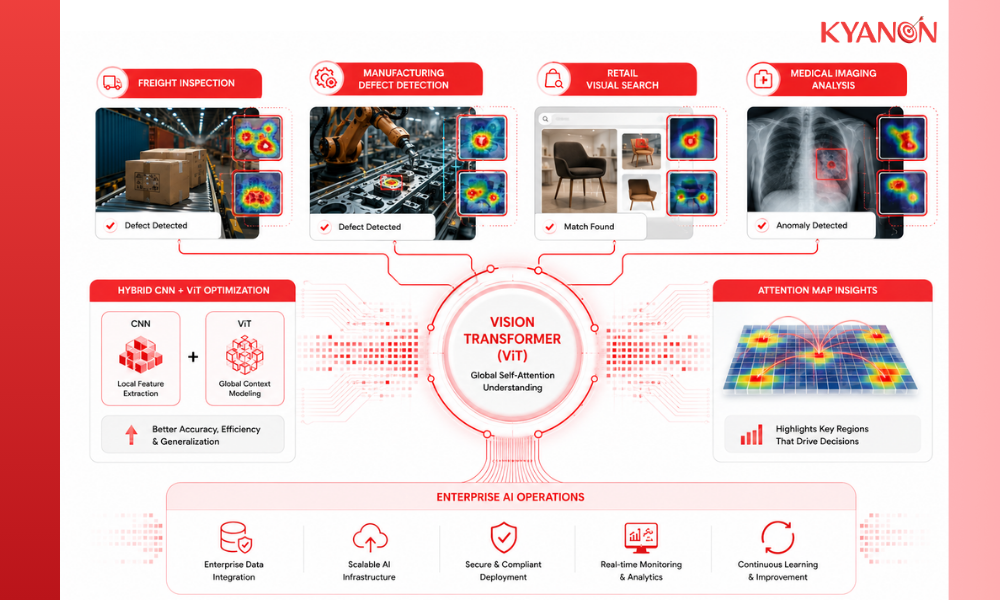
Vision Transformers increasingly support enterprise document intelligence, automated freight inspection, medical imaging analysis, and warehouse robotics by improving contextual understanding across visually complex environments. Their compatibility with unified transformer architectures also simplifies integration with large language models and multi-modal AI systems.
Supporting evidence
According to Forrester (2025), enterprises deploying transformer-based vision architectures observe a 40% reduction in long-term model maintenance costs by standardizing multi-modal data pipelines. A logistics provider in Singapore applied a Vision Transformer for automated freight inspection, resulting in a 25% improvement in defect detection accuracy over legacy systems. This demonstrates how advanced architectural choices translate directly to measurable operational efficiency.
Common misconceptions
“Vision Transformers completely replace traditional CNNs.”
Reality: Convolutional networks remain highly relevant and are often preferred for restricted computing environments or smaller datasets due to their data efficiency. Hybrid approaches combining local feature extraction with global attention are currently the most effective configuration for enterprise deployment.
“ViT models are inherently inefficient and too heavy for production.”
Reality: While original architectures are computationally demanding, optimized lightweight variants utilize token reorganization and pruning to achieve high inference speeds. These adjustments allow Vision Transformers to run efficiently with low computational costs suitable for specific edge environments.
How Kyanon Digital applies Vision Transformers
Kyanon Digital applies Vision Transformers in enterprise computer vision projects across Southeast Asia, where accuracy on complex visual tasks exceeds traditional approaches. Our engineering teams optimize hybrid architectures, balancing data efficiency and global attention mechanisms to deliver measurable improvements in classification without escalating infrastructure TCO.
Kyanon Digital also applies parameter-efficient fine-tuning approaches such as lightweight adapter optimization and low-rank adaptation strategies to customize pre-trained visual transformer models for industry-specific datasets without incurring excessive infrastructure costs.
→ Explore our Custom Computer Vision Software Development Services

 Create project brief with AI