
What is a Retention Strategy?
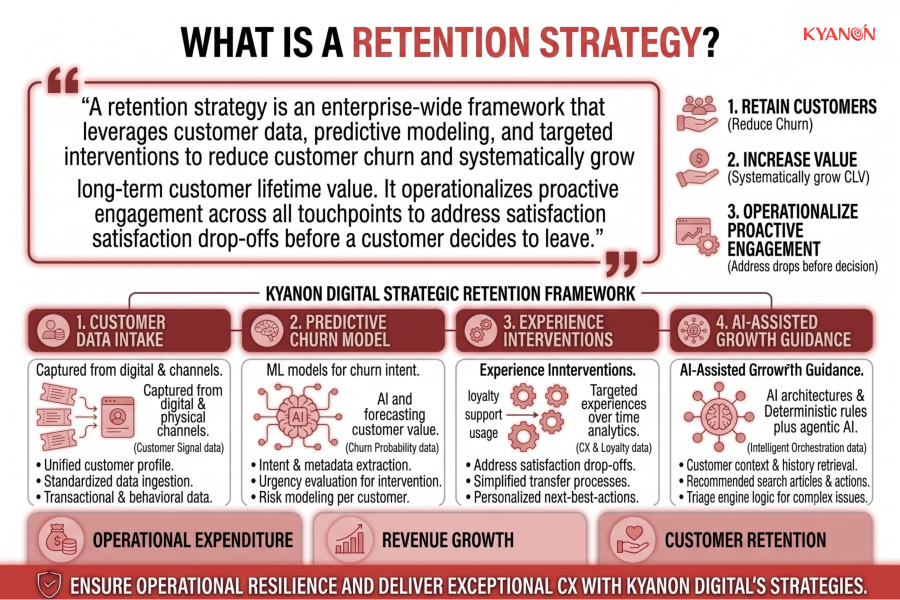
A retention strategy is an enterprise-wide framework that leverages customer data, predictive modeling, and targeted experience interventions to reduce customer churn and systematically grow long-term customer lifetime value. It operationalizes proactive engagement across all touchpoints to address satisfaction drop-offs before a customer decides to leave.
How Retention Strategy Works
Modern retention strategies help businesses identify when customers may be losing interest and take action before they decide to leave.
By bringing together customer behavior, support activity, and account information, businesses can move from reacting to churn to addressing potential issues earlier.
By continuously monitoring customer signals and risk levels, enterprises can deliver automated, personalized interventions at the right time.
Monitoring Customer Behavior
The system brings together customer activity from different sources to identify changes that may indicate declining engagement.
Common signals include:
- Product usage drops, such as fewer logins or lower feature usage
- More support requests or unresolved issues
- Changes in subscription plans or payment activity
- Reduced engagement with key services or features
Looking at these signals together gives businesses a clearer picture of customer health.
Identifying At-Risk Customers
Customer activity is compared with previous patterns to identify accounts that may be at risk of leaving.
Customers can then be grouped into different risk levels, such as:
- Low risk
- Medium risk
- High risk
This helps customer-facing teams focus their efforts where they are most needed instead of treating every customer the same way.
Taking Action at the Right Time
When a customer shows signs of disengagement, the business can respond with actions that match the customer’s situation.
For example:
- Customer success teams can reach out directly
- Users can receive guidance on features that may help them
- Businesses can offer support when technical issues are affecting the experience
- Relevant content or recommendations can encourage continued engagement
The goal is to address customer concerns early and make it easier for them to continue getting value from the product or service.

Comparative Analysis: Reactive Churn Mitigation vs. Predictive Retention Architecture
Dimension | Reactive Churn Mitigation | Predictive Retention Architecture |
| Intervention Timing | Post-cancel request | Continuous, real-time behavioral triggers |
Primary Metric | Immediate save rate | Customer Lifetime Value (CLV) |
| Data Architecture | Siloed, channel-specific logs | Unified real-time Customer Data Platform |
Primary Mechanism | Manual discounts & save teams | Automated contextual next-best-experience |
| Operational Impact | High churn, elevated service cost | Scalable retention, lower cost-to-serve |
Why Retention Strategy Matters
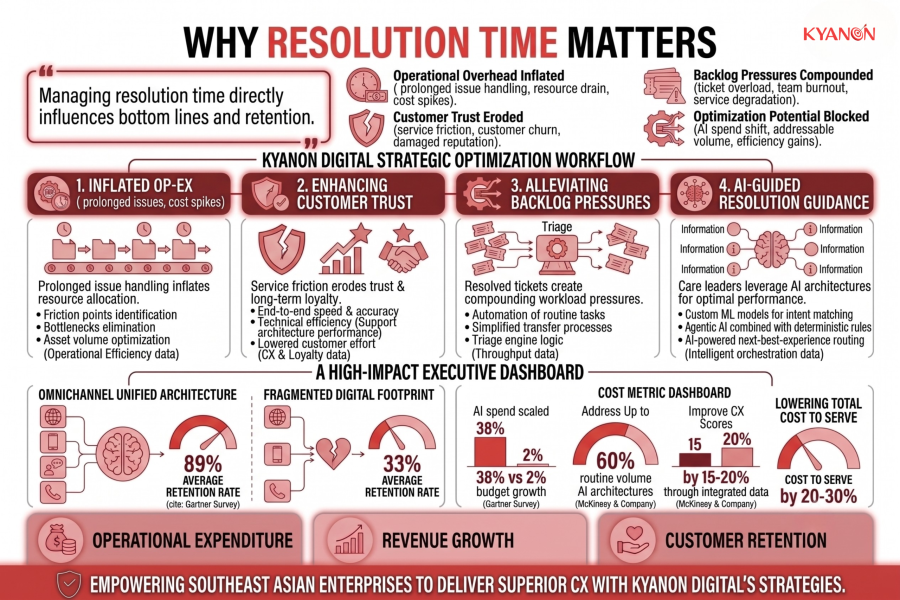
Executing a modern retention strategy enables enterprise leaders to protect revenue margins, minimize customer acquisition pressures, and drive compound top-line expansion through existing account bases.
Deploying unified lifecycle data directly forms the foundation of real-time churn prevention algorithms. According to McKinsey & Company, calibrating AI models to access integrated datasets across the entire customer lifecycle improves overall customer satisfaction metrics by 15% to 20%. Implementing AI-powered next-best-experience routing systems scales top-line revenue by 5% to 8% while simultaneously lowering the total cost to serve by 20% to 30%.
Beyond cost containment, long-term retention performance depends on channel cohesion and focus on long-term value creation. Research from Gartner reveals that high-growth enterprise organizations prioritize customer lifetime value as their primary growth indicator, whereas low-growth entities remain focused on basic, reactive churn reductions. Furthermore, enterprises executing coordinated omnichannel experience models maintain an average 89% retention rate, compared to a 33% retention rate for organizations with fragmented digital footprints.
Common Misconceptions
Retention starts when a customer is about to leave
If an organization waits until a customer initiates a cancellation flow to address dissatisfaction, the customer has usually disengaged weeks or months prior. Last-minute discount codes and aggressive save-teams address symptoms rather than root causes, whereas sustainable retention is established on day one through frictionless onboarding and consistent service quality.
If customers aren’t complaining, they are happy and staying
The vast majority of dissatisfied customers never submit support tickets or register complaints; they simply cease product usage and quietly transition to alternative vendors. Evaluating account health based purely on ticket volumes creates a false sense of security, making proactive telemetry and usage tracking necessary to identify silent churn risks.
A great loyalty program will fix a bad customer experience
Reward points and cashback initiatives cannot compensate for persistent software bugs, delayed deliveries, or poor customer support. Treating loyalty rewards as a substitute for core operational quality fails to stem churn, as loyalty mechanisms are effective only as value additions to an already reliable product experience.
We should make it as hard as possible for them to cancel
Forcing customers through convoluted cancellation flows and lengthy phone queues generates friction that destroys remaining brand goodwill. While restrictive cancellation steps may temporarily delay churn, they eliminate any potential for future customer win-backs and drive negative public feedback.
How Kyanon Digital Applies Retention Strategy
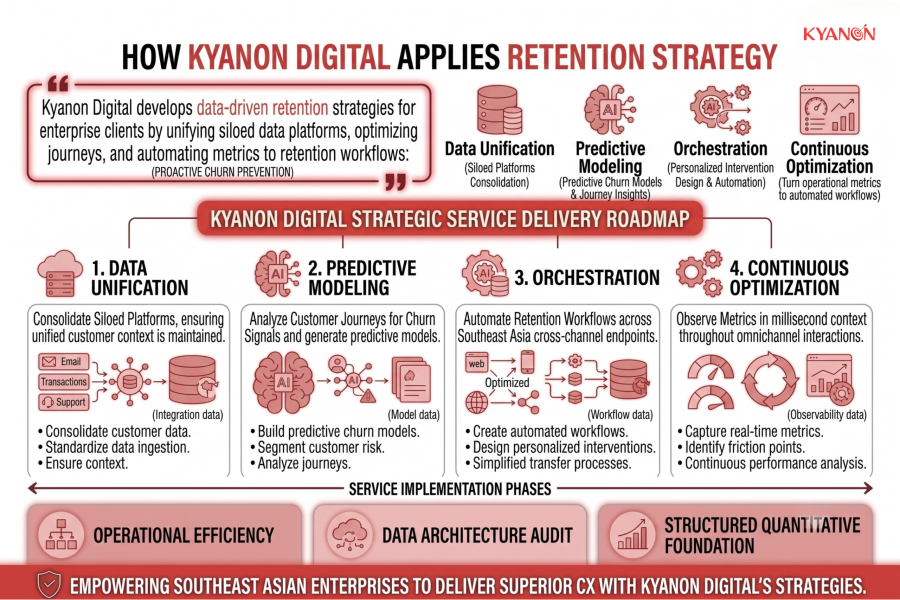
Kyanon Digital develops data-driven retention strategies for enterprise clients using predictive churn modeling and personalized intervention design. We unify siloed data platforms, optimize cross-channel customer journeys, and build custom integration layers that turn real-time operational metrics into automated retention workflows.
Explore our services:

 Create project brief with AI