
What is Weight (Neural Network)?
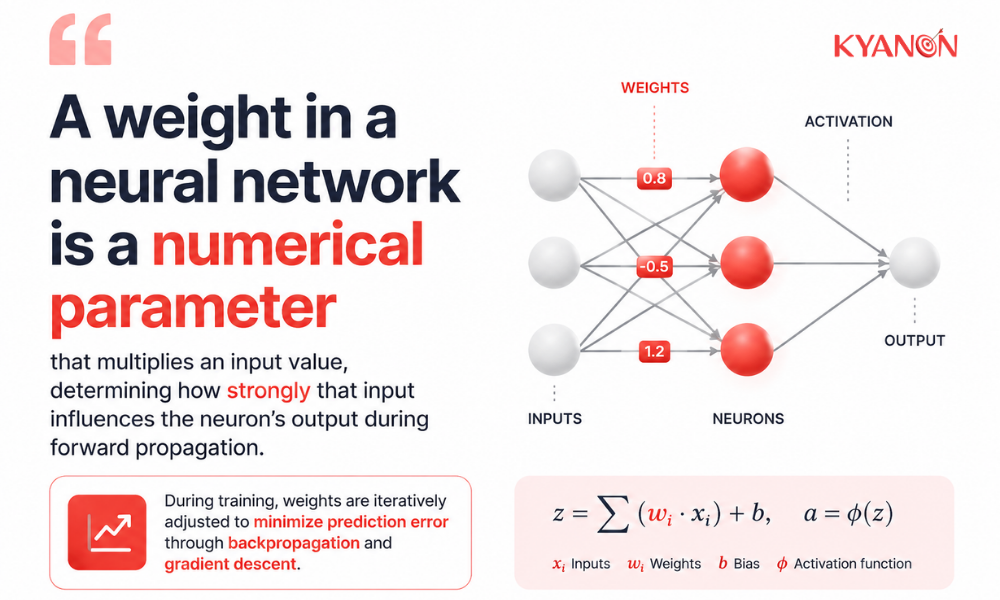
A weight in a neural network is a numerical parameter that multiplies an input value, determining how strongly that input influences the neuron’s output during forward propagation. During training, weights are iteratively adjusted to minimize prediction error through backpropagation and gradient descent.
How Weight (Neural Network) works
Weights act as adjustable coefficients inside neurons, transforming raw inputs into meaningful activations.
Mathematical operation inside a neuron
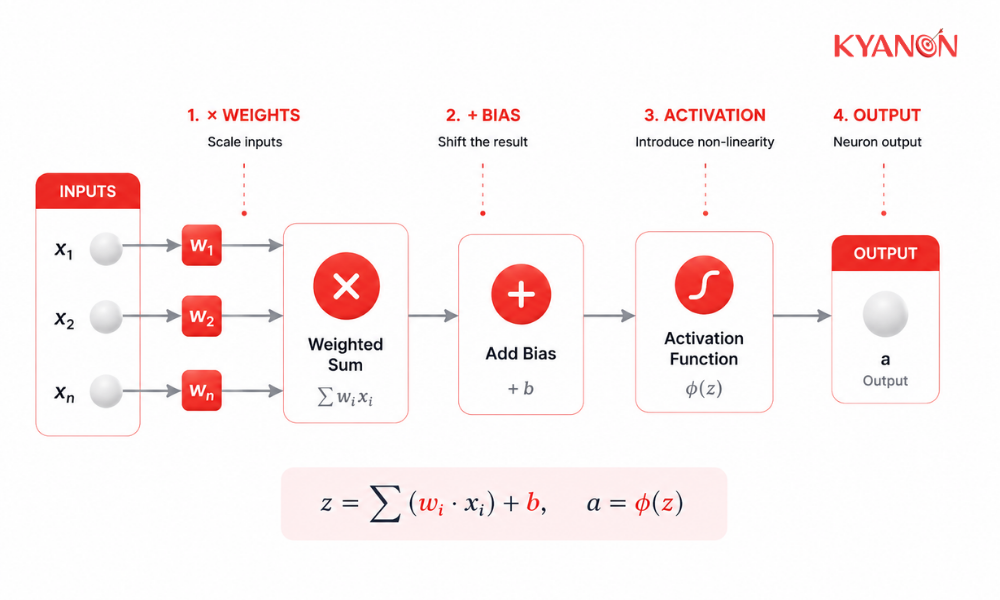
A neuron computes its output using the equation:
z = ∑ (wi x xi) + b, a = ϕ(z)
Where xi are inputs, wi are weights, b is bias, and ϕ is a non-linear activation function such as ReLU or Sigmoid.
Weights mathematically transform the original input feature space into a new representation space before non-linear activation is applied.
This transformation is what allows deep networks to learn complex patterns rather than simple linear relationships.
Gradient update via backpropagation
During backpropagation, each weight is updated based on the multivariate total derivative of the loss function because early-layer weights influence multiple downstream paths simultaneously.
Regularization
Techniques such as L2 regularization (weight decay) intentionally constrain weight magnitude to reduce overfitting and improve generalization.

The mechanics of weight optimization
Training a neural network is a continuous loop of adjusting weights to minimize prediction error.
Step 1: Forward propagation
The model computes predictions using current weight values.
Step 2: Loss evaluation
A loss function measures the numerical gap between prediction and ground truth.
Step 3: Backpropagation
The network computes gradients of the loss with respect to every weight.
Step 4: Gradient descent update
wnew = wold – α x ∂Loss/∂w
Where α is the learning rate controlling how large a step the model takes during optimization.
Key strategies for weight optimization
| Strategy | Optimization purpose | How it works |
| Smart Initialization | Prevents symmetric learning and dead neurons | Xavier/Glorot or He initialization samples weights from controlled distributions |
| Weight Regularization | Prevents overfitting | L1/L2 penalties constrain weight growth |
| Weight Pruning | Improves deployment efficiency | Removes near-zero weights to compress model size |
| Weight Quantization | Reduces memory & hardware cost | Converts 32-bit weights into lower-precision formats like 8-bit integers |
Weight (Neural Network) vs Bias (Neural Network)
Both parameters shape neuron behavior, but weights scale inputs while biases shift activation thresholds.
Dimension | Weight | Bias |
| Functional role | Scales input value | Shifts the activation threshold |
| Effect when input = 0 | No effect | Still affects output |
| Mathematical analogy | Slope | Intercept |
| Sensitivity to feature scale | High | Low |
| Impact on model expressiveness | Controls feature influence | Controls firing condition |
When to consider Weight (Neural Network)
Consider weight optimization focus if:
- Model accuracy stalls despite more data, often linked to poor initialization or unstable weights.
- Overfitting appears even with large datasets, commonly caused by unmanaged weight magnitude.
- Fine-tuning pre-trained models requires predictable convergence.
It may not be the right priority if:
- The project is still validating problem–solution fit, and model performance is not yet a constraint.
Why Weight (Neural Network) matters for retail & e-commerce AI
In retail analytics, recommendation engines, demand forecasting, and computer vision rely on millions of weights encoding statistical relationships between customer behavior, products, and context.
Supporting evidence
According to Xavier Glorot and Yoshua Bengio (2010), improper weight initialization can cause vanishing or exploding gradients, severely slowing convergence in deep networks.
A Southeast Asian retailer improved recommendation accuracy and reduced retraining time after applying controlled initialization and weight decay during model retraining, demonstrating a direct impact on time-to-market and conversion.
Common misconceptions
“Backpropagation is just applying the simple chain rule.”
Reality: Backpropagation uses the multivariate total derivative because each weight influences multiple computational paths in parallel.
“Starting all weights at zero is a neutral baseline.”
Reality: Zero initialization causes neurons to learn identical features due to symmetry, collapsing model capacity.
“Large weights mean important features.”
Reality: Weight magnitude depends on the input scale and often indicates overfitting rather than importance.
How Kyanon Digital applies Weight (Neural Network)
Kyanon Digital implements disciplined weight initialization, monitoring, pruning, and quantization-aware retraining when building neural models for retail analytics, recommendation systems, and computer vision across Southeast Asia. This approach focuses on stable convergence, reduced model size for deployment, and predictable optimization outcomes.

→ Explore our Insights & Analytics











 Create project brief with AI