
What is Variational Autoencoder (VAE)?
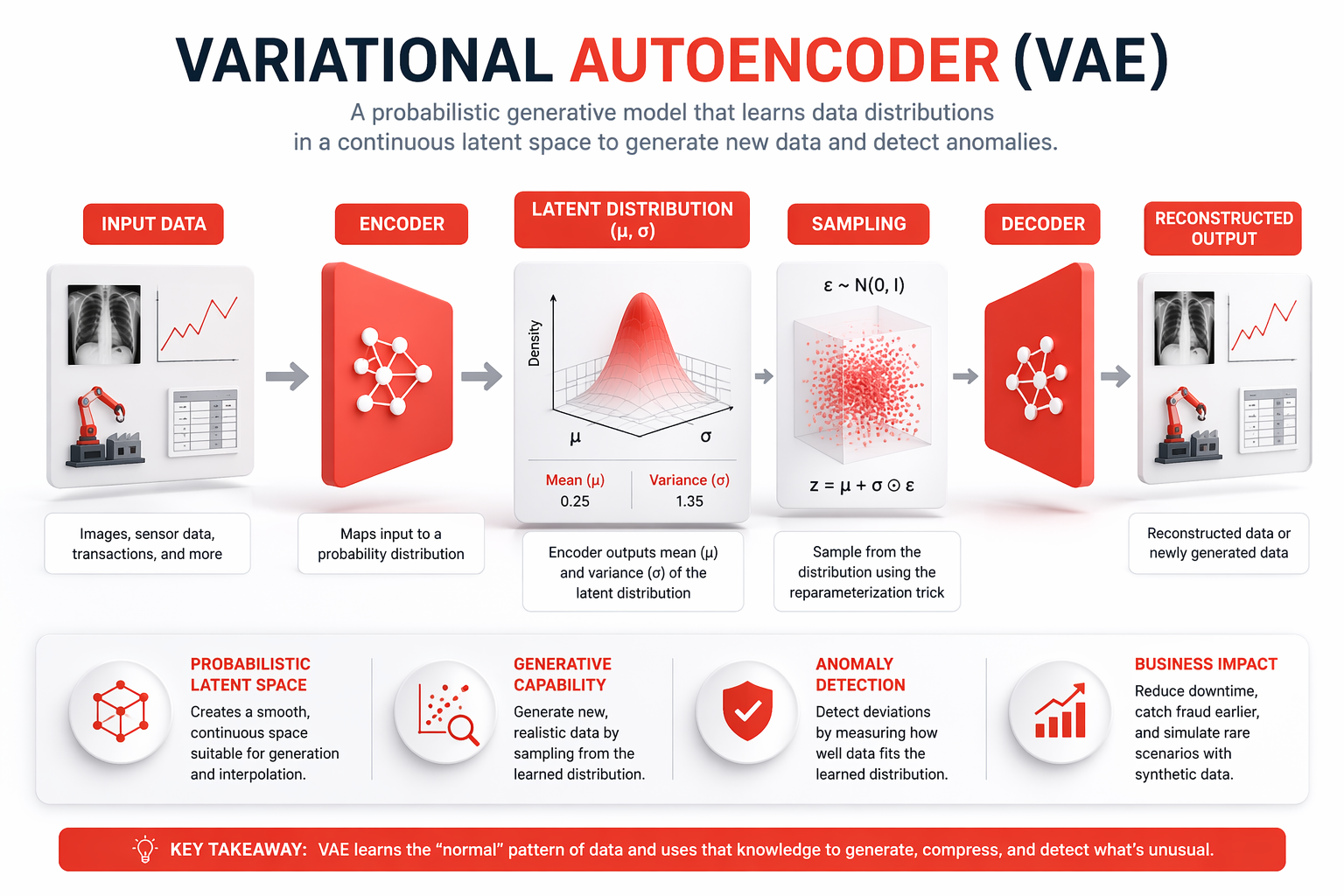
A Variational Autoencoder (VAE) is a probabilistic generative model that encodes input data into a distribution in latent space and reconstructs outputs by sampling from that distribution rather than mapping inputs to fixed representations.
How Variational Autoencoder (VAE) works
A VAE works by learning both how to compress data into a structured latent distribution and how to generate new data by sampling from that distribution, enabling controlled generation and probabilistic reasoning.
Encoder (Inference Network)
The encoder maps input data into a probability distribution defined by mean and variance rather than a single point. This allows the model to capture uncertainty and variability in the data. For enterprise use cases, this is critical when data is noisy or incomplete.
Latent Space Sampling (Reparameterization Trick)
The model samples from the latent distribution using a deterministic transformation that enables gradient-based optimization. This mechanism ensures the model remains trainable while preserving the stochastic behavior required for generation.
Decoder (Generative Network)
The decoder reconstructs data from sampled latent variables, effectively learning how to generate new data points that follow the original data distribution. This enables use cases such as synthetic data generation and anomaly detection.

Variational Autoencoder (VAE) vs Autoencoder (AE)
Both approaches use encoder-decoder architectures, but differ in whether they model deterministic representations or probabilistic distributions.
|
Dimension |
Variational Autoencoder (VAE) | Autoencoder (AE) |
| Latent representation | Probability distribution (mean, variance) | Fixed point |
| Output type | Generative (can create new data) | Reconstruction only |
| Training objective | Reconstruction + distribution regularization | Reconstruction loss only |
| Stability | Stable training | Stable but limited capability |
| Best for | Generative modeling, anomaly detection | Compression, denoising |
| Interpretability | Structured latent space | Less structured |
| Cost model | Higher compute cost | Lower computing cost |
When to consider Variational Autoencoder (VAE)
A VAE is most relevant when the problem requires modeling uncertainty, generating new data, or identifying deviations from learned distributions.
Consider a Variational Autoencoder (VAE) if:
- You need to detect anomalies in high-dimensional data (e.g., manufacturing sensor streams or financial transactions) where rule-based systems fail.
- Your organization is generating synthetic datasets to overcome data scarcity or privacy constraints in regulated industries.
- You require a structured latent space to simulate scenarios or explore variations in product, customer, or operational data.
It may not be the right priority if:
- Your use case only requires deterministic reconstruction or compression without any need for generative capability or probabilistic reasoning.
Why Variational Autoencoder (VAE) matters for enterprise AI
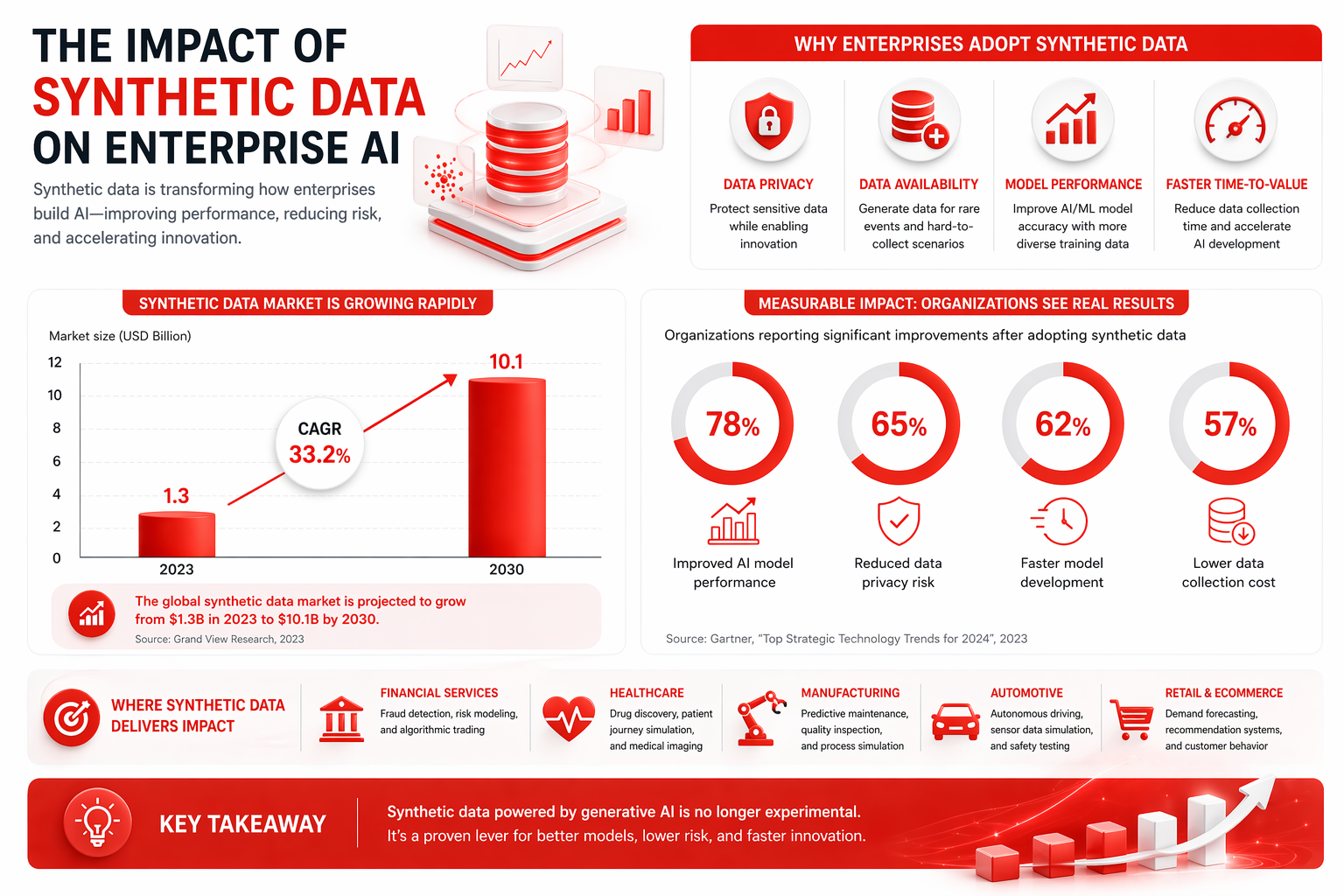
VAEs matter because they enable organizations to model uncertainty and generate realistic synthetic data, which is essential in environments where real data is limited, sensitive, or imbalanced.
Supporting evidence
According to Gartner (2023), synthetic data is projected to account for 60% of all data used in AI projects by 2024, indicating a structural shift toward generative modeling approaches such as VAEs.
A financial services firm in Southeast Asia applied VAE-based anomaly detection to transaction data, reducing false positives in fraud detection while maintaining detection coverage. This demonstrates how probabilistic modeling translates into measurable operational efficiency.
Common misconceptions
“VAE is just a regularized autoencoder”
Reality: A VAE is fundamentally a probabilistic model that learns distributions, not just compressed representations. Treating it as a regular autoencoder leads to incorrect assumptions about its outputs and capabilities.
“VAEs are outdated compared to GANs”
Reality: VAEs and GANs solve different problems; VAEs are preferred when stability, interpretability, and a structured latent space are required. In enterprise settings like anomaly detection or simulation, VAEs are often the more reliable choice.
How Kyanon Digital applies Variational Autoencoder (VAE)
Kyanon Digital applies VAEs in enterprise AI projects involving anomaly detection and generative modeling, particularly in manufacturing and financial data environments across Southeast Asia and ANZ markets. The implementation typically combines VAEs with modern ML frameworks (e.g., TensorFlow, PyTorch) and integrates them into production data pipelines to ensure measurable outcomes such as reduced false positives and faster model deployment cycles.
→ Explore our Machine Learning Services

 Create project brief with AI