
What is a Vector Database?
A vector database is a specialized data management system designed to store, index, and retrieve high-dimensional numerical representations of data known as embeddings. Unlike traditional databases that rely on exact keyword matches, vector databases utilize mathematical distance metrics to identify items with similar semantic meaning within a multidimensional space.
How a Vector Database Works
The core mechanism of a vector database involves converting unstructured data, such as text, images, or audio, into numerical arrays, known as vectors, through an embedding model. These vectors are mapped in a latent space where the physical proximity of two points represents their conceptual similarity. To maintain high performance, these databases employ specialized indexing algorithms, such as Hierarchical Navigable Small World (HNSW), to perform Approximate Nearest Neighbor (ANN) searches.
Embedding model
The embedding model serves as a translator, converting raw data into high-dimensional numerical representations. These models capture conceptual nuances, allowing related items to be clustered together in the database, even if they do not share the same keywords.
Vector indexing
Vector databases use specialized indexing structures to organize high-dimensional points for rapid retrieval. These indices, such as HNSW, allow the system to navigate millions of vectors efficiently by narrowing the search area without comparing a query against every record.
Similarity metrics
Similarity metrics, such as Cosine Similarity or Euclidean Distance, provide the mathematical formula for ranking results. These metrics measure the distance between the user’s query vector and the stored data vectors to determine the most relevant matches.

Vector Database vs Relational Database
While relational databases excel at structured business logic, vector databases are essential for processing unstructured data in AI applications.
Dimension | Vector Database | Relational Database (SQL) |
| Data type | Unstructured (text, images) | Structured (rows, columns) |
| Query method | Semantic similarity | Exact match / Logic |
| Accuracy | Probabilistic (ANN) | Deterministic (exact) |
| Search latency | Low (scales with dimensions) | Low (scales with records) |
| Best for | RAG, semantic search | Transactions, business logic |
| Cost model | High (memory-intensive) | Low (disk-intensive) |
Types of Vector Database infrastructure
Organizations typically adopt either dedicated vector engines or hybrid relational systems with vector search extensions.
| Type | Examples | Best For |
| Dedicated Vector Databases | Pinecone, Milvus, Weaviate, Qdrant | Large-scale AI workloads requiring high-performance similarity search across billions of vectors |
| Hybrid & Relational Extensions | PostgreSQL with pgvector, Databricks Mosaic AI, Azure AI Search | Enterprises seeking to combine structured operational data with vector search within a unified stack |
This hybrid architecture is increasingly common in enterprise environments where semantic retrieval must coexist with transactional business systems.
When to consider a Vector Database
Consider a Vector Database if:
- You are implementing Retrieval-Augmented Generation (RAG) to provide Large Language Models (LLMs) with access to proprietary enterprise data.
- Your platform requires a semantic search engine that understands user intent and conceptual relationships rather than just keyword frequency.
- You need to perform cross-modal retrieval, such as using text queries to search through a massive library of images or videos.
It may not be the right priority if:
- Your primary use case involves transactional data integrity, such as financial accounting, where exact matching and deterministic logic are required.
Why Vector Databases matter for digital commerce
For enterprise leaders, vector databases unlock the value of unstructured data, turning static documents and product catalogs into active knowledge bases. This technology serves as the backbone for high-performance recommendation engines and personalized customer experiences that drive conversion.
Supporting evidence
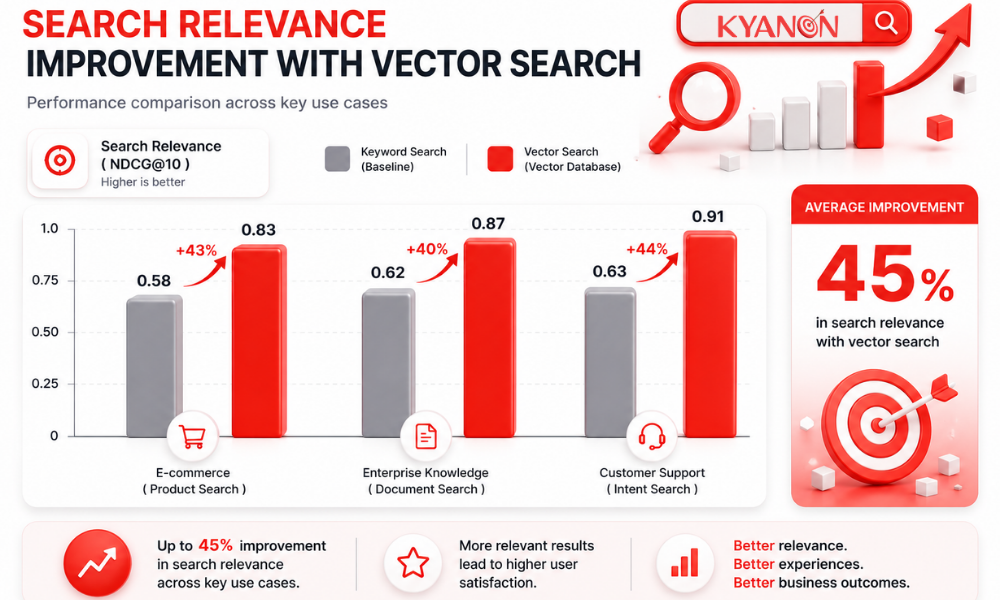
According to Gartner (2024), the rapid adoption of Generative AI has made vector databases a critical component of the modern data stack, with over 80% of enterprise AI projects expected to require vector storage by 2026. This reflects a shift toward “Knowledge Retrieval” as a primary competitive advantage in regional markets.
In ANZ, a leading e-commerce provider applied a vector database to their product discovery engine, resulting in a 25% increase in search-to-cart conversion. This demonstrates how vector databases translate from complex mathematical structures into measurable business impact.
Common misconceptions
“Vector databases possess linguistic understanding.”
Reality: Vector databases process mathematical distance, not language. They identify items that are numerically similar based on the output of an embedding model; if the model is not trained to recognize a specific conceptual relationship, the database will not find it.
“Vector databases replace traditional relational systems.”
Reality: Vector databases are complementary to, not replacements for, SQL databases. Most production systems utilize a hybrid search approach, combining vector similarity for conceptual matching with SQL for structured filters and business logic.
How Kyanon Digital applies Vector Databases
Kyanon Digital implements vector databases like Pinecone, Weaviate, and pgvector as core infrastructure within our Retrieval-Augmented Generation (RAG) and semantic search solutions. Serving clients across Vietnam, Singapore, and ANZ, we focus on deep implementation expertise to ensure these databases are correctly indexed for production scale. Our approach prioritizes TCO by selecting optimal indexing strategies to balance search speed with memory efficiency.
→ Explore our Gen AI Development Services and AI Integration Services

 Create project brief with AI