
What are Weigh (Neural Network)?
In artificial neural networks, weights are the learnable mathematical coefficients that quantify the connection strength between neurons and dictate exactly how much influence specific input data has on the model’s final prediction. In an enterprise context, these specific configurations of trained parameters represent the accumulated logic and core intellectual property of an AI system, acting like a massive array of interconnected volume knobs that amplify or mute specific data signals based on their predictive value.
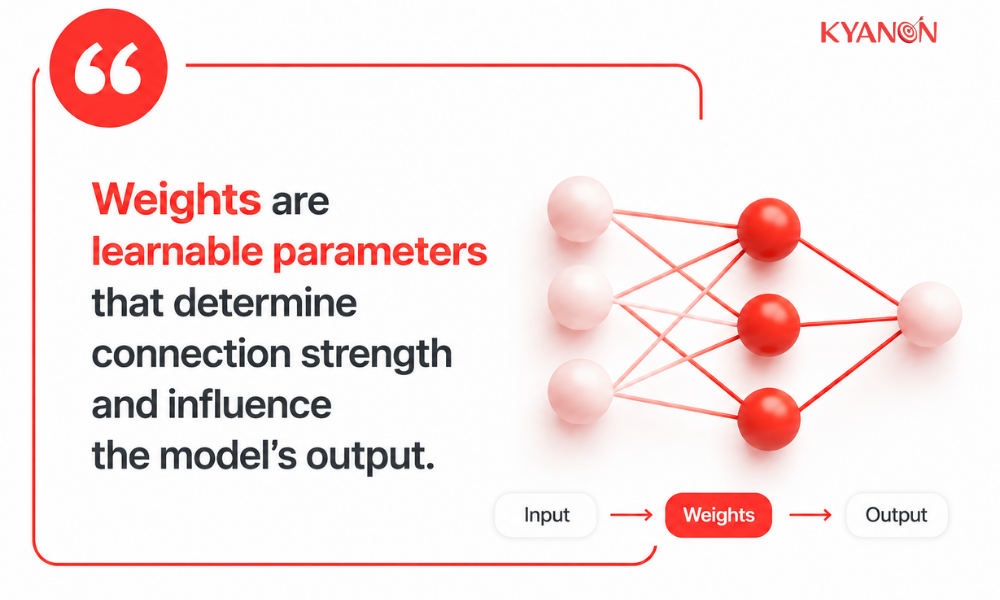
How Weights (Neural Network) work
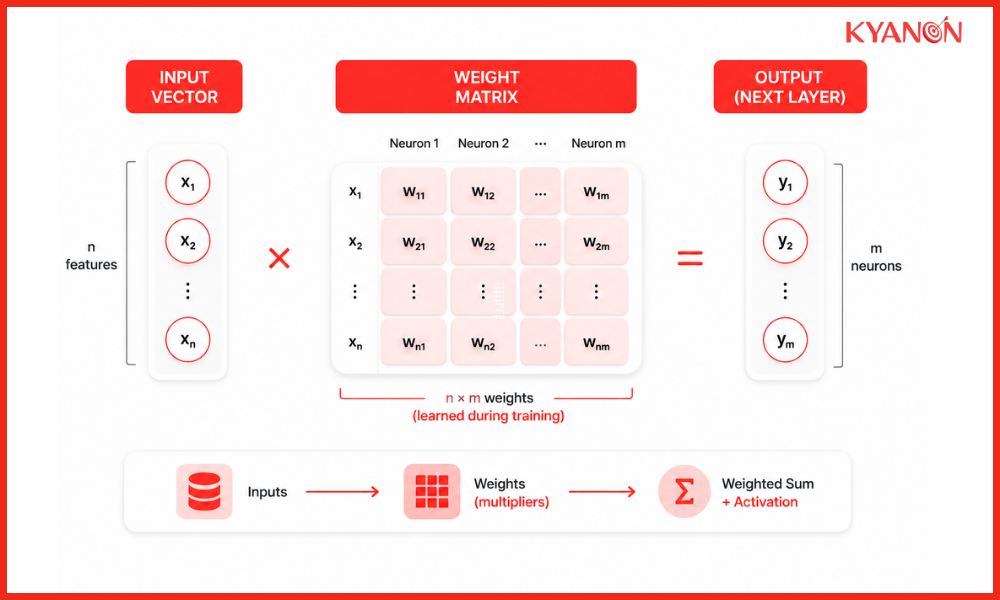
Neural network weights operate as dynamic multipliers within a high-dimensional matrix calculation. During training, optimization algorithms calculate the gradient of the loss function, mathematically adjusting each weight through backpropagation to minimize the system’s prediction error and encode business logic into the model architecture.
Weight initialization
Before training begins, weights must be assigned initial small random values using techniques like Xavier or He initialization to break symmetry. Setting all weights to zero forces every neuron in a hidden layer to perform identical calculations, effectively eliminating the network’s capacity to learn complex patterns.
The decision mechanism
During inference, input features are multiplied by their corresponding weights as data passes through the network layers. If a specific feature highly predicts an outcome, the network assigns a higher weight to that connection, directly controlling the decision boundaries of the AI model.
Weight optimization and compression
To manage infrastructure demands, technical teams apply compression techniques to cut cloud compute costs. Weight pruning removes near-zero or low-impact weights to reduce the computational complexity of the model. Quantization reduces the mathematical precision of the weights by converting them to lower-bit-width representations, thereby shrinking the memory footprint.

Weights vs Biases
Both parameters are adjusted during training to minimize prediction error, but they serve distinct mathematical functions within the network architecture.
Dimension | Weights | Biases |
| Primary function | Multiplies the input data | Added to the weighted sum |
| Geometric effect | Alters the steepness or angle of the activation function | Shifts the activation function left or right |
| Input dependency | Strictly tied to specific input features | Independent of specific input features |
| Zero-input behavior | Nullified entirely if the input data is zero | Guarantees activation capability even if inputs are zero |
| Initialization strategy | Small random numbers to break network symmetry | Often initialized to zero or small constants |
When to consider fine-tuning open weights
Consider optimizing open weights if:
- Your technical team is auditing vendor risks and needs to mitigate platform dependency by migrating from closed-source commercial APIs to locally hosted architectures.
- You possess proprietary enterprise data that a general-purpose model cannot access, and updating existing model weights yields a high return on investment for domain-specific challenges.
- Your engineering teams are tasked with lowering hosting costs and can compress model weights via quantization before rolling systems out to production workloads.
It may not be the right priority if:
- Your business units rely entirely on general reasoning tasks that closed-source commercial APIs handle efficiently without the need to download or inspect the underlying weights.
Why Weights (Neural Network) matter for enterprise AI
Access to and control over model weights directly dictate an organization’s AI sovereignty, deployment costs, and intellectual property. Training a foundation model on proprietary business records shapes unique weight distributions, creating a competitive data moat that competitors cannot easily replicate. Furthermore, regulatory frameworks increasingly evaluate how these weights are optimized; documenting weight behavior and utilizing open-source licensing can facilitate compliance with requirements such as the EU AI Act.
Supporting evidence
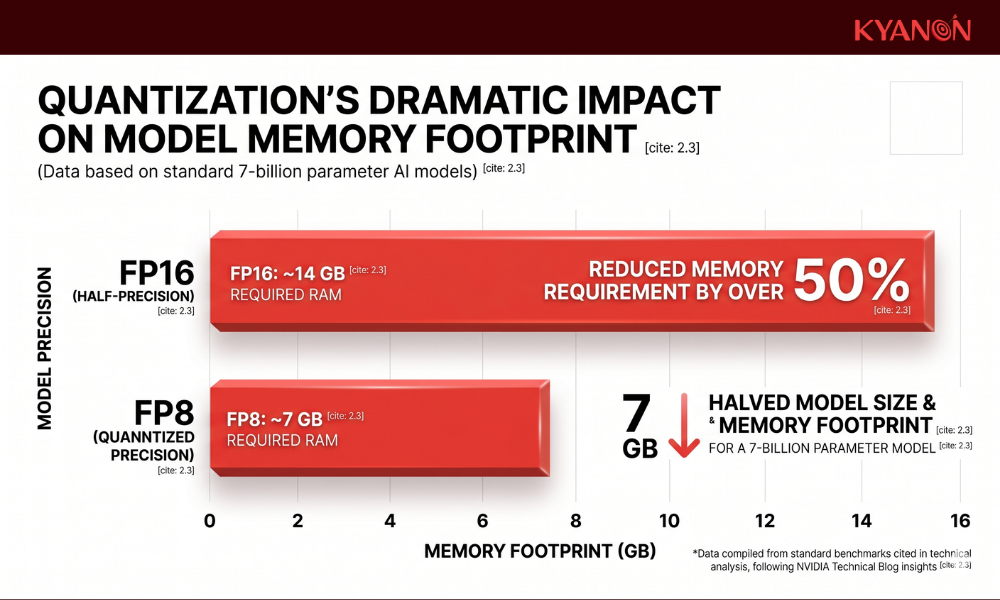
Quantizing model weights directly addresses the infrastructure demands of deploying enterprise AI. Converting a model’s parameters from FP16 to FP8 precision can effectively halve the required memory footprint. For instance, applying this quantization to a 7-billion-parameter model reduces the memory required for the model weights from approximately 14 GB to 7 GB. This reduction decreases the model’s size and computational requirements, enabling faster computation during inference and lower power consumption compared to the original model.
Common misconceptions
“Sharing weights openly is the same as sharing open-source software code.”
Reality: Source code consists of structured, human-readable logic, whereas weights are unreadable arrays of floating-point numbers. When vendor companies discuss proprietary algorithms, they are rarely referring to unique source code; rather, they are referring to the specific configuration of trained model weights.
“A larger weight automatically means that a specific input feature is more important.”
Reality: In deep architectures, the final impact of a weight is heavily modified by non-linear activation functions and downstream layers. A massive weight could be entirely nullified by a saturated activation function or a zero weight further down the network chain.
How Kyanon Digital applies Weights (Neural Network)
Kyanon Digital guides enterprise engineering teams through the complex process of model selection, weight initialization, and fine-tuning for clients across Southeast Asia and the US. Our approach focuses on measurable technical outcomes, prioritizing weight pruning and quantization to lower the total cost of ownership (TCO) and accelerate time-to-market for domain-specific AI deployments.
→ Explore our Data-Driven Insights & Intelligent Augmentation











 Create project brief with AI