
What is workflow automation (AI-powered)?
AI-powered workflow automation uses machine learning, natural language processing, and orchestration systems to automate operational workflows that traditionally require manual review, routing, or data entry. Unlike traditional Robotic Process Automation (RPA), AI-powered systems can process unstructured data, handle operational exceptions, and make real-time decisions across enterprise workflows.
AI-powered workflow automation is primarily used to reduce operational delays, lower manual processing costs, improve SLA adherence, and scale business operations without requiring proportional headcount growth.
How workflow automation (AI-powered) works
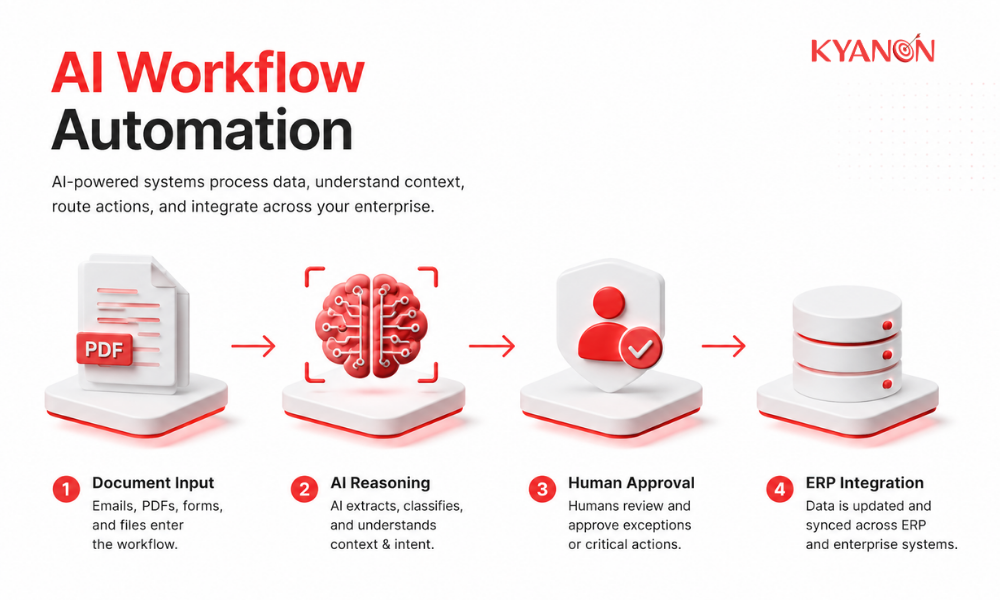
AI-powered workflow automation combines AI reasoning models, orchestration layers, enterprise integrations, and human oversight to automate multi-step operational processes end-to-end. Instead of relying on rigid IF/THEN rules, the system continuously analyzes context, classifies intent, extracts operational data, prioritizes tasks, and routes actions dynamically across departments and applications.
Unstructured data processing
AI models process operational inputs such as invoices, contracts, emails, customer tickets, and approval forms without requiring standardized templates. The system extracts entities, validates fields, classifies intent, and converts fragmented inputs into structured operational data.
This capability is particularly important for enterprises that are still dependent on PDFs, spreadsheets, email approvals, and legacy documentation workflows.
Intelligent workflow orchestration
The orchestration layer coordinates approvals, escalations, API integrations, exception handling, and workflow routing across ERP, CRM, HRM, and legacy enterprise systems. This reduces system fragmentation without requiring large-scale core infrastructure replacement projects.
AI-powered workflow automation often acts as an orchestration layer between disconnected enterprise applications rather than replacing existing systems entirely.
Real-time decision & task routing
AI-powered workflows evaluate workload distribution, urgency, historical patterns, priority tiers, and operational risk before assigning tasks or escalating issues. This allows organizations to improve time-to-resolution and SLA adherence across high-volume operations.
Unlike traditional RPA, AI-driven systems can make probabilistic, context-aware decisions instead of following fixed execution branches.
Human-in-the-Loop (HITL) governance
Human-in-the-Loop checkpoints allow employees to validate sensitive actions such as legal approvals, financial escalations, fraud investigations, or customer compensation decisions. HITL governance preserves operational accountability while allowing AI systems to automate repetitive coordination work.
Because AI workflows are non-deterministic systems, enterprises still require monitoring, auditability, drift management, and escalation controls after deployment.

Workflow automation (AI-powered) vs Traditional RPA
Both approaches reduce repetitive operational work, but they differ fundamentally in how they process data, manage exceptions, and adapt to changing workflows.
Dimension | Workflow Automation (AI-powered) | Traditional RPA |
| Data handling | Structured + unstructured data | Mostly structured data |
| Workflow logic | Context-aware and adaptive | Rigid rule-based logic |
| Decision-making | Real-time prioritization and routing | Fixed IF/THEN instructions |
| Exception handling | Dynamically resolves edge cases | Often requires manual fallback |
| Handles process changes | Moderate to high adaptability | Low adaptability |
| System integration | Cross-platform orchestration layer | Task automation within existing flows |
| Maintenance overhead | Lower after workflow stabilization | High rule maintenance |
| Dependency on structured input | Low | High |
| Best for | Complex operational workflows | Repetitive rule-based tasks |
| Human oversight | HITL governance for critical actions | Limited contextual review |
When to consider workflow automation (AI-powered)
AI-powered workflow automation becomes strategically relevant when operational complexity begins to limit scalability, response speed, or cost efficiency.
Consider Workflow Automation (AI-powered) if:
- Your operations teams spend excessive time manually processing approvals, invoices, tickets, onboarding requests, or customer inquiries across disconnected systems.
- Your organization is scaling transaction volumes faster than operational headcount, creating bottlenecks in approvals, support queues, or internal service delivery.
- Your business relies on seamless cross-functional workflows among finance, HR, IT, logistics, customer service, and e-commerce operations, where delays can directly impact SLA adherence and customer experience.
It may not be the right priority if:
- Your operational workflows are undocumented, unstable, or constantly changing. AI automation improves workflow execution efficiency, but it cannot compensate for unclear operational ownership or inconsistent process governance.
Why workflow automation (AI-powered) matters for enterprise operations
AI-powered workflow automation reduces operational latency, improves workflow consistency, and allows enterprises to scale transaction volumes without linear increases in operational headcount. It also minimizes human error associated with manual copy-pasting, repetitive data entry, and fragmented approval coordination.
For enterprises operating across Southeast Asia, AI-powered automation is increasingly used as an orchestration layer that connects disconnected legacy applications without requiring expensive multi-year transformation programs.
Supporting evidence
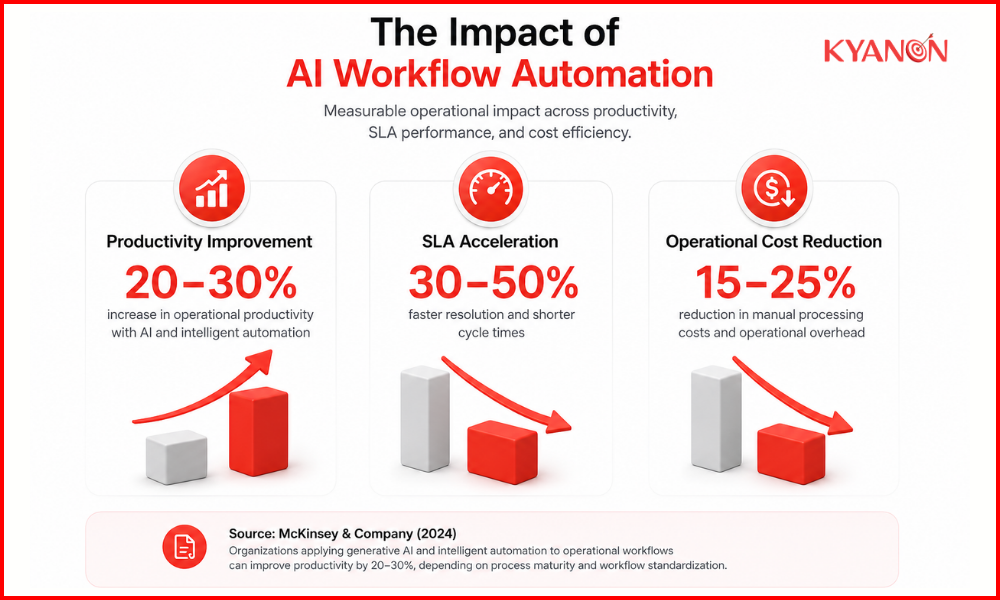
According to McKinsey & Company, organizations applying generative AI and intelligent automation to operational workflows can improve productivity by 20–30%, depending on process maturity and workflow standardization (McKinsey, 2024). The productivity gains are highest in workflows involving document processing, approval coordination, customer operations, and repetitive administrative tasks.
A Southeast Asian enterprise operating across retail distribution and customer operations implemented AI-powered workflow automation for invoice validation, ticket triage, and approval management across multiple ERP systems. The organization reduced manual routing workloads, accelerated internal SLA response times, and improved operational visibility without replacing its legacy infrastructure stack. This demonstrates how AI workflow automation improves scalability by orchestrating fragmented systems rather than rebuilding them entirely.
Common misconceptions
Enterprise leaders often misunderstand AI workflow automation as either a fully autonomous replacement system or a direct substitute for operational process management.
“AI will fix our broken process automatically.”
Reality: AI accelerates workflows, but it does not solve unclear ownership structures, inconsistent approval logic, or undocumented operational policies. Automating operational chaos simply increases the speed of bad outputs.
“AI automation and traditional automation are basically the same thing.”
Reality: Traditional RPA follows rigid rules and predefined pathways. AI-powered workflows interpret context, process unstructured inputs, manage operational exceptions, and make probabilistic decisions dynamically.
“We need pristine enterprise data before starting.”
Reality: AI systems are specifically valuable because they can structure unstructured operational data such as emails, PDFs, contracts, and support tickets. Most organizations begin with imperfect operational data environments and improve governance progressively.
“The workflow can run itself permanently after deployment.”
Reality: AI-powered workflows require ongoing monitoring because models can drift, integrations can fail, and operational conditions can change over time. Enterprises still need observability, governance controls, and escalation of ownership.
“AI workflows will replace operational teams entirely.”
Reality: AI automation removes repetitive coordination tasks, not organizational accountability or strategic judgment. Employees continue handling escalation management, compliance reviews, customer relationships, and high-risk operational decisions.
How Kyanon Digital applies workflow automation (AI-powered)
Kyanon Digital implements AI-powered workflow automation using orchestration platforms, OCR pipelines, large language models, enterprise APIs, and Human-in-the-Loop controls for enterprise clients across Vietnam, Singapore, Malaysia, Thailand, ANZ, the US, and Nordic Europe. Enterprise implementations commonly combine platforms such as UiPath, ServiceNow, Workato, or custom orchestration layers with AI reasoning systems and ERP integrations.
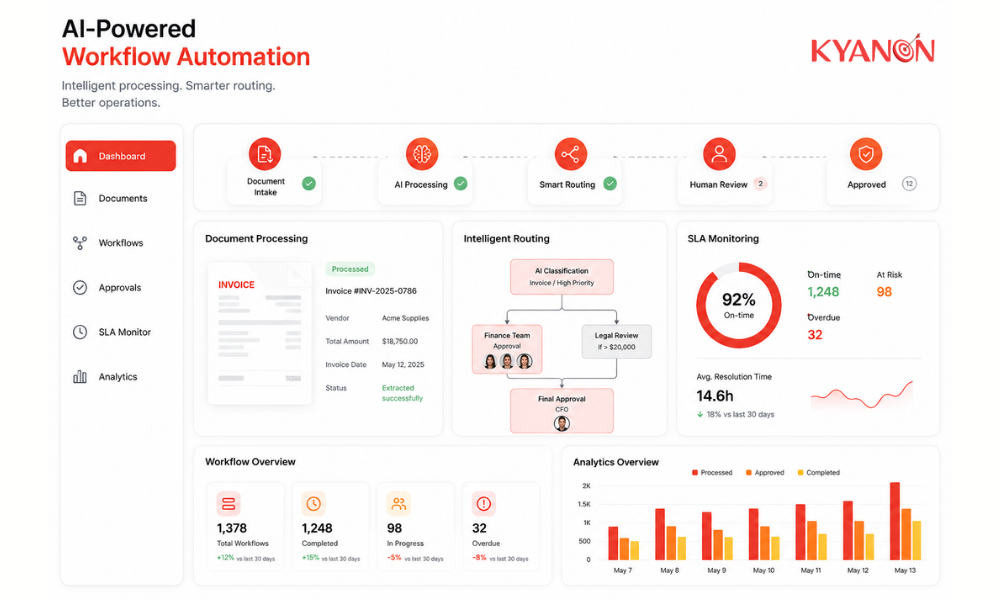
Typical implementations include invoice processing, document routing, customer request triage, approval orchestration, ERP synchronization, onboarding workflows, and internal service desk automation across distributed enterprise operations.
The implementation approach focuses on measurable operational outcomes such as reducing manual processing costs, improving SLA adherence, shortening approval-cycle times, minimizing operational errors, and increasing scalability without proportional headcount growth.
→ Explore our Automation and Integration Services

 Create project brief with AI