
What is Workflow Automation (AI)?
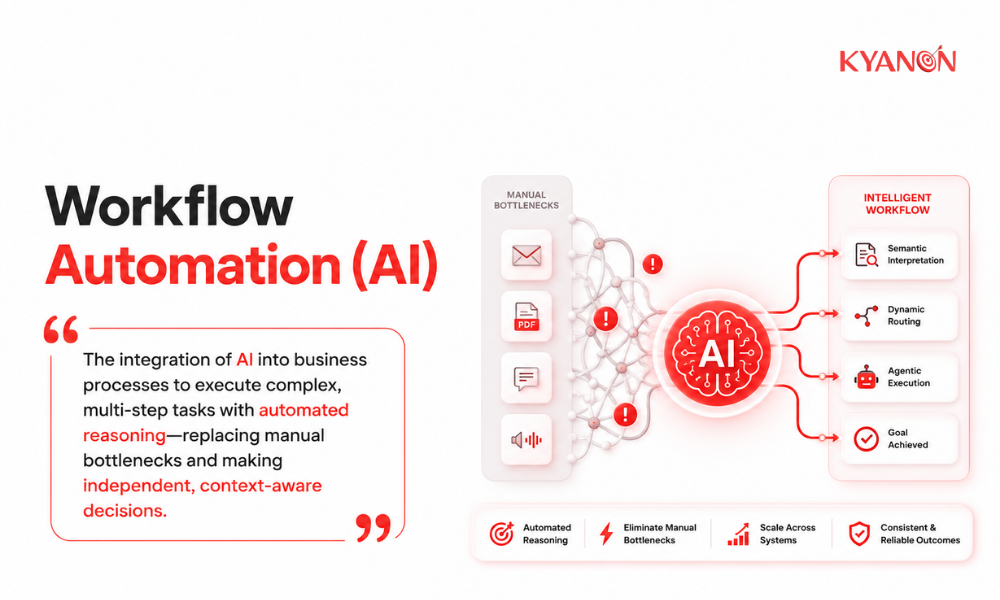
Workflow automation (AI) is the integration of artificial intelligence models into business processes to execute complex, multi-step tasks requiring dynamic judgment and unstructured data interpretation. It replaces manual business bottlenecks by introducing automated reasoning, allowing systems to assess context and make independent decisions rather than merely following rigid, pre-programmed rules.
How Workflow Automation (AI) works
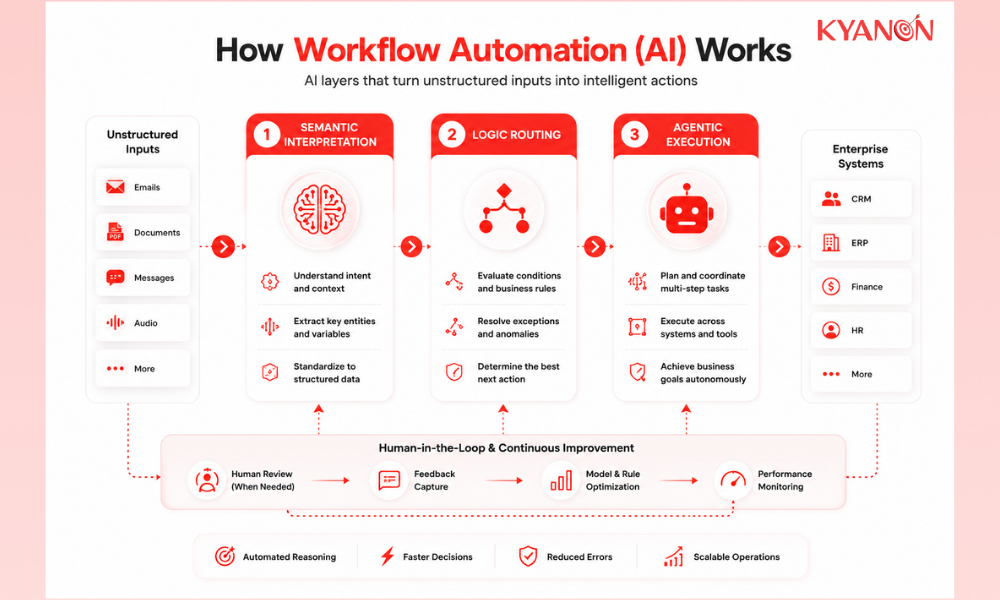
Workflow automation (AI) functions by layering cognitive reasoning capabilities over traditional data pipelines to parse unstructured inputs and trigger downstream actions dynamically. This architecture targets exact friction points where a human would traditionally need to read, cross-reference, and make a logical decision.
Semantic interpretation
Artificial intelligence models analyze intent and extract variables from unstructured text formats like vendor PDFs or customer emails to standardize data instantly. This component translates disorganized inputs into structured formats for downstream processing without requiring custom templates.
Dynamic exception routing
Instead of stalling upon encountering unexpected scenarios, automated reasoning weighs conflicting operational parameters to determine the logical next step. The system self-corrects data anomalies and resolves edge cases without immediately routing to a human exception queue.
Agentic goal execution
Autonomous enterprise agents receive high-level objectives and coordinate the necessary sub-steps across various corporate platforms. The system executes multi-step tasks across CRM and ERP environments independently to achieve the assigned business goal.
How Workflow Automation (AI) works

Workflow Automation (AI) vs Traditional RPA
Traditional RPA relies on rigid, deterministic logic for structured data, whereas AI workflow automation utilizes contextual semantic understanding to manage unstructured inputs.
| Dimension | Workflow Automation (AI) | Traditional RPA |
| Input Type | Unstructured data (emails, PDFs, audio) | Strictly structured data (CSVs, databases) |
| Logic Type | Contextual, adaptive semantic understanding | Rigid, deterministic “If X, then Y” rules |
| Exception Handling | Self-corrects or evaluates the best next step | Stalls completely; flags a human for review |
| System Scalability | High; dynamically maps new data schemas | Low; custom code breaks when software APIs update |
| Upfront Complexity | High (requires data training and AI orchestration) | Low (requires UI or strict rule mapping) |
When to consider Workflow Automation (AI)
Consider Workflow Automation (AI) if:
- Your organization requires intelligent document processing (IDP) to extract context and intent from high volumes of mixed-format legal or vendor contracts.
- Your financial reconciliation processes experience severe delays due to manual spreadsheet line-item matching across disparate software systems.
- Your customer support operations need to replace manual ticket categorization by analyzing sentiment and routing complex issues automatically.
It may not be the right priority if:
- Your target processes rely entirely on strictly structured data sets where rigid, deterministic rules execute perfectly without exception queues.
Why Workflow Automation (AI) matters for enterprise operations
Applying cognitive capabilities to operational workflows shifts resource allocation from rote data processing to strategic validation and exception handling.
According to McKinsey & Company (2023), current generative AI technologies hold the potential to automate work activities that absorb 60 to 70 percent of employees’ time. Financial institutions in Southeast Asia applied workflow automation (AI) to compliance auditing, replacing periodic manual spot-checks with continuous tracking to achieve a zero-variance audit trail. This demonstrates how automated reasoning translates from a technical capability to a measurable business impact.
Common misconceptions
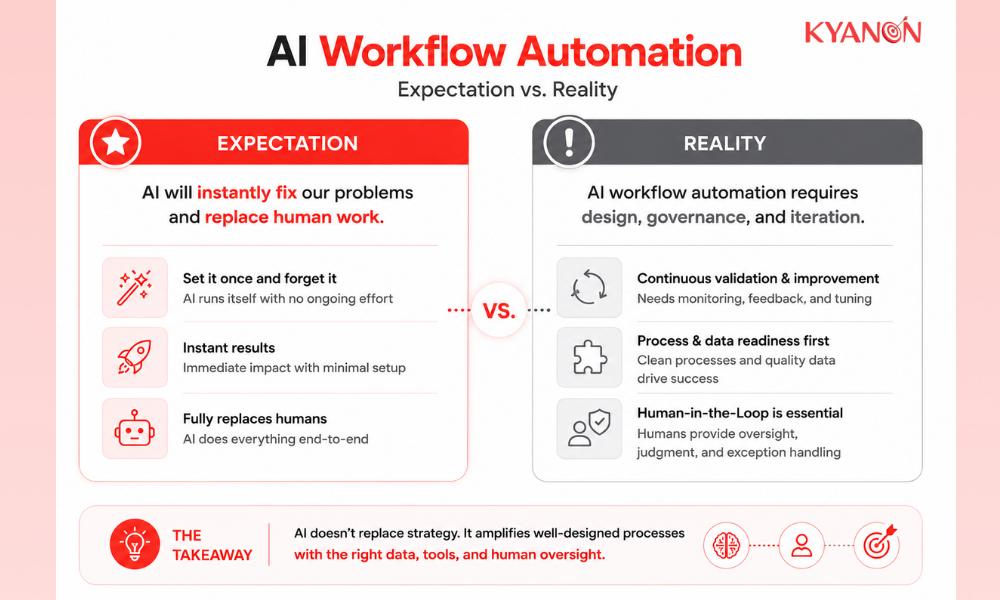
“AI workflow automation is a ‘set-and-forget’ solution that entirely replaces human labor.”
Reality: Workflow automation (AI) manages specific data tasks rather than holistic professions, shifting human responsibility toward strategic oversight. True AI-driven workflows require rigorous human validation, known as Human-in-the-Loop (HITL), and continuous optimization to function over time.
“Applying an AI tool to our existing operations will instantly fix our operational bottlenecks.”
Reality: Implementing AI over a messy manual workflow only serves to accelerate organizational mistakes. True automation relies on a custom tool stack chained together systematically, demanding that underlying business processes are mapped and optimized before AI integration occurs.
How Kyanon Digital applies Workflow Automation (AI)
Kyanon Digital implements workflow automation (AI) by combining LLM reasoning frameworks like LangChain with execution layers for enterprise clients across the HR, legal, and finance sectors. Our approach focuses on eliminating high-volume manual processes in Southeast Asia, ANZ, and US markets by ensuring Human-in-the-Loop (HITL) checkpoints remain central to the architecture, lowering Total Cost of Ownership (TCO) while maintaining strict operational control.
→ Explore our Automation & Integration services











 Create project brief with AI