
What is XML Output Parsing (AI)?
XML Output Parsing (AI) is the computational process of extracting, sanitizing, and validating semi-structured XML text generated by Large Language Models to transform it into strict, parser-safe data structures. By replacing fragile, layout-dependent Regex scripts, this validation system translates probabilistic text predictions into deterministic code blocks required by legacy enterprise software. This architectural framework allows organizations to ingest highly variable documents, such as supplier invoices, shipping logs, and multi-format reports, while ensuring absolute precision in entity extraction and eliminating generative hallucinations during data migration.
How XML Output Parsing (AI) works
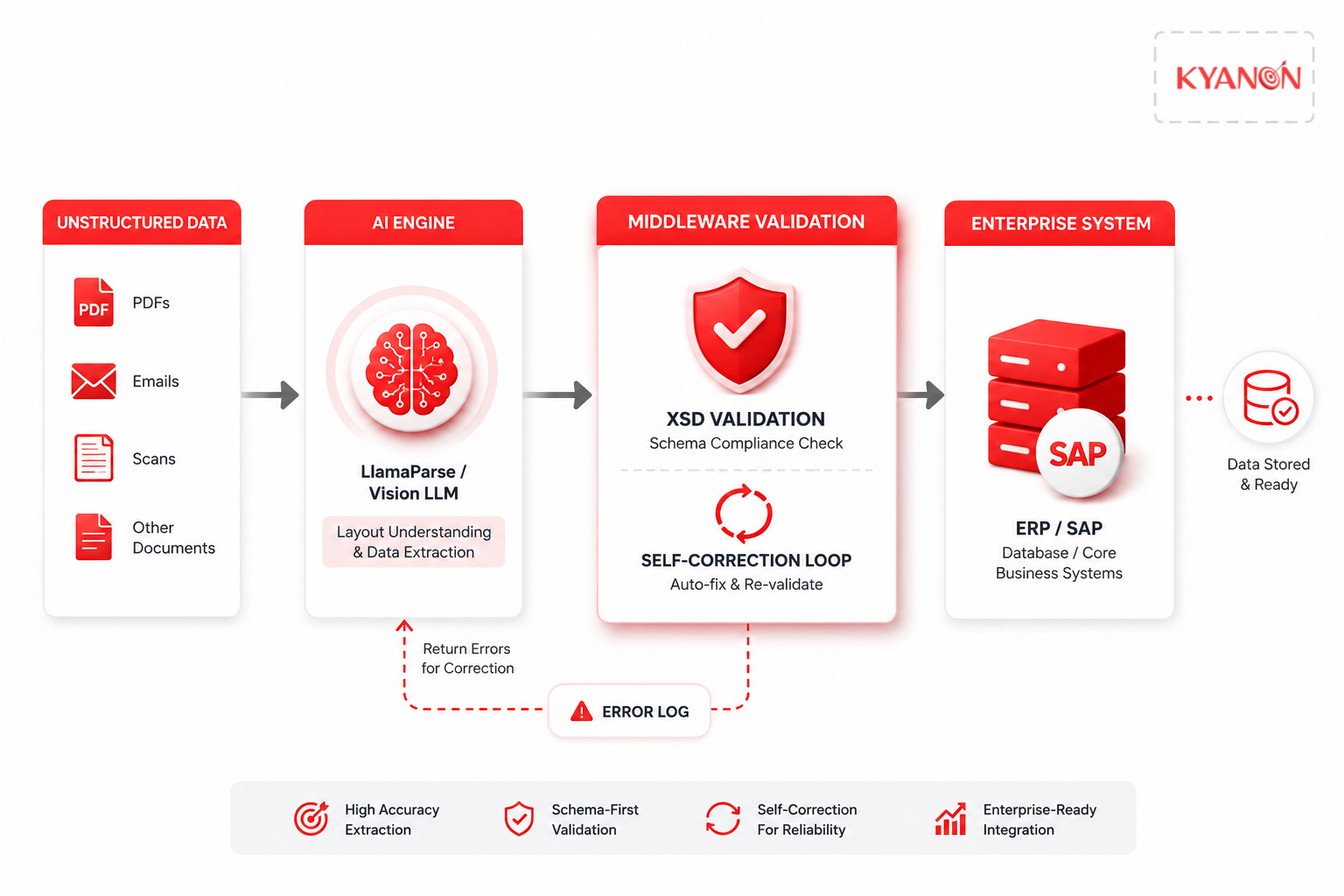
Large Language Models generate data tokens based on statistical probability rather than executing compiling rules, which frequently causes syntax anomalies, unescaped characters, or broken tags. An AI-driven XML output parsing pipeline operates as an automated validation middleware layer situated between the foundational AI processing models and core target databases.
The pipeline ingests multi-format files (such as PDFs, emails, and scans), passes them through vision-capable LLMs for structural decomposition, isolates the core data blocks, and runs them through programmatic verification gateways before target database insertion.
[Unstructured Data] ──> [AI Processing Engine] ──> [Schema Enforced Validation] ──> [Target Enterprise System]
(PDFs, Emails, Scans) (LLM/Agentic Extraction) (Outputting Valid XML) (ERP, CRM, Database)
Multimodal Layout and Extraction Awareness
This initial block utilizes vision-capable AI models to segment incoming documentation visually. Instead of relying on rigid positioning coordinates, it maintains data associations across complex elements like multi-page tables, embedded financial charts, and handwritten text, converting raw unstructured content into initial key-value text pairs.
Programmatic XSD Validation and Self-Correction Loops
The extraction output is instantly subjected to an XML Schema Definition (XSD) compliance check in the backend architecture. If the engine identifies unescaped special characters (such as raw ampersands) or truncated tags, it executes an automated self-correction loop, passing the precise syntax error log back to the AI engine to immediately republish a compliant layout.
Enterprise Integration and Target Orchestration
The final component formats the validated, clean XML string into exact enterprise schemas. Using integration frameworks, it maps and orchestrates the transmission of the structured data directly into target operational environments, such as centralized ERP architectures or relational records setups.

XML Output Parsing (AI) vs JSON Schema Validation (AI Outputs)
Both approaches standardize probabilistic model outputs, but they serve distinct enterprise software architectures and data integration requirements.
| Dimension | XML Output Parsing (AI) | JSON Schema Validation (AI Outputs) |
| Primary Downstream Target | Legacy ERP setups, transactional banking networks, and compliance registries. | Cloud-native web applications, microservices, and mobile application backends. |
| Syntactic Strictness | High; minor character anomalies completely break standard corporate parsing engines. | Moderate; native runtimes process varied JavaScript object notation formats flexibly. |
| Error Handling Method | Multi-step tree-based reconstruction, regex sanitization, and automated self-correction loops. | Native API schema enforcement parameters or programmatic type-casting constraints. |
| Document Node Capability | Superior performance for hierarchical business documents containing intricate inline metadata. | Limited performance for document-heavy structures with dense text descriptions. |
| Token Overhead | Higher token consumption due to repetitive opening and closing structural tag definitions. | Lower token consumption via minimized syntax character requirements. |
When to consider XML Output Parsing (AI)
Automated document processing pipelines require specialized parsing middleware layers depending on system architecture constraints and vendor layout consistency.
Consider XML Output Parsing (AI) if:
- Your corporate automation pipelines route generative AI outputs into legacy enterprise resource planning (ERP) platforms like SAP or Dynamics 365 that mandate strict XML verification.
- Your development teams spend excessive engineering hours writing, updating, and fixing fragile document-scraping scripts every time an external supplier modifies their form formatting.
- Your workflow processes complex documentation containing nested data blocks or multi-page tables where contextual data structure relationships must be preserved during extraction.
It may not be the right priority if:
- Your operational stack is built exclusively on modern cloud-native architectures where native API configurations enforce standardized JSON outputs directly at the model endpoint.
Why XML Output Parsing (AI) matters for enterprise document automation
Data integration failures within automated ingestion pipelines create massive operational friction, requiring engineering remediation and manual data entry intervention. Integrating an automated validation layer eliminates structural errors from document pipelines, allowing organizations to achieve sustained transaction execution velocity.
Supporting evidence
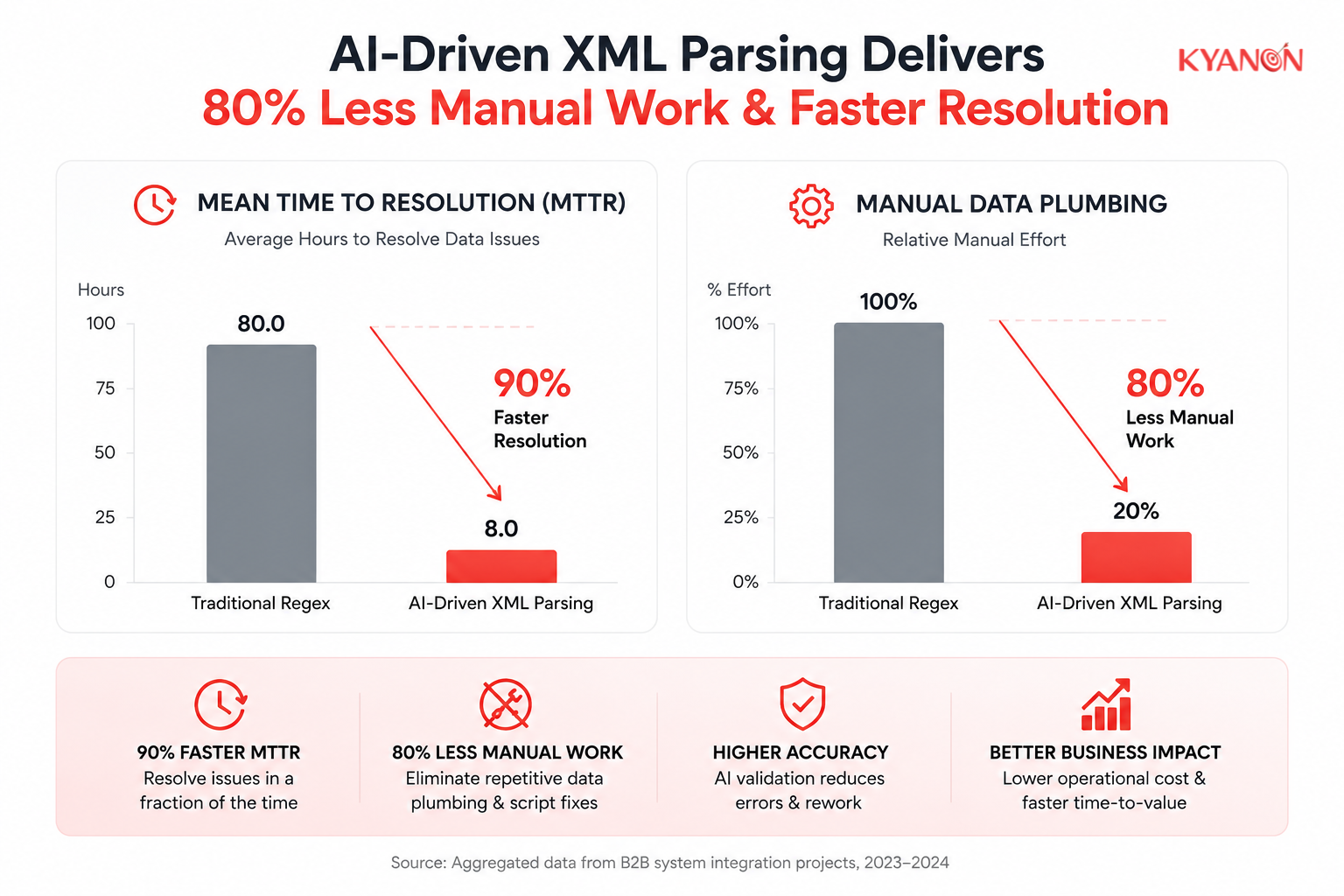
According to technical research by Newline (2024), implementing automated validation frameworks eliminates up to 80%-90% of manual data plumbing, drastically lowering the Mean Time to Resolution (MTTR) when systemic document modifications occur. This optimization removes the requirement for continuous manual script adjustments by engineering staff.
Document analysis frameworks engineered by Lettria demonstrate that advanced AI engines can automatically extract tables, diagrams, reading orders, and multi-column layouts from highly complex PDF documents. By utilizing fine-tuned internal models that target business documents, this system architecture isolates precise entities and semantic relationships while eliminating generative hallucinations. When deployed within enterprise pipelines across Southeast Asia, these layout-aware structural validation workflows successfully manage data drift across international forms, bridging modern generative capabilities with legacy enterprise core systems.
Common misconceptions
“Instructing an AI model via system prompts guarantees perfectly valid XML layouts.”
Reality: Large Language Models function via token probability predictions rather than deterministic code compilation rules. Even explicit prompt instructions prohibiting markdown syntax wrapping can fail during high-volume production runs or when token boundaries cause sudden text truncation.
“Transitioning to AI-driven parsing requires completely rewriting legacy database architectures.”
Reality: The parsing framework functions exclusively as an isolated middleware translation layer that works entirely in-memory. It intercepts, cleans, and structures incoming text streams, outputting schema-compliant XML files that perfectly match existing target input requirements.
How Kyanon Digital applies XML Output Parsing (AI)
Kyanon Digital implements XML output parsing within enterprise document extraction architectures where LLM-generated text streams feed core ERP and compliance databases. We orchestrate data pipelines utilizing specialized parsing platforms like LlamaParse alongside enterprise tools like n8n and Microsoft Power Automate to establish automated data verification flows.
Serving enterprise clients across Singapore, Malaysia, Vietnam, and the ANZ region, our engineering methodology focuses on neutralizing generative unpredictability, reducing manual development overhead, and securing reliable time-to-market metrics while lowering overall total cost of ownership (TCO).
→ Explore our Gen AI Development services

 Create project brief with AI