
What is YOLO (You Only Look Once)?
YOLO (You Only Look Once) is an open-source, single-stage deep learning architecture that executes real-time object detection by predicting bounding boxes and class probabilities directly from a full input image in a single forward propagation pass through the neural network. It bypasses the complex, multi-stage region proposal pipelines utilized by traditional models, allowing developers to deploy compact nano (n) and small (s) variants, such as YOLOv8n or YOLOv10n, onto resource-constrained edge computing environments.
How YOLO (You Only Look Once) works
Traditional object detection frameworks split spatial analysis into two steps: isolating potential regions of interest and classifying those regions sequentially. YOLO reframes object detection as a unified regression problem by evaluating the entire input image simultaneously through a single network pipeline. To achieve the throughput speeds required for industrial assembly lines, the core detection algorithm must be paired with specialized data ingestion techniques and hardware-level precision optimizations.
Quantized single-stage processing
The network segments the input frame into an equal coordinate grid to predict bounding box scales and class allocations concurrently. To minimize execution latency on edge devices, the default FP32 precision models undergo quantization post-training down to FP16 or INT8 formats via compilation toolkits like TensorRT or OpenVINO, matching layer structures directly to the physical silicon architecture.
Hardware-accelerated data ingestion
Industrial cameras stream video feeds using the Real-Time Streaming Protocol (RTSP) over local networks. To eliminate central processor bottlenecks, the capture pipeline offloads input stream compilation from the CPU to dedicated GPU hardware decoding blocks (NVDEC) while using thread-safe, asynchronous queue buffers within OpenCV to prevent frame dropping.
Industrial logic & microservices integration
The raw bounding box coordinates are converted into actionable factory instructions by wrapping the detection engine inside lightweight FastAPI and Docker container microservices. Spatial tracking algorithms, such as ByteTrack, follow detected anomalies across frames to ensure that a discovered manufacturing defect signals a Programmable Logic Controller (PLC) via Modbus, MQTT, or OPC UA protocols exactly once per item.
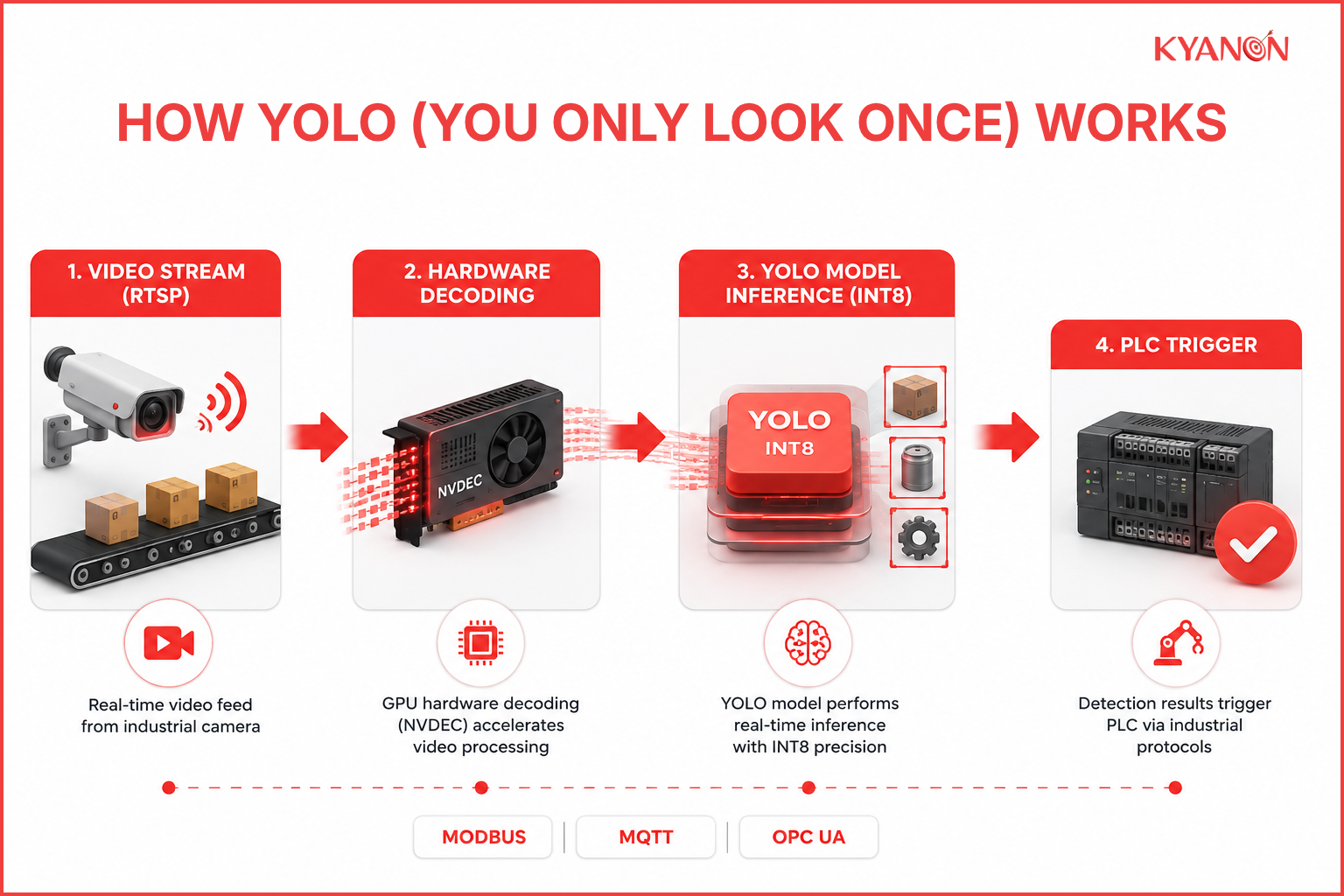

YOLO vs Two-Stage Detectors
Both deep learning approaches solve automated object detection challenges, but they differ fundamentally in processing architecture, network compilation footprints, and deployment edge fitness.
Dimension | YOLO (Single-Stage Architecture) | Two-Stage Detectors (e.g., Faster R-CNN) |
| Processing Speed | Maximizes real-time FPS throughput via single-pass estimation | Slower due to sequential region proposal operations |
| Pipeline Architecture | Unified regression framework utilizing single forward propagation | Dual-stage pipeline separating regional mapping from classification |
| Model Optimization | Highly responsive to INT8 quantization and layer pruning | Heavy structural profiles limit structural pruning efficiency |
| Edge Hardware Fitness | Designed for low-power edge units like NVIDIA Jetson Orin | Massive memory requirements limit deployment to server-grade GPUs |
| Factory System Linkage | Easily wrapped in microservices for PLC stream integration | High latency makes direct mechanical actuator triggers impractical |
When to consider YOLO (You Only Look Once)
Consider YOLO (You Only Look Once) if:
- Your facility requires an automated quality inspection layout that must identify defects instantly on high-speed manufacturing assembly lines.
- You are deploying machine vision applications onto resource-constrained edge hardware, such as ruggedized Industrial PCs (IPCs) or smart cameras with limited thermal thresholds.
- Your operations require multi-task capability, such as simultaneous item tracking, instance segmentation, and pose estimation from a single model footprint.
- You need to translate visual detection events into hardware control movements via direct protocol connections (Modbus, MQTT, OPC UA) to automated factory PLCs.
It may not be the right priority if:
- Your digital product relies entirely on high-latency cloud uploads of static images, where real-time frames-per-second processing provides no operational advantage.
Why YOLO (You Only Look Once) matters for manufacturing and retail
Transitioning to real-time object detection frameworks allows industrial operations to replace intermittent manual sampling with continuous automated auditing, directly protecting profit margins and minimizing operational overhead. By standardizing on high-throughput architectures, companies reduce hardware acquisition costs while scaling localized inspection capabilities across multiple production facilities or retail footprints.
Supporting evidence
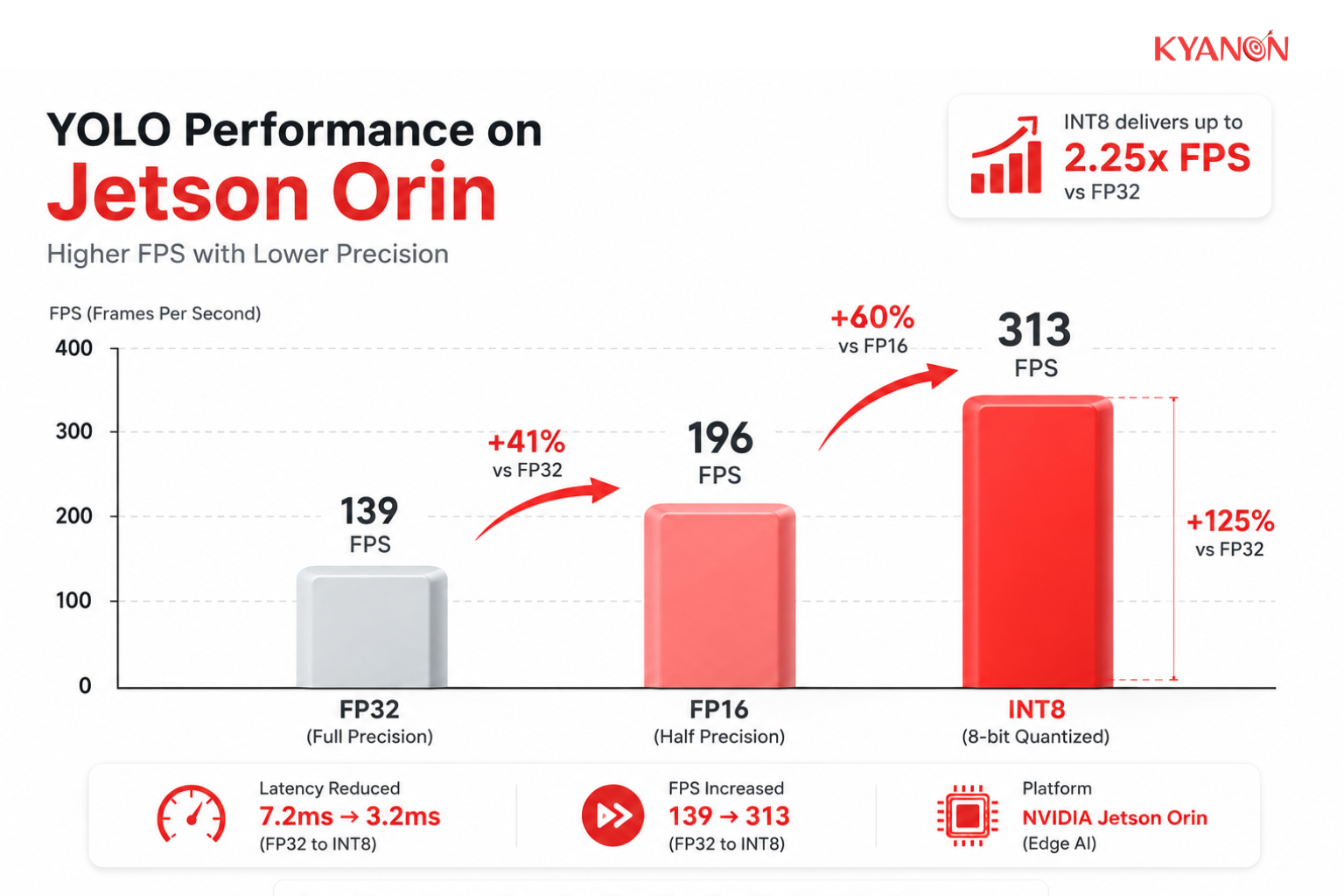
According to hardware optimization benchmarks published by Seeed Studio, quantizing a standard small YOLO model down to INT8 precision using TensorRT acceleration reduces mean execution latency from 7.2ms to 3.2ms on edge compute modules. This architectural adjustment expands throughput capacities from 139 frames per second (FPS) to 313 FPS, allowing high-frequency factory lines to scan visual inputs without creating ingestion backlogs.
An automated logistics facility applied single-stage tracking models to monitor vehicle detection across distribution points, resulting in accurate asset positioning. This deployment demonstrates how moving from theoretical deep learning frameworks to production-ready edge models drives measurable clarity within enterprise supply chains.
Common misconceptions
Technical misconceptions about computer vision frameworks often arise from confusing structural execution names with operational limitations or legacy performance constraints.
“YOLO compromises detection accuracy to maintain its real-time processing speed.”
Reality: While early iterations faced challenges identifying tiny or densely grouped objects, modern variants integrate anchor-free detectors and decoupled heads. These structural additions allow models to match or exceed the precision scores of multi-stage architectures while retaining high frames-per-second performance on localized edge nodes.
“The framework operates as a single, static software package managed by one core team.”
Reality: YOLO represents an evolving lineage of open-source architectures maintained by diverse independent groups over time. The active ecosystem includes distinct frameworks, such as Ultralytics YOLO, Baidu’s PP-YOLO, YOLOX, and YOLO-World, each featuring unique optimization targets, license constraints, and compilation profiles.
How Kyanon Digital applies YOLO (You Only Look Once)
Kyanon Digital integrates optimized YOLO architectures into production-grade computer vision solutions for enterprise clients across Southeast Asian markets, including Vietnam, Singapore, Malaysia, and Thailand. Our engineering teams specialize in the deep implementation of nano and small network footprints (such as YOLOv8n) deployed on NVIDIA Jetson Orin modules and ruggedized industrial PCs utilizing OpenVINO runtimes. We eliminate data ingestion bottlenecks by configuring thread-safe OpenCV queue buffering and NVDEC hardware decoding for real-time RTSP streams. By wrapping compiled INT8 models in lightweight FastAPI and Docker configurations, we build direct integration pipelines with factory PLCs over Modbus and MQTT protocols, utilizing ByteTrack algorithms to achieve precise, deterministic defect tracking that lowers the total cost of ownership (TCO) for automated operations.
→ Explore our Computer vision service

 Create project brief with AI