
What is Zero-Latency Inference?
Zero-latency inference is the execution of an artificial intelligence model’s predictions within human perception thresholds, routinely bringing total system response times below 10 to 50 milliseconds. It relies on architectural optimizations to process inputs immediately at the point of data ingestion without encountering structural network or memory transfer delays.
How Zero-Latency Inference works
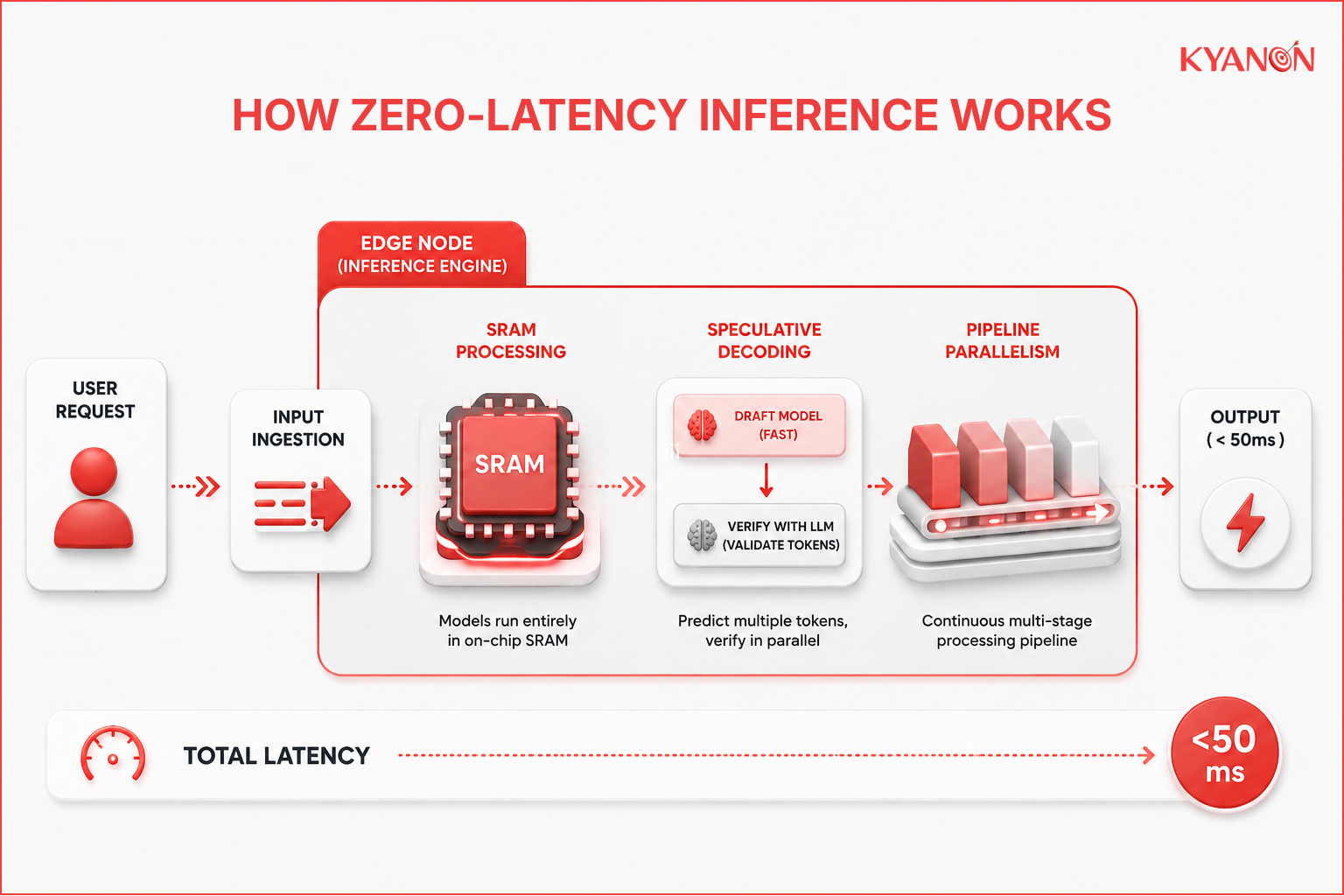
Zero-latency inference eliminates bottlenecks caused by transferring massive datasets between distinct memory chips and processors during model execution. Instead of routing raw telemetry data to centralized cloud servers via high-overhead API requests, systems deploy compressed models on localized hardware designed to process calculations concurrently. This specialized architecture allows multi-tonal algorithmic processing to occur directly alongside active data ingestion layers.
SRAM processing
Models run entirely inside fast Static RAM (SRAM) located directly on the specialized artificial intelligence processor chip. This local memory placement allows the system to skip slow external data transfers associated with high-bandwidth memory (HBM) architectures. By maintaining the active model weights inside the chip core, execution cycles bypass standard bus delay restrictions.
Speculative decoding
Speculative decoding utilizes a secondary, ultra-fast draft model to guess upcoming text token outputs ahead of time during generation cycles. The primary large language model then validates multiple predicted tokens simultaneously within a single computational forward pass. This parallel verification strategy dramatically accelerates text generation speeds by reducing individual step requirements.
Model quantization
Engineers shrink machine learning models by converting high-precision 16-bit floating-point numbers into tighter 4-bit or 8-bit integer configurations. This conversion drops the total storage and memory footprint of the neural network layers without inducing critical accuracy loss. The smaller data footprint enables the underlying hardware to execute matrix mathematics at higher operational speeds.
Pipeline parallelism
Silicon chips split the artificial intelligence workload into a continuous, multi-stage processing assembly line. This pipeline setup allows hardware segments to accept new input tokens while concurrently generating segments of previous computational answers. The continuous distribution prevents hardware processors from sitting idle during sequential execution routines.
Edge computing infrastructure
Moving runtime environments onto local hardware deployments, such as mobile devices, localized gateways, or nearby cellular towers, completely cuts out wide-area internet routing overhead. Bypassing distant cloud data centers insulates system execution from external web traffic congestion. This localization anchors latency variations to stable, predictable device parameters.

Zero-Latency Inference vs Batch Inference
While zero-latency inference processes individual data points instantly at the localized execution layer, batch inference groups high-volume records for delayed processing on central clouds.
Dimension | Zero-Latency Inference | Batch Inference |
Processing model | Single record stream processing | Multi-record dataset bundle execution |
Execution location | Distributed edge nodes or on-chip SRAM | Centralized cloud infrastructure or data lakes |
Optimization focus | Minimizing response speed below 50ms | Maximizing total processing throughput volume |
Resource utilization | Constant, low-overhead compute footprint | High-intensity, periodic server resource spikes |
Primary application | Real-time automated collision avoidance | End-of-month financial account reconciliation |
When to consider Zero-Latency Inference
Enterprise platforms require zero-latency inference when machine learning predictions must occur within the active operational timeframe of a live user interaction or machine safety window.
Consider Zero-Latency Inference if:
- Your digital product relies on voice assistants that must sustain fluid conversations without displaying unnatural audio pauses between speakers.
- Your application incorporates interactive gaming systems where non-player characters (NPCs) generate dynamic dialogue in sync with live gameplay.
- Your operations require automated machinery or self-driving robotics to process immediate visual hazards instantly to prevent collisions.
It may not be the right priority if:
- Your technical teams handle retrospective data analysis, batch text translations, or administrative business reports where delayed execution does not degrade the final utility of the output.
Why Zero-Latency Inference matters for enterprise applications
Processing delays within interactive enterprise systems directly correlate with user abandonment, reduced engagement, and system performance failures. When automated logic layers experience delays during live data feeds, the target workflow stalls and breaks user immersion. Removing memory transit overhead and wide-area network routing protects the core interaction pathway across digital channels.
Supporting evidence
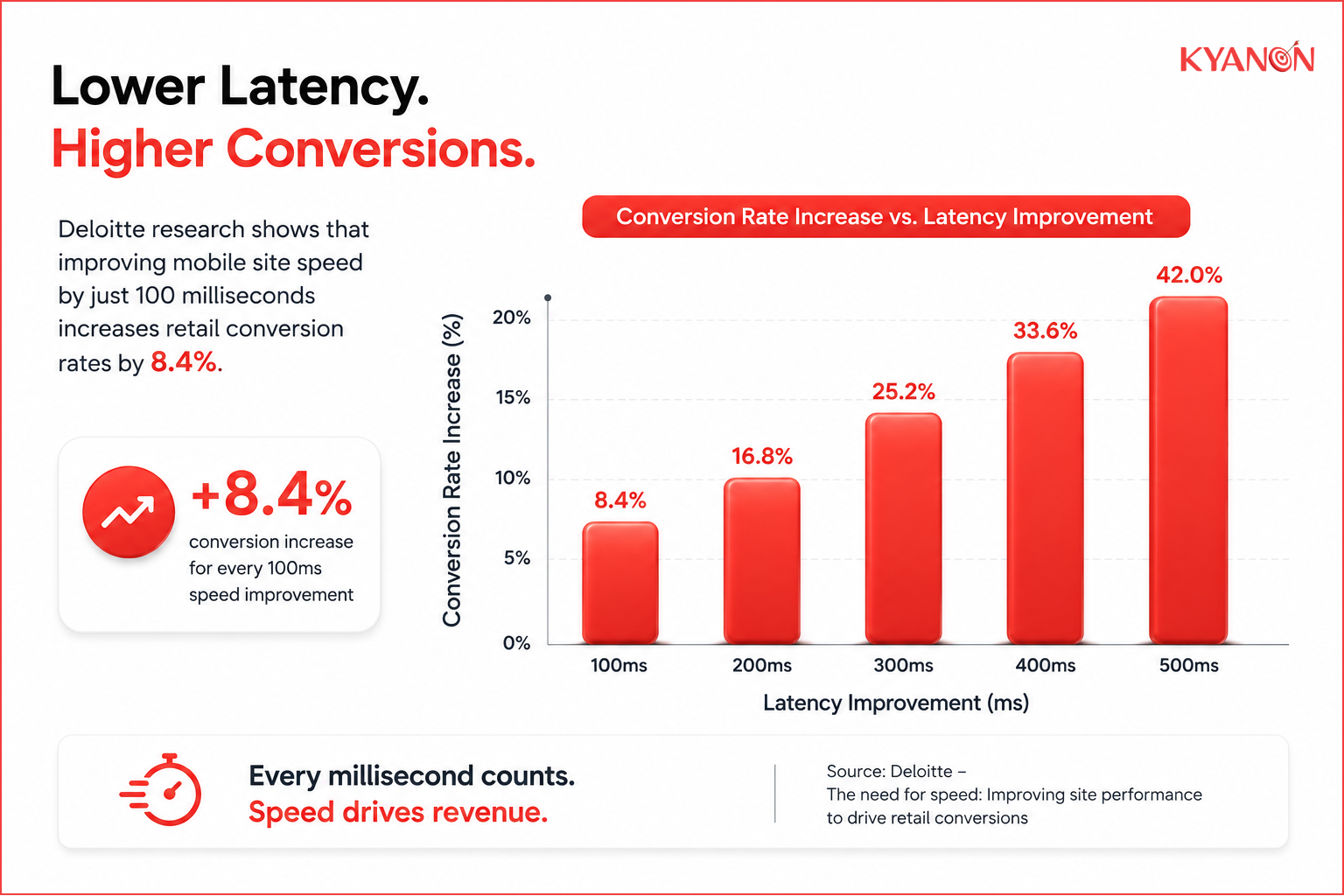
According to OVHcloud, a 100-ms speed upgrade on mobile site loads increases retail conversion rates by 8.4%. This measurable connection demonstrates how technical execution speeds directly dictate top-line transactional revenue within modern customer platforms.
An enterprise automated manufacturing platform deployed edge-based model execution to monitor optical inspection feeds on an assembly line. The installation utilized localized SRAM processing to reduce hazard validation delays below 20 ms, matching the mechanical response rate of the factory floor. This deployment demonstrates how dropping compute delays transitions an enterprise system from a slow monitoring tool into an active safety system.
Common misconceptions
Physical constraints dictate that true instantaneous data transit is impossible, making operational speed a function of structural optimization rather than literal zero delay.
“Zero-latency inference means that data processing takes absolutely zero physical time.”
Reality: Literal zero latency is blocked by physical realities, as data transmission speeds cannot exceed the speed of light, and internal transistors require time to flip states. The industry term represents an engineering baseline where calculations finish faster than the threshold of human noticeability or system interaction loops.
“Achieving real-time AI performance depends solely on upgrading to faster backend cloud server arrays.”
Reality: Upgrading distant backend server capacity cannot fix structural wide-area network routing delays over the internet. Real-world performance improvements require code modifications like model quantization and hardware adjustments like pipeline parallelism to minimize physical transport steps.
How Kyanon Digital applies Zero-Latency Inference
Kyanon Digital configures edge runtime frameworks and model optimization pipelines to reduce machine learning response latencies for enterprise platforms across Southeast Asia. Our engineering teams integrate quantized models and speculative decoding configurations inside regional edge networks and localized systems. This technical approach guarantees that high-frequency operations, including automated fraud screening and real-time content delivery, preserve targeted performance parameters within variable network environments across Vietnam, Singapore, and the wider APAC territory.
→ Explore our AI Integration services

 Create project brief with AI