
What is Zero-Shot Classification?
Zero-shot classification is a machine learning technique that allows an AI model to accurately categorize unstructured data, such as text, images, or audio, into custom, completely unseen labels on the fly without any prior task-specific training data. While traditional supervised classification architectures require thousands of manually labeled examples to master a new category, zero-shot models leverage vast, pre-trained semantic knowledge bases to map data points directly to newly specified target classes.
How Zero-Shot Classification works
Zero-shot models operate fundamentally on the principle of semantic transfer learning. Instead of mapping an input vector to a rigid, fixed numerical ID such as “Class 0” or “Class 1”, the model evaluates data assets by measuring their contextual proximity to explicit natural language descriptions. This operational flexibility is achieved through two primary architectural implementations:
1. Text Classification via Natural Language Inference (NLI)
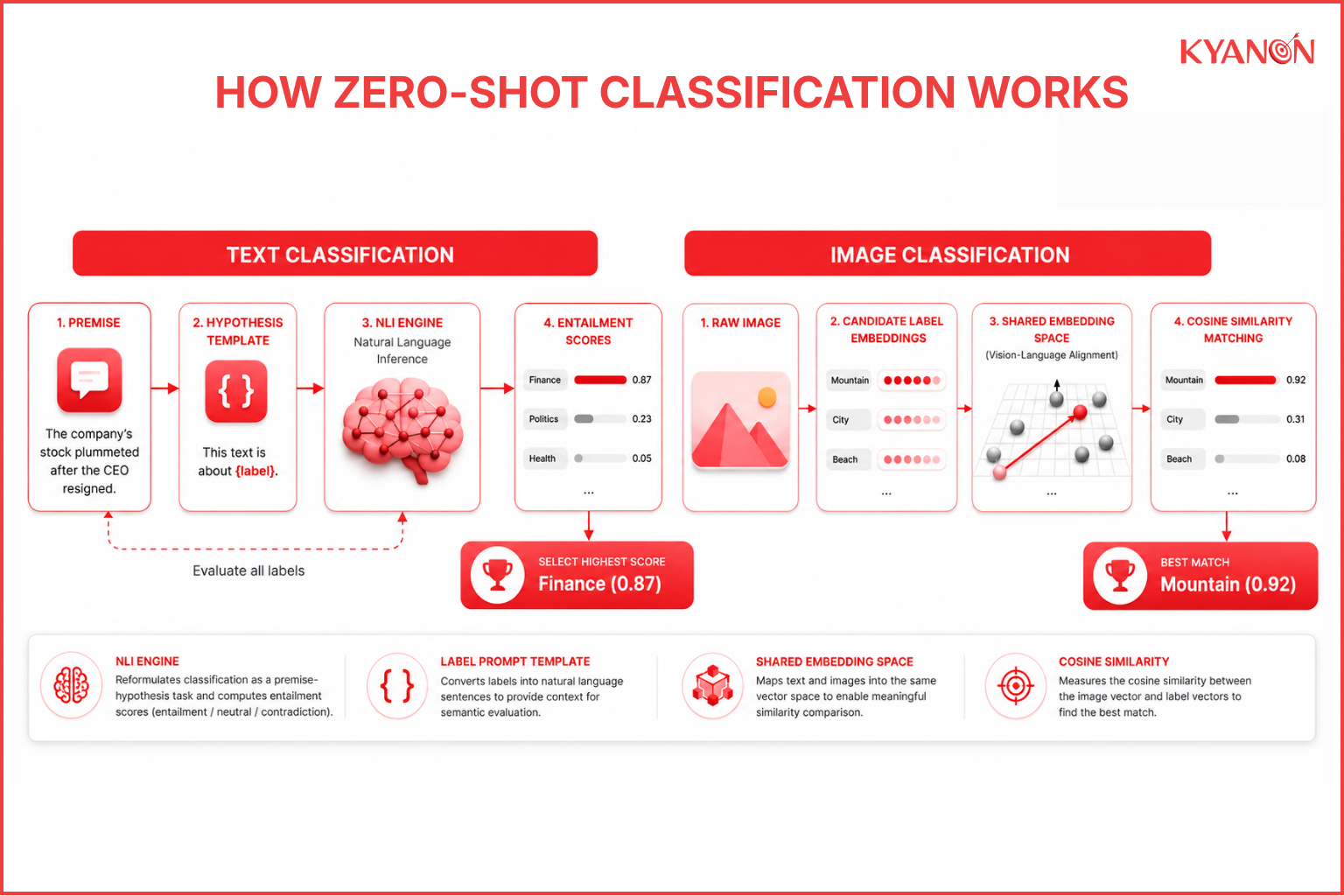
Most modern text classifiers reframe the standard classification challenge into a Natural Language Inference (NLI) task. The input content serves as a factual “premise” (e.g., “The company’s stock plummeted after the CEO resigned.”). The system then dynamically reformulates each user-specified target label into a standardized “hypothesis” sentence template, such as “This text is about {label}.”
The pre-trained underlying model evaluates these structural pairs to compute an entailment score. Whichever candidate label generates the highest mathematical entailment probability is selected as the winning classification category.
2. Image classification via Vision-Language alignment
For computer vision tasks, the artificial intelligence system undergoes pre-training on millions of paired images and textual captions scraped from open-source frameworks. This process constructs a shared embedding space where high-dimensional visual elements and textual concepts align directly with one another.
When processing an unclassified image alongside raw string candidate labels, the model computes vector mathematical paths to identify which specific text embedding sits closest to the targeted image embedding.
Natural Language Inference (NLI) engine
The NLI engine reformulates the standard classification setup into a premise-hypothesis framework. The input data acts as the premise, while each candidate classification label is injected into a structural sentence template to form a hypothesis. The model computes whether the premise entails, contradicts, or remains neutral toward each hypothesis sentence.
Shared embedding space
This mathematical architecture maps disparate data modalities (such as raw text or pixel arrays) into a unified vector environment. By projecting inputs and target labels into the same high-dimensional coordinates, the system calculates semantic distance metrics, like cosine similarity, to assign classes without adjusting model weights.
Label prompt template
The label prompt template is the formatting layer that translates standalone string categories into descriptive sentences (e.g., converting the label “billing” into “This text is about billing.”). Proper configuration of this template provides essential syntactic context, steering the foundation model to evaluate semantic alignment accurately.
Technical implementation workflow
In enterprise software development, executing this pipeline requires minimal structural overhead. Engineers utilize open-source transformer libraries to initialize a pre-trained multi-genre natural language inference model (such as BART-large-MNLI). Rather than writing custom training loops, the software simply feeds the raw data sequence and an array of custom string labels directly into the pipeline interface. The underlying system automatically handles tokenization, calculates semantic similarity scores, and instantly returns the top-performing classification along with its exact mathematical confidence percentage.

Zero-Shot Classification vs Fine-Tuned Classification
Comparing zero-shot classification against traditional fine-tuning highlights the trade-offs between rapid deployment readiness and specialized classification accuracy.
Dimension | Zero-Shot Classification | Fine-Tuned Classification |
Deployment speed | Instant operates out-of-the-box without prior model modifications. | Slow; requires weeks or months for data collection, annotation, and training loops. |
Data dependency | Low; requires zero task-specific training data points from the user. | High demands for large volumes of labeled domain-specific datasets. |
Upfront complexity | Low operates primarily through prompt setup and label configuration. | High necessitates infrastructure for model training, validation, and engineering pipelines. |
Runtime Latency | Higher demands more computational overhead per inference pass due to large underlying models. | Lower, lightweight, specialized architectures process classifications rapidly at lower computational costs. |
Best for | Cold-start scenarios, dynamic taxonomies, and rapid prototyping phases. | Stable taxonomies demanding high accuracy on niche, proprietary terms. |
| Cost model | OpEx is driven entirely by operational inference and API usage costs. | CapEx + OpEx: combines high upfront engineering development costs with routine model upkeep. |
When to consider Zero-Shot Classification
Organizations should consider zero-shot classification when encountering cold-start scenarios with non-existent historical training data or highly volatile data categories.
Consider Zero-Shot Classification if:
- Your organization needs to bypass cold-start problems and build an immediate, functional classifier without spending days or weeks hand-labeling a brand-new dataset.
- Your operational context is a highly dynamic environment where targeting taxonomies or categorization criteria changes day by day inside application code.
- Your system focuses on routing cold inbound data queues, such as automatically sorting incoming customer support tickets into broad corporate departments.
It may not be the right priority if:
- Your operational workflows demand highly specialized accuracy on domain-specific, nuanced, or technical data jargon that foundational models have not digested during public pre-training phases.
- Your production environment operates under strict, low-latency SLA constraints where the higher computational runtime overhead of large zero-shot transformers is unacceptable.
Why Zero-Shot Classification matters for enterprise data management
Managing data structures efficiently remains a significant bottleneck for growing companies attempting to leverage unstructured information assets. Zero-shot classification directly addresses this challenge by removing the friction associated with data ingestion pipelines, transforming raw communications, product logs, and customer feedback into structured, actionable intelligence instantly.
Supporting evidence
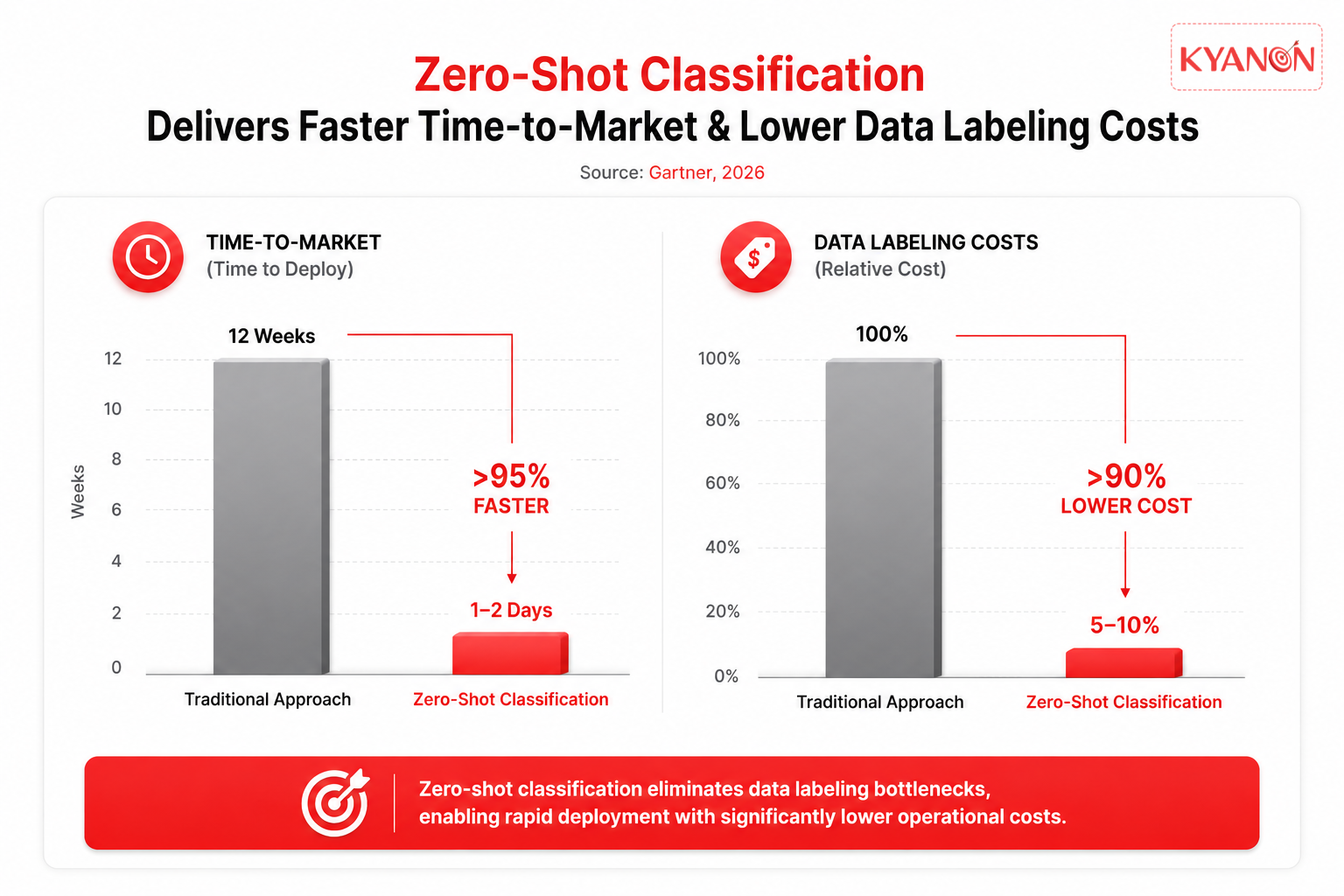
According to the Komprise (2026) Report, 74% of organizations are now managing over 5 Petabytes (PB) of unstructured data. Because data tagging and classification consistently rank as critical bottlenecks in enterprise data workflows, zero-shot architectures bypass this friction by instantly converting raw text and vision assets into structured business attributes without manual data annotation loops.
A cross-border retail enterprise applied zero-shot classification to sort incoming product catalogs from international vendors into centralized regional taxonomies. By mapping unclassified descriptions against dynamic text hypotheses, the company bypassed manual data cleaning loops and integrated new partner inventories into their active channels within 48 hours instead of the typical month-long validation cycle.
Common misconceptions
Zero-shot models do not natively execute direct category prediction but evaluate textual alignment through semantic matching. Understanding the operational realities helps technical leaders avoid common architectural mistakes.
“The system is executing a traditional multi-class classification routine.”
Reality: The system runs textual entailment under the hood. It reformulates your labels into hypotheses and outputs scores based on whether the input text supports or contradicts those statements, rather than calculating direct, hardcoded multi-class probabilities.
“The specific phrasing used for your target classification labels does not matter.”
Reality: Label naming functions as a high-sensitivity variable in prompt engineering. Shifting a candidate label from a broad term like “tech” to “information technology” can yield vastly different output confidence scores because the underlying model relies entirely on the precise embedding placement of those specific tokens.
How Kyanon Digital applies Zero-Shot Classification
Kyanon Digital integrates zero-shot classification pipelines to accelerate the early stages of enterprise data discovery and categorization workflows. We deploy these frameworks using open-source transformer architectures and scalable large language model (LLM) infrastructures for e-commerce, logistics, and data analytics clients operating across Southeast Asia. Our approach focuses on applying zero-shot classification to rapidly prototype AI categorization systems before committing capital to manual dataset creation or heavy fine-tuning pipelines. This specialized methodology allows our clients to discover optimal taxonomy designs and achieve faster time-to-market metrics while maintaining strict control over long-term Total Cost of Ownership (TCO).
→ Explore our Gen AI Development services











 Create project brief with AI