
What is Zero-Shot Learning?
Zero-shot learning (ZSL) is a machine learning paradigm where a model correctly classifies novel data categories without receiving any explicit labeled training examples for those specific classes. It achieves this by mapping unseen categories to a shared semantic space containing known attributes or auxiliary textual descriptions.
How Zero-Shot Learning works
Traditional machine learning frameworks fail when encountering a new class because they map visual or textual features directly to rigid, predetermined labels. Zero-shot learning circumvents this structural constraint by introducing an intermediate semantic embedding space. This allows the configuration to shift from direct feature-to-label matching to a multi-stage semantic attribute association process.
The three phases of execution
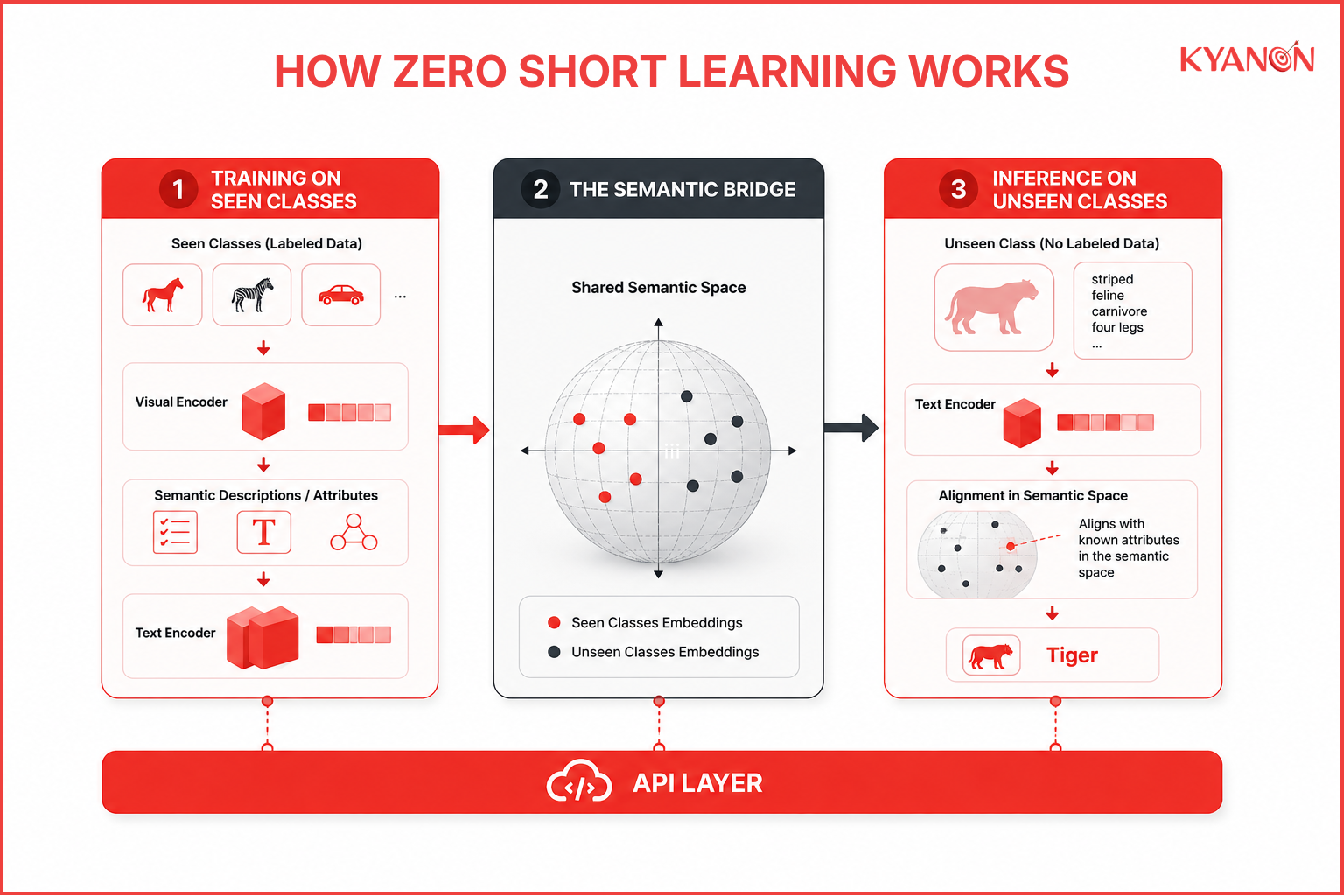
- Training on seen classes: The model analyzes the structural relationships between existing training data and its associated semantic descriptions, such as physical attributes, material properties, or natural language definitions.
- The semantic bridge: Both seen and unseen categories are projected into a shared semantic space. For instance, if a model learns the distinct visual markers for “stripes,” “four legs,” and “hooves” from training images of horses, it maps those abstract concepts directly into a text embedding space.
- Inference on unseen classes: When exposed to an entirely unencountered category (e.g., a tiger), the model reads its structural semantic definition (“striped,” “feline carnivore”) and recognizes the object by aligning the new visual features with known text-based attributes.
Core methodological approaches
- Attribute-Based Learning: High-level semantic features are defined manually or extracted dynamically through algorithmic subsystems. Models identify unknown target objects by detecting specific mathematical combinations of these known attributes.
- Semantic Word Embeddings: Models utilize pre-trained language representations (such as word vectors or text transformers) to automatically position labels within a continuous semantic space, calculating class similarities based on how words are used in natural language.
- Generative Data Synthesis: Advanced zero-shot learning frameworks employ Generative Adversarial Networks (GANs) or Variational Autoencoders (VAEs) to synthesize simulated training features for unseen classes based purely on text descriptions. This conversion transforms a zero-shot problem into a standard supervised training workflow.

Zero-Shot Learning vs Fine-Tuning
Both approaches adapt machine learning architectures for specific business tasks, but they differ fundamentally in data dependency and computational overhead.
Dimension | Zero-Shot Learning | Fine-Tuning |
Deployment speed | Immediate execution once the foundational framework is established. | Slow, requiring multi-stage retraining cycles and validation checks. |
Data requirement | Zero explicit training samples required for new classes. | A high volume of manually labeled data is required per target category. |
Upfront complexity | Low engineering friction since it bypasses localized dataset preparation. | High pipeline complexity due to hyperparameter optimization and data cleansing. |
Best for | Highly dynamic environments with rapidly shifting taxonomies or data scarcity. | Specialized, static domains demanding hyper-targeted precision profiles. |
Cost model | Operational expenditure (OpEx) is driven strictly by active inference token usage. | Capital and operational expenditure (CapEx/OpEx) via engineering hours and computing resources. |
When to consider Zero-Shot Learning
Zero-shot learning is optimized for enterprise environments characterized by extreme data constraints or fluid product categorization parameters.
Consider Zero-Shot Learning if:
- Your business operates in highly niche verticals where collecting, curating, and manually labeling thousands of data or image samples is logistically impossible or cost-prohibitive.
- Your product catalog, inventory tracking taxonomy, or compliance framework changes daily, requiring an automated configuration that categorizes new items instantly without triggering expensive model retraining loops.
- Your operational profile demands the automation of rare scenarios where historical training data cannot easily be collected, such as identifying rare medical anomalies, detecting obscure industrial machinery faults, or identifying unusual road hazards for autonomous vehicle fleets.
It may not be the right priority if:
- Your application demands absolute, deterministic precision in high-risk environments, where localized fine-tuning, explicit rulesets, and intensive human-in-the-loop validation remain mandatory.
Why Zero-Shot Learning matters for enterprise technology
Traditional artificial intelligence initiatives frequently stall during data ingestion because manual annotation requires hundreds of engineering hours. Zero-shot learning changes this operational bottleneck by allowing enterprise software architectures to deploy functional classification systems immediately upon installation. By stripping away the requirement for historical training datasets, organizations accelerate their software release cadences and lower the initial total cost of ownership (TCO) for automated infrastructure.
Supporting evidence
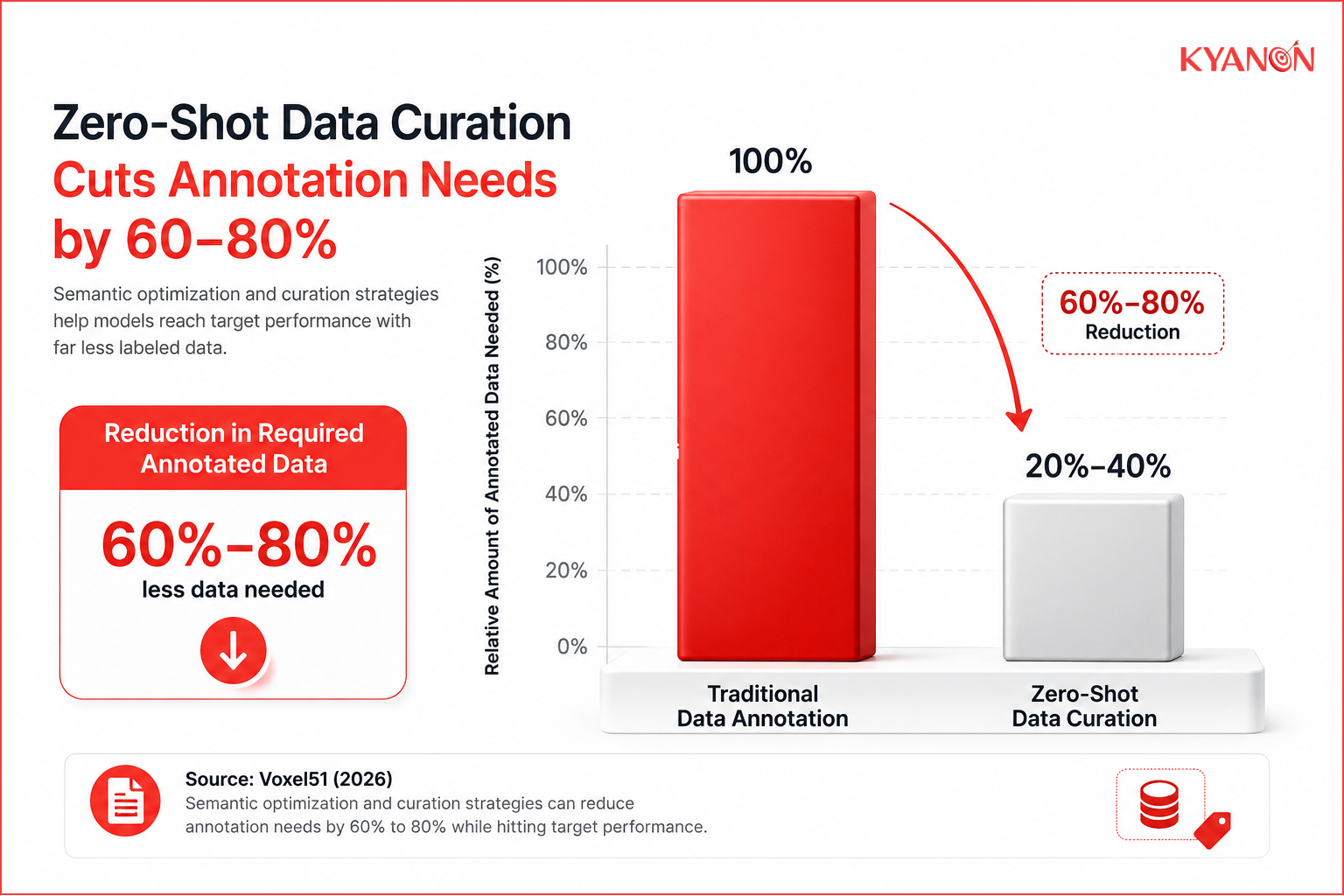
According to a research report published by AI data platform Voxel51 (2026), implementing semantic optimization and curation strategies before annotation allows machine learning models to reach target performance profiles with 60% to 80% less annotated data. This drop in data dependency allows organizations to shift engineering hours away from manual label preparation and directly toward operational deployment.
For instance, an e-commerce enterprise in Singapore integrated zero-shot classification to instantly organize thousands of cross-border SKUs into localized product taxonomies without utilizing historical local datasets. This architectural adjustment compressed a deployment process that typically takes weeks into a single afternoon, translating abstract algorithmic capabilities into immediate operational efficiency.
Technical bottlenecks of Zero-Shot Learning
Deploying zero-shot architectures within high-volume production environments requires active management of specific mathematical and structural constraints:
- Domain Shift: Semantic features derived from seen training datasets regularly exhibit structural variations when applied to completely unseen target deployment domains, impacting final classification accuracy.
- The Hubness Problem: Within high-dimensional vector spaces, a small cluster of data points (known as hubs) frequently becomes the calculated nearest neighbors to nearly all other data elements, causing systemic misclassification errors.
- Bias Toward Seen Classes: In Generalized Zero-Shot Learning (GZSL) environments—where the operational pipeline handles a mix of both seen and unseen classes—models show an inherent internal preference for predicting categories they encountered during initial training cycles.
Common misconceptions
Organizations often misunderstand the exact operational boundaries of non-traditional training configurations, leading to inaccurate infrastructure planning.
“Zero-shot learning requires absolutely zero data to function.”
Reality: A machine learning model cannot predict novel concepts from an absolute informational vacuum. While the model receives zero specific training examples of the unseen target class, it relies heavily on massive auxiliary datasets and visual-linguistic alignments absorbed during its multi-modal pre-training phase.
“Zero-shot performance is completely identical to zero-shot prompting.”
Reality: These terms describe distinct technical layers; zero-shot learning is an architectural machine learning setup centered on cross-modal generalization across unseen classes, whereas zero-shot prompting is an interaction technique where an operator directs a Large Language Model (LLM) to execute a task without providing context examples within the prompt window.
How Kyanon Digital applies Zero-Shot Learning
Kyanon Digital leverages the zero-shot capabilities of foundation models to reduce labeled data requirements for enterprise AI projects in domains with limited training data across Singapore, Malaysia, and Vietnam. Our engineering teams integrate zero-shot classification pipelines directly into existing enterprise search, content management, and e-commerce architectures, bypassing the traditional, labor-intensive manual labeling phase entirely. By focusing on measurable reductions in total cost of ownership (TCO) and rapid time-to-market, we enable regional enterprises to extract immediate value from unstructured data streams without prohibitive infrastructure overhead.
→ Explore our Gen AI Development services











 Create project brief with AI