
What is Zero-Shot Prompting?
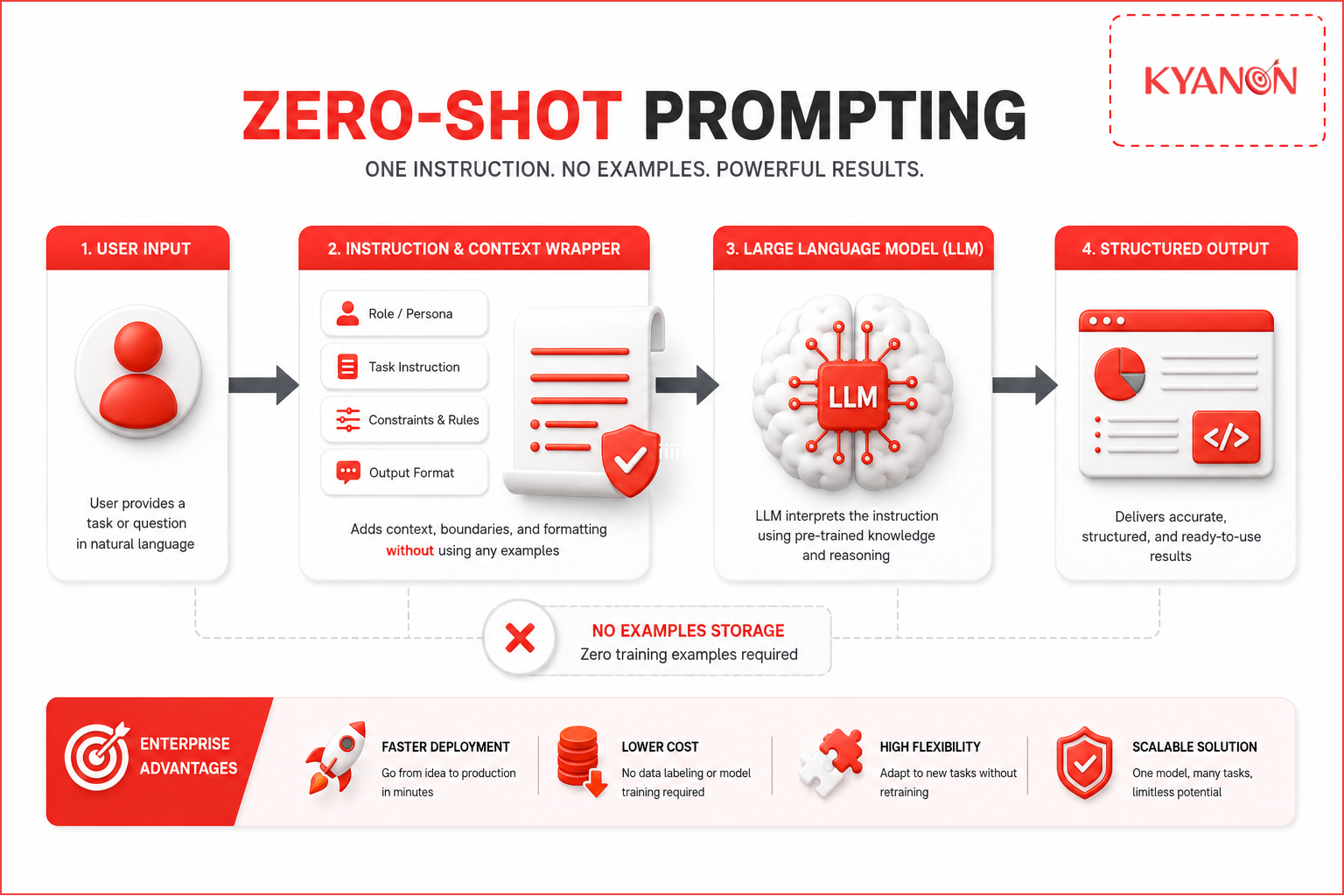
Zero-shot prompting is a prompt engineering technique where a large language model is instructed to perform a specific task without being provided any explicit examples or input-output demonstrations. It relies entirely on the model’s pre-trained semantic weights and contextual understanding to generate the desired output.
How Zero-Shot Prompting works
Large language models leverage pre-trained datasets to map relationships between concepts. In zero-shot prompting, the model decodes instructions by identifying semantic boundaries established during pre-training, which reduces complex production infrastructure down to a single API call. This architectural simplification shifts development from traditional data pipeline coding to writing text-based instructions, facilitating instant prototyping where teams validate AI concepts in minutes by altering text instructions.
Contextual persona assignment
Defining a specific corporate role or expert profile anchors the model’s latent space. This filters out irrelevant semantic associations and narrows vocabulary selection to match industry standards.
Structural constraints and execution boundaries
Explicit parameters dictating length, tone, prohibited terms, and specific formatting wrappers substitute for the lack of training examples. This leaves zero ambiguity for model deviation during inference.
Multi-Task versatility configuration
Structuring a single base prompt allows one model deployment to handle varied tasks like translation, text summarization, and sentiment analysis simultaneously. This eliminates the need to maintain distinct pipeline architectures for standard text-processing jobs.

Zero-Shot Prompting vs Few-Shot / Fine-Tuning
Both approaches guide large language models to execute specific tasks, but they differ fundamentally in data dependency, deployment velocity, and infrastructure footprint.
Dimension | Zero-Shot Prompting | Few-Shot / Fine-Tuning |
Setup Cost | Extremely Low (Zero manual data annotation required) | High to Very High (Requires manual data labeling pipelines) |
Time to Live | Minutes (Immediate go-to-market once prompt is ready) | Days to Months (Delayed by dataset curation and retraining) |
Accuracy Level | Moderate (Effective for generalized text tasks) | High (Optimized for niche, domain-specific edge cases) |
Token Usage | Low per request (Conserves context window capacity) | Higher per request (Few-shot examples inflate input payloads) |
| Storage Overhead | None (Avoids hosting multiple task-specific models) | High (Requires dedicated hosting for modified iterations) |
When to consider Zero-Shot Prompting
Consider Zero-Shot Prompting if:
- Your team needs to build a Minimum Viable Product (MVP) to launch fast and test market demand without establishing expensive data annotation pipelines.
- You are developing dynamic applications that must handle unpredictable or constantly changing user tasks that cannot be hardcoded into static training examples.
- Your core product requires standard text processing workloads such as generic classification, multi-language translation, or content summarization.
It may not be the right priority if:
- Your enterprise workflow demands absolute accuracy regarding non-standard compliance data structures or highly localized regulations where general model reasoning fails without explicit demonstrations.
Why Zero-Shot Prompting matters for enterprise technology
For enterprise technology leaders, managing the total cost of ownership (TCO) and velocity of generative AI implementations is a core operational challenge. Zero-shot prompting serves as an efficiency driver by removing the computational costs required to retrain models and reducing engineering hours, allowing organizations to achieve immediate go-to-market positioning.
Supporting evidence
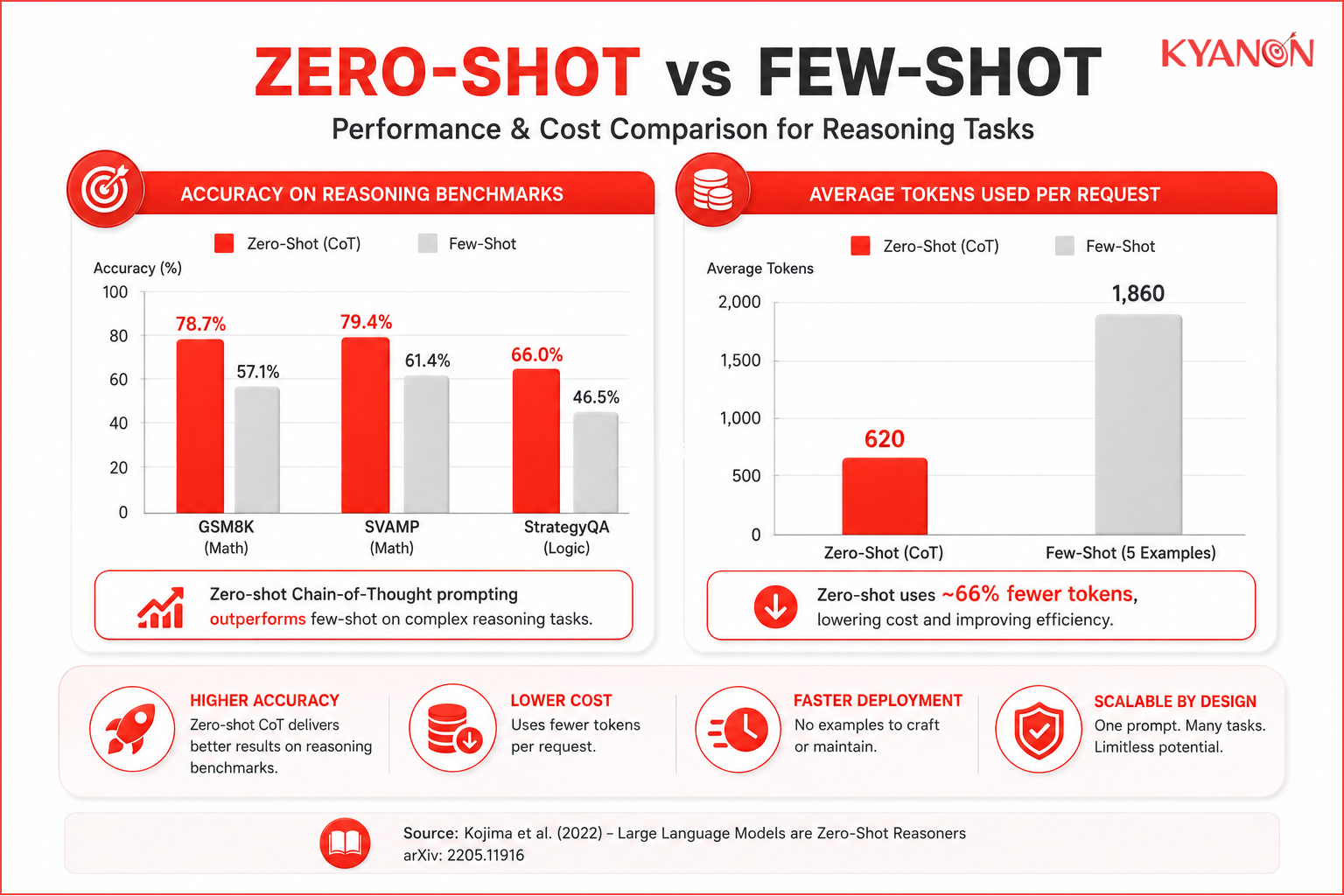
According to a landmark study by Kojima et al. (2022), modifying a zero-shot prompt to trigger structured reasoning, specifically appending “Let’s think step by step”, increased large language model accuracy on reasoning benchmarks from 17.7% to 78.7%. This demonstrates how strategic instruction modification yields enterprise-grade accuracy without data-labeling costs. An enterprise e-commerce platform applied zero-shot classification to categorize product SKUs, reducing processing time from weeks to hours while maintaining consistent classification accuracy.
Common misconceptions
“Zero-shot prompting means writing short, zero-effort text instructions.”
Reality: Zero-shot means providing zero input-output examples, not omitting context. Enterprise-grade zero-shot prompts require comprehensive context, clear role alignment, and explicit execution boundaries to avoid generic outputs.
“Few-shot prompting always delivers superior accuracy compared to zero-shot approaches.”
Reality: For complex logic or mathematical reasoning, providing static examples can cause models to copy flawed structural steps blindly. Research indicates that zero-shot chain-of-thought methods frequently outperform few-shot frameworks on heavy logical workloads.
How Kyanon Digital applies Zero-Shot Prompting
Kyanon Digital integrates zero-shot prompting as a baseline evaluation framework within enterprise generative AI configurations. Our engineering teams test zero-shot prompting as an initial performance baseline in enterprise GenAI deployments before recommending or investing in resource-intensive few-shot formatting or fine-tuning approaches. This evaluation phase ensures optimal resource allocation and cost-efficient scaling for organizations deploying technology solutions across Southeast Asia.
→ Explore our Generative AI Development services

 Create project brief with AI