
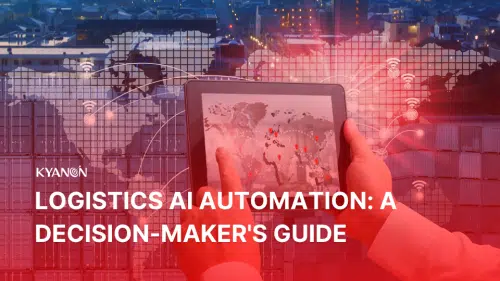
Logistics AI Automation is rapidly evolving from an innovation initiative into a critical operational capability for logistics and supply chain leaders. Yet many organizations struggle to move beyond isolated pilots due to fragmented data, legacy systems, and governance challenges. Kyanon Digital’s white paper, “Logistics AI Automation: A Decision-Maker’s Guide,” provides a practical roadmap for reducing costs, improving service performance, and building resilient logistics operations through AI-powered automation. From demand forecasting and route optimization to warehouse orchestration and exception management, this guide explores how organizations can turn AI investments into measurable business outcomes while maintaining governance, transparency, and scalability. Download the whitepaper to learn how leading logistics enterprises are transforming supply chain performance through intelligent automation.
Is your logistics operation ready to scale with AI-powered automation?
Logistics organizations are operating in an increasingly complex environment shaped by labor shortages, supply chain disruptions, rising customer expectations, and growing operational costs. While many companies are investing in AI, success depends on more than technology alone. Achieving meaningful results requires the right data foundation, process redesign, governance framework, and implementation strategy.
This white paper by Kyanon Digital provides a strategic framework to help logistics leaders evaluate, implement, and scale AI automation across supply chain operations while delivering measurable improvements in efficiency, service quality, and resilience.
As supply chains become more interconnected and data-intensive, manual decision-making can no longer keep pace with operational complexity. AI-powered logistics solutions enable organizations to anticipate disruptions, optimize resources, automate repetitive tasks, and improve visibility across transportation, warehousing, inventory management, and customer service. However, selecting the right use cases, technology architecture, and governance model remains a major challenge for many enterprises.
This guide helps decision-makers understand where AI delivers the greatest business value, how to build a scalable implementation roadmap, and which organizational capabilities are required for long-term success. Whether your organization is exploring its first AI initiative or expanding existing automation programs, this white paper offers practical insights to accelerate adoption while minimizing risk.
What’s inside
- Logistics AI Fundamentals: What AI-powered automation means across transportation, warehousing, fulfillment, planning, and customer service operations.
- Industry Challenges & Market Drivers: Why labor shortages, operational complexity, and customer expectations are accelerating AI adoption in logistics.
- High-Impact AI Use Cases: How AI improves demand forecasting, inventory optimization, route planning, shipment visibility, exception management, and customer support.
- Technology Foundation: The critical role of predictive analytics, workflow orchestration, real-time visibility, ERP, WMS, TMS integration, and connected data ecosystems.
- Business Impact & ROI: How AI helps reduce logistics costs, improve inventory efficiency, increase service quality, and strengthen operational resilience.
- AI Governance & Risk Management: How to address data quality, model transparency, oversight, compliance, human-in-the-loop controls, and operational risk.
- Implementation Roadmap: A practical four-stage approach covering assessment, pilot execution, scaling, and governance.
- Platform Evaluation Framework: Key criteria for selecting AI solutions that can predict, orchestrate, and integrate effectively within enterprise logistics environments.
- Performance Measurement: Which KPIs matter most, including forecast accuracy, on-time delivery, exception resolution time, labor productivity, and cost per shipment.
- Enterprise AI Success Factors: Lessons learned from high-performing organizations that have successfully scaled AI across logistics operations.
- Future-Ready Supply Chains: How logistics leaders can move from experimentation to operational transformation and long-term competitive advantage.
Table of content
- Executive Summary
- Chapter 1: Logistics Is Entering a High-Pressure Operating Environment
- Chapter 2: The Race Toward Intelligent Logistics Operations
- Chapter 3: How AI-Powered Logistics Enterprises Actually Operate
- Chapter 4: What Successful AI Logistics Deployments Reveal
- Chapter 5: How to Implement Logistics AI Successfully at Scale
- Chapter 6: From AI Experimentation to Operational Transformation
- Conclusion
- References
- About Kyanon Digital
- Regarding Copyright and Intellectual Property
Download now to get the full whitepaper!
 Create project brief with AI