
What is drop shipping?
Drop shipping is a retail fulfillment model in which a seller accepts a customer order but does not keep the product in stock; the order is sent to a supplier, wholesaler, manufacturer, or third-party partner that ships the product directly to the customer. The seller owns the customer relationship, while the fulfillment partner owns the physical storage, packing, and shipping workflow.
Michigan’s consumer protection guidance defines drop-shipping as selling goods not kept in stock and sending the order to another company to ship directly to the buyer.
How drop shipping works
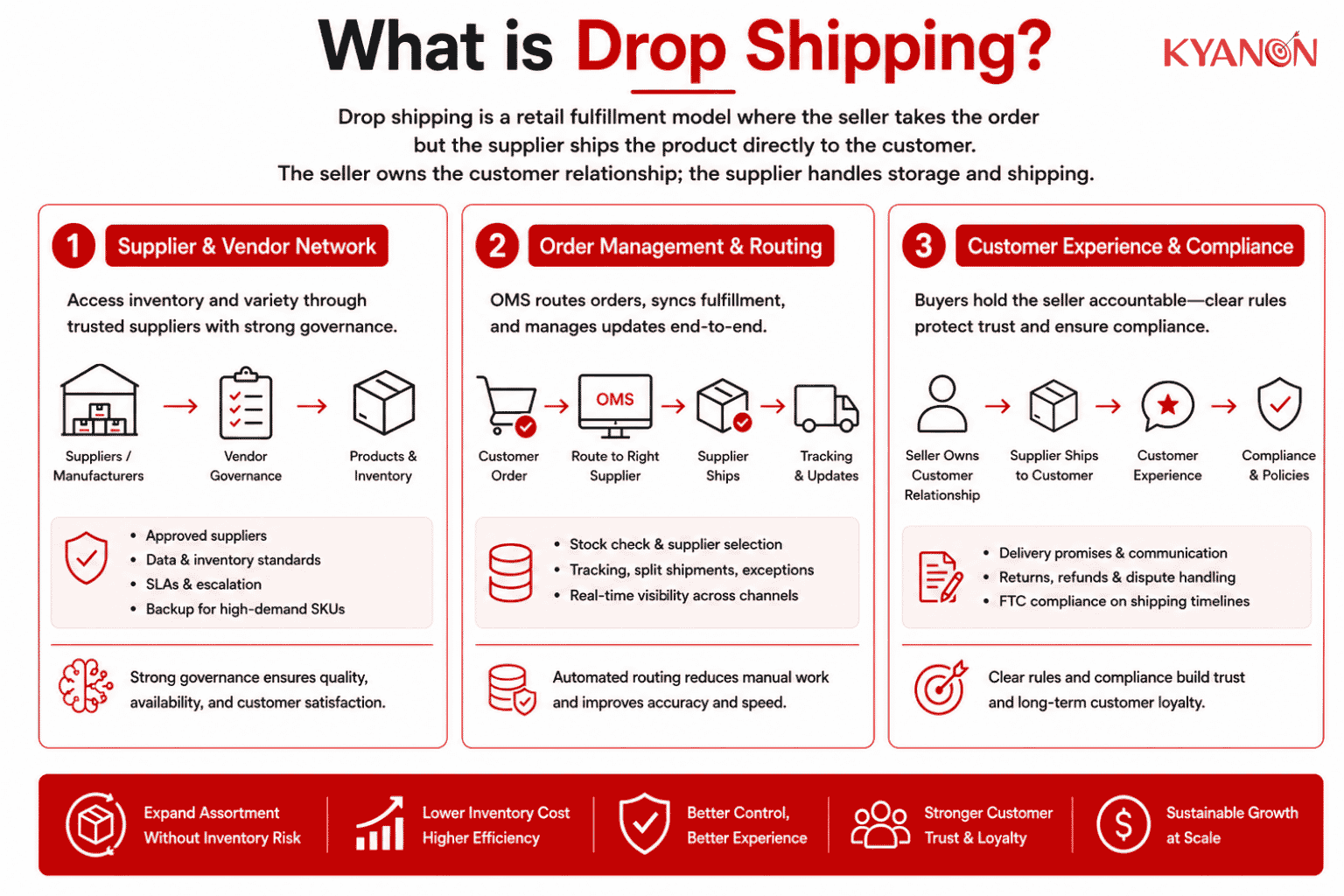
Drop shipping works because it separates inventory ownership from customer-facing commerce, allowing retailers to expand product assortment without holding every SKU in their own warehouses. The model is effective when supplier inventory, order routing, shipment tracking, customer service rules, and return ownership are governed through connected commerce systems rather than handled manually.
FedEx describes the core model as supplier-to-customer shipping after the seller receives an order, while the FTC requires sellers to have a reasonable basis for promised shipping timelines.
Supplier and vendor network
The supplier network makes drop shipping effective because it gives the retailer access to inventory, category depth, and fulfillment capacity without requiring full warehouse ownership. For B2B and marketplace operators, the business value comes from vendor governance: approved suppliers, product data standards, inventory update rules, service-level agreements, escalation paths, and backup suppliers for high-demand SKUs. Without vendor governance, the retailer may reduce inventory cost but lose control over delivery quality and customer experience.
Order management and routing
Order management makes drop shipping scalable because it turns supplier selection, stock checks, shipment updates, and exception handling into a controlled operating process. In a mature drop shipping model, the OMS routes each order to the right supplier, syncs fulfillment status, updates tracking numbers, manages split shipments, and flags issues when stock or delivery dates change. This reduces manual coordination and gives commerce teams better visibility across storefronts, marketplaces, vendors, warehouses, and logistics partners.
Customer experience and compliance
Customer experience governance makes drop shipping sustainable because buyers usually hold the seller accountable, even when a supplier ships the product. Clear rules for product claims, delivery promises, refund handling, returns, and dispute resolution protect the seller from service gaps created by external partners. The FTC’s Mail, Internet, or Telephone Order Merchandise Rule requires sellers to manage shipping promises responsibly, which makes compliance a core part of drop shipping operations rather than a back-office detail.
Operating lifecycle in one view
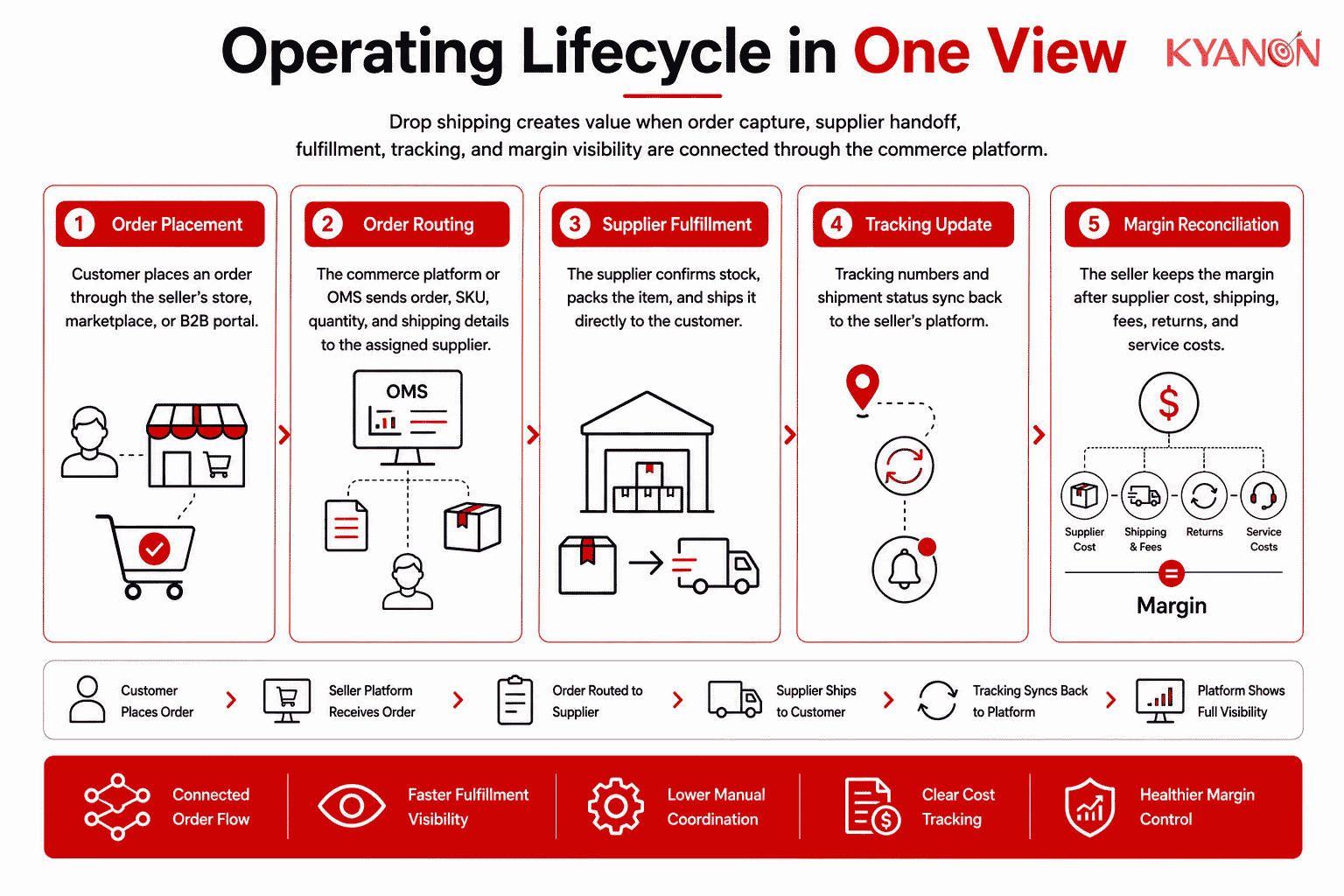
A drop shipping transaction creates value when order capture, supplier handoff, fulfillment, and margin reconciliation are connected through the commerce platform. The seller captures the customer order at retail price, forwards the order details to an approved supplier, pays the supplier cost, and keeps the difference after fulfillment, platform, marketing, service, and payment costs.
- Order placement: The customer buys a product through the seller’s e-commerce store, marketplace, or B2B portal.
- Order routing: The commerce platform or OMS sends the order, SKU, quantity, and shipping details to the assigned supplier.
- Supplier fulfillment: The supplier confirms stock, packs the product, and ships it directly to the customer.
- Tracking update: Shipment status and tracking numbers are synced back to the seller’s platform.
- Margin reconciliation: The seller keeps the margin after supplier cost, shipping, transaction fees, returns, and service costs are accounted for.
Drop shipping vs. 3PL fulfillment
Drop shipping and 3PL fulfillment both reduce the need for in-house warehousing, but they differ in inventory ownership, control, margin structure, and customer experience risk. Drop shipping usually relies on supplier-owned inventory, while 3PL fulfillment usually stores and ships inventory that the retailer or brand already owns.
| Dimension | Drop shipping |
3PL fulfillment |
|
Inventory ownership |
Usually held by supplier, wholesaler, manufacturer, or vendor | Usually owned by retailer or brand and stored with a 3PL |
| Fulfillment owner | Supplier or vendor ships directly to customer |
3PL warehouse picks, packs, and ships on behalf of retailer |
|
Upfront inventory cost |
Lower because retailer avoids bulk stock purchase | Higher because retailer usually buys or allocates inventory first |
| Control over packaging | Lower unless supplier supports branded packaging rules |
Higher because 3PL can follow brand packaging and insert rules |
|
Shipping consistency |
Depends on supplier capability and location | More controllable through 3PL network, carrier rules, and SLAs |
| Best for | Long-tail assortment, marketplace expansion, demand testing, vendor-managed products |
Branded fulfillment, faster delivery, predictable operations, owned inventory control |
|
Margin profile |
Can be tighter because supplier handles product and fulfillment | Can be stronger at scale if inventory planning and warehouse costs are managed well |
| Main operational risk | Supplier stockouts, slow shipping, inconsistent product data, weak returns handling |
Inventory overstock, storage cost, warehouse capacity, carrier performance |
|
Technology dependency |
Vendor portal, OMS, inventory sync, marketplace integrations |
WMS, OMS, 3PL integration, carrier integration, inventory forecasting |
When to consider drop shipping
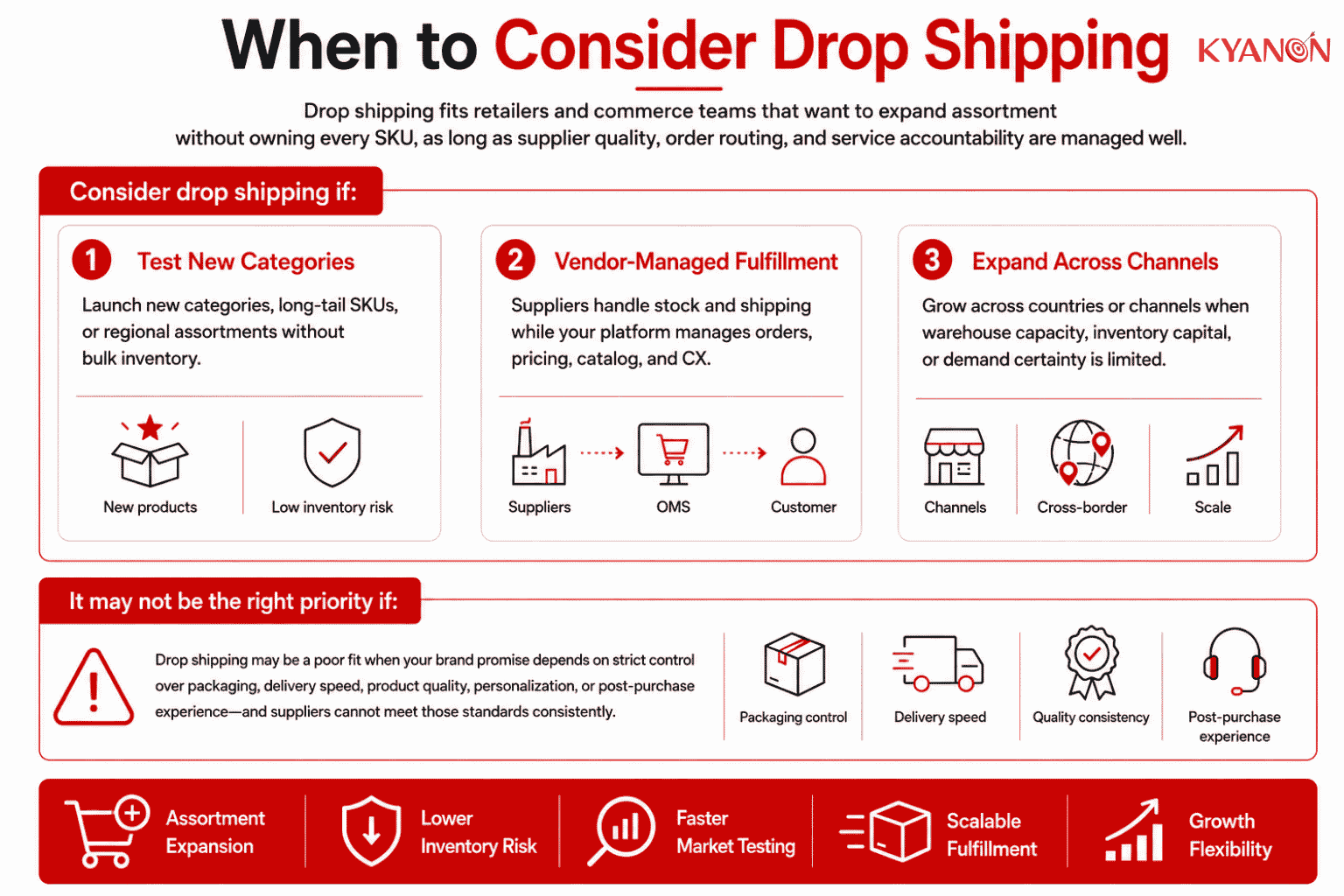
Drop shipping becomes relevant when a retailer, marketplace operator, or B2B commerce team wants to expand assortment without carrying every SKU in owned inventory. It is most useful when the business can manage supplier quality, order routing, customer service, and fulfillment accountability through connected commerce systems.
Consider drop shipping if:
- Your business wants to test new product categories, long-tail SKUs, or regional assortments without committing to bulk inventory.
- Your marketplace or B2B commerce platform needs vendor-managed fulfillment, where suppliers manage stock and shipping while your platform manages orders, pricing, catalog, and customer experience.
- Your team needs to expand product range across countries or channels, but warehouse capacity, inventory capital, or demand uncertainty makes owned stock too risky.
It may not be the right priority if:
- Your brand promise depends on strict control over packaging, delivery speed, product quality, personalization, or post-purchase experience, and your suppliers cannot meet those standards consistently.
Advantages and trade-offs to consider
Drop shipping reduces inventory exposure, but it shifts operational risk toward supplier governance, customer service, and fulfillment visibility.
|
Dimension |
Advantage |
Trade-off |
|
Inventory cost |
Lower upfront capital because the seller does not buy bulk inventory before demand is proven | Per-item cost can be higher than bulk purchasing, which can reduce margin |
| Assortment expansion | Easier to add or test new products without warehouse expansion |
Too many unrelated SKUs can dilute brand focus and increase catalog complexity |
|
Operations overhead |
Less need for owned warehousing, packing, and inventory storage | Supplier delays, defects, or stock errors still affect the seller’s reputation |
| Location flexibility | Products can be fulfilled from supplier or regional partner locations |
Multi-supplier orders can create split shipments, inconsistent tracking, and service gaps |
|
Customer service |
The seller can own the customer relationship and storefront experience |
The seller still handles complaints, refunds, returns, and delivery disputes |
Why drop shipping matters for retail and B2B commerce
Drop shipping matters for retail and B2B commerce because it allows businesses to expand product availability without holding every item in owned inventory. For enterprise commerce teams, the model is not only a low-inventory tactic; it is a vendor orchestration model that affects catalog governance, order routing, customer service, compliance, and profitability.
Grand View Research estimated the global dropshipping market at USD 464.4 billion in 2025 and projected it to reach USD 583.5 billion in 2026, with a 20.7% CAGR from 2026 to 2033. This growth shows that drop shipping is moving beyond small online stores into broader e-commerce, marketplace, and supplier-network models.
Deloitte’s 2026 Retail Industry Global Outlook found that 96% of surveyed global retail executives expect revenue growth and 81% expect margin expansion in the year ahead. In that environment, drop shipping can support assortment expansion and capital discipline, but only when supplier performance, fulfillment promises, and order exceptions are managed through reliable operating systems.
A regional B2B distributor can use drop shipping to list specialized SKUs from approved suppliers without storing every item in its own warehouses. The business still needs strong catalog rules, vendor onboarding, OMS routing, delivery tracking, and return policies because the customer experience remains attached to the seller’s brand, not the supplier’s back office.
Common misconceptions
The biggest misconception is that drop shipping is a low-effort business model when it is actually an operating model that shifts inventory work to suppliers but keeps commercial accountability with the seller. Drop shipping reduces upfront inventory exposure, but it does not remove the need for marketing, supplier governance, customer service, platform integration, and compliance management.
“Drop shipping means we do not need startup capital.”
Reality: Drop shipping can reduce upfront inventory cost, but it does not remove platform, marketing, payment, product testing, customer support, integration, and compliance costs. For enterprise teams, the larger cost is often operational: supplier onboarding, product data governance, OMS integration, return handling, and performance monitoring.
“Drop shipping can run on autopilot.”
Reality: Drop shipping is not an autopilot fulfillment model. Sellers still need to manage supplier reliability, product data accuracy, stock synchronization, shipping promises, refund rules, customer disputes, and replacement workflows.
“Drop shipping always means slow delivery.”
Reality: Slow delivery is not inherent to drop shipping; it usually comes from weak supplier selection, poor inventory visibility, or distant fulfillment locations. Domestic suppliers, regional distributors, and 3PL-connected vendor networks can reduce delivery times when the commerce platform supports accurate routing and tracking.
“We can sell anything through drop shipping.”
Reality: Broad, random assortment increases brand risk and operational complexity. A stronger drop shipping strategy focuses on approved categories, supplier quality controls, accurate product data, clear return rules, and products that match the retailer’s brand promise.
“Drop shipping is illegal.”
Reality: Drop shipping is a legitimate fulfillment model, but sellers still need to comply with consumer protection, shipping, refund, tax, product safety, intellectual property, and marketplace rules. Amazon’s drop shipping policy allows third-party fulfillment only when the seller is clearly identified as the seller of record, and the FTC requires sellers to have a reasonable basis for shipping claims.
How Kyanon Digital applies drop shipping
Kyanon Digital applies drop shipping in marketplace and B2B commerce platforms by integrating vendor management, catalog governance, OMS routing, fulfillment tracking, and operational reporting. In practice, this means designing vendor portals, supplier onboarding workflows, product data approval rules, order handoff logic, shipment status synchronization, exception handling, and returns workflows for commerce platforms across Southeast Asia and regional markets.
Core platform capabilities needed
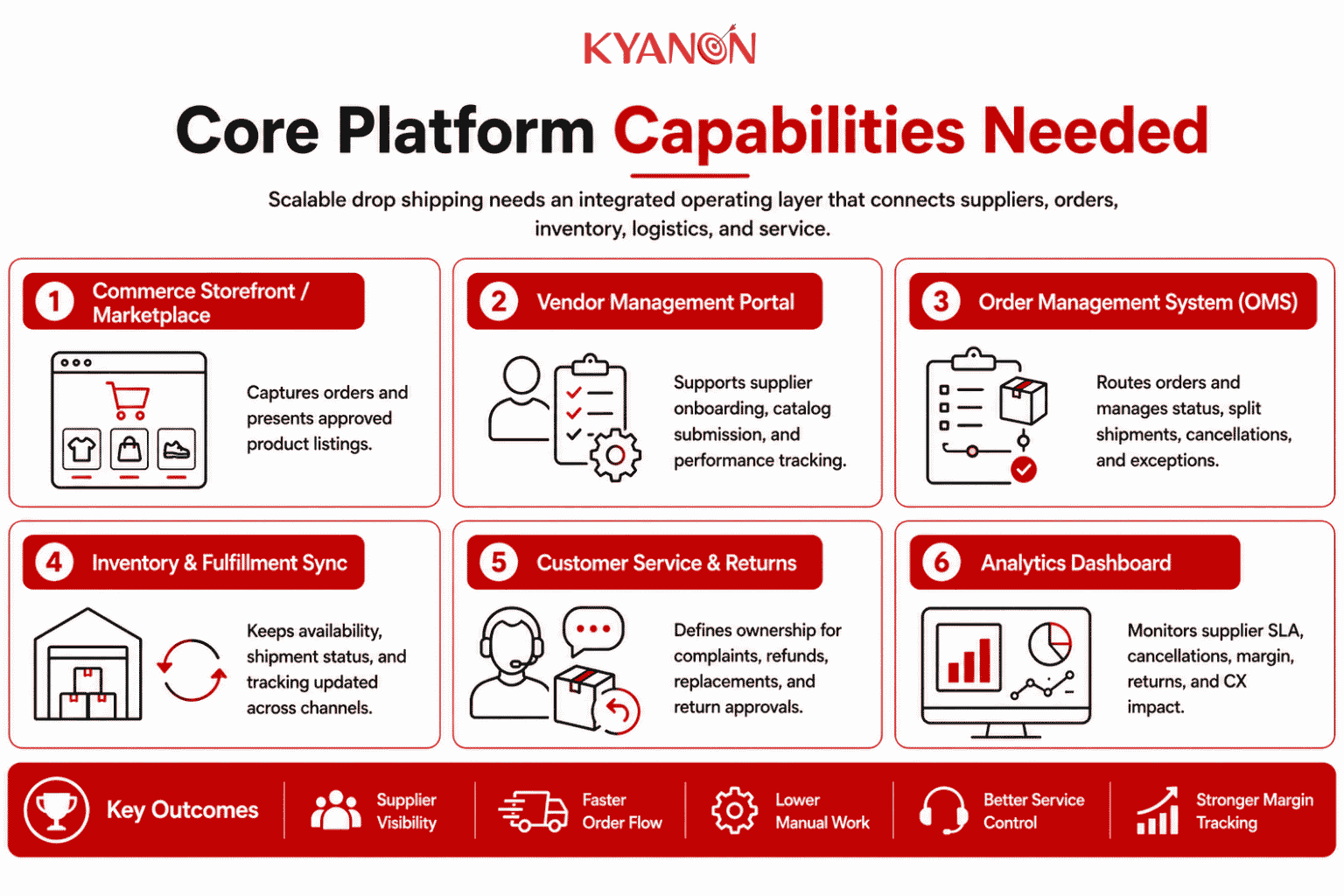
A scalable drop shipping model needs more than an online storefront; it needs an integrated operating layer that connects suppliers, orders, inventory, logistics, and customer service.
- Commerce storefront or marketplace: Captures customer orders and presents approved product listings.
- Vendor Management Portal: Enables supplier onboarding, catalog submission, fulfillment updates, and performance tracking.
- Order Management System (OMS): Routes orders to the right supplier and manages order status, split shipment, cancellation, and exception workflows.
- Inventory and fulfillment sync: Keeps product availability, shipment status, and tracking information updated across channels.
- Customer service and returns workflow: Defines who handles complaints, refunds, replacements, and return approvals.
- Analytics dashboard: Tracks supplier performance, fulfillment SLA, cancellation rate, margin, return rate, and customer experience impact.
Case study: How Kyanon Digital built a seller center for one of Thailand’s largest conglomerates

Kyanon Digital built a Seller Center platform for one of Thailand’s major conglomerates to support a proprietary multi-vendor marketplace where sellers manage catalogs, orders, payments, fulfillment, and customer interactions in one operating system.
Challenge
The client needed to enter Thailand’s competitive e-commerce market quickly while supporting large-scale seller onboarding, complex seller workflows, and high platform volume. The platform was expected to handle up to 1 million products, 1 million orders, and 100,000 concurrent sellers.
The solution
Kyanon Digital delivered the platform through a phased MVP → MMP → MLP model. The MVP was launched in three months, covering core seller workflows such as shop registration, product listing, order management, and payment tracking.
- Seller operations built: The Seller Center included catalog management, fulfillment visibility, logistics integration, customer query handling, returns and dispute workflows, finance dashboards, payout tracking, campaign management, and promotion tools.
- Architecture & integration: Kyanon Digital designed a cloud-native, API-driven architecture that could connect with logistics providers, warehouse systems, payment gateways, customer service tools, and external marketing platforms.
Results & impact
The Seller Center helped the client launch ahead of schedule, onboard sellers earlier, validate the marketplace foundation, and build a scalable operating backbone for future e-commerce growth.
For drop shipping use cases, this case study shows how vendor-managed commerce depends on more than product listing. It needs seller onboarding, catalog control, order visibility, logistics integration, payment tracking, customer service workflows, and scalable architecture to keep fulfillment accountable across external partners.
→ Explore our Omnichannel Ecommerce Development services.











 Create project brief with AI