
What is an eCommerce platform?
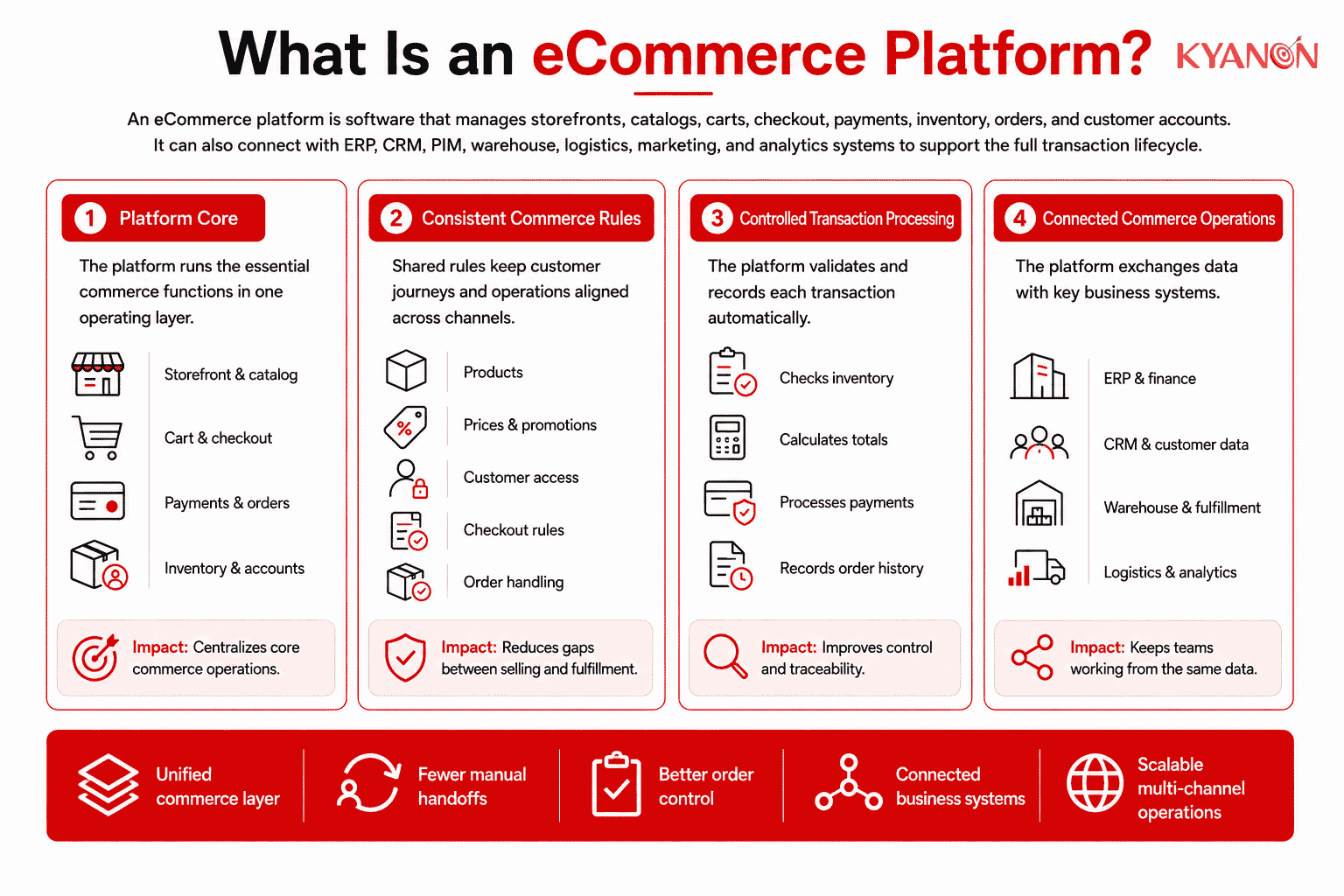
An eCommerce platform is software that manages digital storefronts, product catalogs, carts, checkout, payments, inventory, orders, and customer accounts.
It can also connect with ERP, CRM, PIM, warehouse, logistics, marketing, and analytics systems to support the complete transaction lifecycle.
Shopify, for example, combines storefront, payment, inventory, order, shipping, and reporting functions within one commerce environment.
How does an eCommerce platform work?
An eCommerce platform works because it applies consistent commerce rules across customer journeys, transactions, and connected business systems.
This shared operating layer reduces manual handoffs, prevents conflicting product or order data, and allows the business to manage several channels without rebuilding core commerce functions for each one.
Consistent commerce rules
The platform applies common rules for products, prices, promotions, customer access, checkout, and orders.
This reduces differences between what customers see and what operational teams can fulfill.
Controlled transaction processing
The platform validates inventory, calculates order totals, processes payments, and records each transaction.
Automating these controls reduces manual processing and creates a traceable order history.
Connected commerce operations
The platform exchanges data with inventory, finance, customer, fulfillment, and analytics systems.
Connected data allows commercial and operational teams to work from the same product, customer, and order information.
What are the key features of an eCommerce platform?
A complete eCommerce platform covers both the customer buying journey and the operational functions required to complete each sale.
|
Feature |
Business function |
|
Storefront management |
Manages navigation, product pages, content, search, and customer-facing experiences. |
| Catalog management |
Organizes products, categories, variants, SKUs, descriptions, and prices. |
|
Shopping cart and checkout |
Holds products, calculates totals, collects customer details, and completes purchases. |
| Payment processing |
Connects with payment gateways, cards, bank transfers, and digital wallets. |
|
Inventory management |
Tracks availability across products, locations, and sales channels. |
| Order management |
Records, routes, fulfills, updates, cancels, and returns orders. |
|
Customer management |
Maintains accounts, addresses, order histories, access rules, and customer groups. |
| Integration and reporting |
Connects commerce data with enterprise systems and performance dashboards. |
The required feature set depends on the operating model. A D2C store may prioritize storefront and checkout capabilities, while an enterprise may also need B2B pricing, approval workflows, multiple catalogs, regional stores, and complex integrations.
What are the main types of eCommerce platforms?
eCommerce platforms should be classified separately by their operating model and technical architecture.
Platform operating models
|
Model |
How it is managed | Best fit |
Main consideration |
|
SaaS or hosted |
The vendor manages the core software, hosting, security, and updates. | Businesses prioritizing launch speed and lower infrastructure responsibility | Customization follows the vendor’s platform rules |
| Open-source or self-managed | The business controls the source code, hosting, extensions, and maintenance. | Organizations requiring code ownership and custom workflows |
Security, upgrades, and hosting require technical ownership |
|
Managed enterprise cloud |
A vendor provides enterprise commerce capabilities with managed cloud infrastructure. | Multi-brand, multi-market, B2B, or complex B2C operations |
Higher implementation and governance requirements |
Shopify is a hosted commerce platform, while WooCommerce is an open-source platform built on WordPress that gives businesses control over hosting, checkout, data, and customization.
Platform architectures
| Architecture |
What it means |
|
Traditional or integrated |
The storefront and commerce backend are delivered within one platform structure. |
| Headless commerce |
The customer-facing frontend is separated from backend commerce functions and connected through APIs. |
|
Composable commerce |
Independent commerce capabilities are selected and integrated as modular components. |
- Headless commerce is an architecture, not a hosting or licensing model. A SaaS, open-source, or enterprise platform can support a headless implementation.
- Composable commerce extends headless architecture by separating additional backend functions such as catalog, checkout, pricing, and promotions into independent components.
Which eCommerce platform fits which business?
The right eCommerce platform depends on transaction complexity, business model, integration requirements, internal technical capacity, and expected scale.
|
Business requirement |
Platforms commonly evaluated |
Selection consideration |
|
Fast launch for a standard D2C store |
Shopify or Squarespace | Prioritize standard features and lower infrastructure work |
| WordPress-based commerce | WooCommerce |
Requires ownership of hosting, extensions, security, and maintenance |
|
Enterprise SaaS commerce |
Shopify Plus | Suitable when the business wants managed infrastructure with enterprise commerce capabilities |
| Complex B2B and B2C operations | Adobe Commerce or Salesforce Commerce Cloud |
Evaluate catalog, pricing, account, approval, and integration requirements |
|
API-first or composable commerce |
commercetools | Requires stronger architecture and integration capability |
| Highly specific operating workflows | Magento Open Source, Adobe Commerce, or custom commerce |
Evaluate whether customization value justifies lifecycle cost |
Salesforce positions its commerce platform for B2B, B2C, and D2C models, with capabilities spanning storefronts, order management, payments, headless commerce, and composable commerce.
WooCommerce provides source-code and hosting control, while commercetools uses an API-first, headless model for connecting commerce functions to different customer interfaces.
Platform selection should not begin with brand popularity alone. Decision-makers should compare workflow fit, implementation time, regional requirements, integration effort, technical ownership, and total cost of ownership.
eCommerce platform vs. composable commerce
A traditional eCommerce platform provides most commerce functions within an integrated product, while composable commerce assembles selected capabilities as independent services connected through APIs.
|
Dimension |
Traditional eCommerce platform |
Composable commerce |
|
Architecture |
Commerce capabilities are delivered as an integrated system | Capabilities are assembled from independent components |
| Implementation speed | Faster when standard functions match business requirements |
More integration and architecture work is required initially |
|
Customization |
Uses themes, modules, extensions, and platform APIs | Individual components and customer experiences can be replaced |
| Frontend model | Often uses the platform’s presentation framework |
Frontends can be built and deployed independently |
|
Vendor model |
Primarily dependent on one platform provider | May combine services from several providers |
| Upgrade management | Managed centrally by the vendor or platform team |
Each component and integration needs lifecycle governance |
|
Initial complexity |
Lower for standard commerce models | Higher because components must be selected and coordinated |
| Cost structure | Subscription or license plus implementation and extensions |
Component costs plus integration and platform operations |
|
Best fit |
Standardized commerce and faster deployment |
Complex channels, differentiated workflows, or frequent change |
Composable commerce is not automatically the better option. It creates the most value when standard platform constraints create measurable limits on customer experience, operational workflows, or market expansion.
When to consider an eCommerce platform
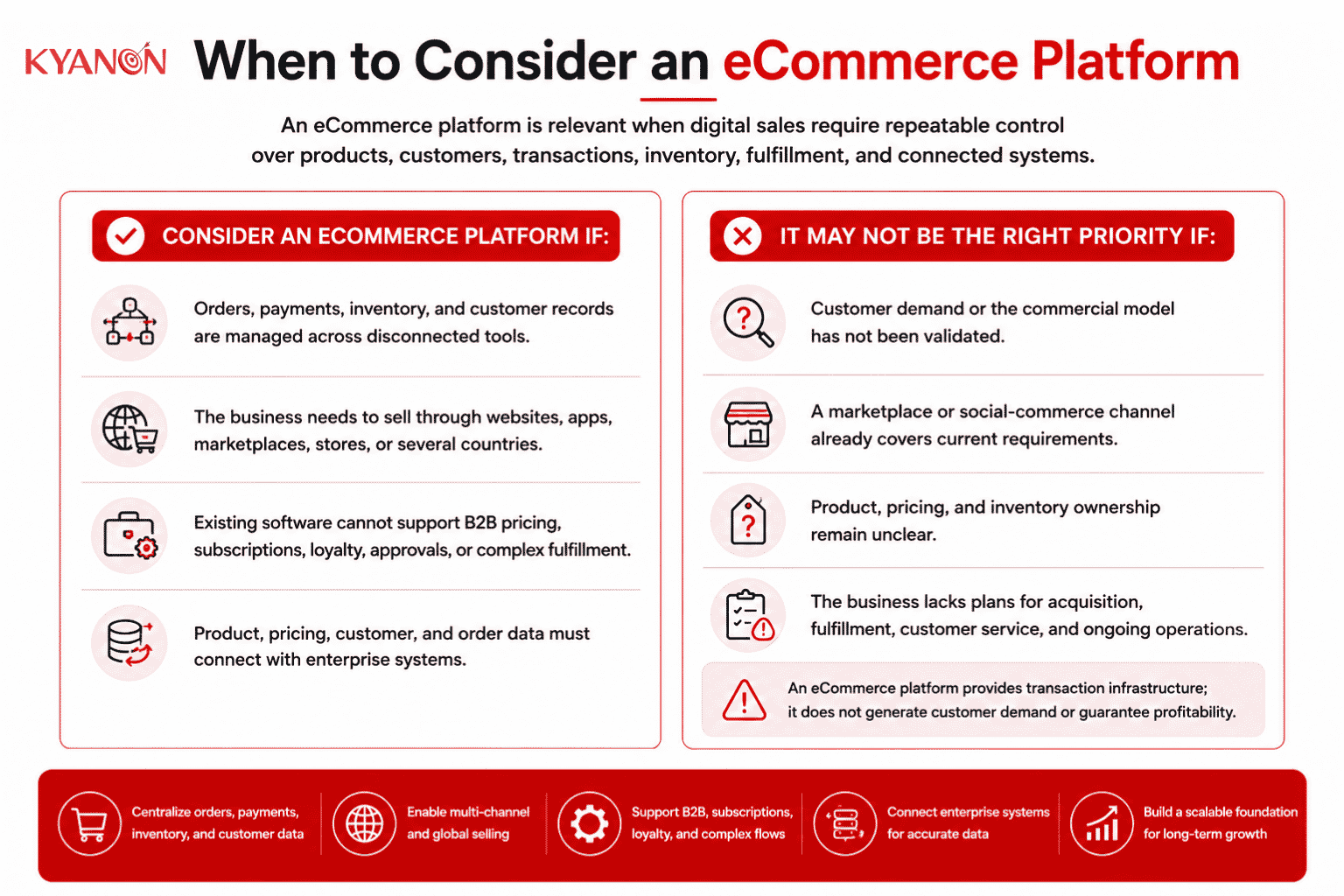
An eCommerce platform is relevant when digital sales require repeatable control over products, customers, transactions, inventory, fulfillment, and connected systems.
Consider an eCommerce platform if:
- Orders, payments, inventory, and customer records are managed across disconnected tools.
- The business needs to sell through websites, apps, marketplaces, stores, or several countries.
- Existing software cannot support B2B pricing, subscriptions, loyalty, approvals, or complex fulfillment.
- Product, pricing, customer, and order data must connect with enterprise systems.
It may not be the right priority if:
- Customer demand or the commercial model has not been validated.
- A marketplace or social-commerce channel already covers current requirements.
- Product, pricing, and inventory ownership remain unclear.
- The business lacks plans for acquisition, fulfillment, customer service, and ongoing operations.
An eCommerce platform provides transaction infrastructure; it does not generate customer demand or guarantee profitability.
Why do eCommerce platforms matter for enterprise commerce?
An eCommerce platform matters because customer experience and operational execution depend on consistent product, inventory, pricing, payment, and order data.
When this data is fragmented, businesses face incorrect availability, inconsistent pricing, checkout failures, manual reconciliation, and fulfillment delays.
Baymard’s 2026 benchmark reports an average documented online shopping cart abandonment rate of 70.22%, calculated from 50 studies. The figure reinforces why checkout usability, payment availability, cost transparency, and transaction reliability must be treated as platform requirements.
Case study: Retail transformation for an iconic Singaporean retailer

Challenges
- Legacy custom platform had limited scalability and speed to market.
- Online and in-store systems were disconnected.
- Inventory, fulfillment, and customer data lacked integration.
- Website and mobile journeys required modernization.
Solutions
- Migrated to a standard enterprise eCommerce platform.
- Revamped the eStore and mobile shopping app.
- Integrated CRM, PIM, OMS, WMS, and fulfillment systems.
- Introduced mobile POS and fulfillment tools for store teams.
Results and Impacts
- Enabled click-and-collect, in-store returns, and ship-from-store journeys.
- Improved order processing and real-time inventory visibility.
- Increased fulfillment accuracy and store-associate productivity.
- Unified customer data for personalized marketing and clearer reporting.
- Created a more scalable foundation for future commerce expansion.
Explore more: Retail Transformation For An Iconic Singaporean Retailer
Common misconceptions about eCommerce platforms
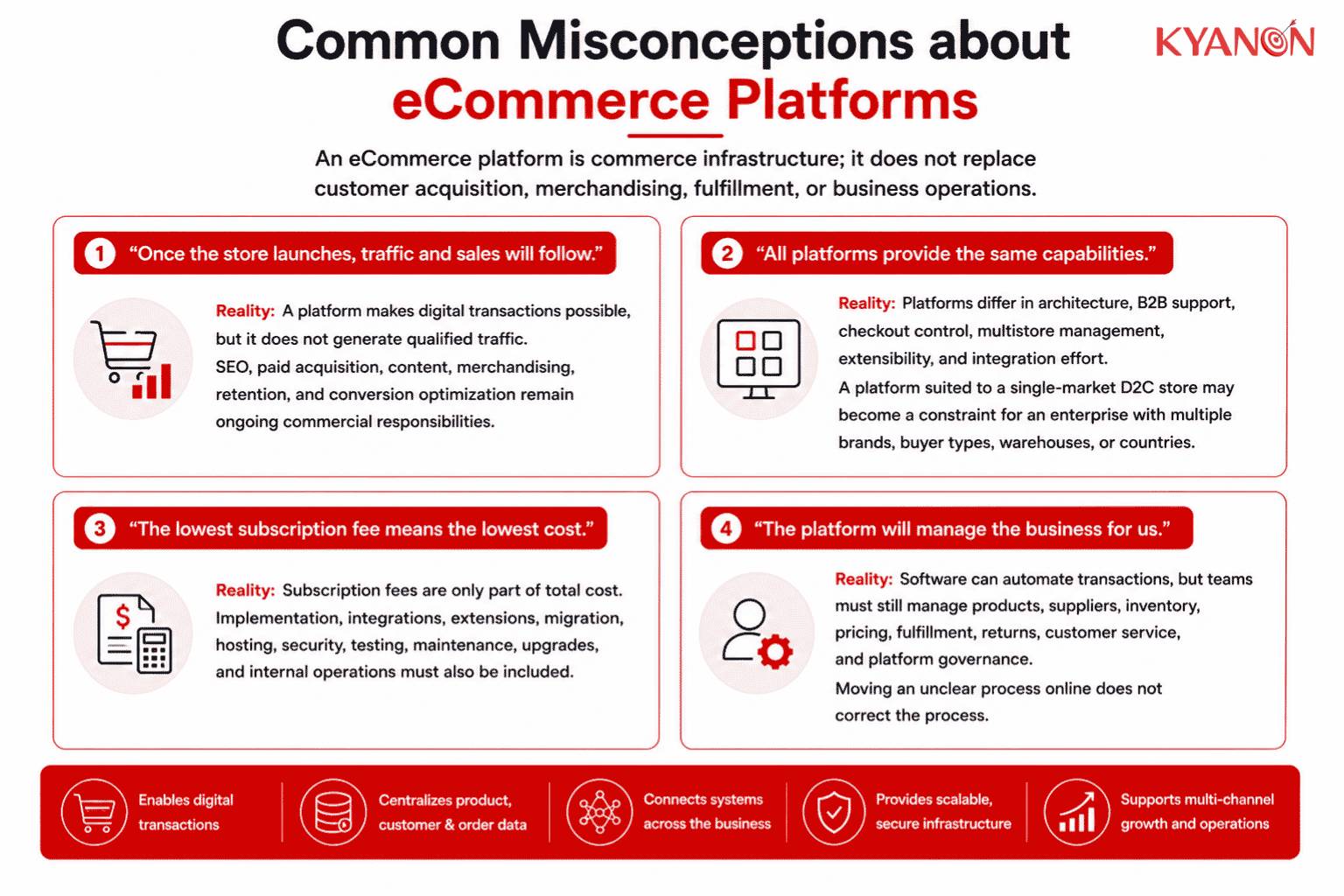
An eCommerce platform is commerce infrastructure; it does not replace customer acquisition, merchandising, fulfillment, or business operations.
“Once the store launches, traffic and sales will follow.”
Reality: A platform makes digital transactions possible, but it does not generate qualified traffic.
SEO, paid acquisition, content, merchandising, retention, and conversion optimization remain ongoing commercial responsibilities.
“All platforms provide the same capabilities.”
Reality: Platforms differ in architecture, B2B support, checkout control, multistore management, extensibility, and integration effort.
A platform suited to a single-market D2C store may become a constraint for an enterprise managing several brands, buyer types, warehouses, or countries.
“The lowest subscription fee means the lowest cost.”
Reality: Subscription or license fees represent only one part of the total cost of ownership.
Implementation, integrations, extensions, migration, hosting, security, testing, maintenance, upgrades, and internal operations must also be included.
“The platform will manage the business for us.”
Reality: Software can automate transactions, but teams must still manage products, suppliers, inventory, pricing, fulfillment, returns, customer service, and platform governance.
Moving an unclear process online does not correct the process.
How Kyanon Digital applies eCommerce platforms
Kyanon Digital selects, builds, and integrates eCommerce platforms according to the client’s operating model, channel strategy, integration requirements, and expected transaction scale.
Kyanon Digital works with platforms such as Magento and Adobe Commerce, Shopify and Shopify Plus, and composable technologies such as commercetools. Implementations can connect storefronts with ERP, CRM, PIM, OMS, payment, inventory, logistics, marketplace, and analytics systems.
Projects focus on practical decisions such as:
- Whether standard platform functions can support the required workflows.
- Which capabilities require configuration, integration, or custom development.
- How customer and transaction data will remain consistent across channels.
- Which architecture provides an appropriate balance between time to market and control.
- How implementation and operating costs affect long-term TCO.
Headless or composable architecture is applied when independent storefront delivery, API-first integration, or multiple customer channels create a clear business requirement, not simply because the architecture is newer.
→ Explore Kyanon Digital’s Omnichannel eCommerce Development Services.











 Create project brief with AI