
What is elastic search?
Elastic search is a distributed search and analytics engine that indexes structured, unstructured, and vector data for near-real-time retrieval and analysis.
In e-commerce, elastic search supports product search, filtering, autocomplete, relevance ranking, semantic search, and analysis across large catalogs.
How elastic search works
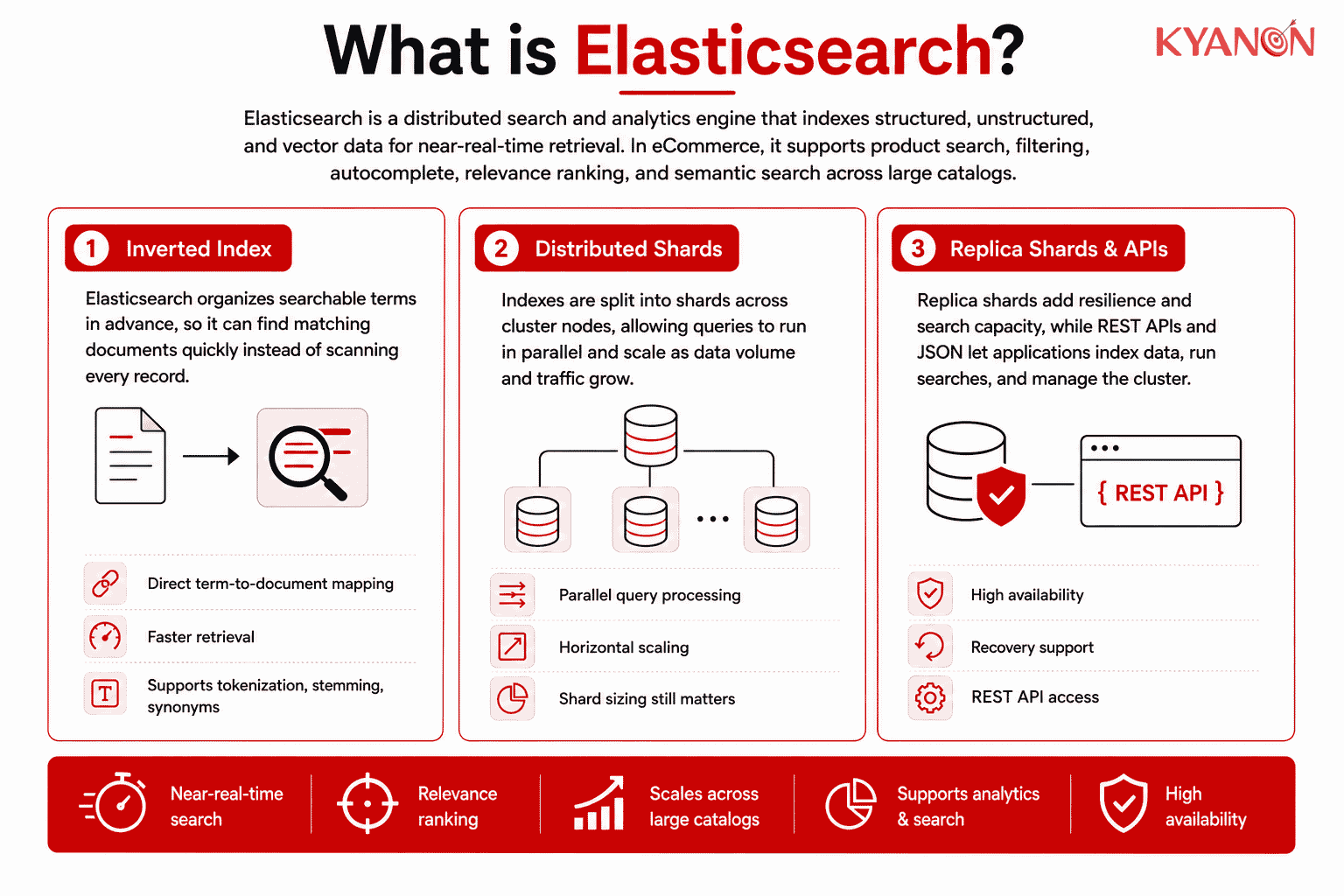
Elasticsearch is effective because it pre-organizes data into search indexes and distributes query processing across shards, avoiding a sequential scan of every source record for each search.
This architecture supports fast retrieval, relevance ranking, horizontal scaling, and service continuity across large or frequently updated datasets.
Inverted index
An inverted index maps each searchable term to the documents containing that term.
Instead of checking every product or record individually, Elasticsearch can locate matching documents directly and rank them by relevance. Text analysis can also normalize words through tokenization, lowercasing, stemming, and synonyms.
Distributed shards
Elasticsearch divides an index into shards that can be allocated across several cluster nodes.
Search requests can be processed across shard copies and their results combined, allowing infrastructure capacity to expand as data volume and query traffic increase. Shard strategy must still be sized for the actual workload because excessive or poorly sized shards create resource overhead.
Replica shards and API access
Replica shards maintain additional copies of indexed data on other nodes, increasing search capacity and supporting recovery when a node or shard becomes unavailable.
Applications communicate with Elasticsearch through REST APIs and JSON requests to index documents, run searches, update mappings, and manage the cluster.
What are the main elastic search use cases?
Elasticsearch is used when organizations need low-latency retrieval or analysis across text, event, operational, security, or vector data.
|
Use case |
What elastic search does |
Business application |
|
Application and e-commerce search |
Searches and ranks products, content, documents, or listings | Product search, autocomplete, faceted filters, and recommendations |
| Log analytics and observability | Indexes logs, metrics, traces, and system events |
Application monitoring, troubleshooting, and performance analysis |
|
Security analytics |
Searches security events and detects suspicious patterns | SIEM, threat detection, incident investigation, and response |
| AI and vector search | Stores embeddings and retrieves semantically similar content |
Hybrid search, semantic queries, AI assistants, and RAG pipelines |
Elastic search combines full-text search, filters, vector retrieval, aggregations, and analytics within the same engine.
What is the elastic stack?
The elastic stack is a group of products that collect, process, index, search, analyze, and visualize data, with Elasticsearch serving as the central search and data engine.
A traditional elastic stack data flow can be summarized as:
Beats or Logstash → Elasticsearch → Kibana
|
Component |
Primary role |
| Beats |
Lightweight agents that collect and forward logs, metrics, and other operational data |
|
Logstash |
Ingests, transforms, enriches, and routes data from different sources |
| Elasticsearch |
Stores, indexes, searches, and analyzes the data |
|
Kibana |
Provides dashboards, visualizations, search interfaces, and management tools |
Elastic search can operate without every component, while Beats and Logstash are optional ingestion tools selected according to the data source and processing requirements.
Elastic search vs. relational databases
Elastic search is optimized for search and analytics, while relational databases such as PostgreSQL and MySQL are designed to manage authoritative transactional records and structured relationships.
The two systems commonly operate together rather than replacing each other.
|
Dimension |
Elastic search |
Relational database |
|
Primary purpose |
Search, relevance ranking, retrieval, and analytics | Reliable transactional storage and data management |
| Data model | JSON documents with explicit or dynamic field mappings |
Structured tables, columns, keys, and constraints |
|
Search capability |
Full-text, fuzzy, faceted, semantic, and vector search | Exact lookups, structured filtering, and SQL queries |
| Transactions | Document-level updates and optimistic concurrency controls |
Multi-statement transactions with commit and rollback |
|
Relationships |
Denormalized documents; limited parent-child relationships | Joins, foreign keys, and normalized relationships |
| Schema behavior | Flexible ingestion, but every indexed field receives a mapping |
Defined schemas and controlled relational structures |
|
Scaling model |
Distributed indices and shards across cluster nodes | Depends on the database architecture and replication model |
| Typical role | Derived search or analytics layer |
Primary system of record |
|
Best fit |
Product discovery, logs, security events, analytics, and AI retrieval |
Orders, payments, inventory transactions, accounts, and financial records |
Elastic advises against recreating complex relational models through several levels of parent-child relationships because each level adds query-time memory and computation costs. PostgreSQL, by comparison, supports transaction blocks in which multiple changes can be committed or rolled back together.
When to consider elastic search
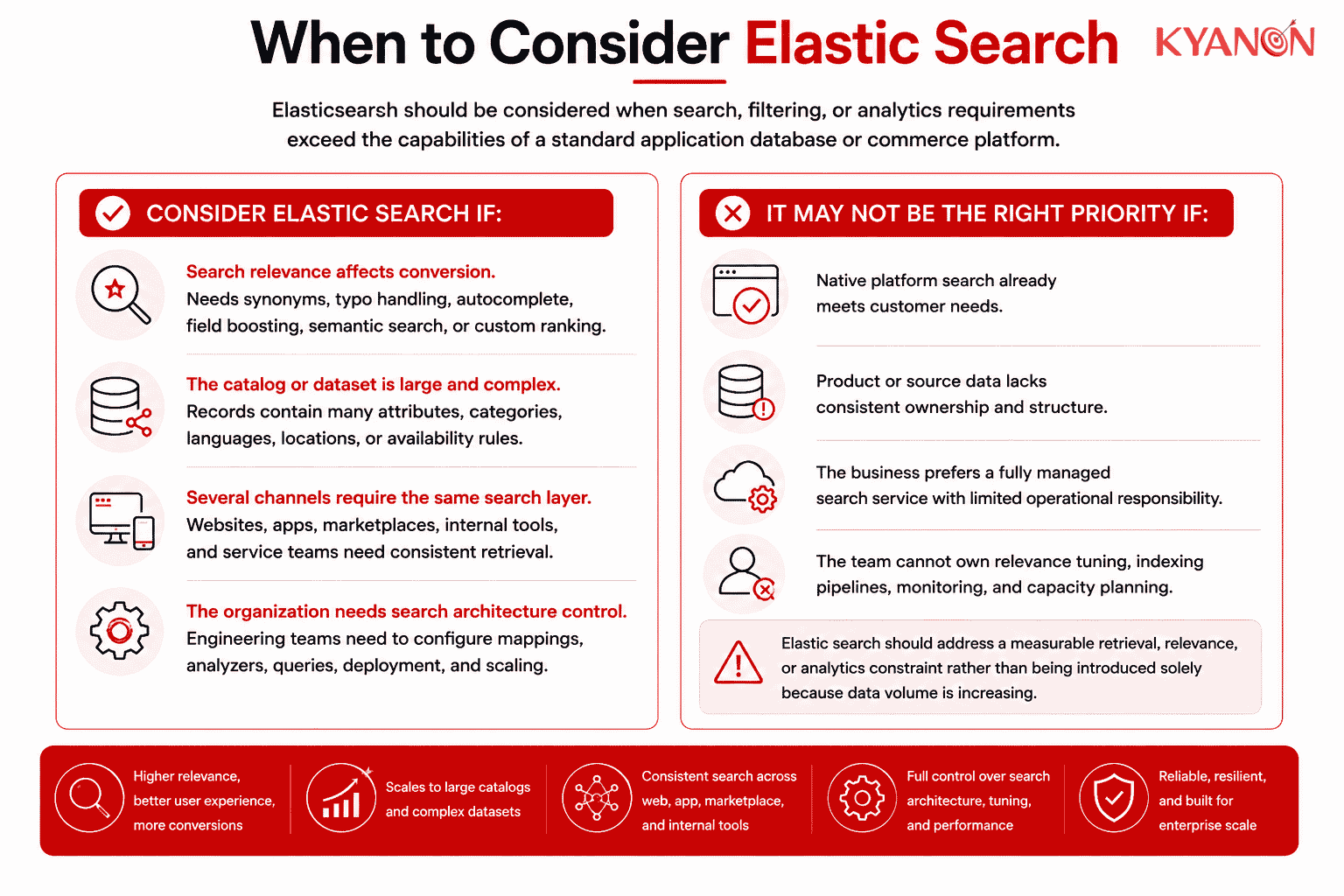
Elastic search should be considered when search, filtering, or analytics requirements exceed the capabilities of a standard application database or commerce platform.
Consider elastic search if:
- Search relevance affects conversion. The business needs synonyms, typo handling, autocomplete, field boosting, semantic search, or custom ranking.
- The catalog or dataset is large and complex. Records contain many attributes, categories, languages, locations, or availability rules.
- Several channels require the same search layer. Websites, apps, marketplaces, internal tools, and service teams need consistent retrieval.
- The organization needs search architecture control. Engineering teams need to configure mappings, analyzers, queries, deployment, and scaling.
It may not be the right priority if:
- Native platform search already meets customer needs.
- Product or source data lacks consistent ownership and structure.
- The business prefers a fully managed search service with limited operational responsibility.
- The team cannot own relevance tuning, indexing pipelines, monitoring, and capacity planning.
Elastic search should address a measurable retrieval, relevance, or analytics constraint rather than being introduced solely because data volume is increasing.
Why elastic search matters for e-commerce
Elastic search matters for e-commerce because search quality determines whether shoppers can find relevant products within a large catalog and continue toward purchase.
Commerce teams can combine text relevance with product attributes, availability, popularity, merchandising rules, customer behavior, and vector similarity. This supports search boxes, autocomplete, faceted navigation, multilingual discovery, personalized ranking, and recommendations.
Elastic’s 2024 HSE case study reported a 4% increase in search-page click-through rate, an 8% increase in customer satisfaction, and a 42% reduction in maintenance time after the retailer adopted Elasticsearch on AWS.
HSE used filters, aggregations, field boosting, sorting, semantic retrieval, and AI capabilities to serve customers searching by product number, brand, creator, or general description. The case shows that search value comes from relevance configuration and operational integration, not from installing the engine alone.
Common misconceptions about elastic search
Elastic search is a search-oriented data platform, not a drop-in substitute for a transactional database or a search experience that operates without configuration.
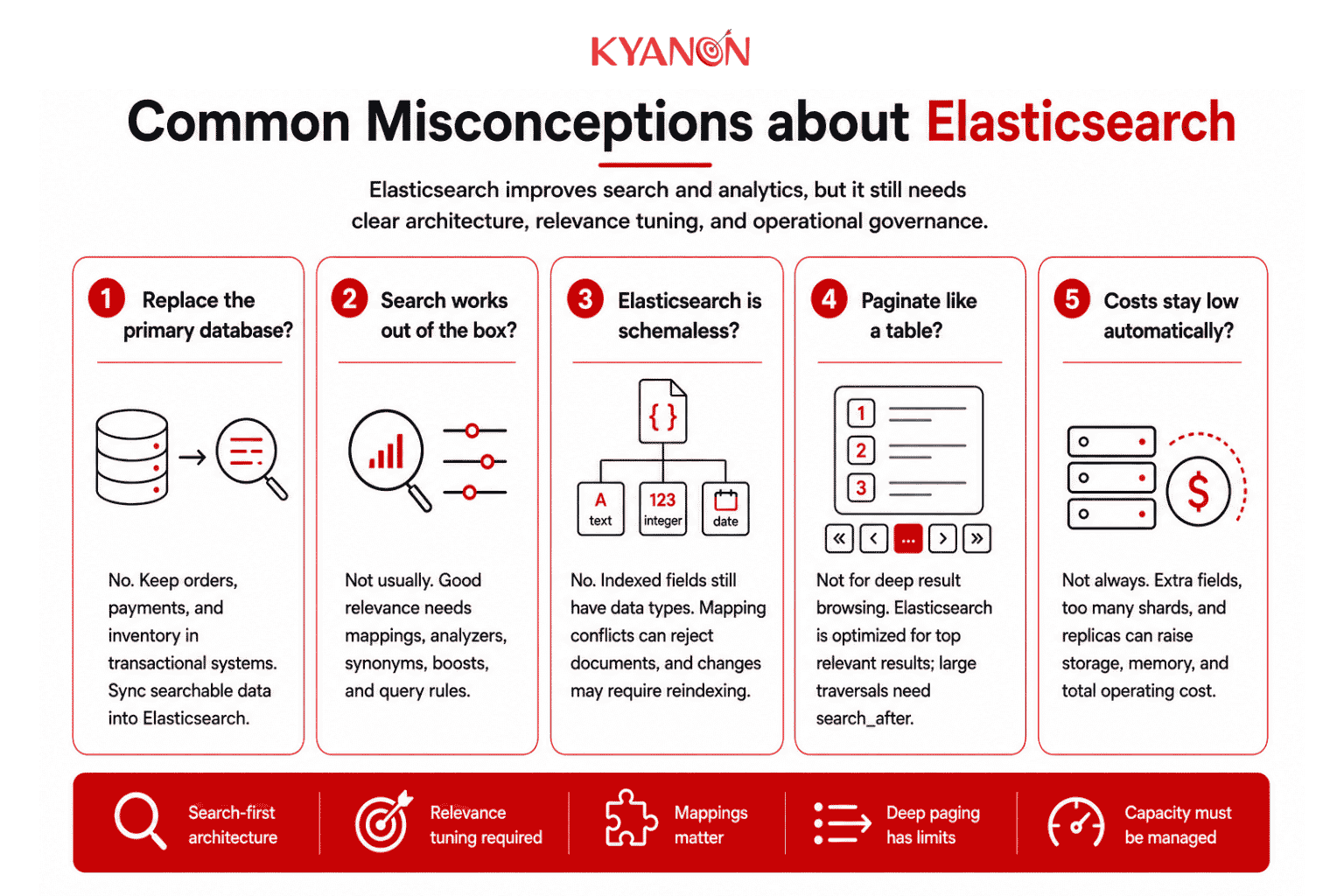
“Elastic search can replace our primary database.”
Reality: Elasticsearch does not provide the same multi-statement transaction and relational constraint model as a database such as PostgreSQL.
Orders, payments, inventory movements, and other authoritative transactions should normally remain in the relevant primary system, with searchable data synchronized into Elasticsearch.
“Relevant search will work out of the box.”
Reality: Default search behavior does not understand a company’s catalog, customer language, commercial priorities, or merchandising rules.
Product search requires field mappings, analyzers, synonyms, filters, boosts, query rules, and relevance evaluation.
“Elastic search is schemaless.”
Reality: Elasticsearch can create mappings dynamically when receiving JSON documents, but every indexed field still receives a defined data type.
Conflicting field types can reject documents, while changing an existing mapping may require a new index and data reindexing.
“We can paginate through millions of records like a table.”
Reality: Elasticsearch is optimized for relevant top results rather than unrestricted deep pagination.
Standard from and size pagination cannot pass 10,000 hits by default because deep pages increase memory and CPU consumption. Elastic recommends search_after, often with a point-in-time view, for larger result traversal (Elasticsearch).
“Storage and cluster costs will remain minimal.”
Reality: Elastic search requires storage and computing capacity for indexes, source documents, mappings, shards, replicas, aggregations, and cluster operations.
Indexing unnecessary fields or creating too many shards can increase disk use, memory requirements, reindexing effort, and total cost of ownership.
How Kyanon Digital applies elastic search
Kyanon Digital can use elastic search as a search and discovery layer within larger e-commerce implementations that connect product, inventory, pricing, and customer data.
Product, pricing, availability, and customer behavior data can be synchronized from commerce platforms, PIM, ERP, inventory, and analytics systems into search-specific indexes. Implementations may cover:
- Product and attribute mappings
- Multilingual analyzers and synonyms
- Autocomplete and query suggestions
- Faceted navigation and filters
- Relevance scoring and merchandising rules
- Availability-aware product ranking
- Semantic and hybrid search
- Recommendation signals
- Search analytics and zero-result monitoring
- Cluster sizing and index optimization
Transactional data remains in the appropriate source system, while elastic search provides an optimized retrieval layer for customer-facing and internal search.
Kyanon Digital’s e-commerce capabilities include smart search and discovery, AI-driven recommendations, composable commerce, platform integration, and connections with ERP, CRM, inventory, payment, logistics, and fulfillment systems.
→ Explore Kyanon Digital’s Big Data and Omnichannel eCommerce Development Services.











 Create project brief with AI