
What is fulfillment automation?
Fulfillment automation is the use of software, connected systems, workflows, APIs, and optional automated equipment to coordinate order processing, inventory allocation, warehouse execution, shipping, tracking, and exception handling with limited manual intervention.
It can automate a single fulfillment task or orchestrate the order lifecycle across eCommerce platforms, order management systems, warehouses, stores, carriers, and third-party logistics providers. IBM defines supply chain automation as using technology to perform supply chain tasks with limited human intervention, while Oracle describes order and warehouse management systems as automating order processing and managing inventory and fulfillment operations.
How fulfillment automation works
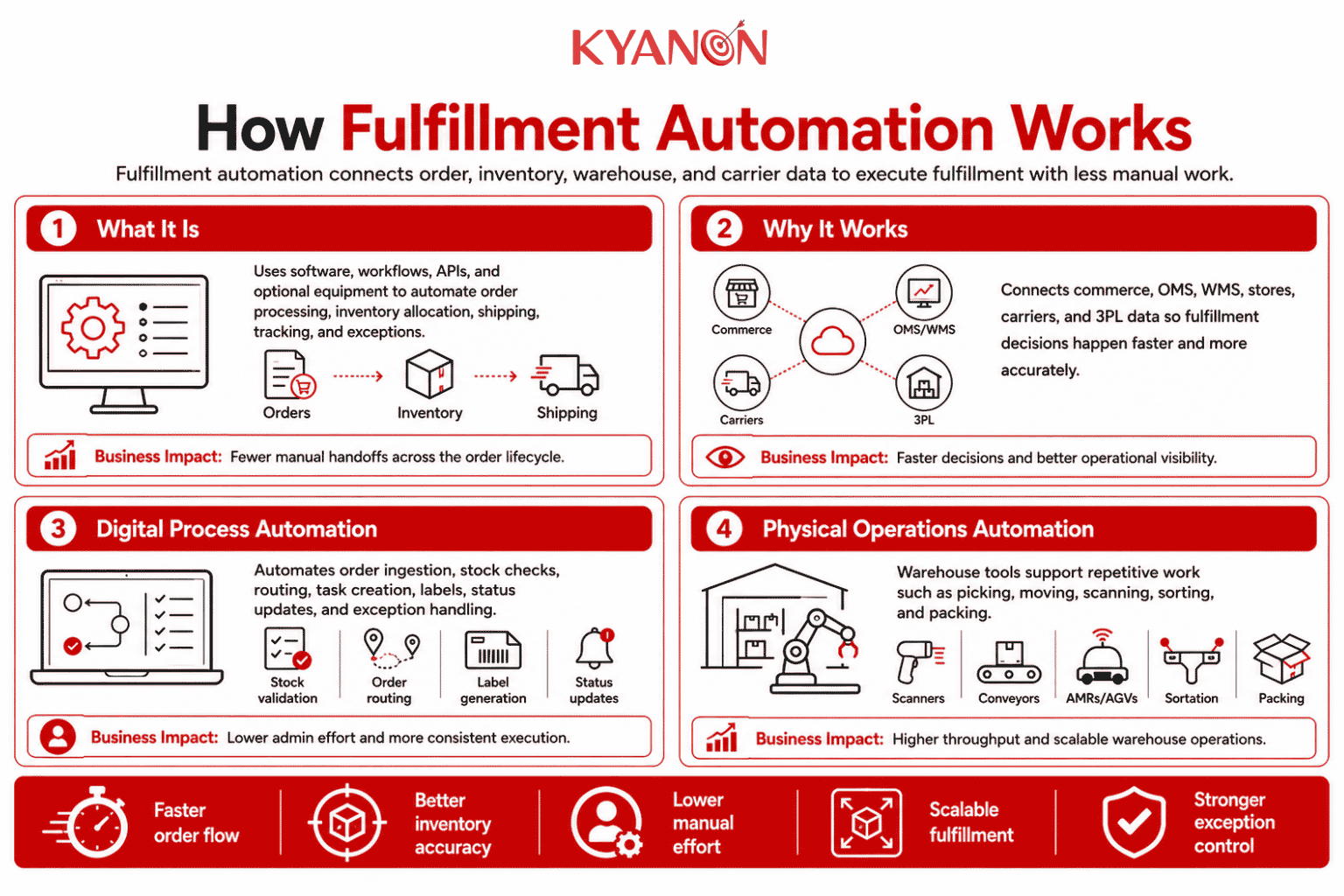
Fulfillment automation is effective because it connects order, inventory, warehouse, and carrier data so each fulfillment decision can be executed without repeated manual handoffs.
It combines two layers: software automates information and decision flows, while warehouse equipment can automate repetitive physical tasks. Businesses can deploy either layer independently or connect both when order volume and operational complexity justify the investment.
Digital process automation
Software connects commerce platforms, OMS, WMS, inventory systems, carriers, stores, and 3PL providers.
It can automate order ingestion, stock validation, fulfillment-location selection, task creation, label generation, status updates, and exception routing. Shopify confirms that automatic order-routing rules can consider inventory availability, shipping cost, customer proximity, and custom business logic.
Physical operations automation
Warehouse equipment performs or supports repetitive physical work such as transporting inventory, directing picks, sorting parcels, scanning items, and preparing packages.
This layer may include conveyors, barcode scanners, autonomous mobile robots, automated guided vehicles, sortation systems, or packing equipment. Oracle confirms that warehouse-management platforms can integrate with AMRs, conveyors, sortation systems, carousels, and scales.
Human oversight and exceptions
Employees remain responsible for damaged goods, inventory discrepancies, unusual orders, customer changes, and operational exceptions.
Automation handles repeatable decisions within defined rules, while human teams manage situations that require judgment or service recovery.
What does an automated fulfillment workflow include?
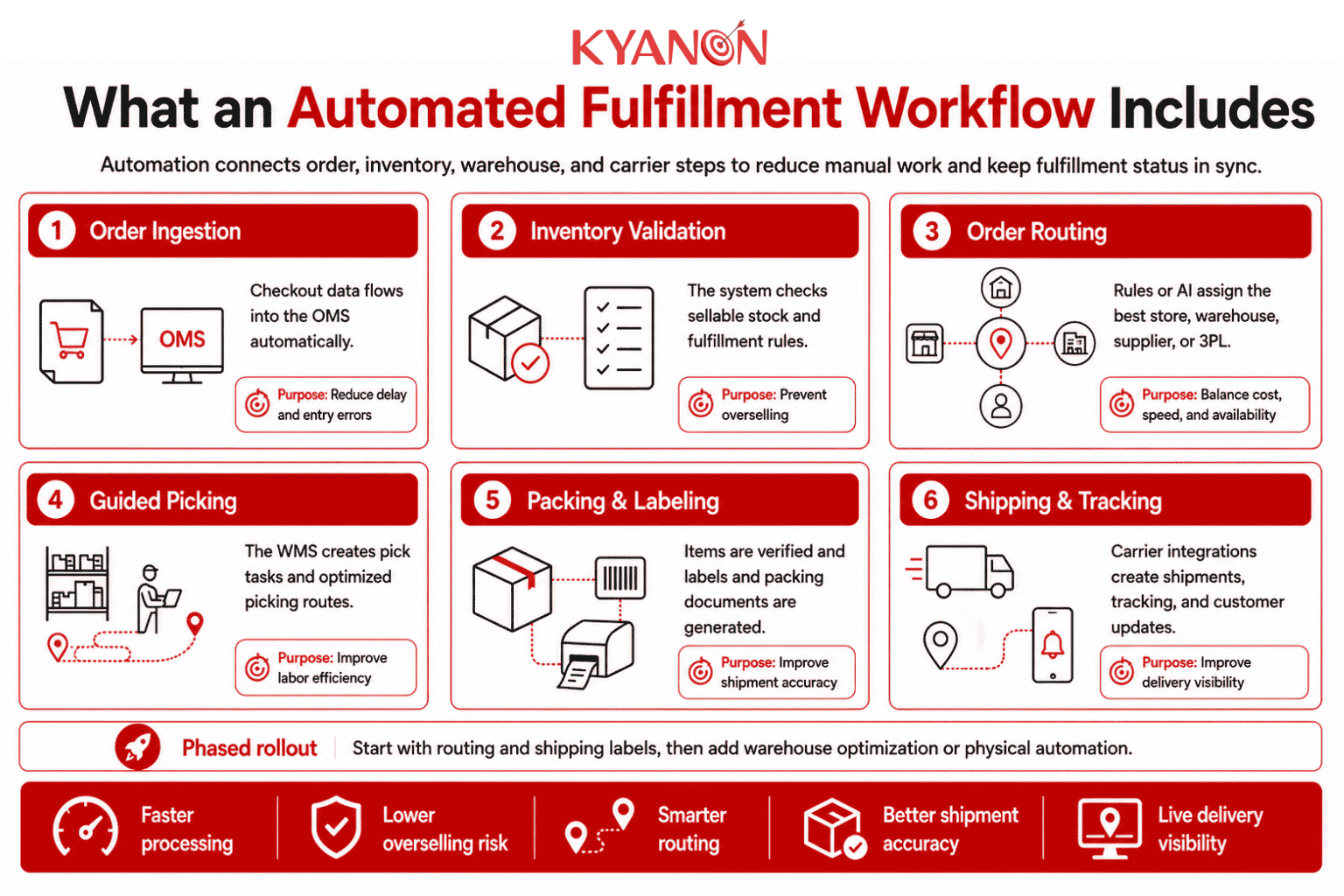
An automated fulfillment workflow coordinates the stages between receiving an order and handing the shipment to a carrier, while keeping inventory and customer-facing statuses synchronized.
Order ingestion → Inventory validation → Order routing → Picking → Packing and labeling → Shipping and tracking
| Stage | Automated activity |
Business purpose |
|
1. Order ingestion |
Checkout data flows from the sales channel into the OMS without manual re-entry. | Reduces processing delay and transcription errors |
| 2. Inventory validation | The system checks sellable stock and fulfillment constraints across eligible locations. |
Reduces overselling and failed fulfillment promises |
|
3. Order routing |
Rules, optimization models, or AI select a store, warehouse, supplier, or 3PL. | Balances availability, proximity, cost, and delivery commitment |
| 4. Guided picking | The WMS generates pick tasks, optimized routes, or instructions for workers and equipment. |
Reduces unnecessary movement and inconsistent task allocation |
|
5. Packing and labeling |
The system validates items, creates packing documents, and generates shipping labels. | Improves shipment accuracy and reduces repeated data entry |
| 6. Shipping and tracking | Carrier integrations support service selection, shipment creation, tracking, and customer notifications. |
Maintains delivery visibility and coordinates last-mile execution |
Automation does not require every stage to be deployed at once. A retailer may begin with order routing and shipping labels before adding warehouse task optimization or physical equipment.
What are the benefits of fulfillment automation?
Fulfillment automation creates value by allowing operations to process more orders with fewer manual handoffs while maintaining consistent inventory, routing, and shipping rules.
| Benefit |
Business impact |
|
Scalable order processing |
Supports seasonal or campaign-driven volume increases without a proportional rise in coordination work |
| Fewer fulfillment errors |
Reduces manual entry, incorrect routing, wrong-item shipments, and missed status updates |
|
Faster order cycles |
Moves orders from capture to warehouse execution and carrier handoff with fewer delays |
| Lower repetitive workload |
Automates label creation, status updates, task allocation, carrier selection, and notifications |
|
Better inventory utilization |
Routes orders across eligible stores, warehouses, suppliers, and 3PL locations |
| Consistent delivery communication |
Synchronizes tracking and fulfillment statuses across customer-facing channels |
The business case should be measured through order cycle time, fulfillment accuracy, cost per order, throughput, exception volume, inventory utilization, and on-time delivery, not order volume alone.
Fulfillment automation vs. warehouse management system
Fulfillment automation coordinates processes across the order lifecycle, while a warehouse management system (WMS) manages inventory and operational execution within a warehouse or distribution center.
A WMS can be a central component of fulfillment automation, but it does not automatically cover order orchestration, carrier selection, customer notifications, or last-mile delivery.
|
Dimension |
Fulfillment automation |
Warehouse management system |
| Primary purpose | Coordinate and automate fulfillment across systems and locations |
Manage inventory and work inside a warehouse |
|
Process scope |
Order routing through shipping, tracking, and exceptions | Receiving, putaway, picking, packing, and dispatch |
| Operating boundary | Commerce, OMS, warehouses, stores, carriers, and 3PLs |
Warehouse or distribution-center operations |
|
Inventory role |
Uses availability data to determine fulfillment decisions | Records and manages warehouse inventory |
| Order-routing role | Selects fulfillment location, method, or carrier |
Executes warehouse tasks after an order is assigned |
|
Customer communication |
Can automate order and delivery updates | Usually sends status data to another system |
| Hardware requirement | May be software-only or include robotics and equipment |
Can operate with manual or automated warehouse equipment |
|
Implementation approach |
Often introduced across selected workflows and integrations | Deployed as a warehouse operating system |
| Best fit | Omnichannel businesses coordinating several systems and locations |
Businesses requiring greater warehouse control and visibility |
When to consider fulfillment automation
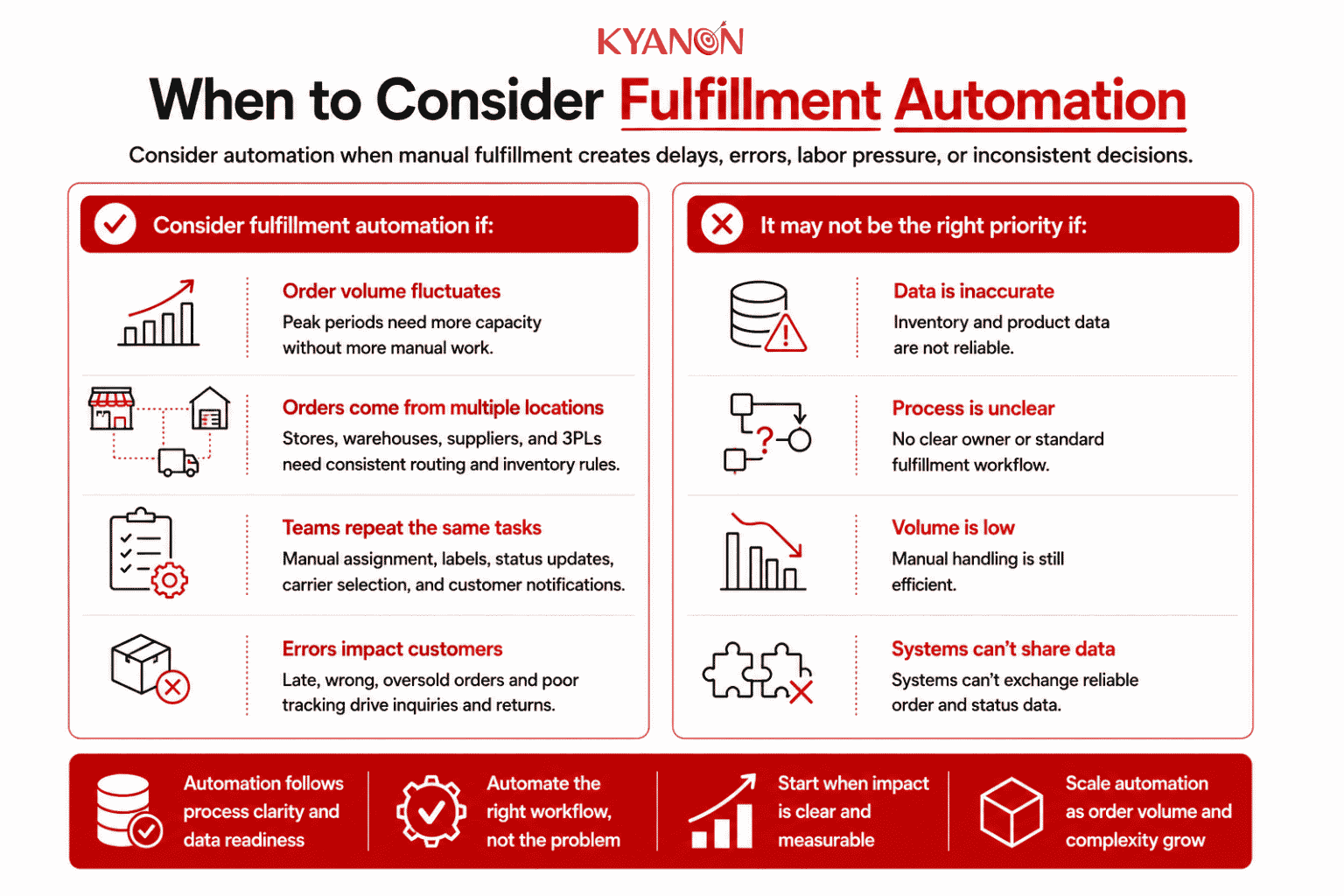
Fulfillment automation should be considered when manual processes create measurable delays, errors, labor pressure, or inconsistent fulfillment decisions.
Consider fulfillment automation if:
- Order volume fluctuates significantly. Peak periods require additional capacity without a proportional increase in manual coordination.
- Orders can be fulfilled from several locations. Stores, warehouses, suppliers, and 3PLs need consistent routing and inventory rules.
- Teams repeat the same fulfillment tasks. Staff manually assign orders, create labels, update statuses, select carriers, or notify customers.
- Fulfillment errors affect customer experience. Late deliveries, incorrect items, overselling, and weak tracking increase service inquiries and returns.
It may not be the right priority if:
- Inventory and product data are inaccurate.
- The underlying fulfillment process has no clear owner or standard workflow.
- Order volume is low and manual handling remains efficient.
- Existing systems cannot exchange reliable order and status data.
Automation should follow process clarity and data readiness; automating an inconsistent workflow usually reproduces the inconsistency at greater scale.
Why fulfillment automation matters for omnichannel commerce
Fulfillment automation matters for omnichannel commerce because each additional channel, inventory location, carrier, and delivery option increases the number of decisions required to complete an order.
Automation allows businesses to process higher volumes while maintaining consistent routing, warehouse execution, delivery communication, and exception handling.
IBM reported in 2026 that Dahl increased the automation level of its order-fulfillment operations from 60% to between 80% and 90%. During testing, 10 of 12 warehouse-automation tests also operated successfully at 120% of peak order volume. The results are specific to Dahl’s operating environment and should not be treated as a universal benchmark.
The MHI and Deloitte 2025 Annual Industry Report found that 55% of supply chain leaders were increasing technology and innovation investment, while 60% planned to invest more than USD 1 million. The findings indicate that connected supply chain execution is becoming an operational investment priority rather than a limited warehouse experiment.
Common misconceptions about fulfillment automation
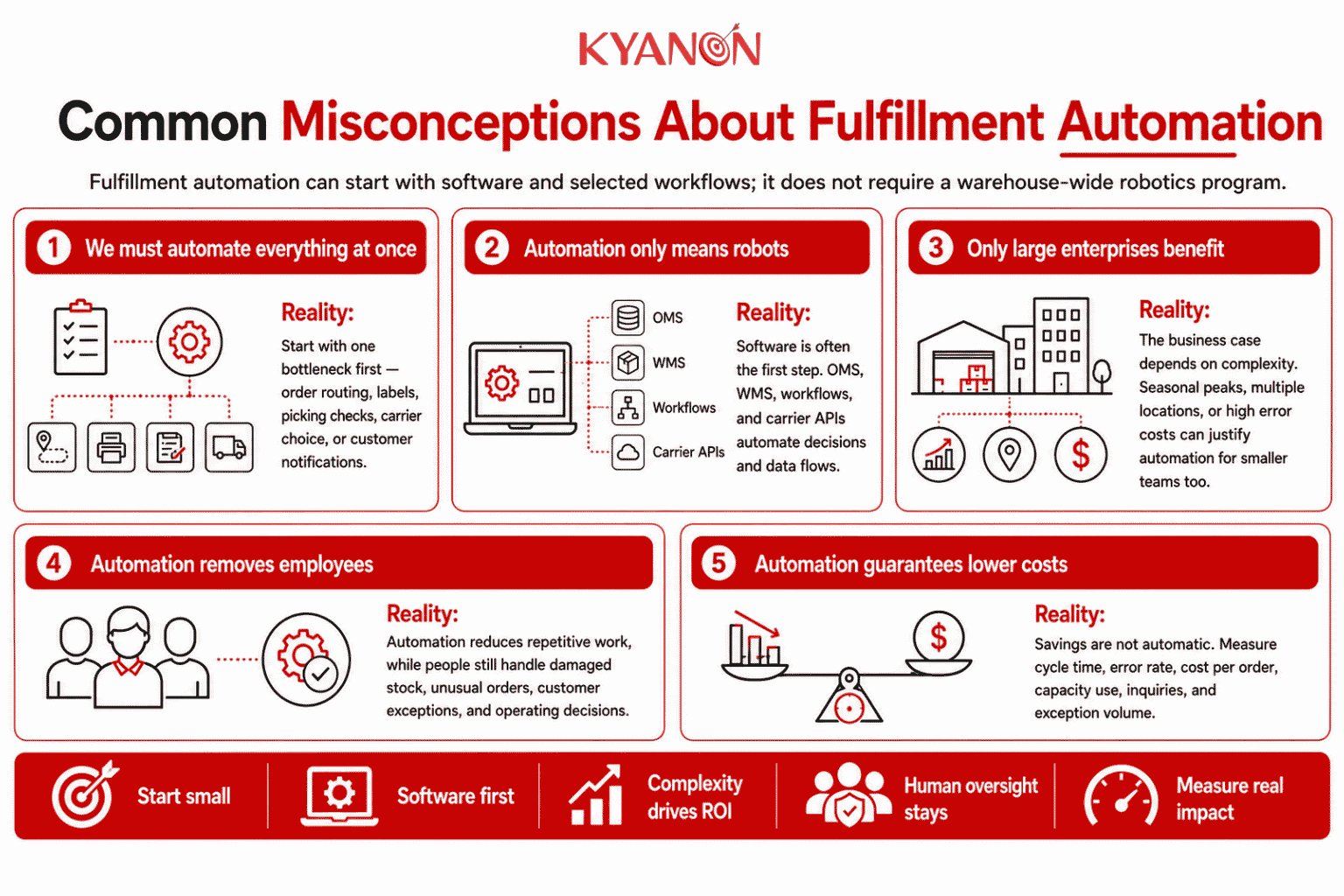
Fulfillment automation is a scalable operating model that can begin with software and selected workflows; it does not require an immediate warehouse-wide robotics program.
“We must automate the entire fulfillment center at once.”
Reality: Fulfillment automation can begin with one defined bottleneck, such as order routing, label generation, picking validation, carrier selection, or customer notifications.
A limited implementation allows the business to validate process impact, integration requirements, and operating cost before expanding.
“Fulfillment automation only means warehouse robots.”
Reality: Software automation is often the first layer.
An OMS, WMS, workflow engine, integration platform, or carrier API can automate decisions and information flows without deploying physical robotics.
“Automation is only practical for large enterprises.”
Reality: The business case depends on fulfillment complexity, not company size alone.
A smaller retailer with seasonal peaks, several fulfillment locations, or high manual-error costs may have a clearer automation case than a larger operation with stable, simple workflows.
“Automation removes employees from fulfillment.”
Reality: Automation shifts repetitive and rules-based tasks away from employees while retaining human judgment for damaged inventory, unusual orders, customer exceptions, and operational decisions.
The objective should be to reduce avoidable manual work, not to remove human oversight.
“Automation guarantees lower fulfillment costs.”
Reality: Automation can introduce software, integration, infrastructure, equipment, support, and process-change costs.
The business case should measure order cycle time, error rate, cost per order, capacity utilization, customer inquiries, and exception volume rather than assuming that automation creates savings automatically.
How Kyanon Digital applies fulfillment automation
Kyanon Digital implements fulfillment automation by connecting commerce, ERP, POS, inventory, OMS, warehouse, carrier, and 3PL systems through APIs and event-driven workflows.
In a 2025 retail project, Kyanon Digital delivered an integrated omnichannel fulfillment and transportation platform with automated picking and packing optimization, barcode scanning, intelligent order batching, inventory integration, carrier selection, delivery-fee calculation, order tracking, notifications, and digital proof of delivery.
Case study: How Kyanon Digital integrated omnichannel fulfillment for retail
Challenges
- Fragmented fulfillment and delivery operations
- Delays and high processing-error rates
- Limited integration across ERP, POS, eCommerce, and logistics
- Weak real-time order and delivery visibility
Solutions
- Automated pick-and-pack optimization and order batching
- Connected inventory visibility and warehouse task management
- AI-supported route and load planning
- Automated carrier selection, fees, notifications, and tracking
- Integrated ERP, POS, eCommerce, and 3PL APIs
Results and impacts
- Faster order processing and delivery execution
- Fewer manual tasks and fulfillment errors
- Better inventory and delivery visibility
- Lower transportation and operating costs
- A modular foundation for additional channels and locations
The results are based on a 12-month post-implementation analysis, and individual outcomes depend on the operating model and implementation scope.
Read the full case study: Transforming Retail Operations: Integrated Omnichannel Fulfillment & Transportation Management Solution.
Kyanon Digital’s implementation approach focuses on automating defined operational constraints while preserving human controls for exceptions, commercial rules, and service recovery. Its omnichannel eCommerce services also include middleware connecting eCommerce platforms with POS, ERP, CRM, inventory, payment, and logistics systems.
→ Explore our Artificial Intelligence Software Development Services and Omnichannel eCommerce Solutions











 Create project brief with AI