
What is last-mile delivery integration?
Last-mile delivery integration connects commerce, order, carrier, fleet, and customer communication systems to coordinate shipment creation, dispatch, tracking, proof of delivery, and delivery exceptions.
The integration covers the final movement of an order from a store, warehouse, distribution center, or logistics provider to the customer or pickup point. FedEx’s developer documentation shows that carrier APIs can exchange rates, labels, shipment events, estimated delivery windows, returns data, and proof-of-delivery information with business applications.
How last-mile delivery integration works
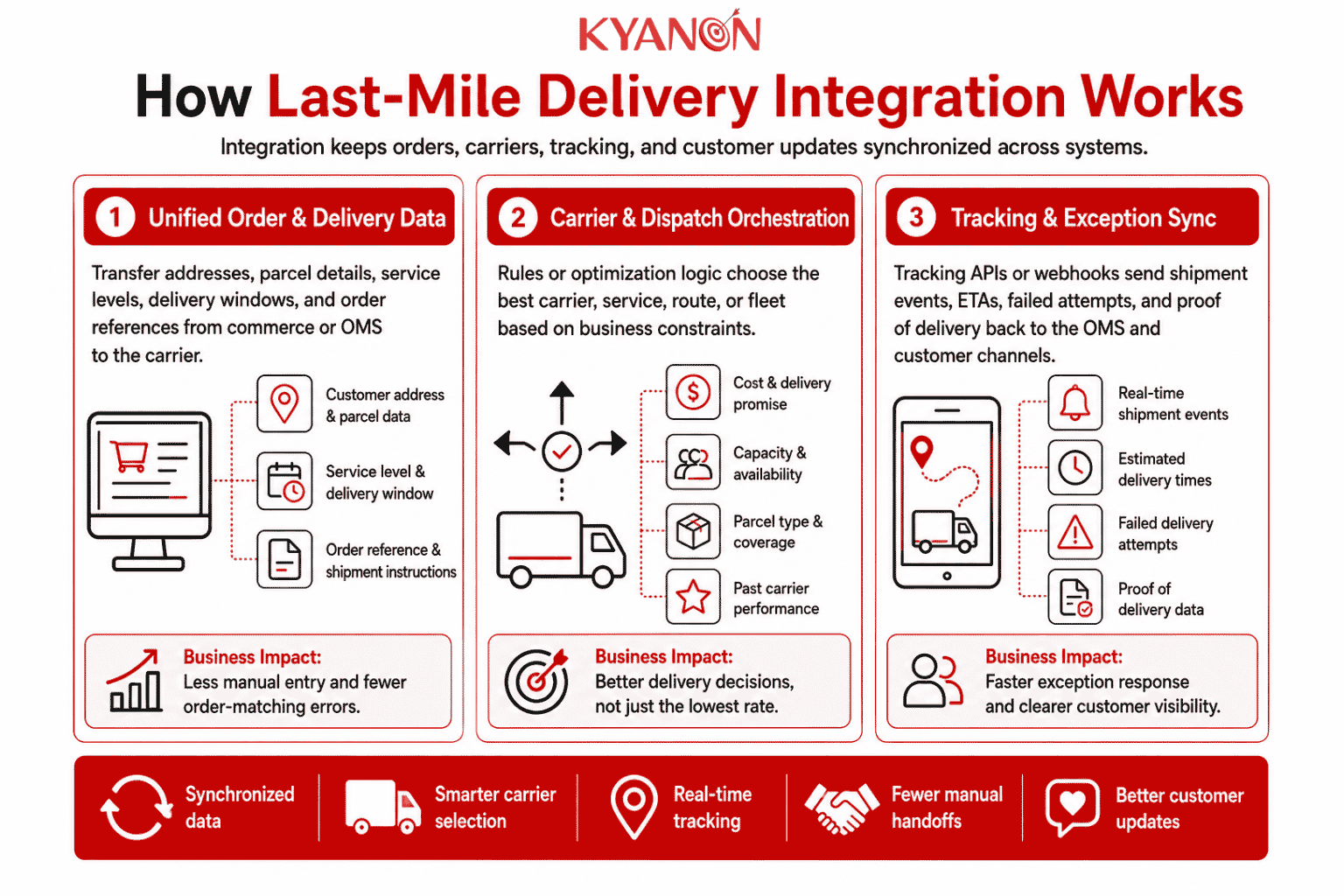
Last-mile delivery integration is effective because it keeps delivery promises, carrier execution, shipment events, and customer communication synchronized across systems.
Without integration, employees must repeatedly copy addresses, create shipments, check carrier portals, update order statuses, and respond to delivery exceptions manually. A connected delivery layer turns these handoffs into coordinated system events.
Unified order and delivery data
The integration transfers customer addresses, packages, service levels, delivery windows, order references, and shipment instructions from the commerce or OMS layer to the selected carrier.
A shared data model reduces manual entry and ensures that shipment events can be matched to the correct customer order.
Carrier and dispatch orchestration
Rules, optimization models, or AI can select a carrier, delivery service, route, or fleet according to availability, cost, delivery promise, capacity, and business constraints.
The purpose is not always to select the lowest quoted rate. The decision may also consider service coverage, delivery time, parcel characteristics, surcharges, and prior carrier performance.
Tracking and exception synchronization
Tracking APIs or webhooks return shipment events, estimated delivery times, failed attempts, and proof-of-delivery data to the OMS and customer-facing channels.
FedEx distinguishes basic tracking requests from push-based visibility webhooks that provide near-real-time events, delivery predictions, and picture or GPS proof of delivery. This illustrates why tracking quality depends on the capability and coverage of each carrier integration.
What are the main types of last-mile delivery integration?
Last-mile delivery integrations are commonly implemented through direct carrier APIs, delivery management platforms, or prebuilt eCommerce apps and extensions.
| Integration model | How it works | Best suited for |
Main consideration |
|
Direct API connection |
An OMS, WMS, ERP, or commerce platform connects directly to a carrier or courier API. | Enterprises requiring control over rates, labels, tracking, delivery services, and regional workflows | Every carrier connection requires separate mapping, testing, monitoring, and maintenance |
| Delivery management platform | A middleware platform connects orders with multiple carriers, contracted fleets, or internal drivers. | Businesses managing multi-carrier dispatch, routing, tracking, and proof of delivery |
The platform adds another vendor, data model, and operating dependency |
|
eCommerce app or extension |
A prebuilt Shopify app, WooCommerce extension, or platform connector adds shipping and tracking functions. | Lower-complexity stores that prioritize faster setup |
Features, carrier coverage, and customization depend on the extension |
DHL provides APIs for rates, transit times, shipment creation, pickups, labels, and tracking, illustrating the scope available through a direct carrier connection. Delivery platforms such as Onfleet expose APIs for tasks, drivers, recipients, tracking, and delivery management, while Shopify and WooCommerce support carrier connections and shipping extensions within their commerce environments.
The appropriate model depends on carrier count, regional coverage, delivery complexity, internal engineering capacity, and the level of control required over customer journeys.
Which systems are involved in last-mile delivery integration?
A complete last-mile delivery integration connects the customer order source with order management, warehouse execution, delivery orchestration, carrier systems, and customer communication channels.
| System |
Role in the delivery flow |
|
eCommerce platform or marketplace |
Captures the order, delivery address, selected service, and customer promise |
| Order Management System |
Coordinates order status, fulfilment assignment, shipment creation, and exceptions |
|
Warehouse Management System |
Confirms picking, packing, staging, package dimensions, and dispatch readiness |
| Delivery management platform or TMS |
Manages carrier selection, routing, dispatch, driver tasks, and delivery performance |
|
Carrier, courier, or 3PL APIs |
Exchange rates, labels, pickups, shipment events, tracking, and proof of delivery |
| Customer communication layer |
Sends tracking links, estimated delivery updates, delay notices, and completion messages |
Not every implementation requires a separate product for each function. A commerce platform may provide basic carrier integrations, while a complex regional operation may need middleware to normalize several carrier APIs and delivery-status formats.
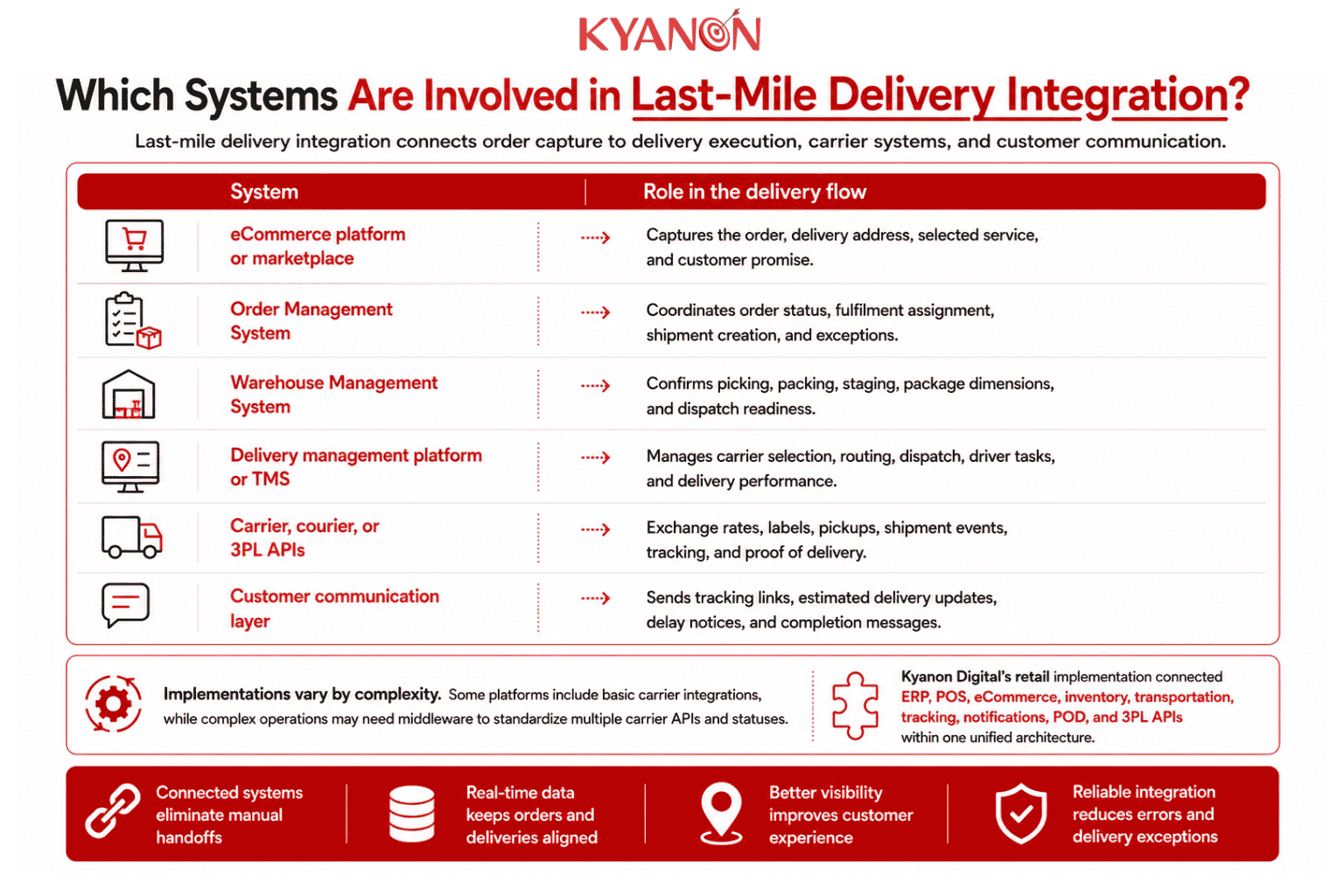
Kyanon Digital’s retail implementation connected ERP, POS, eCommerce, inventory, transportation, customer tracking, notifications, proof of delivery, and 3PL APIs within one fulfillment and delivery architecture.
What are the benefits of last-mile delivery integration?
Last-mile delivery integration reduces manual coordination by allowing order, dispatch, carrier, and tracking data to move between systems under consistent business rules.
| Benefit |
Business impact |
| Scalable shipment processing |
Reduces repeated copying of addresses, order data, labels, and tracking numbers as volume increases |
|
Carrier diversification |
Allows orders to be assigned across carriers according to service area, capacity, rate, delivery promise, and business rules |
| Better address quality |
Validates and standardizes customer addresses before orders enter the delivery network |
|
Consistent delivery visibility |
Returns shipment events, estimated delivery information, failed attempts, and proof of delivery to customer-facing systems |
| Faster exception handling |
Routes delays, invalid addresses, rejected shipments, and failed attempts to the appropriate operational team |
|
Lower operational dependency on portals |
Reduces the need for teams to manage each shipment through a separate carrier website |
Carrier diversification does not mean that carriers can be switched without commercial or technical work. Contracts, service coverage, parcel constraints, surcharges, API capabilities, and historical performance still affect the routing decision. Shopify confirms that supported carriers differ in policies, service levels, and pricing structures.
Address validation can identify missing or incorrect address components and prompt customers to correct them before fulfillment. Google states that address validation can improve delivery predictability and reduce failures, although coverage and data quality vary by market.
Tracking integrations can return current shipment statuses, while more advanced webhook services may provide near-real-time events, delivery predictions, and photo or GPS proof of delivery. The exact visibility available depends on the carrier, service, geography, and account configuration.
The value of integration should be measured through dispatch time, manual touches per shipment, first-attempt delivery rate, tracking coverage, exception-resolution time, delivery cost, and customer-service contacts.
Last-mile delivery integration vs. 3PL integration
Last-mile delivery integration connects systems involved in the final delivery stage, while 3PL integration connects a business with an outsourced logistics provider that may manage warehousing, inventory, fulfillment, transportation, and returns.
|
Dimension |
Last-mile delivery integration |
3PL integration |
| Primary scope | Dispatch through final delivery |
Broader outsourced logistics operations |
|
Starting point |
Order is ready for shipment or carrier assignment | Inventory receipt, storage, or order fulfillment |
| Typical partners | Parcel carriers, courier fleets, delivery platforms, drivers |
Warehousing and logistics service providers |
|
Core data |
Rates, labels, routes, tracking, ETA, POD, exceptions | Inventory, inbound receipts, orders, warehouse tasks, shipments, returns |
| Inventory ownership | Usually consumes inventory and order data |
May manage inventory inside 3PL facilities |
|
Warehouse role |
Limited to shipment handoff and dispatch | Can include storage, picking, packing, and shipping |
| Customer visibility | Central requirement |
May be provided through the 3PL or another delivery integration |
|
Proof of delivery |
Common integration output | One component within a broader service scope |
| Best fit | Businesses coordinating several carriers or delivery services |
Businesses outsourcing logistics execution |
Maersk describes 3PL services as extending from warehousing and inventory management through fulfillment, transportation, final delivery, and returns. Last-mile integration is therefore narrower in scope but can connect several 3PLs and carriers to the same commerce architecture.
When to consider last-mile delivery integration
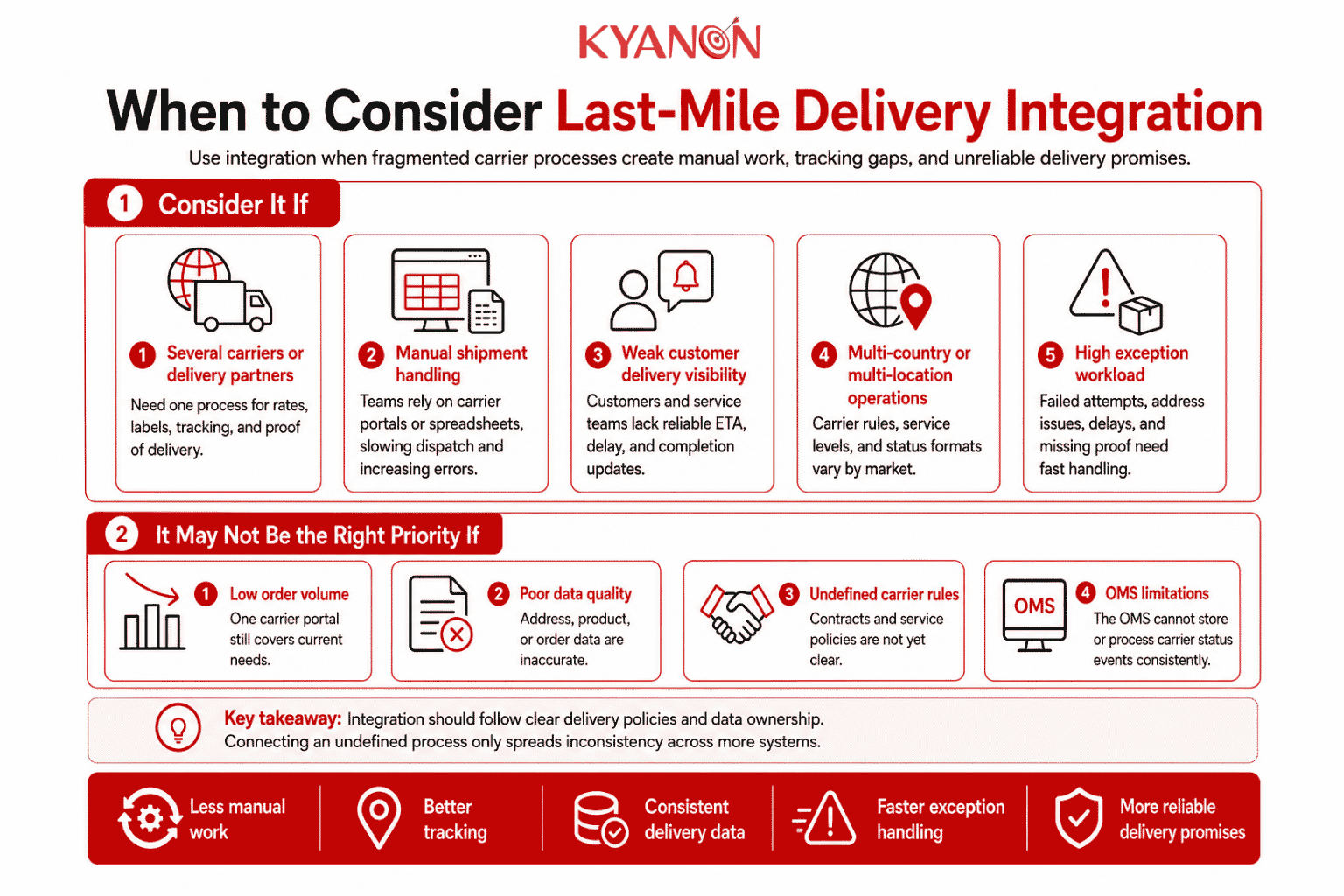
Last-mile delivery integration should be considered when fragmented carrier processes create inconsistent costs, tracking gaps, manual work, or unreliable customer delivery promises.
Consider last-mile delivery integration if:
- The business uses several carriers or delivery partners. Teams need one process for rates, labels, tracking statuses, and proof of delivery.
- Employees manage shipments through carrier portals or spreadsheets. Manual entry delays dispatch and increases the risk of mismatched addresses or order statuses.
- Customers cannot obtain reliable delivery updates. Order pages and service teams lack current ETA, attempt, delay, and completion information.
- The business operates across several countries or fulfillment locations. Carrier availability, service levels, status formats, and delivery rules differ by market.
- Delivery exceptions create a high service workload. Failed attempts, address problems, delays, and missing proof must be identified and routed quickly.
It may not be the right priority if:
- Order volume is low, and one carrier portal covers the current process.
- Address, product, and order data are inaccurate.
- Carrier contracts and delivery service rules have not been defined.
- The OMS cannot store or process carrier status events consistently.
Integration should follow clear delivery policies and data ownership; connecting an undefined process only distributes its inconsistencies across more systems.
Why last-mile delivery integration matters for omnichannel retail
Last-mile delivery integration matters because the delivery option shown at checkout must remain consistent with carrier capacity, dispatch execution, tracking, and the final customer outcome.
The integration connects the commercial promise made by the storefront with the operational systems responsible for completing it.
The DHL 2026 E-Commerce Trends Report, based on surveys of 29,000 online shoppers and 5,800 eCommerce businesses across 29 countries, found that 67% of shoppers had abandoned a cart because of the delivery offering. Seven in ten shoppers also said they would not buy from a brand if they did not trust its delivery and returns provider or were not offered suitable delivery and return options.
Kyanon Digital’s 2025 retail case study documented an integrated fulfillment and transportation platform with automated carrier selection, delivery-fee calculation, real-time vehicle and order tracking, customer notifications, digital proof of delivery, and 3PL API integration. The reported impacts included faster order processing, fewer manual tasks and errors, improved visibility, lower transportation costs, and easier addition of channels and partners; results were based on a 12-month post-implementation analysis.
These findings show that last-mile integration affects both conversion before purchase and operational performance after checkout.
Read the full case study: Custom Software Development for FMCG Operations in Singapore.
Common misconceptions about last-mile delivery integration
Last-mile delivery integration is an ongoing system capability, not a one-time connector that works identically across every carrier, market, and delivery model.
“Carrier integrations are plug-and-play.”
Reality: Carrier APIs differ in authentication, data fields, status codes, service coverage, webhooks, quotas, and error handling.
A production integration normally requires data mapping, middleware, testing, monitoring, and maintenance when carrier specifications change. FedEx, for example, separates API projects, webhook projects, rate limits, tracking services, and regional feature availability.
“Manual dispatch costs less than integration.”
Reality: Manual dispatch avoids initial development cost but adds repeated work for rate checking, shipment entry, labels, status updates, and exception handling.
The commercial comparison should include cost per shipment, dispatch time, delivery-error rate, customer inquiries, and the cost of maintaining integrations.
“Every carrier provides real-time tracking.”
Reality: Carrier data may arrive through manual uploads, scheduled polling, standard tracking APIs, or push-based webhooks.
Even within one carrier, near-real-time updates and advanced proof-of-delivery features may depend on the service, geography, account, and commercial plan.
“Using one carrier always protects our shipping discounts.”
Reality: A single carrier may simplify operations, but the lowest base rate does not necessarily produce the lowest delivered cost.
Carrier evaluation should include fuel and remote-area surcharges, failed-attempt policies, delivery coverage, service performance, parcel profiles, and customer delivery requirements.
“A failed first attempt is only a carrier problem.”
Reality: Failed delivery can originate from inaccurate addresses, unrealistic time windows, missing customer instructions, delayed status data, or weak exception workflows.
The retailer, OMS, delivery partner, and customer communication layer share responsibility for preventing and resolving failed attempts.
How Kyanon Digital applies last-mile delivery integration
Kyanon Digital implements last-mile delivery integration through API-first middleware that connects eCommerce platforms, POS, ERP, OMS, inventory, TMS, carrier, 3PL, driver, and customer-facing systems for retailers across Singapore, Malaysia, and Vietnam.
The implementation can include:
- Carrier and 3PL API adapters
- Canonical shipment and status data models
- Automated carrier and service selection
- Delivery-rate and fee calculation
- Route and load optimization
- Shipping-label and shipment creation
- Tracking webhooks and status normalization
- Customer notifications and delivery portals
- Signature, photo, and GPS proof of delivery
- Failed-attempt and exception workflows
- Monitoring, retry logic, and integration support
Kyanon Digital delivers real-time tracking, carrier selection, fee calculation, route optimization, proof of delivery, and 3PL API integration within an API-first fulfillment and transportation platform. Its omnichannel commerce service also covers custom middleware connecting commerce with POS, ERP, CRM, inventory, logistics, and fulfillment systems.
The implementation focus is not the number of carrier connectors. It is whether the business can maintain accurate delivery promises, consistent event data, controlled exceptions, and acceptable total cost of ownership across markets.
→ Explore Kyanon Digital’s Omnichannel eCommerce Development Services.











 Create project brief with AI