
What is 2-step checkout?
2-Step Checkout is an e-commerce design strategy that splits the purchasing process into two distinct screens or phases. Its primary goals are to reduce form fatigue, capture lead data early, and boost conversion rates.
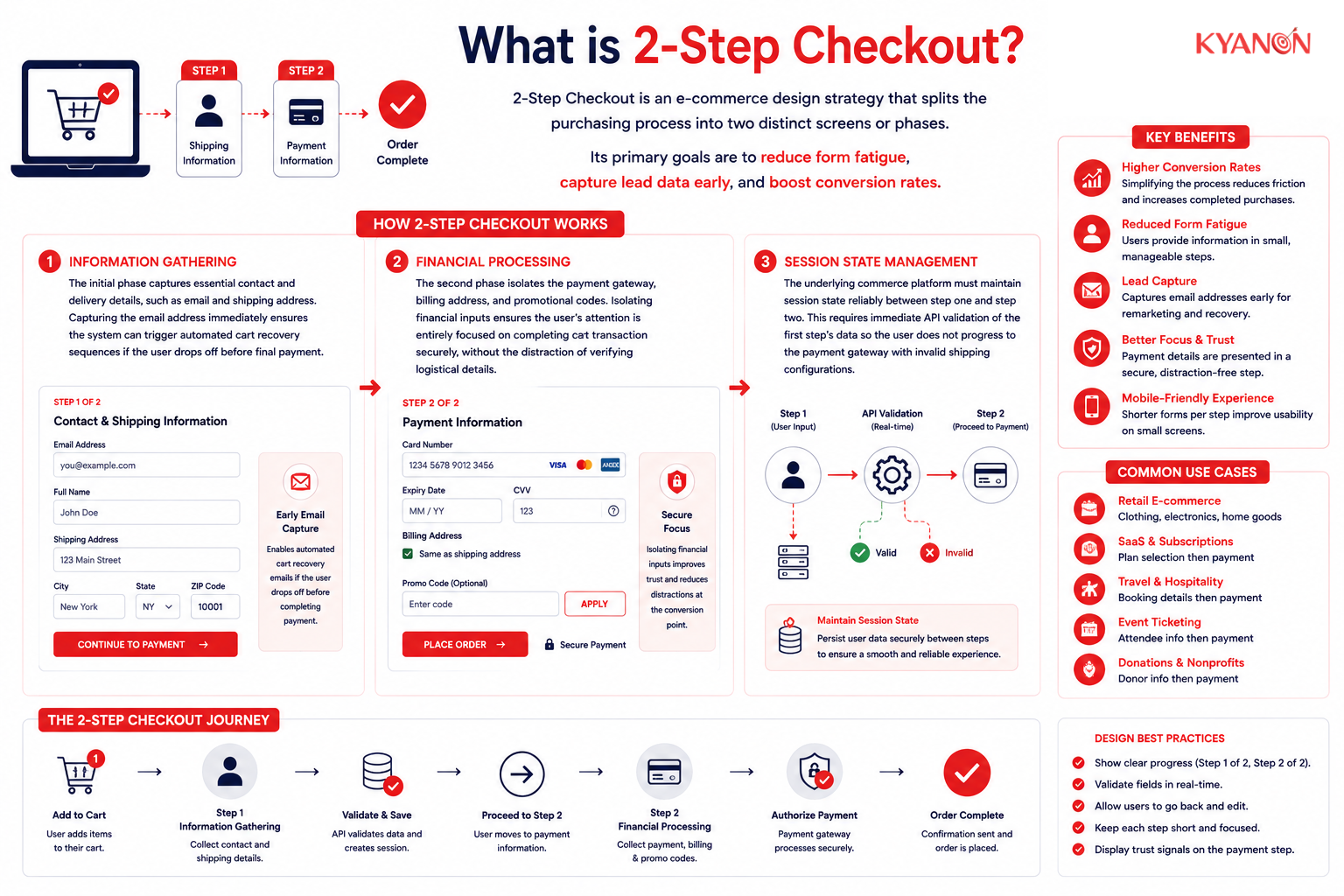
How 2-step checkout works
A 2-step checkout operates on the principle of progressive disclosure, presenting shoppers only with the input fields necessary for the immediate stage of their purchase. By separating logistical data from financial data, the architecture prevents overwhelming users with a single dense form, mitigating decision fatigue at the conversion point.
Information gathering
The initial phase captures essential contact and delivery details, such as email and shipping address. Capturing the email address immediately ensures the system can trigger automated cart recovery sequences if the user drops off before final payment.
Financial processing
The second phase isolates the payment gateway, billing address, and promotional codes. Isolating financial inputs ensures the user’s attention is entirely focused on completing the transaction securely, without the distraction of verifying logistical details.
Session state management
The underlying commerce platform must maintain session state reliably between step one and step two. This requires immediate API validation of the first step’s data so the user does not progress to the payment gateway with invalid shipping configurations.
Key benefits
- Cart abandonment recovery: If a customer abandons the purchase at Step 2, the system already captured their email in Step 1. This allows businesses to trigger automatic abandoned cart recovery emails.
- Less overwhelming: Presenting fewer fields on a single page prevents users from feeling overwhelmed by long forms.
- Micro-commitments: Once a user completes Step 1, they feel invested in the process and are more likely to finish Step 2.
2-Step Checkout vs 1-Step Checkout
Both approaches aim to finalize a transaction, but they differ fundamentally in how they distribute user friction across the purchase journey.
|
Dimension |
2-Step Checkout | 1-Step Checkout |
| Cart recovery data capture | Early (High success rate) |
Late (Low success rate) |
|
Cognitive load per view |
Segmented and low | Concentrated and high |
| Form field density | Low per page |
High per page |
|
Best for |
High-AOV, physical goods, complex shipping | Low-AOV, digital goods, impulse buys |
| Initial development complexity | Moderate |
High (Requires complex dynamic validation) |
When to consider 2-Step Checkout
Consider 2-step checkout if:
- Your brand sells physical goods requiring complex shipping calculation rules that must be finalized before displaying accurate final payment totals.
- Your cart abandonment recovery rates are underperforming because users drop off before entering their email addresses on a unified checkout page.
- You are migrating to a headless architecture where decoupling the frontend allows for custom, multi-step transaction flows tailored to specific regional compliance rules.
It may not be the right priority if:
- Your business model exclusively sells digital downloads or software subscriptions where shipping addresses are entirely irrelevant to the transaction flow.
Why 2-step checkout matters for retail E-commerce
A 2-step checkout separates the checkout process into two clear stages—typically customer information followed by payment and order review. While a single-page checkout can work well for simple purchases, a well-designed 2-step flow often delivers a better balance between user experience, conversion, and operational efficiency, especially for retail e-commerce.
Baymard’s qualitative research, based on years of usability testing and benchmarking hundreds of leading e-commerce sites found that checkout design itself is frequently the primary reason users abandon purchases. Their research also concludes that the average enterprise retailer could improve conversion by approximately 35% through checkout UX improvements alone.
Common misconceptions
Fewer steps always mean higher conversions
What matters most is perceived effort, not the number of clicks. A 1-step checkout that crams 30 form fields onto a single screen looks intimidating and causes cognitive overload. A clean, spacious 2-step checkout often converts better because it feels less overwhelming to the shopper.
It slows down the customer journey
Modern 2-step checkouts utilize instant, asynchronous page transitions (using AJAX or JavaScript frameworks) that load the next step in milliseconds. Because the form fields are divided logically, users actually fill out two smaller pages faster than one massive, cluttered page.
It hides shipping costs until the very end, causing sticker shock
Hidden shipping fees cause abandonment in any checkout layout. To prevent this in a 2-step model, successful retailers display estimated shipping rates, thresholds for free shipping, or dynamic tax calculators right on the cart page before the customer even initiates Step 1.
How Kyanon Digital Applies 2-Step Checkout
Kyanon Digital designs 2-step checkout architectures specifically for mobile-first commerce builds where friction reduction directly impacts conversion rates. Our approach utilizes composable commerce platforms to decouple the presentation layer, allowing us to deploy segmented transaction flows that capture early cart data and minimize cognitive load for enterprise clients across the APAC region.
Explore our Ecommerce services:











 Create project brief with AI