
What is catalog management?
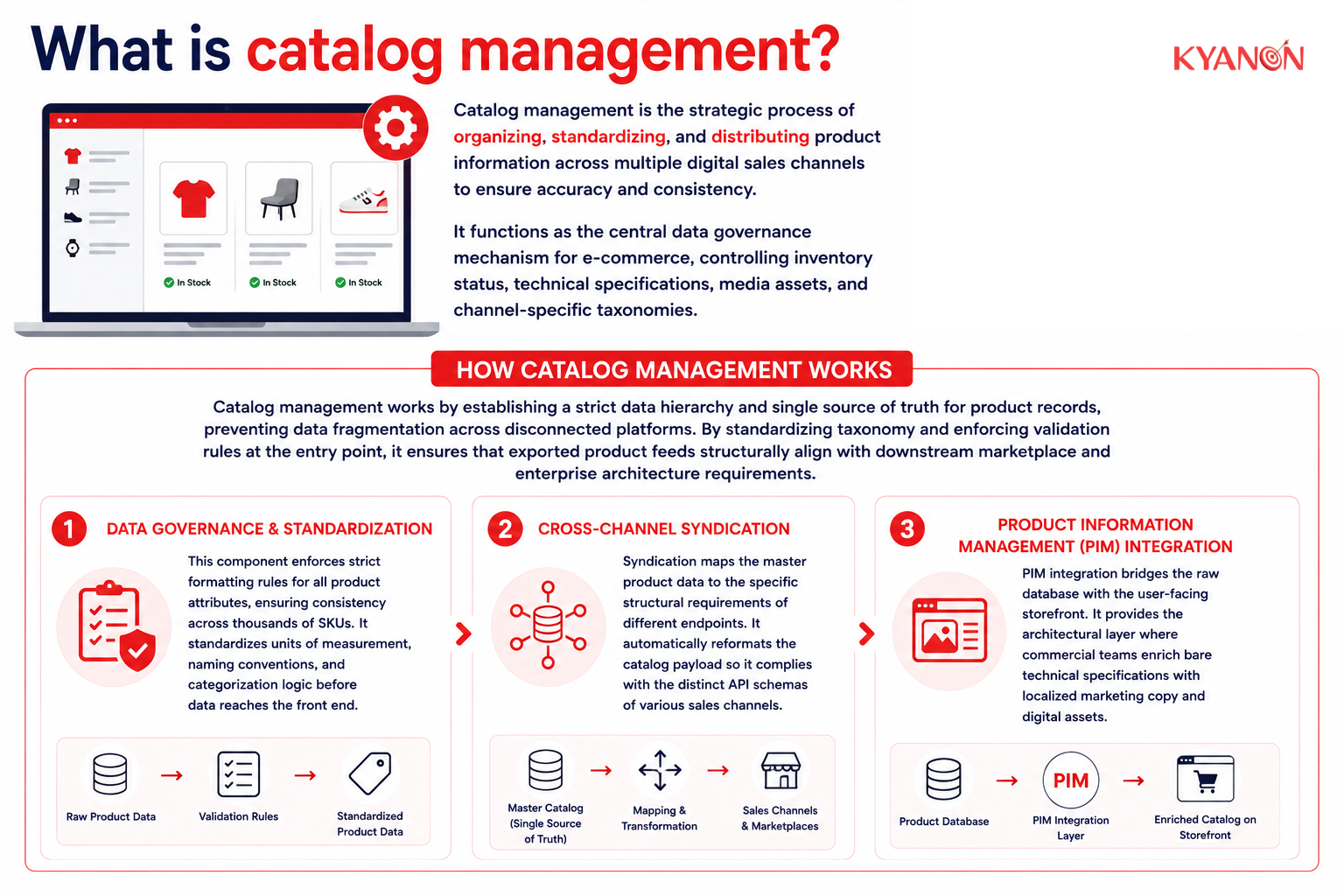
Catalog management is the strategic process of organizing, standardizing, and distributing product information across multiple digital sales channels to ensure accuracy and consistency. It functions as the central data governance mechanism for e-commerce, controlling inventory status, technical specifications, media assets, and channel-specific taxonomies.
How catalog management works
Catalog management works by establishing a strict data hierarchy and single source of truth for product records, preventing data fragmentation across disconnected platforms. By standardizing taxonomy and enforcing validation rules at the entry point, it ensures that exported product feeds structurally align with downstream marketplace and enterprise architecture requirements.
Data governance & standardization
This component enforces strict formatting rules for all product attributes, ensuring consistency across thousands of SKUs. It standardizes units of measurement, naming conventions, and categorization logic before data reaches the front end.
Cross-channel syndication
Syndication maps the master product data to the specific structural requirements of different endpoints. It automatically reformats the catalog payload so it complies with the distinct API schemas of various sales channels.
Product Information Management (PIM) Integration
PIM integration bridges the raw database with the user-facing storefront. It provides the architectural layer where commercial teams enrich bare technical specifications with localized marketing copy and digital assets.
Catalog Management vs Product Information Management (PIM)
Both concepts address product data, but differ in scope and architectural position.
|
Dimension |
Catalog management | Product Information Management (PIM) |
|
Core function |
Organizing, mapping, and routing data to channels |
Storing, enriching, and centralizing product data |
| Primary scope | Operational workflows and channel distribution |
Master data management and content enrichment |
|
Platform dependence |
Can occur within an ERP, ecommerce platform, or PIM |
Requires dedicated, standalone software |
|
Execution focus |
Inventory, pricing logic, channel mapping |
Rich text, multimedia assets, localization |
|
Upfront complexity |
High |
High |
When to consider catalog management
Consider enterprise-grade catalog management if:
- You are expanding into new regions or channels and manual attribute mapping is causing prolonged launch delays.
- Your organization handles complex B2B transactions requiring customer-specific pricing, volume tiers, and custom contract catalogs.
- High customer return rates are consistently traced back to inaccurate product dimensions, outdated technical specifications, or missing compatibility data.
It may not be the right priority if:
- Your product line consists of under 100 simple SKUs sold exclusively through a single, direct-to-consumer storefront managed by a small team.
Why catalog management matters for enterprise retail
Enterprise catalog management is the operational engine that translates millions of complex SKUs into predictable, global revenue. In large-scale retail, catalog management is no longer an administrative task, it is a critical infrastructure requirement that prevents margin erosion and scales operations.
Cosmetics retail presents a particularly complex product catalog. A single lipstick collection may include dozens of shade variations, each with unique attributes such as finish, undertone, coverage, and ingredients. Helping customers identify the right product online and enabling beauty advisors to provide personalized recommendations in-store requires consistent product information across every touchpoint.
Sephora has invested in centralized product data and omnichannel technologies to deliver this experience. Rich product attributes power digital discovery features, while the Virtual Artist application uses augmented reality (AR) to let customers virtually try on thousands of makeup shades before purchasing. By combining detailed product information with customer data across channels, Sephora enables more personalized recommendations and a more consistent shopping experience online and in stores.
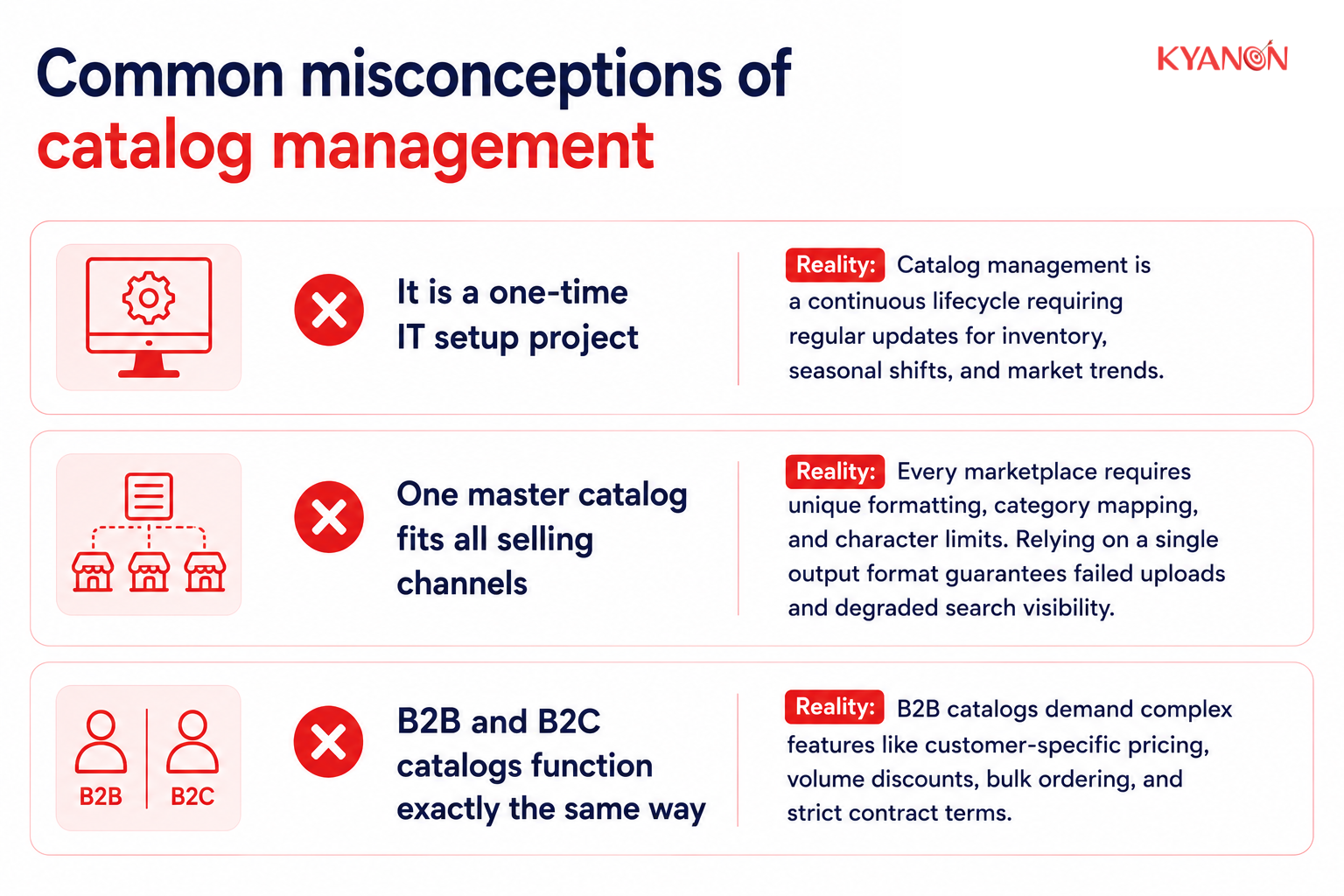
Common misconceptions
It is a one-time IT setup project
Reality: Catalog management is a continuous lifecycle requiring regular updates for inventory, seasonal shifts, and market trends.
One master catalog fits all selling channels
Reality: Every marketplace requires unique formatting, category mapping, and character limits. Relying on a single output format guarantees failed uploads and degraded search visibility.
B2B and B2C catalogs function exactly the same way
Reality: B2B catalogs demand complex features like customer-specific pricing, volume discounts, bulk ordering, and strict contract terms.
How Kyanon Digital applies catalog management
Kyanon Digital integrates enterprise PIM systems with leading composable commerce platforms for large-scale retail clients across Vietnam, Singapore, and ANZ. Our approach focuses on structuring strict data governance frameworks and building automated syndication workflows, ensuring complex catalogs load quickly, map accurately, and drive measurable conversion outcomes.
Explore our services:











 Create project brief with AI