
What is commerce API?
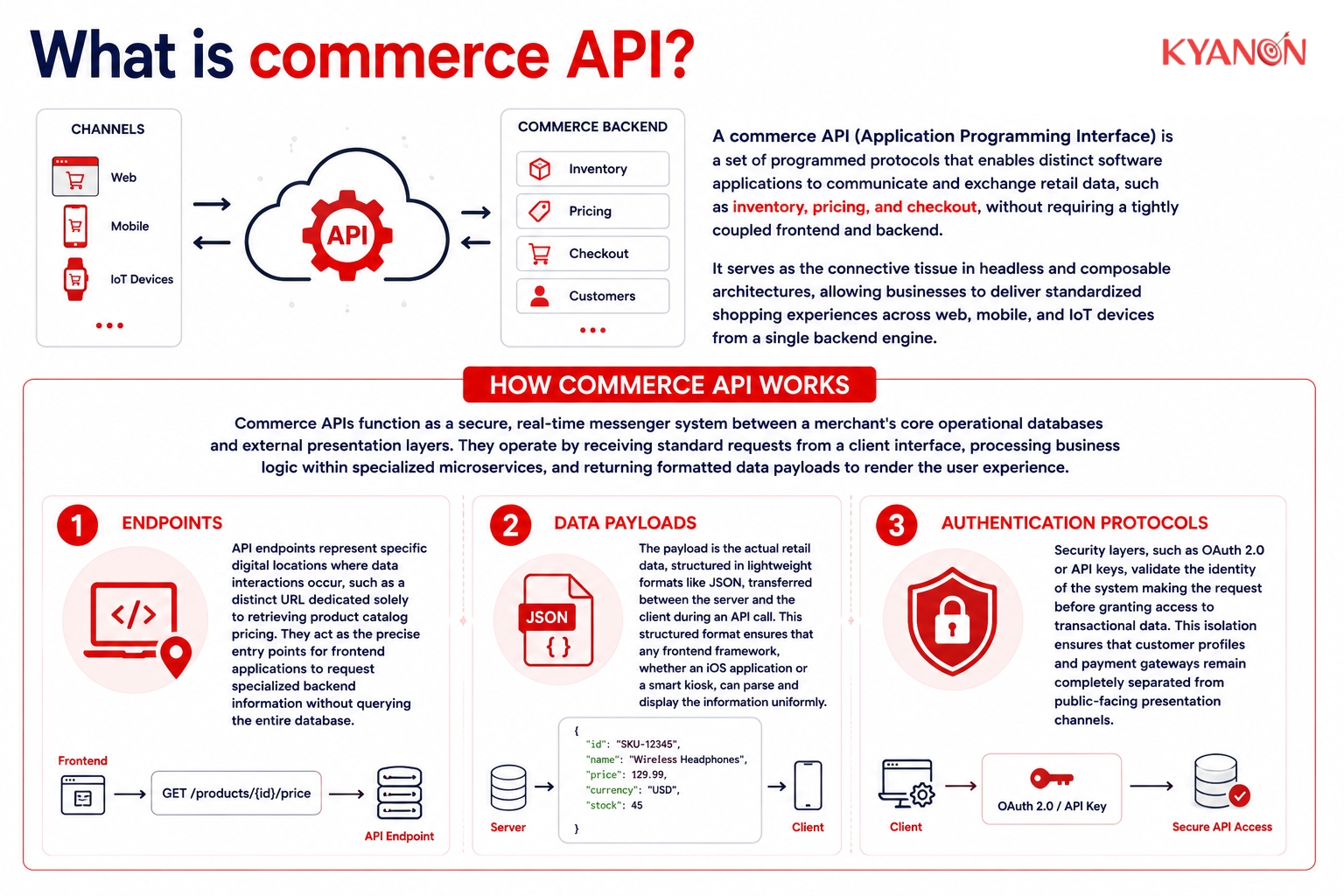
A commerce API (Application Programming Interface) is a set of programmed protocols that enables distinct software applications to communicate and exchange retail data, such as inventory, pricing, and checkout, without requiring a tightly coupled frontend and backend. It serves as the connective tissue in headless and composable architectures, allowing businesses to deliver standardized shopping experiences across web, mobile, and IoT devices from a single backend engine.
How commerce API works
Commerce APIs function as a secure, real-time messenger system between a merchant’s core operational databases and external presentation layers. They operate by receiving standard requests from a client interface, processing business logic within specialized microservices, and returning formatted data payloads to render the user experience.
Endpoints
API endpoints represent specific digital locations where data interactions occur, such as a distinct URL dedicated solely to retrieving product catalog pricing. They act as the precise entry points for frontend applications to request specialized backend information without querying the entire database.
Data payloads
The payload is the actual retail data, structured in lightweight formats like JSON, transferred between the server and the client during an API call. This structured format ensures that any frontend framework, whether an iOS application or a smart kiosk, can parse and display the information uniformly.
Authentication protocols
Security layers, such as OAuth 2.0 or API keys, validate the identity of the system making the request before granting access to transactional data. This isolation ensures that customer profiles and payment gateways remain completely separated from public-facing presentation channels.
Commerce API vs Traditional E-commerce Plugins
Both approaches extend e-commerce functionality, but differ significantly in architectural coupling and scalability.
|
Dimension |
Commerce API | Traditional plugin |
| Deployment speed | Fast (Independent releases) |
Slow (Requires monolithic updates) |
|
Vendor lock-in |
Low (Modular swapping) | High (Tightly coupled to platform) |
| Upfront complexity | High |
Low |
|
Best for |
Omnichannel, multi-region scaling | Single-channel, monolithic websites |
| Cost model | OpEx (Consumption-based) |
CapEx / Fixed subscription |
When to consider commerce API
Consider commerce API if:
- Your organization is expanding into new digital touchpoints, like mobile apps or social commerce and needs a single source of truth for inventory and pricing.
- Your frontend development team is blocked by backend release cycles, causing critical delays in time-to-market for new user interfaces.
- You need to integrate specialized third-party microservices, such as advanced search or AI-driven personalization, without rebuilding your core transactional engine.
It may not be the right priority if:
- Your organization operates a single, standardized web storefront with low traffic volatility and a small technical team lacking API governance expertise.
Why commerce API matters for enterprise retail
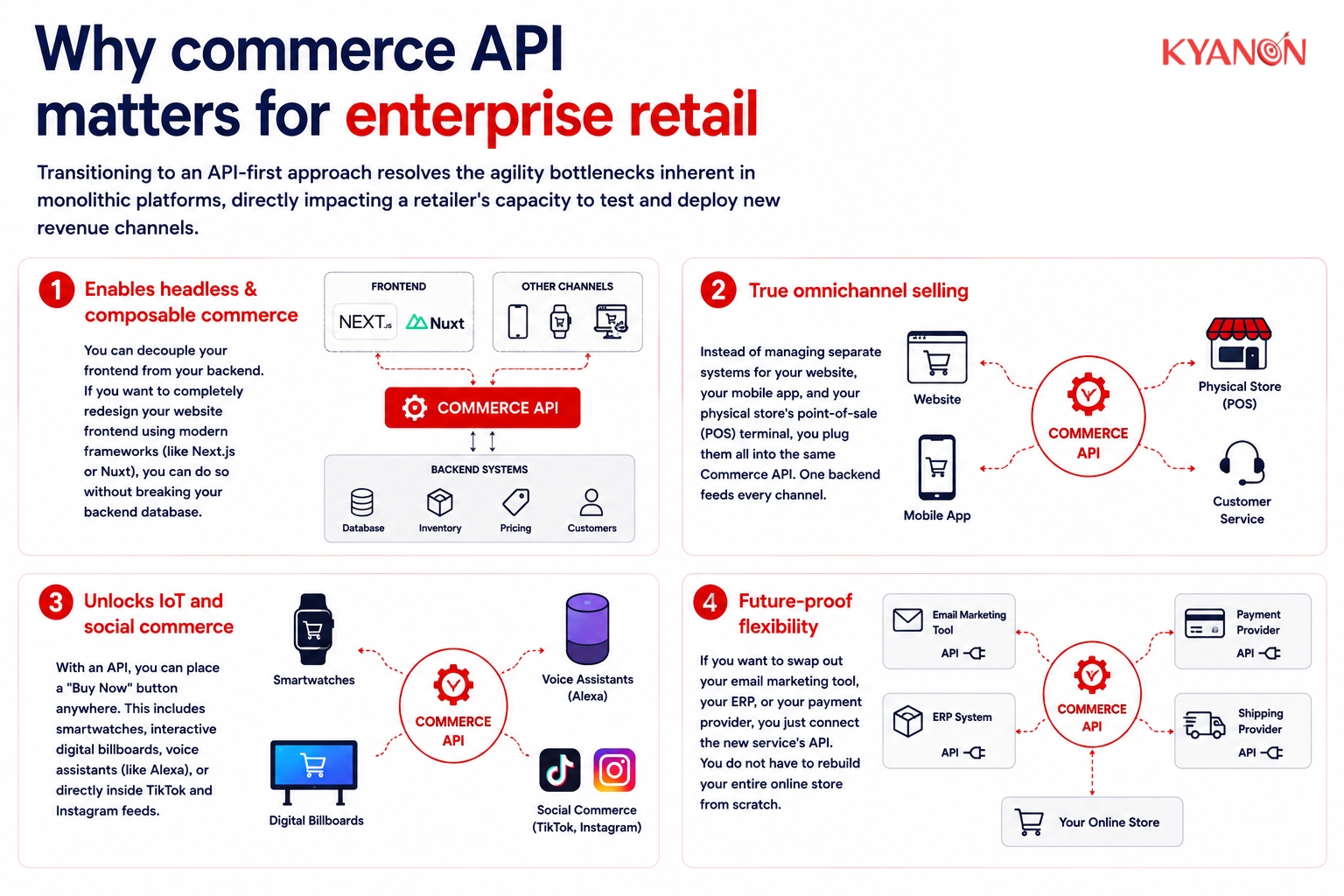
Transitioning to an API-first approach resolves the agility bottlenecks inherent in monolithic platforms, directly impacting a retailer’s capacity to test and deploy new revenue channels.
Enables headless & composable commerce
You can decouple your frontend from your backend. If you want to completely redesign your website frontend using modern frameworks (like Next.js or Nuxt), you can do so without breaking your backend database.
True omnichannel selling
Instead of managing separate systems for your website, your mobile app, and your physical store’s point-of-sale (POS) terminal, you plug them all into the same Commerce API. One backend feeds every channel.
Unlocks IoT and social commerce
With an API, you can place a “Buy Now” button anywhere. This includes smartwatches, interactive digital billboards, voice assistants (like Alexa), or directly inside TikTok and Instagram feeds.
Future-proof flexibility
If you want to swap out your email marketing tool, your ERP, or your payment provider, you just connect the new service’s API. You do not have to rebuild your entire online store from scratch.
Common misconceptions
Simply having an API means you are Headless
Reality: Many brands believe that if they sync data between two monolithic systems using an API, they have achieved headless commerce. True headless architecture requires a complete architectural separation between the frontend presentation framework and backend logic. Passing data from a monolithic e-commerce engine to a rigid CMS that still dictates the frontend is just an integration, not true headless or API-first commerce.
APIs make e-commerce websites inherently slower
Reality: There is a fear that making multiple API calls to pull product data, pricing, and inventory will lag and slow down page performance. API-first architectures built on modern MACH principles (Microservices, API-first, Cloud-native, Headless) are optimized for extreme speed and high transaction volumes. Speed issues only happen with bad API governance. Proper implementations use Content Delivery Networks (CDNs), smart caching, and efficient edge-computing layers to load pages faster than traditional all-in-one platforms.
Shifting to Commerce APIs slows down non-technical marketing teams
Reality: Marketers often worry that without a traditional “drag-and-drop” website builder, they will be entirely dependent on developers just to change a banner or launch a campaign. Commerce APIs decouple the content from the code, giving marketers more freedom. A properly structured Commerce API connects to a Headless Content Management System (CMS). This allows marketing teams to publish updates across the web, mobile apps, and kiosks simultaneously from one single dashboard without touching backend code.
Commerce APIs compromise data security
Reality: Business managers sometimes fear that opening up endpoints to connect multiple third-party services creates unnecessary data vulnerabilities. Secure APIs significantly lower the risk of data breaches compared to manual data transfers or monolithic architectures. Modern APIs rely on role-based access controls, tight token encryption, and isolated microservices. If one service (like an external product review widget) is compromised, your core checkout and payment database remain safely isolated.
APIs are only useful for global enterprise brands
Reality: Smaller or mid-market retail businesses often dismiss Commerce APIs as an over-engineered luxury that is too expensive to justify. API flexibility is highly beneficial for growing brands that need to rapidly test new sales channels, like social commerce or pop-up retail. Rather than building custom systems from scratch, smaller brands can use pre-built API connectors from platforms like Shopify or WooCommerce to launch quickly without heavy technical debt.
How Kyanon Digital applies commerce API
Kyanon Digital designs commerce APIs to enable headless and composable architecture for enterprise clients across Vietnam, Singapore, Malaysia, Thailand, ANZ, the US, and Nordic Europe. Our approach relies on deep implementation expertise, utilizing modern frameworks to dismantle monolithic bottlenecks, strictly focusing on measurable outcomes such as accelerated time-to-market, higher conversion rates, and optimized Total Cost of Ownership (TCO).
Explore our services:











 Create project brief with AI