
What is hybrid commerce?
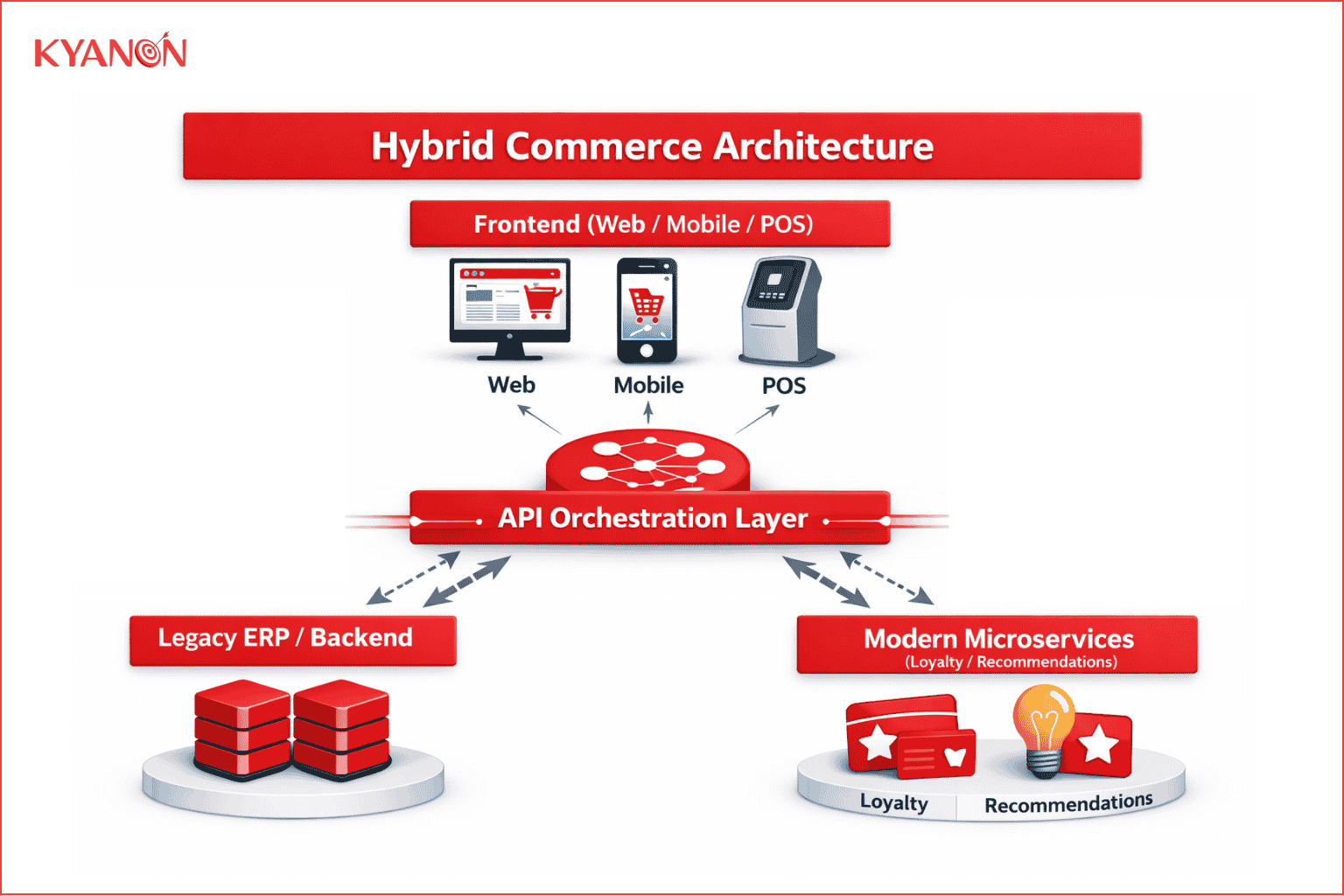
Hybrid commerce is an enterprise retail architecture that decouples front-end digital and physical customer touchpoints from legacy back-end systems, using an API orchestration layer to unify inventory, order management, and customer data into a single ecosystem without requiring a complete platform rewrite. This architectural model allows retail organizations to preserve their stable enterprise resource planning (ERP) databases while incrementally deploying modular, cloud-native microservices for agile channel expansion.
How hybrid commerce works
Hybrid commerce functions by establishing a decoupled middleware layer that isolates stable legacy infrastructure, such as core ERPs and warehouse databases, from fast-changing consumer touchpoints across web, mobile, and physical point-of-sale (POS) terminals. Rather than executing a high-risk, multi-year migration to replace monolith backends, engineering teams deploy an API Gateway to route data traffic between existing core engines and newly introduced microservices. This integration strategy allows organizations to isolate and upgrade high-value functionalities, such as unified checkout, cross-channel loyalty programs, or AI-driven product recommendations, in phased deployments while maintaining operational continuity across all physical and digital stores.
API gateway & orchestration layer
An enterprise API Gateway serves as the centralized data routing controller that translates communications between modern front-end touchpoints and legacy back-end databases. By decoupling the presentation layer from core business logic, the gateway prevents frontend spikes from overloading legacy ERPs and enables real-time synchronization of pricing, inventory, and customer accounts across all operational channels.
Modular order management & unified cart engine
The unified cart and order management engine functions as an independent microservice that synchronizes active shopping sessions across digital storefronts, mobile applications, and in-store POS terminals. It queries the legacy ERP for baseline inventory rules while continuously updating stock allocations in real time, executing complex fulfillment workflows like buy-online-pickup-in-store (BOPIS) and endless aisle without modifying core backend source code.
Centralized customer data platform (CDP)
A centralized CDP aggregates historical transaction logs from brick-and-mortar checkout registers and behavioral data from digital storefronts into a single, synchronized shopper profile. This data repository feeds accurate customer intelligence directly to retail store associates and automated marketing workflows, ensuring consistent loyalty reward calculations and personalized engagement regardless of where the interaction originates.
Hybrid commerce vs. traditional multi-channel retail
Both approaches facilitate retail operations across online and physical locations, but differ fundamentally in infrastructure preservation, data architecture, and deployment risk.
|
Dimension |
Hybrid commerce |
Traditional multi-channel retail |
|
Replatforming requirement |
None; preserves legacy ERPs via API wrappers | High; requires full monolithic system replacement |
| Deployment strategy | Phased, incremental feature isolation |
All-or-nothing system migration |
|
Data synchronization |
Real-time unified state across API middleware | Siloed batch processing with operational latency |
| Upfront capital risk | Low operational and financial disruption |
High risk of system downtime and budget overruns |
|
Time-to-market for new features |
Weeks via modular microservices integration | Months or years due to rigid backend dependencies |
| Cross-channel returns (BORIS) | Immediate enterprise-wide record verification |
Manual store overrides or restricted mail-in policies |
When to consider hybrid commerce
Consider hybrid commerce if:
- Your existing ERP and warehouse management systems are operationally stable and reliable, but your front-end e-commerce user experience is rigid, slow, and losing market share to agile competitors.
- Your engineering leadership needs to launch unified capabilities—such as cross-channel loyalty programs, localized store pickup, or real-time inventory visibility—within a 6-to-12-month window without triggering a high-risk backend rewrite.
- Your IT organization requires a phased technology upgrade roadmap to systematically replace legacy functional modules over time while preserving historical data and existing software license investments.
It may not be the right priority if:
- Your business operates an early-stage, single-channel e-commerce model with under 10,000 SKUs and no immediate architectural complexity requiring legacy database preservation or offline store integration.
Why hybrid commerce matters for retail & e-commerce
For enterprise technology leaders, rip-and-replace replatforming initiatives carry extreme financial and operational risks, frequently resulting in extended system freezes, budget overruns, and critical data migration failures. A hybrid commerce architecture eliminates these hazards by decoupling the modernization timeline from legacy backend replacement, allowing enterprises to capture revenue from modern omnichannel experiences while maximizing the return on investment of their existing ERP infrastructure. By implementing phased microservice upgrades at the edge, organizations drastically reduce total cost of ownership (TCO) and accelerate time-to-market for customer-facing innovations without exposing core business operations to catastrophic downtime.
According to McKinsey, retailers that modernize legacy commerce platforms with modular, microservice-based architectures gain greater flexibility and scalability while enabling capabilities such as real-time inventory visibility and consistent omnichannel customer experiences across digital and physical touchpoints. McKinsey also found that retailers with advanced digital capabilities generated 3.3 times higher total shareholder returns (TSR) than digital laggards between 2016 and 2020. In addition, the firm estimates that the right technology investments can accelerate the time to market of digital offerings by a factor of three while reducing run costs by up to 20 percent, allowing retailers to reinvest those savings into further digital innovation.
Common misconceptions
“To get true omnichannel synchronization between our website and physical stores, we have to endure a complete rip-and-replace of our legacy ERP and POS systems.”
Reality: A complete platform rewrite is an outdated approach to retail transformation. Hybrid commerce utilizes API gateways and middleware wrappers to extract data from legacy ERPs and POS terminals without altering their core architecture, allowing IT teams to deploy modern microservices for checkout, inventory visibility, and loyalty in controlled, phased releases.
“Hybrid commerce is simply a marketing term for running an e-commerce storefront alongside brick-and-mortar retail locations.”
Reality: Operating separate online and offline channels without unified backend data is traditional multi-channel retail, which traps inventory and customer histories in isolated silos. Hybrid commerce represents a specific architectural integration where API routing layers force digital engines and physical store terminals to read and write from a single, synchronized operational data state.
How Kyanon Digital applies hybrid commerce
Kyanon Digital executes hybrid commerce transformation for enterprise retail and distribution organizations across Vietnam, Singapore, Thailand, and the wider ANZ region by applying MACH-aligned (Microservices, API-first, Cloud-native, Headless) integration frameworks over existing legacy infrastructure. Our engineering teams specialize in deploying custom API orchestration layers that connect legacy ERP backends, such as SAP, Oracle, or Microsoft Dynamics, with modern headless storefronts and cloud POS edge nodes. This phased implementation approach enables enterprise clients to isolate high-value cross-channel workflows, eliminate data synchronization lag, and achieve measurable improvements in checkout conversion and inventory accuracy without incurring the operational risks of a complete platform replacement.
→ Explore our: E-commerce service











 Create project brief with AI