
What is inventory sync?
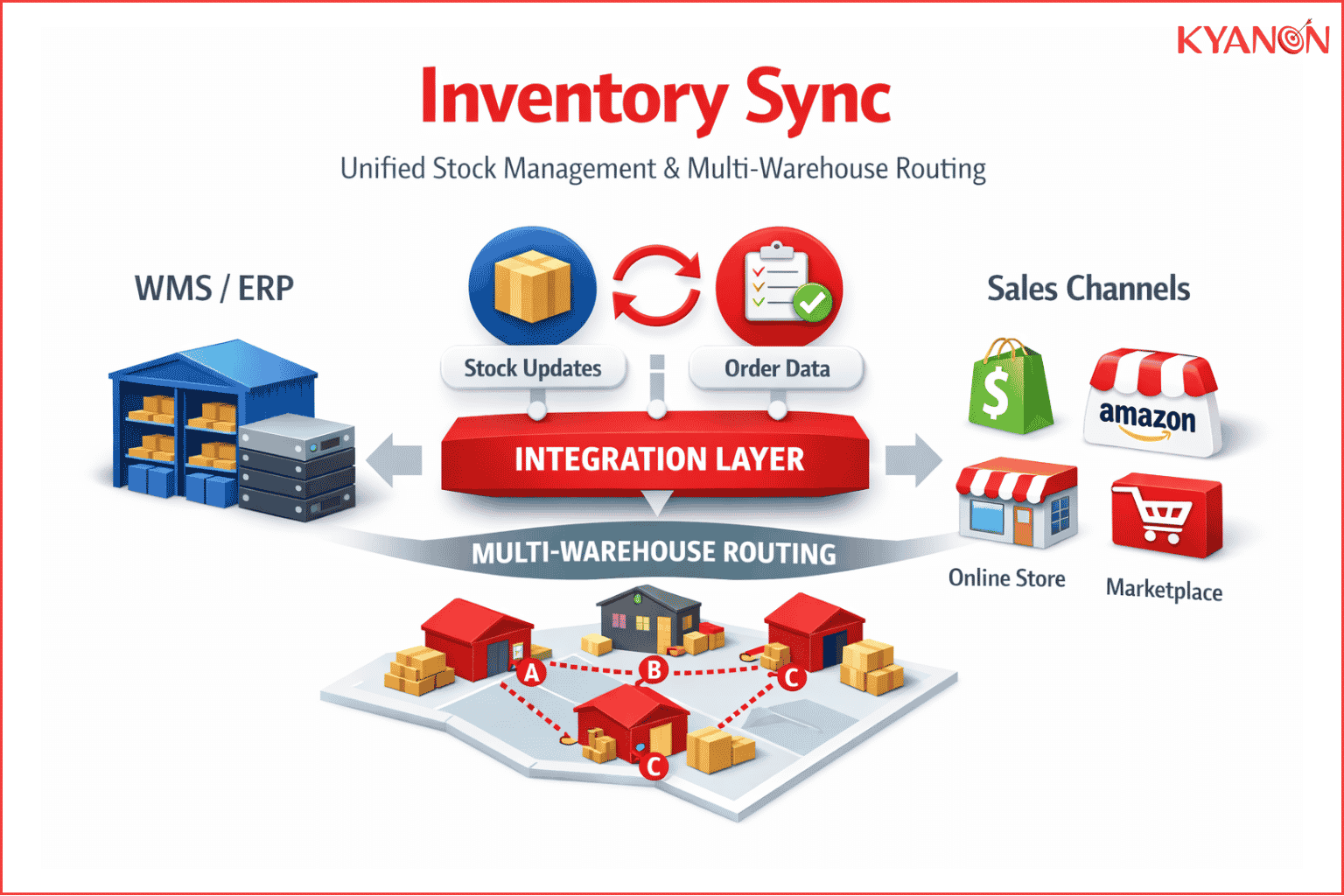
Inventory sync is the automated data exchange process that aligns stock quantity records across distributed sales channels, warehouse management systems (WMS), and enterprise resource planning (ERP) platforms. This synchronization acts as a single source of truth, ensuring that a transaction on one platform instantly adjusts the available inventory across every other connected storefront to prevent duplicate orders.
How inventory sync works
Inventory synchronization functions by establishing a unified data pipeline that updates stock status based on transactional events, bypassing manual counts and delayed polling systems. The mechanism relies on webhook-driven tracking to share order updates and execute multi-warehouse allocations within seconds, maintaining a continuous feedback loop across the omnichannel tech stack.
Immediate stock reservation
Immediate stock reservation deducts item availability at the exact moment a customer’s checkout is accepted. This logic prevents “inventory lag” by securing the unit digitally before physical pick-and-pack operations begin, ensuring consecutive buyers cannot purchase a single physical item.
Multi-warehouse allocation
Multi-warehouse allocation aggregates total supply across distinct regional fulfillment centers and intelligently routes orders based on proximity or capacity. If a primary warehouse depletes its stock, this component seamlessly reroutes fulfillment data to the next available location without double-counting the remaining enterprise supply.
Buffer stock automation
Buffer stock automation enforces dynamic safety thresholds within the synchronization logic to protect against latency during high-traffic events. By setting a hard buffer rule (e.g., automatically marking an item as “sold out” on storefronts when system inventory hits 2 units), the system mathematically eliminates late-second sales rushes that result in overselling.
Inventory sync vs. deep inventory integration
Basic data syncing transfers raw stock numbers, whereas deep integration enforces a resilient, single source of truth for omnichannel operations.
|
Dimension |
Basic data syncing |
Deep inventory integration |
|
Data flow |
Moves raw stock numbers. | Maps reserved, buffer, and salable tiers. |
| Logic anchor | Relies on a shared guess. |
Enforces a single source of truth. |
|
Discrepancies |
Ignores background API drops. | Runs automated daily reconciliations. |
| Risk control | Sells down to the final unit. |
Sets dynamic platform safety buffers. |
|
Order routing |
Fails if the primary location is empty. |
Executes multi-warehouse allocation. |
When to consider inventory sync
Consider inventory sync if:
- Your operations experience overselling during high-traffic periods due to the latency between order placement and manual stock ledger updates.
- Your customer support teams spend excessive operational hours managing refunds, handling disappointed clients, and scrambling for replacement stock due to canceled orders.
- You are expanding into multiple geographic markets and require distinct stock allocations for regional distribution centers across Southeast Asia and the US.
It may not be the right priority if:
- Your business processes a low volume of daily orders entirely through a single sales channel and fulfills them directly from one localized stockroom without marketplace dependencies.
Why inventory sync matters for omnichannel retail
Relying on fragmented stock data directly triggers marketplace penalties, drives up customer acquisition costs through lost loyalty, and reduces supply chain capital efficiency.
According to IHL Group (2020), inventory distortion, which encompasses both overstocks and out-of-stocks, costs retailers approximately $1.9 trillion globally each year. A multinational electronics distributor operating in Singapore and Malaysia utilized automated inventory synchronization to connect their regional ERP with localized storefronts, resulting in a 40% reduction in canceled orders due to stockouts. This operational upgrade prevented severe seller metric penalties on major marketplaces like Amazon while drastically reducing the operational chaos handled by their customer support teams.
Common misconceptions
“Syncing data is the same thing as system integration.”
Reality: True inventory control requires a unified operational strategy rather than just connecting APIs. Passing raw numbers back and forth completely ignores product allocations, geographic distribution, and safety buffers necessary for accurate fulfillment.
“Real-time sync means instantly achieving zero latency across platforms.”
Reality: Systems process data via event-driven webhooks or scheduled API batches, naturally creating a brief sync window. Without dynamic buffer stock rules, this technical delay frequently causes unexpected overselling when buyers purchase identical items simultaneously during flash sales.
How Kyanon Digital applies inventory sync
Kyanon Digital implements deep inventory sync architectures by integrating ERP, WMS, and e-commerce platforms for enterprise clients across Vietnam, Singapore, Thailand, ANZ, and Nordic Europe. Our engineering approach bypasses the limitations of basic data syncing by establishing immediate stock reservations, configuring multi-warehouse allocation rules, and setting automated daily reconciliations. This focus on deep implementation expertise guarantees measurable improvements in time-to-market and Total Cost of Ownership (TCO) by eliminating the technical blind spots that compromise omnichannel fulfillment.
→ Explore our: Omnichannel eCommerce Solutions for Business Growth Service











 Create project brief with AI