
What is Klaviyo integration?
A Klaviyo integration is the technical configuration that connects an e-commerce storefront, customer data platform (CDP), or third-party application to the Klaviyo marketing automation platform via native connections or APIs to synchronize customer behavior and order histories. Integrating Klaviyo correctly is essential to keep your marketing, sales, and support data flowing seamlessly, preventing valuable customer information from being trapped in isolated software systems.
How Klaviyo integration works
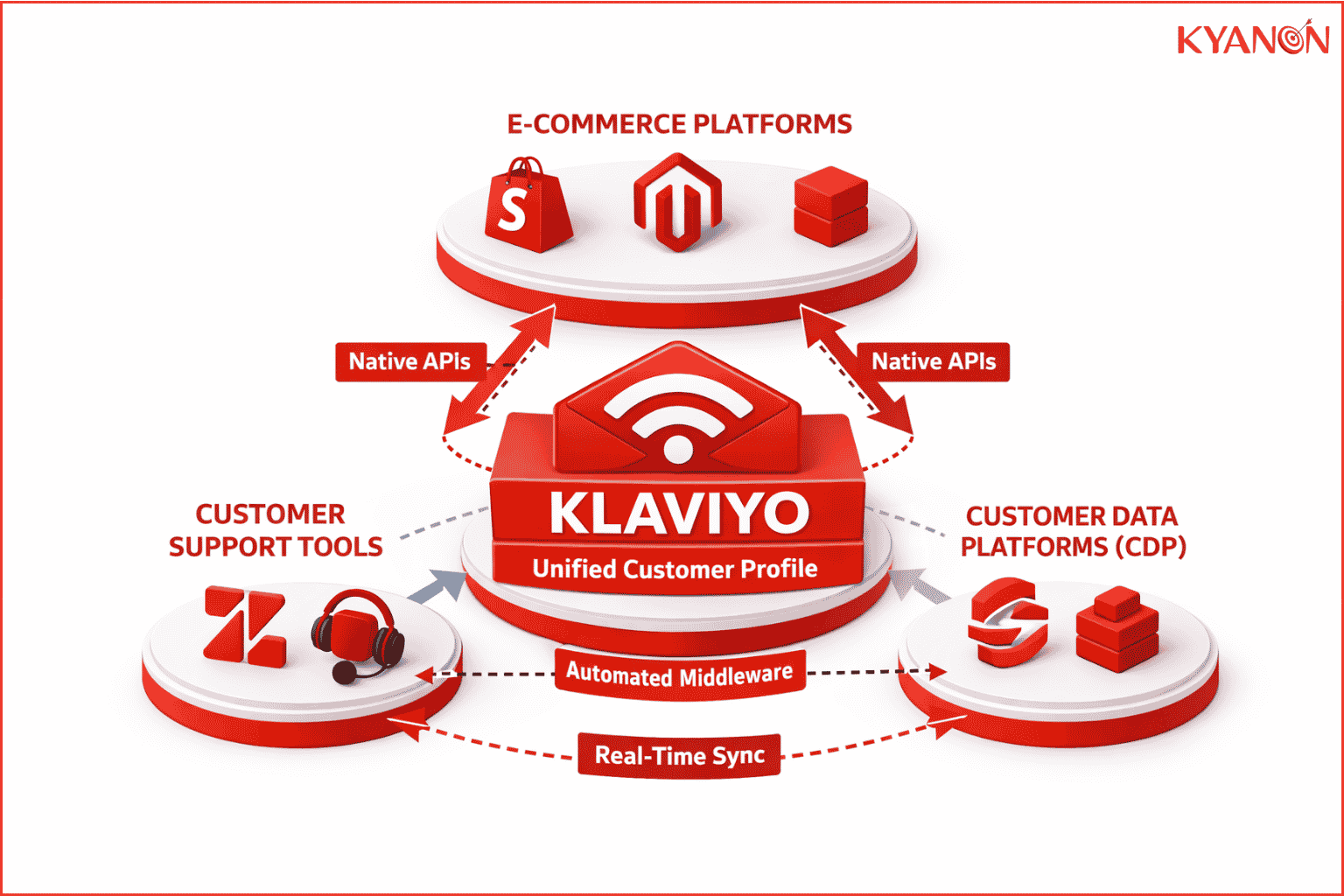
A well-architected integration prevents data silos by establishing real-time synchronization between disparate systems. The connection utilizes direct connectors, automated middleware, and strict governance to ensure customer interactions across support, sales, and marketing are structured into a single, actionable profile.
Native BI – directional connectors
Built-in connectors facilitate direct integration for platforms like Shopify, WooCommerce, and Salesforce by enabling bi-directional syncing, ensuring data flows both into Klaviyo and back out to the ecommerce platform. Avoiding batch-processing tools ensures that data transfers are updated in real time rather than creating synchronization delays.
Customer data platform (CDP) centralization
Connecting Klaviyo to a CDP like Segment or RudderStack establishes a single source of truth by standardizing unique customer identifiers, such as email or phone numbers, across all systems. This centralization allows enterprises to feed offline in-store purchase data into the CDP and share it directly with Klaviyo for unified profiling.
Webhooks and API middleware
For proprietary or niche software lacking native connections, organizations utilize Klaviyo’s robust API to build custom bridges or deploy middleware like Zapier and Make. Setting up webhooks triggers instant alerts to external databases when user profiles update or unsubscribe occur, keeping external systems perfectly aligned.
Klaviyo integration vs. basic ESP connection
Both approaches manage outbound email communications, but differ drastically in their ability to unify cross-functional data and eliminate organizational silos.
|
Dimension |
Klaviyo integration |
Basic ESP connection |
|
Data synchronization |
Real-time bi-directional | Batch or manual CSV uploads |
| System interoperability | Connects CDPs, Support & Sales |
Isolated to marketing lists |
|
Technical complexity |
High (APIs, Webhooks, Governance) | Low (Plug-and-play UI) |
| Best for | Unified lifecycle automation |
Generic newsletter blasts |
|
Data governance |
Centralized cross-platform naming |
Fragmented custom fields |
When to consider Klaviyo integration
Consider Klaviyo Integration if:
- Your marketing teams are blindly sending promotional campaigns without visibility into active helpdesk tickets on Gorgias, Zendesk, or Gladly.
- Your organization is adopting a CDP to standardize customer identities across web, mobile apps, and point-of-sale terminals, requiring a downstream marketing engine to activate that unified data.
- Your current setup suffers from broken syncs and duplicated fields, necessitating strict data governance and standardized naming conventions across all integrated apps.
It may not be the right priority if:
- Your business model strictly involves one-off B2B enterprise sales where account executives manage communication entirely through a CRM, requiring no automated e-commerce behavioral tracking.
Why Klaviyo integration matters for retail
Disconnected software systems leave valuable customer information trapped, preventing marketing teams from executing timely, hyper-personalized campaigns based on recent support interactions or offline purchases.
When systems fail to communicate, frustrated customers often receive promotional emails while simultaneously experiencing unresolved service issues. Linking helpdesk software to your marketing engine allows you to track support tickets and use open ticket statuses to automatically pause marketing emails to frustrated customers. A regional e-commerce brand utilized Klaviyo’s API to share conversation history from Zendesk directly into user profiles, allowing marketing teams to see support interactions before building segments, fundamentally eliminating negative friction in their automated flows.
Common misconceptions
“All e-commerce events track automatically out-of-the-box.”
Reality: Connecting the integration tracks basic orders, but crucial behavior metrics, like “Added to Cart” or “Viewed Product”, usually require activating app embeds or inserting custom snippets into your store theme. Without doing this, you cannot run standard browse abandonment flows.
“Third-party apps seamlessly share data through the main integration.”
Reality: If you use separate apps for subscription management, loyalty rewards, or landing pages, that data does not automatically flow to Klaviyo just because your e-commerce store is connected. Each third-party tool requires its own independent API integration.
“The integration automatically configures my email deliverability.”
Reality: Connecting a store does not handle domain authentication. To prevent your automated e-commerce emails from hitting the spam folder, you must manually set up a Dedicated Sending Domain (DKIM/SPF records) inside your domain provider.
How Kyanon Digital applies Klaviyo integration
Kyanon Digital integrates Klaviyo in an e-commerce and loyalty platform built for retail clients needing lifecycle marketing automation. Our approach focuses on measurable outcomes, reducing time-to-market and lowering TCO, by architecting custom API bridges, centralizing data through CDPs, and establishing strict data governance protocols to eliminate software silos across enterprise operations in Southeast Asia, Australia, and Nordic Europe.
→ Explore our services:











 Create project brief with AI