
What is Product Feed Management?
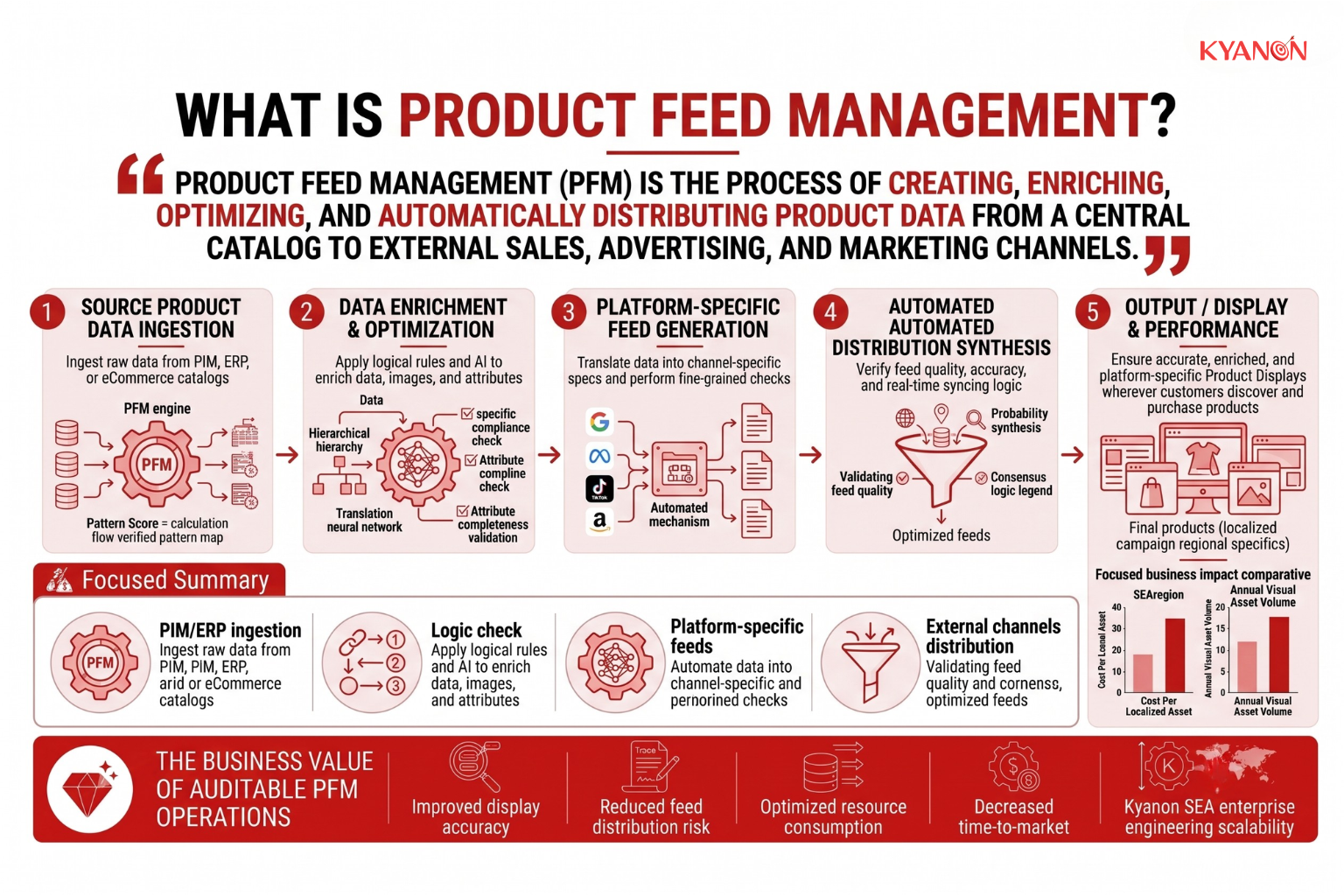
Product Feed Management is the process of creating, enriching, optimizing, and automatically distributing product data from a central catalog to external sales, advertising, and marketing channels. It transforms internal product information into channel-specific data feeds that comply with each platform’s technical specifications, ensuring products are accurately displayed wherever customers discover and purchase them.
How Product Feed Management Works
A Product Feed Management system creates an intermediary processing layer between a retailer’s core product database and external sales and marketing channels. Rather than allowing marketplaces and advertising platforms to query production systems directly, it extracts, enriches, and transforms product data into channel-specific formats before distributing optimized feeds. This architectural decoupling protects backend commerce systems from excessive API traffic while ensuring external channels always receive accurate, up-to-date product information.

Data Extraction and Ingestion
The first stage collects product information from systems such as a Product Information Management (PIM) platform, ERP, inventory database, or eCommerce platform to create a centralized working dataset without modifying the original source of truth.
Key capabilities include:
- API- and webhook-driven ingestion to capture incremental changes such as inventory updates, price adjustments, and newly added products without repeatedly scanning entire databases.
- Unified master caching, combining product content from multiple systems, including marketing data, inventory levels, and pricing, into a single processing layer.
- Read-only database isolation, ensuring feed generation never impacts checkout performance or production transaction databases.
Rule-Based Transformation Engine
Once product data is ingested, configurable business rules automatically transform it to satisfy the technical requirements of each destination channel.
Typical transformations include:
- Title and description optimization by cleaning HTML, removing unsupported characters, and generating search-friendly product titles.
- Category mapping, converting internal category structures into standardized taxonomies such as Google Product Categories.
- Attribute formatting, applying channel-specific requirements for field length, currencies, availability, pricing, and custom attributes to maximize product approval and visibility.
This transformation layer enables retailers to maintain a single master catalog while automatically generating optimized feeds for multiple platforms.
Automated Distribution and Synchronization
After transformation, optimized product feeds are distributed through XML, CSV, scheduled file transfers, or real-time APIs to marketplaces, advertising platforms, and affiliate networks.
Modern feed management platforms support:
- Real-time API synchronization, immediately updating inventory or pricing changes in platforms such as Google Merchant Center and Meta Catalog to reduce overselling and wasted advertising spend.
- Delta synchronization, transmitting only modified product records instead of regenerating entire catalogs, significantly improving synchronization efficiency.
- Automated monitoring and retry mechanisms, detecting failed feed deliveries, retrying transmissions, and alerting administrators to maintain reliable product syndication across all connected channels.
By combining automated ingestion, intelligent transformation, and continuous synchronization, Product Feed Management enables retailers to maintain accurate product information across every sales and marketing channel while minimizing operational overhead and protecting the performance of core commerce systems.
Product Feed Management vs Direct API Integrations
Retailers distributing products across multiple marketplaces and advertising platforms typically choose between Product Feed Management and direct API integrations. The key difference lies in architectural flexibility versus real-time connectivity.
Direct API integrations establish a dedicated connection between an eCommerce platform and a single external channel. While this approach is well suited for real-time operations such as inventory synchronization or order processing, it requires separate development, maintenance, and monitoring for every additional platform.
Product Feed Management introduces a decoupled middleware layer between internal systems and external channels. Instead of building custom integrations for each destination, retailers maintain a single product data source while the feed platform transforms and distributes channel-specific data automatically.
Comparison of product feed management and direct API integrations
|
Dimension |
Product Feed Management | Direct API Integrations |
| Architecture | Decoupled middleware that processes and distributes product data independently |
Direct, tightly coupled connection between backend systems and individual channel APIs |
|
Scalability |
High
New channels can be added through configuration and mapping |
Lower
Each new channel requires custom development and testing |
|
Data transformation |
Dynamic rule engines support field mapping, category conversion, content enrichment, and validation |
Transformations are typically hardcoded into application logic |
| Engineering effort | Moderate
Configure a single master feed and channel-specific rules |
High Build and maintain authentication, synchronization, error handling, and API integrations for each platform |
|
Monitoring & diagnostics |
Centralized dashboard with validation errors, rejected products, and synchronization status | Monitoring is distributed across application logs and individual integration services |
| Maintenance | Feed platform automatically adapts to many third-party specification changes |
Internal development teams must update integrations whenever APIs or channel requirements change |
When to Consider Product Feed Management
Implementing a dedicated feed optimization architecture is necessary when a brand manages over 1,000 SKUs across multiple advertising endpoints and marketplaces.
Consider a centralized feed approach if:
- Your marketing team faces high ad disapproval rates on Google or Meta due to missing attributes, broken image links, or pricing mismatches.
- You are expanding into international markets and need to dynamically append currency conversions, translated titles, and regional sizing charts to your listings.
- You want to programmatically pause advertising spend on low-margin or low-inventory items without requiring manual intervention from the operations team.
It may not be the right priority if:
- Your digital commerce operation consists of a highly curated catalog of under 50 items sold exclusively through a single direct-to-consumer storefront.
Why Product Feed Management Matters for Retail
Product feed management has evolved from a simple data distribution task into a core component of retail performance infrastructure. Accurate, real-time product feeds determine whether products are discovered, trusted, and purchased across search engines, marketplaces, social commerce platforms, and AI-powered shopping assistants.
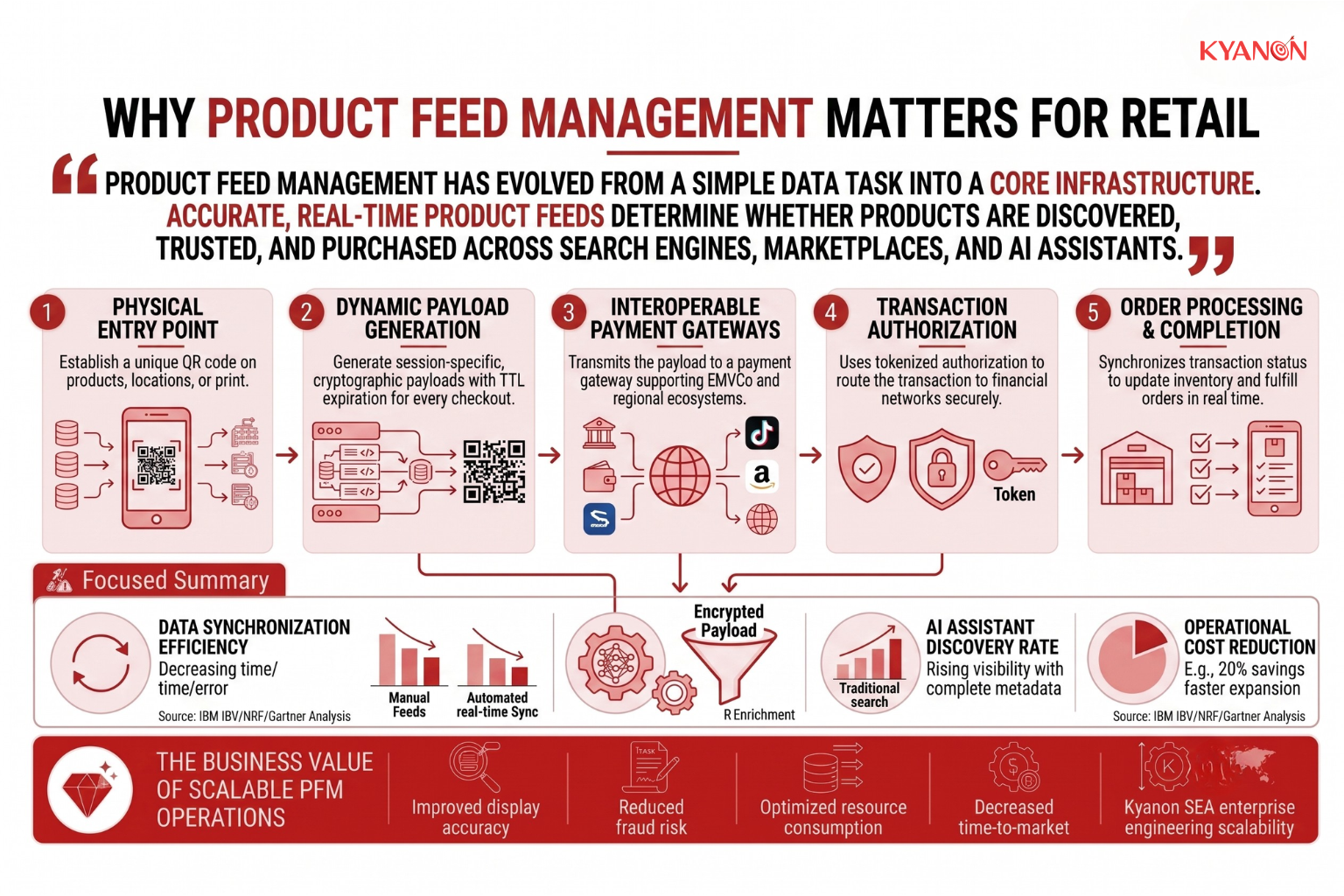
- Real-time operations are now essential. According to IBM Institute for Business Value, 90% of executives believe they will lose competitive advantage if their organizations cannot synchronize data in real time. For retailers, delayed product feeds often result in incorrect pricing, unavailable inventory, and wasted advertising budgets.
- AI is changing product discovery. IBM and the National Retail Federation (NRF) found that 33% of consumers already use AI assistants to research products before purchasing.
- Retailers face increasing margin pressure. Retailers continue to operate under flat demand and shrinking margins, making automation and operational efficiency essential. Automated feed management reduces manual formatting, minimizes data errors, and helps teams scale product distribution across channels such as Google Shopping, Amazon, and TikTok Shop.
- Automated syndication improves operational efficiency. Organizations using automated product data syndication reduce channel onboarding time, enabling faster expansion across marketplaces while maintaining consistent product information.
A regional sporting goods retailer, for example, implemented rule-based feed transformations to enrich Google Shopping product titles with brand and material attributes. The improved feed quality increased ad relevance, leading to higher Quality Scores and a measurable reduction in cost per acquisition (CPA).
Common Misconceptions
B2B organizations frequently miscalculate the architectural requirements of data syndication, assuming that basic website HTML data is sufficient for algorithmic ad networks.
The text on our website is perfectly optimized for ads
Website product titles are designed for human browsing (e.g., “The Classic Tee – Midnight”). Ad algorithms need structured, keyword-heavy titles to match search intent (e.g., “Men’s 100% Cotton Crewneck T-Shirt, Black, Size L”). Feed management rewrites this data specifically for machines without changing your frontend store design.
Our platform syncs automatically, so our feed is fine
Standard plugins often push incomplete data. Missing color attributes, generic categorization tags, or broken image URLs lead to silent ad disapprovals, low quality scores, and drastically higher costs per click (CPC).
We must advertise every single product in our catalog
High-performing feed management includes data filtering. Smarter feeds automatically exclude low-margin items, out-of-stock sizes, or perennially low-converting products to prevent your budget from being drained by “zombie” listings.
Feed optimization doesn’t affect our campaign performance
Data quality directly dictates ad placement. Platforms like Google Shopping and Meta Ads rank your products based on how thoroughly your feed answers a user’s search query. A highly optimized feed can cut acquisition costs even without changing your budget or bidding strategy.
How Kyanon Digital Applies Product Feed Management
Product Feed Management has evolved from a simple data synchronization tool into a critical driver of digital commerce performance. By automatically distributing accurate, optimized product data across search engines, marketplaces, and social commerce platforms, retailers can reduce wasted advertising spend, improve product visibility, and accelerate omnichannel growth.

- Faster campaign optimization: According to McKinsey, organizations adopting advanced, automated digital commerce and AI execution systems can achieve up to a 4x increase in workflow speed during content creation pilots by replacing manual, slow processes with data-driven workflows.
- Improved product discoverability: Rich, structured product feeds help these systems accurately interpret product information, improving visibility across search and discovery channels.
- Reduced advertising waste: Gartner reports that 59% of CMOs lack sufficient budgets to fully execute their marketing strategies. Automated feed management helps maximize limited budgets by keeping inventory, pricing, and promotions synchronized, preventing ads from promoting unavailable products.
Explore our Ecommerce services:











 Create project brief with AI