
What is Quick Commerce Architecture?
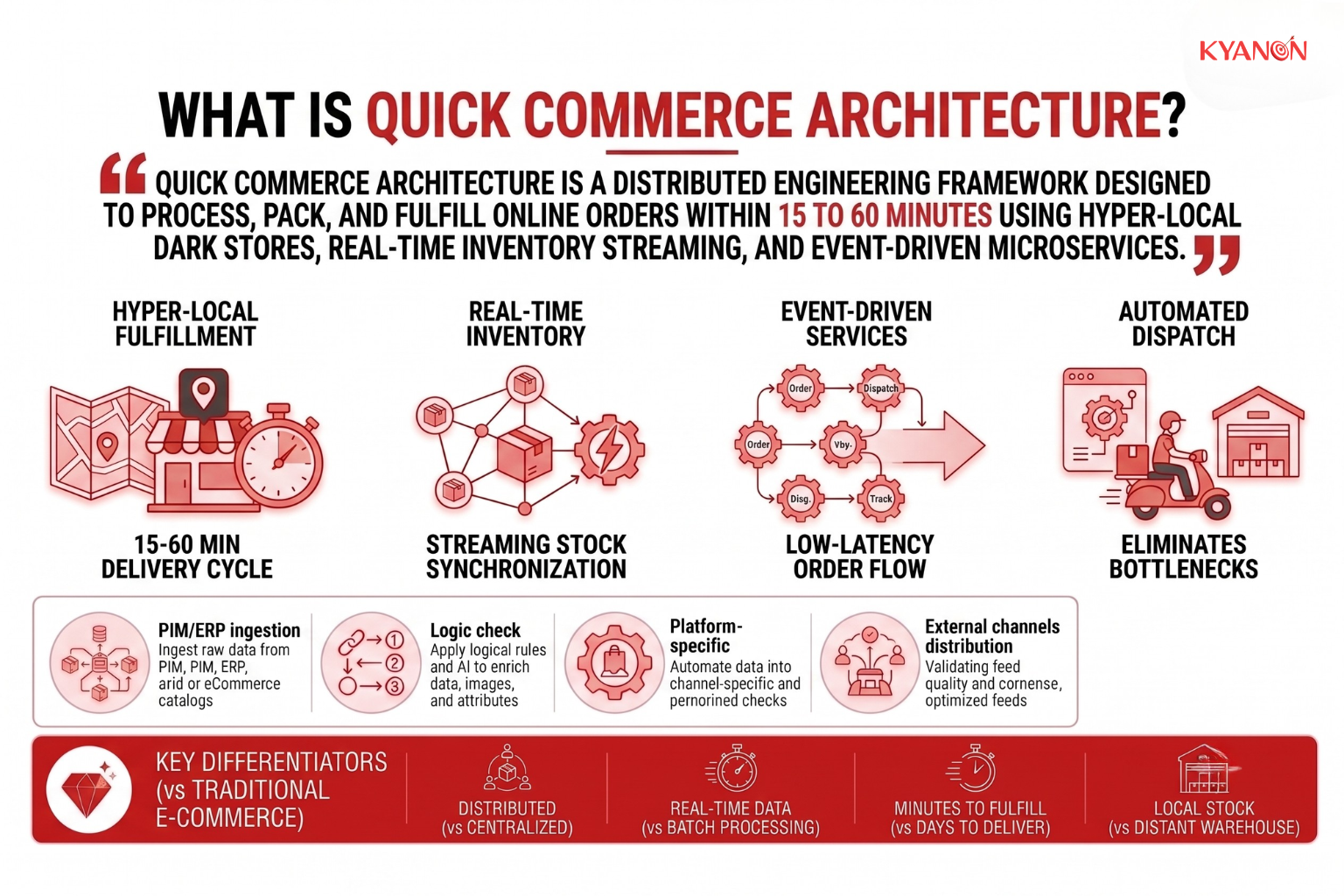
Quick commerce architecture is a distributed engineering framework designed to process, pack, and fulfill online orders within 15 to 60 minutes using hyper-local dark stores, real-time inventory streaming, and event-driven microservices. Unlike traditional e-commerce setups that rely on centralized warehouses and scheduled batch processing, this architecture prioritizes low-latency stock synchronization and automated localized dispatch to eliminate stockouts and bottlenecks during high-velocity demand surges.
How Quick Commerce Architecture Works
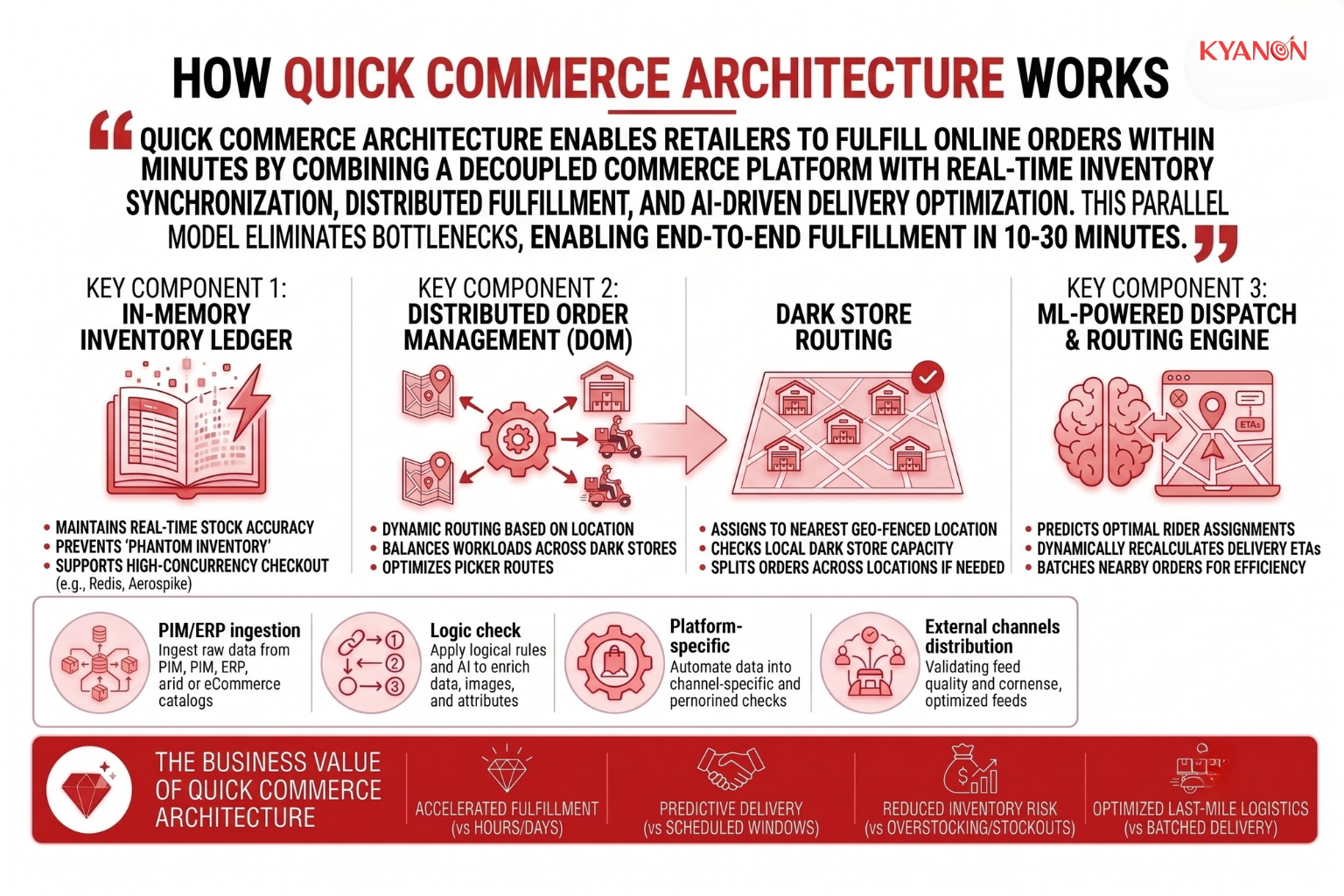
Quick commerce architecture enables retailers to fulfill online orders within minutes by combining a decoupled commerce platform with real-time inventory synchronization, distributed fulfillment, and AI-driven delivery optimization. Rather than relying on a centralized warehouse, the architecture continuously coordinates inventory, fulfillment, and logistics across geographically distributed micro-fulfillment centers (also known as dark stores).
When a customer browses a mobile app or website, the storefront communicates through APIs with an event-driven backend. The system queries an in-memory inventory ledger mapped to the nearest geo-fenced fulfillment location, allowing product availability to reflect physical shelf counts in near real time. Once checkout is completed, inventory is atomically reserved, a picking task is immediately generated for the assigned dark store, and an AI-powered dispatch engine begins identifying the optimal delivery rider—even before packing is finished.
This parallel processing model eliminates bottlenecks found in traditional eCommerce architectures, enabling end-to-end fulfillment in as little as 10–30 minutes.
In-Memory Inventory Ledger
Maintaining accurate inventory is one of the biggest technical challenges in quick commerce. Traditional relational databases often experience replication delays during peak shopping periods, resulting in “phantom inventory” where customers purchase products that are already out of stock.
To prevent this, quick commerce platforms use an in-memory data grid that stores inventory states in memory rather than relying solely on disk-based databases. Technologies such as Redis or Aerospike can process inventory updates within milliseconds, allowing the platform to:
- Execute atomic inventory locking immediately after checkout
- Synchronize physical shelf counts with digital storefronts in near real time
- Eliminate cache invalidation delays through event-driven updates
- Maintain inventory separately for each geo-fenced micro-warehouse
This architecture ensures inventory accuracy even during flash sales and high-concurrency checkout events.
Distributed Order Management (DOM) & Dark Store Routing
Instead of sending every order to a centralized distribution center, a Distributed Order Management (DOM) system dynamically determines the optimal fulfillment location based on multiple operational factors, including:
- Real-time inventory availability
- Dark store capacity and packing queue depth
- Customer location
- Rider proximity
- Estimated fulfillment time
After an order is assigned, the DOM automatically generates prioritized picking tasks for warehouse staff, optimizes picker routes inside the dark store, and splits orders across multiple fulfillment locations when necessary.
By continuously balancing inventory and operational workloads across the network, modern DOM platforms can reduce pick-to-pack cycle times to under three minutes while maximizing fulfillment efficiency.
ML-Powered Dispatch and Routing Engine
The final stage of quick commerce focuses on last-mile optimization. Standard GPS routing systems only calculate the shortest driving route, but quick commerce requires predictions that account for operational variables beyond road traffic.
Machine learning models continuously analyze:
- Historical delivery performance
- Dark store packing times
- Rider dwell times at pickup locations
- Live traffic conditions
- Weather data
- Building access complexity, including elevators and multi-floor deliveries
Using these inputs, the dispatch engine dynamically recalculates delivery ETAs, optimizes rider assignments, batches nearby orders when appropriate, and can even pre-assign riders before warehouse packing is complete. This predictive approach reduces idle time, improves fleet utilization, and helps maintain consistent delivery promises during peak demand.
Quick Commerce Architecture vs Standard E-Commerce Architecture
Both architectures facilitate online retail transactions, but quick commerce architecture trades centralized batch efficiency for hyper-localized real-time execution.
| Dimension | Quick Commerce Architecture | Standard E-Commerce Architecture |
| Fulfillment model | Hyper-distributed micro-warehouses (dark stores) | Centralized regional fulfillment centers |
| Inventory synchronization | Real-time event streaming and atomic locking | Scheduled batch updates (hourly or daily) |
| Data architecture | Decoupled microservices with in-memory ledgers | Monolithic or traditional relational database replication |
| Order processing latency | Sub-second order routing and pick-list generation | Minutes to hours for order batching and allocation |
| Primary optimization metric | Pick-to-pack speed and last-mile transit time | Warehouse throughput and shipping cost efficiency |
When to Consider Quick Commerce Architecture
Implementing quick commerce architecture is necessary when a business model relies on fulfillment SLAs under one hour and operates across densely populated urban centers.
Consider Quick Commerce Architecture if:
- Your order volume experiences extreme localized surges, such as grocery spikes during flash rainstorms, that cause traditional monolithic databases to lock or crash under simultaneous checkout requests.
- Your operations suffer from high rates of order cancellation or customer dissatisfaction caused by “phantom inventory,” where master-slave database lag allows customers to buy items already purchased in-store or by another online user.
- You are expanding a grocery, convenience, or F&B delivery network using multi-node dark stores and need automated, sub-three-minute pick-to-pack workflows integrated directly with third-party or internal rider fleets.
It may not be the right priority if:
- Your product catalog consists of non-perishable goods with standard 24- to 48-hour delivery expectations, where centralized warehousing and standard order management systems provide significantly better unit economics and lower architecture maintenance costs.
Why Quick Commerce Architecture Matters for Grocery & F&B
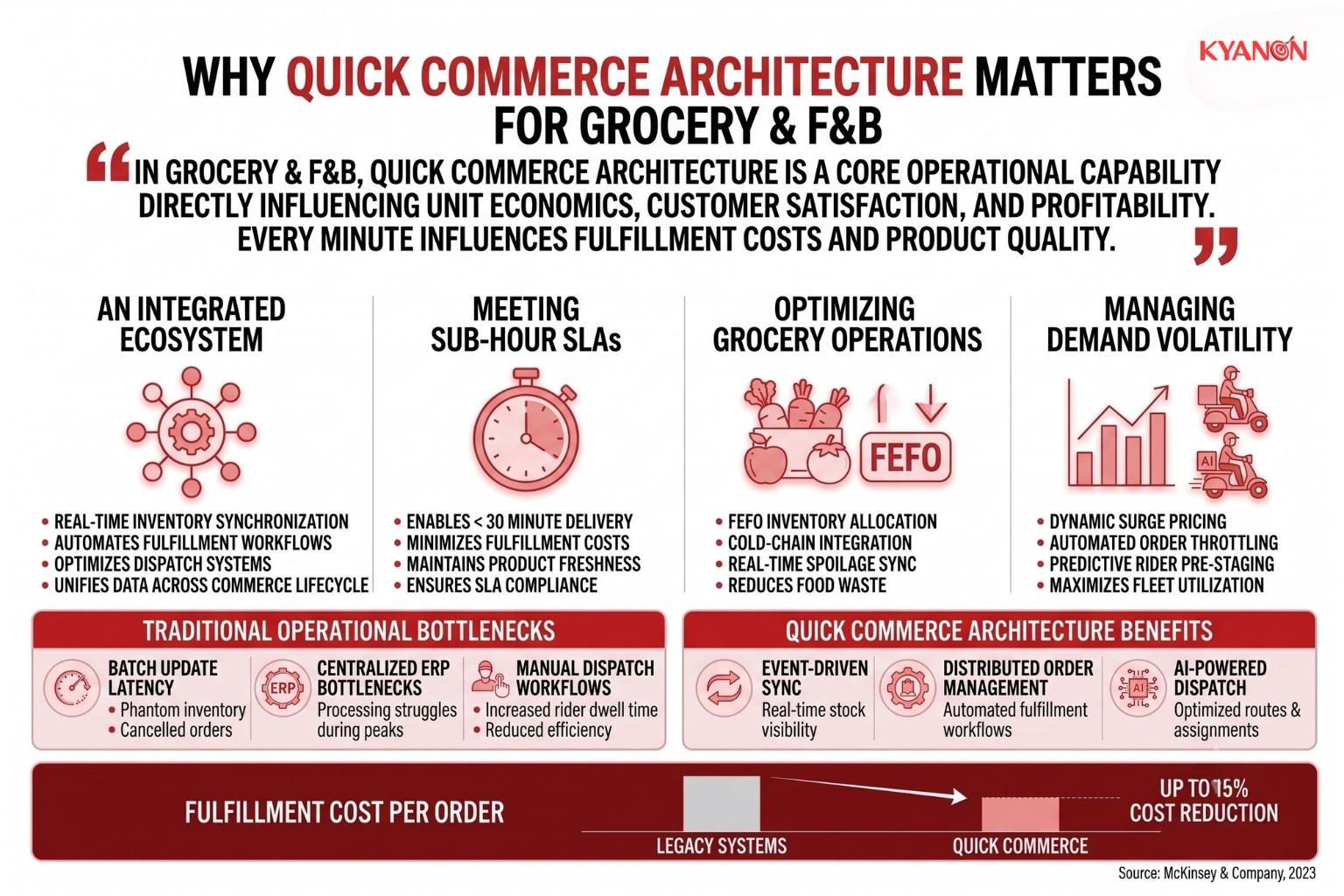
In high-frequency retail sectors such as grocery and food & beverage (F&B), quick commerce architecture is a core operational capability that directly influences unit economics, customer satisfaction, and profitability. Every minute between checkout and delivery affects fulfillment costs, product quality, and a retailer’s ability to meet service-level agreements (SLAs).
Operating a sub-hour delivery network requires more than fast logistics—it depends on an architecture that synchronizes inventory, fulfillment, and dispatch in real time. Legacy systems built around batch inventory updates, centralized ERP databases, or manual dispatch workflows cannot respond quickly enough to rapidly changing demand. The resulting latency creates phantom inventory, order cancellations, rider delays, and missed delivery windows that increase operational costs and erode customer trust.
Modern quick commerce architecture addresses these challenges through event-driven inventory synchronization, distributed order management, and AI-powered dispatch systems that enable real-time decision-making across the entire fulfillment lifecycle. This allows retailers to maintain accurate stock visibility, automate fulfillment workflows, and optimize delivery operations even during breakfast, lunch, dinner, or promotional demand spikes.
Organizations relying on traditional commerce platforms often face several operational bottlenecks, including:
- Batch inventory update latency, causing phantom inventory and cancelled orders.
- Centralized ERP bottlenecks, which struggle to process high-concurrency transactions during peak demand.
- Manual dispatch workflows, increasing rider dwell time and reducing delivery efficiency, particularly for perishable goods.
- SLA breaches, resulting in refunds, wasted inventory, and long-term customer churn.
In contrast, a purpose-built quick commerce architecture delivers measurable operational and financial benefits. For grocery and fresh food retailers, it supports First-Expired, First-Out (FEFO) inventory allocation by integrating with batch and expiry tracking systems, incorporates cold-chain monitoring by combining refrigeration telemetry with fulfillment workflows, and performs real-time spoilage synchronization to instantly remove damaged or expired products from digital shelves. These capabilities improve inventory accuracy, reduce food waste, and help ensure customers receive fresher products.
The architecture also helps retailers manage demand volatility through dynamic surge pricing, which adjusts delivery fees based on localized fulfillment capacity; automated order throttling, which temporarily limits new orders when picking or packing queues exceed operational thresholds; and predictive rider pre-staging, which positions delivery fleets in anticipation of demand spikes. Together, these capabilities improve delivery reliability, maximize fleet utilization, protect SLA performance, and strengthen profitability during peak trading periods.
Common Misconceptions
Technical leaders often underestimate quick commerce complexity by assuming legacy e-commerce infrastructure can achieve sub-hour fulfillment simply by accelerating last-mile shipping logistics.
It is just standard e-commerce with faster shipping
Traditional e-commerce scales via centralized warehouses and batch processing, which cannot physically or programmatically support 15-minute delivery SLAs. Quick commerce requires hyper-distributed micro-warehouses (dark stores) and real-time inventory streaming to localize inventory within minutes of the end consumer.
Regular database replication is fast enough
Master-slave database replication lag creates “phantom inventory” where users buy out-of-stock items during high-traffic surges. Quick commerce architecture must use event-driven, atomic inventory locking at the local store level to ensure an item is secured when the instant checkout begins.
Monolithic architectures can handle the speed
Monolithic systems choke under simultaneous localized surges, such as sudden flash rainstorms driving up instant grocery orders in a specific district. Systems require decoupled microservices to scale checkout, rider assignment, and inventory synchronization independently without system-wide degradation.
ERP inventory numbers are the source of truth
Enterprise Resource Planning (ERP) systems update in scheduled batches, typically on an hourly or daily basis, making them fundamentally incompatible with sub-hour operations. Quick commerce demands an in-memory ledger reflecting exact physical shelf counts instantly across all sales channels.
GPS routing is a solved problem via standard APIs
Basic routing algorithms account only for road distance and traffic, ignoring critical operational constraints like dark store packing delays or multi-floor apartment drop-offs. Architectures need predictive machine learning models that calculate hyper-local internal warehouse and external transit variables to provide accurate ETAs.
How Kyanon Digital Applies Quick Commerce Architecture
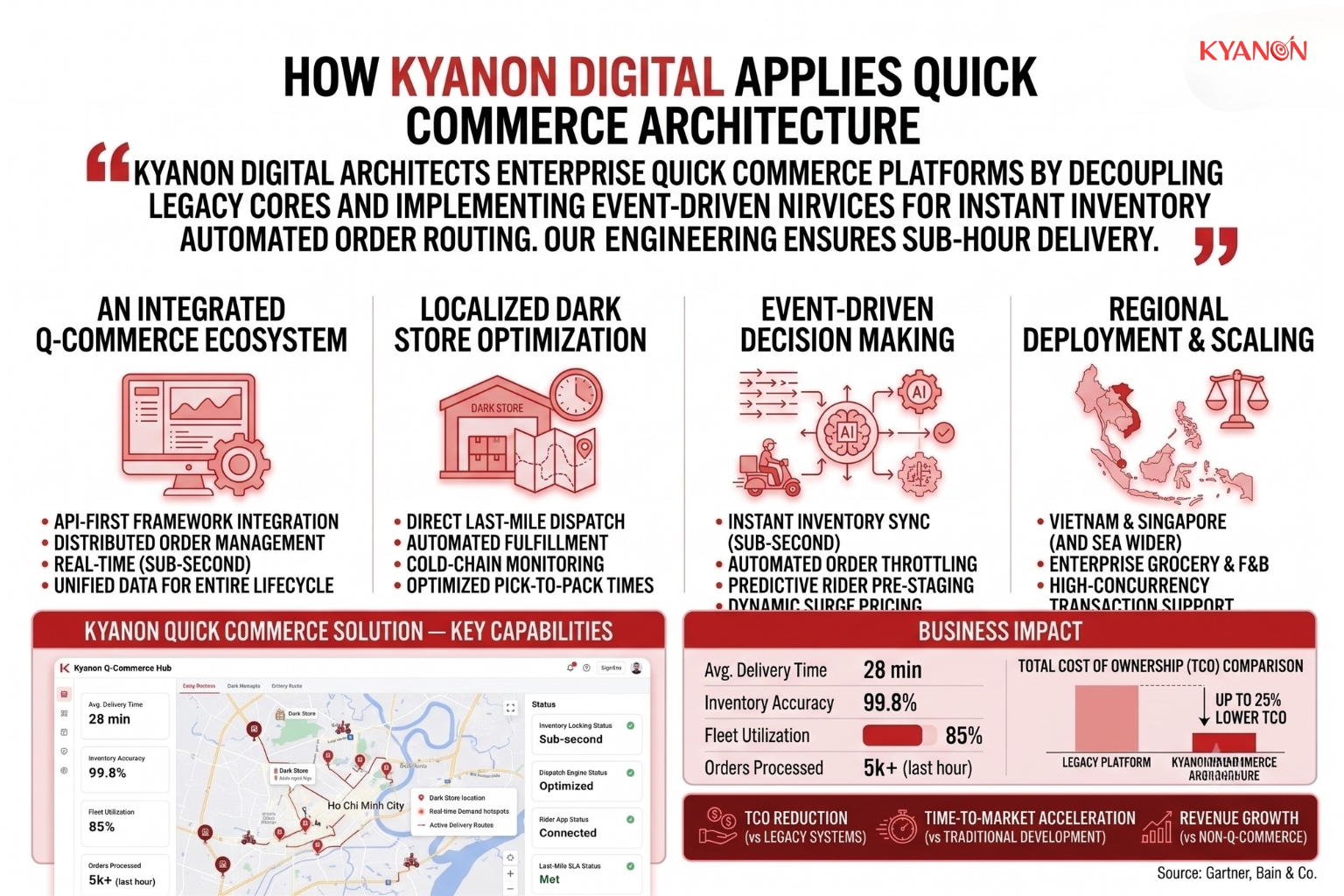
Kyanon Digital architects enterprise quick commerce platforms by decoupling legacy cores and implementing event-driven microservices for instant inventory synchronization and automated order routing. We implement quick commerce architecture using API-first frameworks and distributed order management engines for enterprise grocery and F&B clients across Singapore, Vietnam, and wider Southeast Asia. Our engineering approach focuses on building sub-second inventory locking mechanisms and integrating localized dark store networks directly with last-mile dispatch systems, ensuring sub-hour delivery capabilities while driving down total cost of ownership (TCO) and time-to-market.
Explore our Ecommerce services:











 Create project brief with AI